
Egg freezing has quietly become one of the most significant advances in reproductive medicine over the past decade, yet many women in Southern California still hesitate because they believe the process is riskier than it actually is. The reality is that serious complications occur in fewer than 1% of cases, and there is no evidence that the procedure increases the risk of birth defects or causes long-term ovarian damage. If you are a woman over 30 in Orange County weighing your fertility preservation options, this guide walks you through the full process, addresses the most common concerns, and helps you make a confident, informed decision.
Table of Contents
- Understanding egg freezing and why women choose it
- The egg freezing process step by step
- Risks, side effects, and recovery
- Applying your knowledge: choosing an egg freezing clinic in Orange County
- What most guides miss about egg freezing in Orange County
- Explore your fertility preservation options with Life IVF Center
- Frequently asked questions
Key Takeaways
| Point | Details |
|---|---|
| Egg freezing is safe | Complications are rare and birth defect risk is not increased. |
| Step-by-step guidance | Preparation, stimulation, retrieval, and storage are well-defined stages. |
| Choose clinics carefully | Compare expertise, safety protocols, and personalized care for best results. |
| Recovery is manageable | Most women experience mild symptoms and recover quickly after egg retrieval. |
| Local experts can help | Orange County fertility specialists offer personalized support and flexible options. |
Understanding egg freezing and why women choose it
Egg freezing, known medically as oocyte cryopreservation, is a procedure that allows women to collect and store their eggs at their current biological age for potential use in the future. The eggs are retrieved, frozen using a rapid-cooling method called vitrification, and stored until you are ready to attempt pregnancy. Understanding the egg freezing basics is the first step toward deciding whether this option aligns with your goals.
Women over 30 in Southern California choose egg freezing for a wide range of personal and medical reasons. Some are focused on their careers or have not yet found the right partner. Others have received a diagnosis, such as early-stage cancer, endometriosis, or diminished ovarian reserve, that makes preserving eggs now a medically sound strategy. Still others simply want the peace of mind that comes from knowing they have options.
Common reasons women over 30 pursue egg freezing include:
- Career and life planning: Wanting to delay parenthood without sacrificing biological options
- Medical necessity: Facing treatments like chemotherapy that could affect ovarian function
- Relationship timing: Not yet in a stable partnership but wanting to preserve younger, healthier eggs
- Diminished ovarian reserve: Acting proactively before egg quality or quantity declines further
- Family history concerns: Having a family history of early menopause
One of the most persistent misconceptions is that egg freezing is dangerous or that it will somehow “use up” your ovarian reserve faster. This is not accurate. According to research reviewed by medical experts, egg freezing risks are generally mild, including temporary side effects like bloating, headaches, and mood swings from hormone stimulation. Rare complications such as ovarian hyperstimulation syndrome (OHSS) occur in fewer than 1% of cycles, and there is no documented evidence of increased birth defects or long-term ovarian damage from the procedure.
“Egg freezing does not deplete your ovarian reserve or accelerate the natural aging of your ovaries. The eggs retrieved during a cycle are those that would have been lost naturally in that same menstrual cycle.”
Having established the safety profile and the reasons women pursue this option, let’s explore the step-by-step process in detail.
The egg freezing process step by step
Understanding exactly what happens during an egg freezing cycle removes a great deal of uncertainty. The process is more structured and manageable than most people expect, and Orange County clinics are experienced at coordinating care around your schedule.
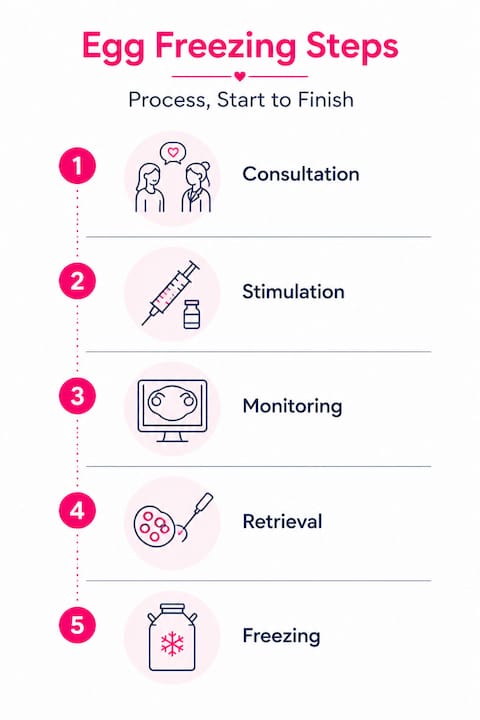
Here is how a typical egg freezing cycle unfolds:
-
Initial consultation and baseline testing: Your fertility specialist reviews your medical history, performs an ultrasound to assess your antral follicle count, and orders blood tests to measure hormone levels including AMH (anti-Müllerian hormone) and FSH (follicle-stimulating hormone). These results help determine the right stimulation protocol for your body.
-
Ovarian stimulation: For approximately 10 to 14 days, you self-administer injectable hormone medications that stimulate your ovaries to develop multiple follicles rather than the single egg your body would naturally release. Your doctor monitors your response through regular ultrasounds and blood tests, typically every two to three days.
-
Trigger shot: Once your follicles reach the appropriate size (usually 18 to 20 millimeters), you receive a trigger injection of human chorionic gonadotropin (hCG) or a GnRH agonist. This final shot matures the eggs and precisely times the retrieval procedure.
-
Egg retrieval: Approximately 36 hours after the trigger shot, the retrieval takes place. You are under light sedation, and your doctor uses a thin needle guided by ultrasound to aspirate the fluid from each follicle. The procedure typically takes 20 to 30 minutes. The complication risk from retrieval is less than 1%, making it a very safe outpatient procedure.
-
Vitrification and storage: The retrieved eggs are immediately assessed by an embryologist. Mature eggs are flash-frozen using vitrification, a rapid process that prevents ice crystal formation, which can damage the egg’s delicate cellular structure. They are then stored in liquid nitrogen at your clinic.
-
Recovery: Most women return to normal activities within one to two days. Some experience mild bloating or pelvic discomfort for a few days after retrieval, which resolves on its own.
Pro Tip: Schedule your initial consultation at the start of your menstrual cycle. Clinics can often begin your stimulation protocol within the first few days of your period, which means your retrieval can happen within the same month. Planning ahead by just a few weeks can save you an entire additional cycle of waiting.
The table below summarizes the key phases, their typical duration, and what to expect:
| Phase | Duration | What you experience |
|---|---|---|
| Consultation and testing | 1 to 3 days | Blood draws, ultrasound, review of results |
| Ovarian stimulation | 10 to 14 days | Daily injections, monitoring appointments |
| Trigger shot | 1 day | Single injection, timed precisely |
| Egg retrieval | 20 to 30 minutes | Light sedation, outpatient procedure |
| Recovery | 1 to 2 days | Mild bloating or cramping |
| Cryopreservation and storage | Ongoing | Eggs stored indefinitely in liquid nitrogen |
Reviewing egg retrieval tips from experienced specialists can help you prepare physically and mentally for each stage. Additionally, exploring fertility preservation packages early in your planning process gives you a realistic picture of costs and what is included in your care.
With the process laid out clearly, it is vital to understand the risks and recovery expectations in more detail.
Risks, side effects, and recovery
The word “risks” can feel alarming, but in the context of egg freezing, most side effects are temporary and manageable. Understanding the full picture helps you approach the process with realistic expectations rather than unfounded fear.
Common, mild side effects during the stimulation phase include:
- Bloating and a sensation of fullness in the abdomen
- Mild headaches
- Mood swings or emotional sensitivity due to hormone fluctuations
- Breast tenderness
- Fatigue
These effects are directly related to the hormone medications and resolve once the stimulation phase ends. They are not signs that something is going wrong.
Rare but serious risks are worth knowing about, even though they occur infrequently:
| Risk | Frequency | Description |
|---|---|---|
| Ovarian hyperstimulation syndrome (OHSS) | Less than 1% | Ovaries become swollen and painful; most cases are mild and self-resolving |
| Bleeding from retrieval | Less than 1% | Rare injury to surrounding tissue during needle aspiration |
| Infection post-retrieval | Less than 1% | Antibiotics are typically prescribed as a precaution |
| Anesthesia reaction | Very rare | Clinics screen patients thoroughly before sedation |
According to current medical evidence, egg freezing does not increase the risk of birth defects, nor does it cause long-term ovarian damage. This is one of the most important facts for women over 30 to internalize, because fear of these outcomes is a common barrier to pursuing fertility preservation.
Clinics in Orange County take several concrete steps to minimize risks. These include individualized stimulation protocols based on your hormone levels and follicle count, frequent monitoring during stimulation to catch early signs of OHSS, and the option to use a GnRH agonist trigger instead of hCG in high-risk patients, which significantly reduces OHSS risk. Reading patient safety stories from women who have been through the process can also provide meaningful reassurance.
For women concerned about their long-term ovarian health, particularly those with a pre-existing diagnosis, resources on ovarian health after freezing offer evidence-based guidance on what to expect.
Recovery after retrieval is generally straightforward. Most women feel well enough to work from home the following day, though strenuous exercise should be avoided for about a week. Your clinic will provide specific post-procedure instructions, and a follow-up appointment is typically scheduled within a few days to confirm that your ovaries are returning to their normal size.

Understanding risks helps you make informed decisions. Now, see how to apply what you have learned when choosing the right clinic for your care.
Applying your knowledge: choosing an egg freezing clinic in Orange County
Not all fertility clinics offer the same level of expertise, technology, or personalized support. When evaluating your options in Orange County, it pays to be specific and thorough in your research.
Key factors to compare across clinics include:
- Laboratory quality: Ask whether the clinic uses vitrification (the gold standard for egg freezing) and what their egg survival rates are after thawing.
- Physician experience: How many egg freezing cycles has the clinic completed? Experience matters when managing stimulation protocols and retrieval precision.
- Monitoring frequency: Clinics that monitor you every two to three days during stimulation can adjust your protocol in real time, reducing the risk of over-stimulation.
- Transparent pricing: Understand exactly what is included in the quoted price. Some clinics charge separately for medications, monitoring, storage, and future thaw cycles.
- Emotional and logistical support: Fertility treatment is emotionally demanding. Clinics that offer dedicated coordinators, clear communication, and flexible scheduling make the process significantly less stressful.
Questions to ask during your consultation:
- How do you manage patients who show early signs of OHSS?
- What is your average number of eggs retrieved per cycle for women my age?
- What does your post-retrieval monitoring protocol look like?
- Are storage fees included, and for how long?
- What happens if I need to use my eggs years from now?
Understanding the full scope of egg freezing costs before committing to a clinic helps you plan financially without surprises. Reviewing local success stories from patients in similar situations gives you a realistic sense of outcomes and what the experience actually feels like.
Pro Tip: Ask specifically whether the clinic offers a personalized stimulation protocol or uses a one-size-fits-all approach. Women with lower ovarian reserve, higher AMH levels, or a history of OHSS need individualized dosing. A clinic that tailors your protocol to your biology is not just offering better service. It is offering safer, more effective care.
The mild side effects from stimulation are manageable, but how a clinic supports you through them, from your first injection to your post-retrieval follow-up, reflects the quality of care you can expect throughout your fertility journey.
All of this information leads to a nuanced perspective based on real-world experience in Southern California.
What most guides miss about egg freezing in Orange County
Most articles about egg freezing focus almost entirely on statistics: success rates, egg survival percentages, and complication frequencies. Those numbers matter, but they do not capture the full picture of what makes a fertility preservation experience genuinely positive or deeply frustrating.
What we observe consistently in Southern California is that the quality of communication between a clinic and its patient is the single most important factor in how women feel about the process. Women who feel informed at every step, who receive clear explanations of their monitoring results, and who have a direct line to their care team report feeling empowered rather than anxious, even when the process does not go exactly as expected.
Personalized care is not a marketing phrase. It is the difference between a stimulation protocol that is adjusted on day six because your follicles are responding faster than expected, and one that continues unchanged until retrieval day regardless of what the ultrasound shows. It is the difference between a coordinator who calls you back within the hour and one who responds three days later.
Orange County has a high concentration of fertility clinics, which means you have real choices. Use that to your advantage. The best clinics in this region recognize that women pursuing egg freezing are often navigating significant emotional complexity alongside the physical demands of the procedure. They build support structures that address both. Reading about patient journeys from women who have been through this process at specialized centers reveals how much the human side of care influences outcomes and overall experience.
The data on safety is reassuring. But the clinic you choose should make you feel that reassurance in every interaction, not just on paper.
Explore your fertility preservation options with Life IVF Center
Taking the step from researching egg freezing to actually moving forward is easier when you have a trusted team guiding you through each decision. Life IVF Center offers personalized fertility preservation care designed specifically for women in Southern California who want answers, not uncertainty.
Whether you are just beginning to explore your options or ready to schedule your first consultation, Life IVF Center provides the resources and expertise to support you. Review detailed egg freezing packages to understand exactly what is included in your care, explore the full range of egg freezing services available at our Orange County locations, and learn how our Precision IVF® treatments approach tailors every protocol to your unique biology. Your reproductive future deserves care that is as individual as you are.
Frequently asked questions
Is egg freezing painful or risky?
Egg freezing involves mild discomfort such as bloating or headaches during stimulation, and major complications are very rare, occurring in fewer than 1% of cases. Most women return to normal activities within one to two days after retrieval.
Does egg freezing increase birth defects?
No. Research consistently shows that egg freezing does not raise birth defect risk or cause long-term ovarian damage. Children born from frozen eggs have outcomes comparable to those from natural conception.
How do Orange County clinics ensure egg freezing safety?
Clinics use individualized stimulation protocols, frequent monitoring, and advanced vitrification technology to minimize risks. According to current evidence, OHSS and retrieval complications each occur in fewer than 1% of cycles when proper protocols are followed.
Can egg freezing help women with diminished ovarian reserve?
Yes. Egg freezing is a viable option for women with diminished ovarian reserve and can be an important part of a personalized fertility strategy. Specialized clinics can tailor stimulation protocols to maximize egg yield even when ovarian reserve is reduced.
Recommended
- Egg & Embryo Freezing – Life IVF Center
- Egg and Embryo Freezing – Fertility Preservation Packages
- Grad, Cryo, Freezing – Life IVF Center
- Egg retrieval tips: Expert guidance for IVF success
Ready to take the next step?
Life IVF Center specializes in individualized Precision IVF® care for complex cases—including diminished ovarian reserve, prior failed cycles, and advanced maternal age. Our in-house labs and dedicated physicians are ready to help.
Book a Free Consultation →