
Most people assume a first appointment with a fertility specialist ends with a prescription or a referral to IVF. That assumption creates unnecessary anxiety before you even walk through the door. The fertility consultation process is, above all, a structured information-gathering visit designed to understand your unique reproductive picture before any treatment is considered. Knowing what actually happens, step by step, reduces fear and helps you arrive prepared to make informed decisions about your reproductive health from a place of clarity rather than stress.
Table of Contents
- Key takeaways
- When and why to seek a fertility consultation
- What happens at your first fertility appointment
- How to prepare for your fertility consultation
- Common fertility assessments after your consultation
- What to expect after your fertility consultation
- My perspective on the fertility consultation process
- Start your fertility journey with Lifeivfcenter
- FAQ
Key takeaways
| Point | Details |
|---|---|
| Consultation is not automatic treatment | Your first visit focuses on gathering information, not starting IVF or other procedures right away. |
| Timing guidelines matter | Seek evaluation after 12 months of trying, or 6 months if you are 35 or older. |
| Both partners need evaluation | Male factors account for 40 to 50% of infertility cases, so concurrent evaluation reduces delays. |
| Preparation improves outcomes | Bringing medical records, medication lists, and prepared questions makes your visit more productive. |
| Testing is personalized and timed | Many diagnostic tests are scheduled around your menstrual cycle for the most accurate results. |
When and why to seek a fertility consultation
Many couples delay reaching out to a specialist because they are unsure whether their situation qualifies as a concern. There are clear guidelines that take the guesswork out of that decision. Fertility evaluation is recommended after 12 months of trying to conceive, or after 6 months if the woman is 35 years of age or older.
Certain medical or lifestyle factors justify seeking a consultation earlier than those timelines suggest. These include:
- Irregular or absent menstrual cycles
- A history of polycystic ovary syndrome (PCOS), endometriosis, or uterine fibroids
- Prior pelvic surgeries or sexually transmitted infections that may have affected reproductive organs
- Known thyroid disorders or other hormonal conditions
- Previous pregnancy losses or recurrent miscarriages
- A personal or family history of premature menopause
One thing that often surprises couples is how much early consultation benefits emotional wellbeing, not just medical planning. Seeing a specialist early gives you realistic timelines, helps you understand your options, and reduces the anxiety that comes from uncertainty. It is not about accelerating treatment. It is about having a plan.
Partner evaluation is non-negotiable from the start. Male factors contribute to 40 to 50% of all infertility cases. Evaluating both partners concurrently prevents the common scenario where months are spent investigating one partner while a straightforward male factor goes undetected. Bringing your partner to the first appointment is genuinely useful, not just symbolic support.
Pro Tip: If you have been diagnosed with conditions like endometriosis or uterine scarring, do not wait for the 12-month mark. Book a fertility consultation as soon as you begin trying to conceive.
What happens at your first fertility appointment
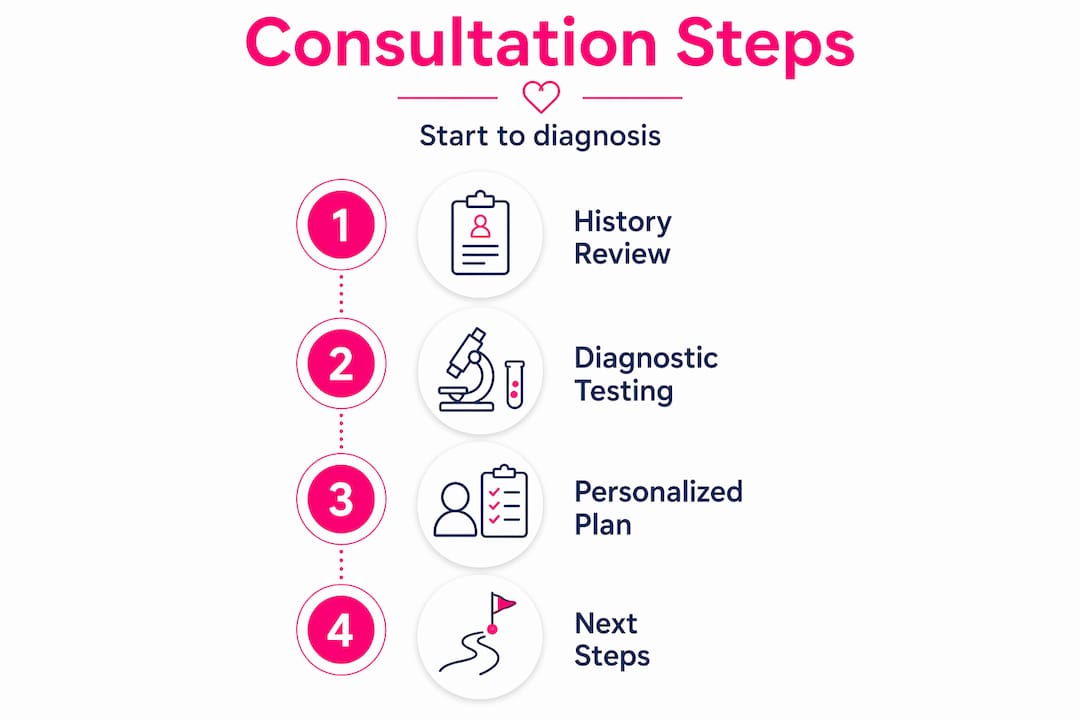
Understanding the structure of your initial visit is one of the best ways to manage expectations. The first fertility consultation focuses on information gathering, not immediate treatment decisions. Here is how a typical visit unfolds, step by step:
-
Medical history review. Your specialist will ask detailed questions about your menstrual cycle regularity, previous pregnancies, miscarriages, contraceptive history, and any known medical conditions. Your partner’s reproductive and general health history will also be reviewed.
-
Lifestyle and environmental factors. Diet, exercise habits, body weight, smoking, alcohol use, and occupational exposures are all discussed. These factors can directly affect fertility and are part of how a specialist builds your clinical picture.
-
Physical examination. This typically includes blood pressure, weight, and a general assessment. For women, a pelvic exam and vaginal ultrasound are common components to evaluate the uterus and ovaries.
-
Blood tests and hormone panels. Initial bloodwork often includes markers related to ovarian reserve, thyroid function, and hormonal balance. The exact tests ordered may vary based on your history.
-
Semen analysis for male partners. If a male partner is present, a semen analysis may be arranged either during or shortly after the visit to assess sperm count, motility, and morphology.
-
Test scheduling discussion. Not all tests happen the same day. Many diagnostic tests are timed around your menstrual cycle for accuracy. Your specialist will explain which tests need to be scheduled for specific cycle days.
-
Preliminary discussion of findings and next steps. By the end of the visit, your doctor will share initial observations and explain what additional evaluations are recommended before any treatment pathway is discussed.
Pro Tip: Take notes or bring a trusted person to help you remember details. Appointments can cover a lot of ground quickly, and having written notes to review later helps you process the information at home.
How to prepare for your fertility consultation

Preparation does not just make the visit feel more organized. It directly improves the quality of care you receive from the first appointment. Having past fertility records and diagnostic results on hand allows your specialist to personalize the consultation and avoid duplicating tests unnecessarily.
Here is what to gather and bring with you:
- Previous fertility treatment records including outcomes from any prior IUI or IVF cycles
- Past diagnostic test results such as semen analyses, hormone panels, or imaging reports
- A complete medication and supplement list including dosages, since certain supplements can affect hormone levels and test results
- Menstrual cycle tracking data from apps, charts, or journals if you have been documenting your cycles
- A list of questions covering your concerns about testing plans, treatment timelines, costs, and emotional support resources
- Your partner’s medical history including any medications or health conditions he is managing
One of the most practical things you can do before the appointment is prepare a decision checklist with questions organized around your key concerns. Specialists recommend this approach because it keeps the conversation focused and helps patients advocate for themselves. You can find suggested questions to consider in resources like Lifeivfcenter’s guide to essential questions for your doctor.
Open, honest communication is also part of preparation. Sharing details that feel private, such as sexual health history or emotional struggles, gives your specialist the full picture they need to support you properly. Nothing you share will be judged. Fertility specialists hear these conversations daily and rely on your honesty to give accurate guidance.
Common fertility assessments after your consultation
Once the initial visit is complete, your specialist will recommend a series of diagnostic evaluations tailored to your history. Understanding what these tests reveal helps you see them as useful tools rather than intimidating procedures. Hormone testing and imaging are scheduled with cycle timing in mind to optimize accuracy.
| Test | What it evaluates | Why it matters |
|---|---|---|
| Ovarian reserve panel (AMH, FSH, AFC) | Egg supply and ovarian function | Guides treatment planning and timing decisions |
| Transvaginal ultrasound | Uterine structure, ovarian cysts, fibroid presence | Detects structural issues that may affect implantation |
| Semen analysis | Sperm count, motility, morphology | Identifies male factor contributions early |
| Thyroid and hormone panel | TSH, prolactin, testosterone, estradiol | Uncovers hormonal imbalances affecting ovulation |
| Hysterosalpingogram (HSG) | Fallopian tube patency and uterine cavity | Checks for blockages or abnormalities in reproductive anatomy |
Conditions like endometriosis and uterine scarring are sometimes discovered or confirmed through these evaluations, even when symptoms were not obvious beforehand. That kind of discovery changes the treatment plan meaningfully. Reviewing your fertility evaluation checklist before your testing begins can help you understand which assessments apply to your specific situation and why.
Results from these tests do not lead to a one-size-fits-all recommendation. They form the foundation of a personalized care plan that reflects your biology, your age, your history, and your goals.
What to expect after your fertility consultation
The outcome of your first consultation depends entirely on what your evaluation reveals. Not every couple leaves with a referral to a specific treatment. Some receive monitoring recommendations or lifestyle guidance first.
Common next steps after a fertility consultation include:
- Lifestyle modifications such as weight optimization, stress reduction, or dietary adjustments that can meaningfully improve natural conception chances
- Ovulation support or medication for women with irregular cycles or ovulatory disorders
- Intrauterine insemination (IUI) for couples with mild male factor infertility or unexplained fertility challenges
- In vitro fertilization (IVF) for more complex cases, typically informed by the full diagnostic picture gathered during and after the consultation
- Fertility preservation through egg or embryo freezing, which may be discussed if treatment or timing concerns make preservation a priority
Your specialist will walk you through how the IVF process is tailored to individual diagnostic findings when that pathway is appropriate. What matters is that every treatment recommendation should trace back to your specific test results, not a general protocol. Knowing that your plan is built around your biology rather than a template is a meaningful reassurance for most patients.
Emotional support is also part of post-consultation care. Many clinics offer access to fertility counselors or support groups. If your specialist does not raise this proactively, ask. Fertility treatment affects mental health significantly, and support resources are genuinely helpful during this period.
My perspective on the fertility consultation process
I have spoken with many patients who describe their first fertility consultation as one of the most relieving experiences in their reproductive health journey, not because they received good news immediately, but because they finally had answers. The uncertainty before that appointment is often harder than anything the appointment itself reveals.
What I have seen consistently is that the patients who arrive prepared, with their records organized, their questions written out, and an open mind, get significantly more from that first visit. They leave with a clear picture of their situation and a framework for next steps. Patients who arrive overwhelmed and reactive often spend most of the appointment processing anxiety rather than gathering information.
The misconception I most want to challenge is that scheduling a fertility consultation means committing to treatment. It does not. Knowing your fertility status is simply information. That information might lead to a natural conception with minor lifestyle changes. It might lead to a clear treatment plan. Or it might tell you that your fertility health is fine and the timing just needs more patience. All of those outcomes are valuable.
Advocating for yourself starts before you walk into the clinic. Prepare your questions. Review your fertility testing options in advance. Ask your specialist to explain anything you do not understand. You are not being difficult. You are being an informed participant in your own healthcare, which is exactly what good fertility care requires.
— Ben
Start your fertility journey with Lifeivfcenter
If you are ready to take the first concrete step toward understanding your reproductive health, Lifeivfcenter provides thorough consultation and evaluation services across multiple Southern California locations. The team builds every patient’s care plan around their unique diagnostic profile, which is the foundation of their Precision IVF approach.
Lifeivfcenter offers fertility treatment packages designed to be accessible without compromising on quality of care. Whether you are just beginning the evaluation process or exploring specific treatment pathways, their team supports both the clinical and emotional dimensions of your experience. Insurance support is also available for qualifying patients. You do not have to figure this out alone, and you do not have to wait until you feel certain. A consultation is where clarity begins.
FAQ
What is a fertility consultation?
A fertility consultation is a structured medical appointment where a specialist reviews your medical history, discusses your reproductive health concerns, and recommends diagnostic testing to understand why conception may be challenging.
How long does the initial fertility consultation take?
Most initial fertility consultations last between 60 and 90 minutes, covering medical history, a physical exam, and a discussion of recommended next steps and testing.
Do both partners need to attend the first fertility appointment?
Both partners attending is strongly recommended. Since male factors account for 40 to 50% of infertility cases, evaluating both partners from the start leads to faster and more accurate diagnosis.
Will I start fertility treatment at my first consultation?
No. The first consultation focuses on gathering information through history review and diagnostic testing. Treatment decisions come after a full evaluation of both partners.
What should I bring to my first fertility appointment?
Bring previous diagnostic results, a list of current medications and supplements, menstrual cycle tracking records, and a written list of questions about testing plans, treatment options, and timelines.
Recommended
- Essential questions to ask your fertility doctor
- Your fertility evaluation checklist: Steps, tests, and benchmarks
- Becoming a Patient: Consultation & Evaluation – Life IVF Center
- Why consider fertility testing? Key insights and action steps
Ready to take the next step?
Life IVF Center specializes in individualized Precision IVF® care for complex cases—including diminished ovarian reserve, prior failed cycles, and advanced maternal age. Our in-house labs and dedicated physicians are ready to help.
Book a Free Consultation →