
IVF is one of the most emotionally demanding medical experiences a person can face. The role of counseling in IVF is often treated as optional, something you add on if things get really hard. But research tells a different story. Counseling integrated throughout treatment reduces psychological distress, improves decision-making, and in some cases, directly correlates with better clinical outcomes. This guide walks through what counseling actually does at every stage of IVF, from the first consultation to life after the final result.
Table of Contents
- Key takeaways
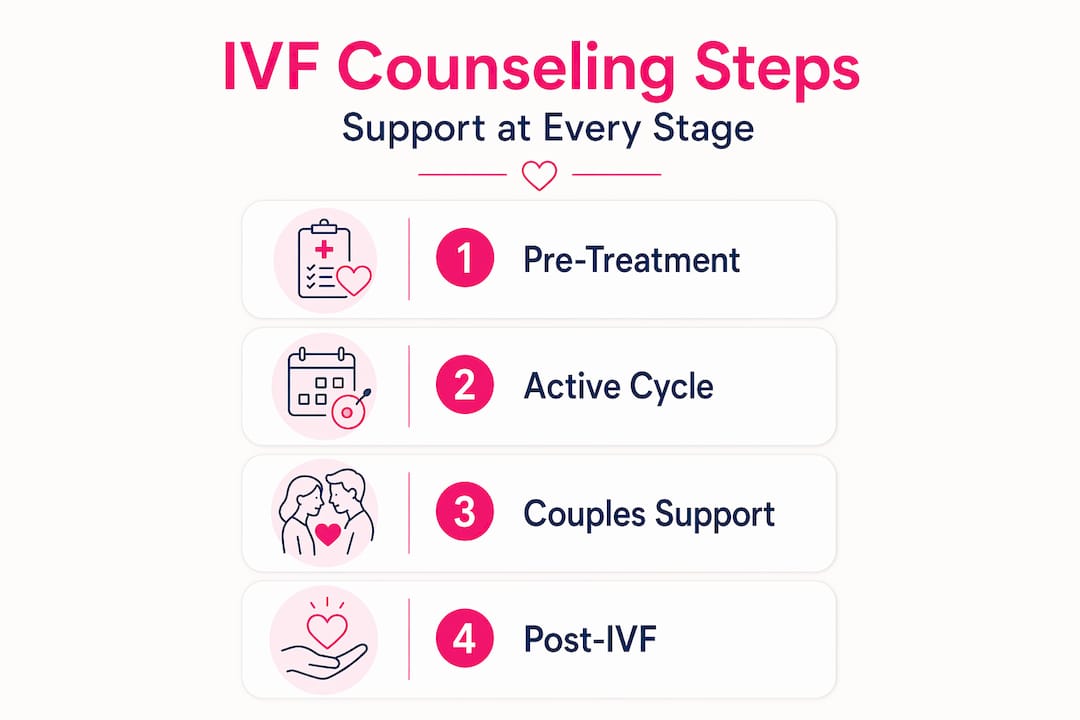
- The role of counseling in IVF before treatment begins
- Emotional support during active IVF cycles
- Couples counseling and relationship support during IVF
- Long-term and post-IVF counseling
- How to access and use IVF counseling effectively
- My honest perspective on counseling and IVF success
- How Life IVF Center supports you through every step
- FAQ
Key takeaways
| Point | Details |
|---|---|
| Start counseling before treatment | Pre-treatment support sets realistic expectations and strengthens emotional readiness before IVF begins. |
| Counseling reduces anxiety and depression | Evidence-based interventions like CBT significantly lower distress levels during active IVF cycles. |
| Both partners need support | Women report higher distress, but men are also affected; couples counseling improves communication and shared resilience. |
| Post-IVF support matters equally | Whether the cycle succeeds or fails, counseling helps patients process outcomes and plan next steps. |
| Peer support complements professional therapy | Group settings normalize difficult emotions and reduce isolation alongside formal counseling services. |
The role of counseling in IVF before treatment begins
Most people assume counseling only becomes relevant when something goes wrong. The reality is that pre-treatment counseling may be the most strategically valuable support you receive throughout the entire process. Informed decision-making in IVF depends on patients having a realistic picture of success rates, physical demands, and the emotional weight of each stage before they commit.
Pre-treatment sessions help you examine several factors that directly affect treatment readiness:
- Medical and lifestyle factors: A counselor works alongside your care team to address modifiable habits, such as stress management, sleep, and nutrition, that can influence IVF success.
- Emotional readiness: Counseling assesses whether you are psychologically prepared for the uncertainty ahead, not to screen you out, but to prepare you more thoroughly.
- Shared decision-making: You and your partner can clarify your values around treatment limits, donor options, and how many cycles you are willing to attempt.
- Reducing early dropout: Patients who receive pre-treatment support are more likely to complete planned cycles rather than discontinue due to emotional overwhelm.
Counseling before IVF also strengthens informed consent, which goes beyond signing a form. It means you genuinely understand what you are agreeing to and feel confident asking questions throughout. According to clinical guidance, integrating counseling early into fertility care supports better coordination between medical and emotional aspects of treatment planning.
Pro Tip: Ask your fertility clinic whether pre-treatment psychological screening is part of the intake process. If it is not offered automatically, request it. Early support produces stronger results than waiting until distress peaks.
Emotional support during active IVF cycles
The period between starting stimulation medications and waiting for a pregnancy test result is psychologically intense. Many patients describe the two-week wait as among the hardest stretches of their lives. Anxiety and depression are not rare reactions during this time. They are common and clinically documented.

A systematic review of psychological distress found that women experience higher anxiety and depression at every stage of IVF compared to men. That gap is widest during the active treatment phases. Without structured support, many patients reach crisis points that could have been prevented.
Cognitive behavioral therapy, commonly called CBT, is one of the most well-researched counseling approaches for IVF patients. CBT programs for infertility show meaningful reductions in anxiety scores and improvements in emotional regulation during treatment cycles. The therapy works by identifying and reframing distorted thinking patterns, such as “if this cycle fails, I have no future,” and replacing them with more accurate and balanced perspectives.
“Psychosocial care in infertility is not optional. It is evidence-based practice that improves decision-making, emotional regulation, and coping at every stage of treatment.” (Psychosocial support in fertility care)
What counseling specifically targets during active cycles:
- Egg retrieval anxiety: Many patients experience anticipatory fear before procedures. Counselors provide breathing techniques, grounding practices, and cognitive reframing before appointments.
- Managing uncertainty: Waiting for fertilization reports, embryo grading, and transfer results creates cycles of hope and dread. Counseling helps regulate the emotional spikes.
- Addressing stigma: Psychological support also helps patients manage the shame and isolation that can come from social stigmas around infertility.
- Improving clinical outcomes: A randomized controlled trial found that four sessions of psychotherapy produced an implantation rate of 71.3% versus 52.7% in the control group, suggesting that emotional support may have a measurable biological benefit.
Timing matters significantly. Interventions delivered before ART produce stronger effects on depression and anxiety than those started mid-treatment or after a failed cycle. If you are already in a cycle and have not yet connected with a counselor, it is not too late, but starting earlier is consistently better.
Couples counseling and relationship support during IVF
Infertility does not happen to one person. It happens to a couple, even when the medical diagnosis falls on one partner. Yet the emotional experience within a couple is rarely equal. Research confirms that women carry higher distress throughout IVF, while men often underreport their own anxiety or attempt to cope by appearing strong and stoic. That gap, when left unaddressed, creates distance rather than connection.
Couples counseling provides a structured space to close that gap. Effective couples counseling during fertility treatment focuses on several specific areas:
- Communication under pressure: Many couples struggle to discuss fears, expectations, or limits without those conversations escalating. A counselor facilitates productive dialogue.
- Role clarity: One partner may take on more of the medical coordination while the other manages finances or emotional labor. Counseling helps distribute that weight more fairly.
- Intimacy during treatment: IVF can reduce sex to a clinical act and strain emotional closeness. Couples therapy actively addresses this shift.
- Aligning on limits: Deciding how many cycles to attempt, whether to use donor eggs, or when to pause treatment requires both partners to be heard. Counseling creates a safe framework for those decisions.
The importance of support in IVF extends well beyond the clinic walls. How partners show up for each other between appointments significantly affects resilience during treatment.
Pro Tip: If your partner is reluctant to attend counseling, frame the first session as a practical planning meeting rather than emotional therapy. Many men engage more readily when the focus is on decision-making and communication strategy.
Long-term and post-IVF counseling
A completed IVF cycle marks a transition, not an end. Whether the result is a positive pregnancy test or another loss, the psychological work is not finished. Patients who achieved pregnancy often face a new wave of anxiety, fear of miscarriage, and difficulty trusting that the pregnancy will last. Those who did not achieve pregnancy face grief, identity questions, and decisions about what comes next.
Therapy supports patients through grief even when there is no clear resolution. This is a point many patients miss. Counseling is not only useful when you have a specific problem to solve. It is also valuable for processing ambiguous loss, shifting expectations, and finding a way forward that feels honest rather than forced.
Here is how post-IVF support typically differs depending on outcomes:
| Situation | Counseling focus | Format |
|---|---|---|
| Failed cycle | Grief processing, reviewing options, managing identity shifts | Individual or couples therapy |
| Recurrent failure | Decision-making about donor options, surrogacy, or stopping treatment | Specialist fertility counselor |
| Successful pregnancy | Managing anxiety about loss, bonding, and transition to parenthood | Perinatal counseling |
| Choosing to stop treatment | Life reconfiguration, alternative paths, closure | Individual therapy or peer support |
For patients who have experienced previous IVF failures, ongoing counseling is particularly important because each failed cycle can compound grief and erode confidence in future treatment. Peer-led support groups add a complementary layer to formal counseling. Virtual IVF support groups through organizations like RESOLVE provide monthly sessions where patients normalize difficult feelings through shared experience. Peer support reduces isolation in ways that individual therapy sometimes cannot, simply because shared experience carries its own credibility.
How to access and use IVF counseling effectively
Knowing counseling helps is one thing. Knowing how to actually access and use it is another. Many patients never connect with support services simply because the process feels unclear or the timing seems wrong. Here is a practical framework.
- Ask your fertility clinic directly. Most reputable clinics offer counseling services for fertility as part of their care model or can refer you to a licensed therapist who specializes in reproductive psychology. Do not wait for it to be offered. Ask at your first appointment.
- Understand the types of support available. Clinical options include individual psychotherapy, CBT, and couples counseling. Complementary options include mindfulness-based stress reduction, acupuncture-supported therapy, and peer support groups. Each serves a different need.
- Schedule sessions at key transition points. Pre-treatment, before egg retrieval, during the two-week wait, and after receiving results are high-stakes moments where counseling provides the most value.
- Be specific about your goals. A counselor works more effectively when you arrive with a clear focus, whether that is managing anxiety about a specific procedure, improving communication with your partner, or processing a past cycle.
- Track your emotional patterns. Keeping a brief daily log of mood, stress levels, and sleep can help both you and your counselor identify triggers and measure progress over time.
Pro Tip: When searching for a therapist, look specifically for credentials in reproductive psychology or infertility counseling. Specialists in this area understand the clinical context and will not need lengthy explanations about IVF protocols.
My honest perspective on counseling and IVF success
I have spent years observing how patients move through fertility treatment, and the single most consistent difference I notice between those who endure the process with their sense of self intact and those who feel broken by it is not their diagnosis or their protocol. It is whether they had real psychological support built into their care from the start.
What I find frustrating is that counseling is still framed as supplemental, something reserved for patients who are “struggling.” That framing is backwards. Counseling is not a rescue tool. It is a preparation tool. The patients who start counseling services for fertility before their first retrieval show up to appointments clearer, ask better questions, and recover faster from setbacks.
I have also seen the cost of waiting. Couples who delay seeking couples therapy support until their relationship is already strained face a much steeper climb. The same applies to individuals who dismiss their anxiety as something to push through alone, only to find it compounding with each failed cycle.
Normalizing counseling as a standard part of IVF care is not about weakness. It is about treating the whole patient, not just the biological variables. The psychological aspects of IVF are not separate from the clinical outcomes. They are woven into them.
How Life IVF Center supports you through every step
At Life IVF Center, emotional support is not an afterthought. It is built into the care model from your very first consultation. Whether you are just beginning to explore your options or you are processing a difficult cycle result, the team is designed to support both the clinical and psychological dimensions of your treatment.
Life IVF Center’s fertility treatment packages are designed to be both affordable and patient-centered, incorporating counseling resources alongside the clinic’s Precision IVF® protocols. This means your emotional readiness is considered alongside your biological profile from day one. If you have experienced failed cycles elsewhere and are wondering what comes next, a second opinion consultation can include a full review of both your prior treatment and your current support needs. Reach out to Life IVF Center to schedule a consultation and find out how personalized fertility care, with counseling built in, can make a genuine difference.
FAQ
What is the role of counseling in IVF treatment?
Counseling in IVF supports emotional readiness, reduces anxiety and depression, strengthens couples communication, and helps patients make informed decisions throughout all stages of treatment. Research shows it can also improve clinical outcomes including implantation rates.
When should IVF patients start counseling?
Starting counseling before treatment begins produces the strongest results. Pre-ART psychological interventions significantly reduce distress compared to support initiated during or after treatment.
Can counseling actually improve IVF success rates?
Evidence suggests it can. A randomized controlled trial found that psychotherapy during IVF produced a 71.3% implantation rate compared to 52.7% in patients who received no psychological support.
Do both partners need IVF counseling?
Both partners benefit, even though women typically report higher distress. Couples counseling addresses communication gaps, shared decision-making, and relationship strain that commonly arise during fertility treatment.
What types of counseling are available for IVF patients?
Options include individual psychotherapy, CBT, couples counseling, mindfulness-based programs, and peer support groups. The most effective approach often combines professional counseling with peer-led group support for comprehensive emotional coverage.
Recommended
- How to Support Your Partner Through IVF: A Complete Guide
- IVF Process Explained: Personalize Your Path to Success
- Egg retrieval tips: Expert guidance for IVF success
- ICSI in IVF: Benefits, risks, and when it’s needed
Ready to take the next step?
Life IVF Center specializes in individualized Precision IVF® care for complex cases—including diminished ovarian reserve, prior failed cycles, and advanced maternal age. Our in-house labs and dedicated physicians are ready to help.
Book a Free Consultation →