

If you’ve been exploring fertility treatment options, you may have heard about mild stimulation IVF and wondered whether it could be the right path for you. Understanding what is mild stimulation IVF goes beyond simply knowing it uses less medication. There is a common misconception that fewer drugs automatically means better egg quality or a gentler experience for everyone. The reality is more specific. This article breaks down how the process works, who it genuinely suits, what the benefits and limitations look like, and what you can realistically expect if your doctor recommends this approach.
Table of Contents
- Key takeaways
- What is mild stimulation IVF
- Benefits of mild stimulation IVF
- Limitations and honest considerations
- How mild stimulation IVF works: Step by step
- Mild stimulation IVF vs. conventional IVF
- My perspective: Why patient fit matters more than protocol
- Explore your options at Life IVF Center
- FAQ
Key takeaways
| Point | Details |
|---|---|
| Lower medication protocol | Mild stimulation IVF uses reduced doses over 5-7 days, targeting 2-8 eggs per cycle. |
| Not a universal upgrade | It works best for specific patient profiles, particularly those with low ovarian reserve or poor medication response. |
| Reduced OHSS risk | Lower doses significantly decrease the risk of ovarian hyperstimulation syndrome compared to conventional IVF. |
| Costs may balance out | Lower upfront medication costs can be offset if multiple cycles are needed to achieve pregnancy. |
| Personalized protocols matter | Matching the right protocol to your biology and fertility profile is the most reliable path to a successful outcome. |
What is mild stimulation IVF
Mild stimulation IVF, sometimes called mini IVF, minimal stimulation IVF, or soft IVF, is a modified version of conventional in vitro fertilization that uses lower doses of fertility medication over a shorter period. The goal is not to produce the maximum possible number of eggs. Instead, the protocol targets a smaller, carefully selected cohort of eggs, with most cycles aiming to retrieve 2 to 8 eggs, compared to the 10 to 20 eggs typically sought in standard IVF.
The fundamental steps of the IVF cycle itself remain the same in both approaches: ovarian stimulation, egg retrieval, fertilization in the laboratory, and embryo transfer. The primary difference lies in how intensively the ovaries are stimulated to produce eggs.
Medication used in mild stimulation IVF
Rather than relying heavily on injectable gonadotropins from the start, mild stimulation IVF typically uses oral medications like clomiphene citrate or aromatase inhibitors, combined with a limited course of low-dose injections. This approach shortens the stimulation phase and reduces total medication exposure significantly. Many patients find this appealing because the injection burden is considerably lower.
Here is how the mild stimulation IVF protocol differs from a conventional IVF approach at a clinical level:
- Stimulation duration: Typically 5 to 7 days, compared to 10 to 14 days in conventional IVF.
- Medication type: Oral agents (clomiphene citrate or letrozole) plus minimal injectable gonadotropins.
- Egg retrieval target: 2 to 8 mature eggs per cycle versus 10 to 20 in standard IVF.
- Monitoring visits: Fewer ultrasound and blood monitoring appointments due to shorter stimulation.
- Hormonal impact: Reduced total hormone exposure to the body throughout the cycle.
Understanding these clinical distinctions helps set realistic expectations before beginning treatment. The IVF process fundamentals are preserved. Only the intensity of stimulation changes.
Benefits of mild stimulation IVF
For the right patient, the IVF mild stimulation benefits are meaningful. The reduced medication load translates into several practical and medical advantages that can make treatment more manageable, especially for those who have struggled emotionally or physically with intensive protocols.

Reduced risk of OHSS. Ovarian hyperstimulation syndrome is one of the most serious complications of IVF. OHSS affects 1 to 5% of IVF cycles, but mild ovarian stimulation IVF significantly lowers this risk by avoiding the high hormone doses that trigger the condition in susceptible patients.
Fewer injections and physical discomfort. Fewer medication days mean less bloating, fewer injection sites, and generally reduced physical side effects during the stimulation phase. For patients with needle anxiety or sensitivity to hormonal fluctuations, this difference can be genuinely significant.
Lower upfront medication costs. Fertility medications can be one of the largest expenses in an IVF cycle. Because mild stimulation IVF uses fewer doses and shorter stimulation, medication costs are lower for each individual cycle. This appeals to patients facing financial constraints or those without comprehensive insurance coverage.
Better tolerance and emotional well-being. The physical and emotional stress reduction from fewer injections and clinic visits helps patients remain more engaged and less exhausted during treatment. This can improve overall adherence to the treatment plan.
Appropriate for poor ovarian responders. For patients with diminished ovarian reserve or those who responded poorly to high-dose stimulation in a prior conventional IVF cycle, mild stimulation may actually yield similar or better quality eggs. Quality over quantity is the operating principle here.
Pro Tip: If you have a low antral follicle count or elevated FSH levels, discuss mild stimulation IVF specifically with your specialist. It may be a better fit for your biology than a high-dose approach.
Limitations and honest considerations
Mild stimulation IVF is not the right choice for every patient, and presenting it as universally superior would be misleading. There are real trade-offs that deserve a straightforward discussion before you commit to this path.
The most direct limitation is the lower egg yield per cycle. Fewer eggs mean fewer embryos available for transfer or freezing. For patients who are younger, have normal ovarian reserve, or need to bank multiple embryos for genetic testing, a conventional protocol will typically produce more options in a single retrieval.
Success rates for mild stimulation IVF can be lower than those for conventional IVF in patients who are good responders to standard protocols. If your ovaries can safely tolerate higher stimulation and produce more eggs, there may be a clinical reason to pursue that route instead.
Consider these additional factors carefully:
- Multiple cycles may be needed. Because fewer embryos are created per cycle, more complete IVF cycles may be required to achieve a pregnancy. This can erode the initial cost savings from lower medication expenses, with total costs potentially matching or exceeding conventional IVF over time.
- Not suitable for all diagnoses. Patients with certain fertility diagnoses, such as those requiring preimplantation genetic testing across many embryos, may need a higher-yield conventional protocol.
- Age considerations matter significantly. Older patients, particularly those over 38, may benefit from having more embryos available to select the most viable one. A single-cycle approach with fewer eggs narrows those options.
“Mild stimulation IVF is not a universal upgrade in IVF. It can be strategically the better choice for certain medical profiles, particularly poor ovarian responders, but patient selection is the deciding factor.” — Northwell Health
One more nuance worth noting: conventional IVF protocols have become significantly gentler over the past decade, with clinics now using roughly half the hormone dosage previously standard. This has narrowed the gap between the two approaches. A well-managed conventional cycle today may feel less dramatically different from mild stimulation than patients expect.
How mild stimulation IVF works: Step by step
If your specialist recommends mild stimulation IVF, here is what you can expect throughout the process. Knowing each stage in advance helps reduce anxiety and allows you to prepare practically and emotionally.
-
Initial consultation and testing. Your doctor will review your ovarian reserve, hormone levels, and overall fertility profile to confirm you are a good candidate. This typically includes an antral follicle count ultrasound and blood tests for AMH and FSH.
-
Starting oral medication. Around day 2 to 3 of your menstrual cycle, you will begin taking an oral agent, most commonly clomiphene citrate or letrozole. These medications prompt the ovaries to begin developing follicles.
-
Adding low-dose injections. After a few days of oral medication, a small number of low-dose injectable gonadotropins are added to support follicle growth. The total injection count is substantially lower than in a conventional protocol.
-
Monitoring appointments. You will attend ultrasound appointments every 1 to 2 days during peak stimulation to track follicle development and time the trigger shot precisely. Monitoring is less frequent than in standard IVF due to the shorter stimulation window.
-
Trigger shot and egg retrieval. Once follicles reach the target size, a trigger injection is given. Egg retrieval typically takes place 34 to 36 hours later under light sedation, usually taking 15 to 20 minutes.
-
Fertilization in the laboratory. Retrieved eggs are fertilized using either conventional insemination or intracytoplasmic sperm injection (ICSI). Fertilized eggs develop into embryos over 3 to 5 days.
-
Embryo transfer. One or more viable embryos are transferred to the uterus. The two-week wait for a pregnancy test follows.
Pro Tip: Keep a simple log of your injection times, monitoring appointments, and how you feel physically each day. Bringing this record to clinic visits helps your care team make precise adjustments to your protocol in real time.
The practical experience of mild stimulation IVF for most patients involves fewer overall clinic visits and a shorter treatment window, which many find less disruptive to work and daily life.
Mild stimulation IVF vs. conventional IVF
The table below summarizes the key clinical differences between the two protocols to help you understand your options at a glance.
| Feature | Mild stimulation IVF | Conventional IVF |
|---|---|---|
| Medication type | Oral agents plus low-dose injections | High-dose injectable gonadotropins |
| Stimulation duration | 5 to 7 days | 10 to 14 days |
| Eggs targeted per cycle | 2 to 8 | 10 to 20 |
| OHSS risk | Lower | Higher in susceptible patients |
| Medication cost per cycle | Lower | Higher |
| Embryos available | Fewer | More |
| Best suited for | Poor responders, low reserve, OHSS risk | Normal to high responders, genetic testing needs |
| Total cost across cycles | Variable (more cycles may be needed) | Variable (fewer cycles often needed) |
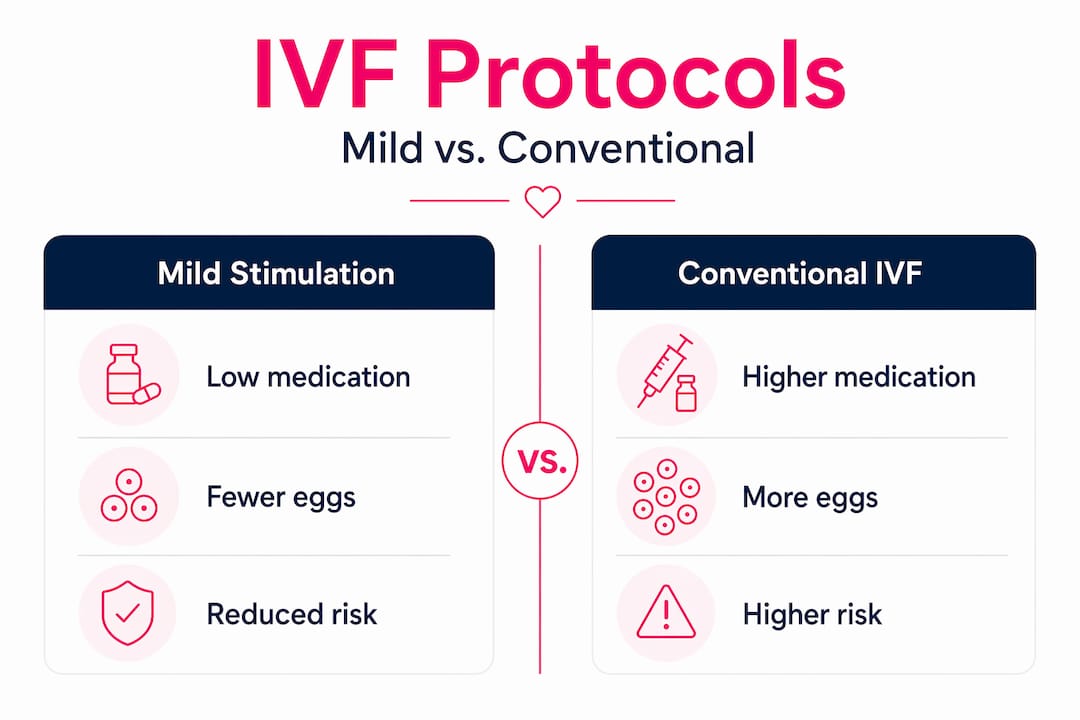
The right protocol depends entirely on your individual profile. Fertility treatment options are not one-size-fits-all, and the choice between mild and conventional IVF should always be made in direct conversation with a specialist who knows your full medical history.
My perspective: Why patient fit matters more than protocol
I’ve seen patients come in convinced that mild stimulation IVF is simply a “better” or “more natural” version of conventional IVF because it uses less medication. That belief, while understandable, can lead patients to advocate for a protocol that isn’t actually the best choice for their specific biology.
What I’ve found over years of working in this field is that the most successful outcomes don’t come from selecting the gentler-sounding option. They come from matching the protocol to the patient. A woman with low ovarian reserve and a history of OHSS is an excellent candidate for mild stimulation. A 34-year-old with normal reserve who needs multiple embryos for PGT-A testing is usually not.
The evolution of IVF technology and protocols over the past decade has also changed this conversation considerably. Conventional IVF is not what it was 15 years ago. Dosing has dropped significantly, monitoring has improved, and individualized protocols have become standard. My honest advice: go in open to either path. Ask your specialist to explain specifically why they are recommending one approach over the other for your profile. That conversation is more valuable than any general comparison.
— Ben
Explore your options at Life IVF Center
At Lifeivfcenter, mild stimulation IVF is part of a broader menu of personalized fertility treatment protocols available across multiple Southern California locations. The clinic’s Precision IVF® approach means your treatment is designed around your specific biology, not a standard template.
Whether you are exploring mild stimulation as a first option or reconsidering your protocol after a previous cycle, the team at Lifeivfcenter offers consultations that map your ovarian reserve, medical history, and goals to the most appropriate treatment path. You can review available fertility treatment packages to understand cost structures and what is included in each cycle. For patients at the start of their IVF research, the IVF introduction resources offer a clear overview of what the process involves and how to prepare for your first consultation.
FAQ
What is mild stimulation IVF in simple terms?
Mild stimulation IVF is an IVF approach that uses lower doses of fertility medication over a shorter period to retrieve a smaller number of eggs, typically 2 to 8, rather than the 10 to 20 eggs targeted in conventional IVF. The core process of fertilization and embryo transfer remains the same.
Who is the best candidate for mild stimulation IVF?
Patients with low ovarian reserve, a history of poor response to high-dose protocols, or those at elevated risk for ovarian hyperstimulation syndrome tend to benefit most from mild stimulation IVF. It is not typically recommended as the first choice for patients with normal or high ovarian reserve.
Does mild stimulation IVF have lower success rates?
Success rates can be lower per cycle compared to conventional IVF because fewer embryos are produced, but outcomes may be comparable in carefully selected patient groups such as poor ovarian responders. Multiple cycles may be needed, which can affect both the timeline and total cost.
Is mild stimulation IVF less expensive?
Medication costs per cycle are lower, but if more cycles are required to achieve pregnancy, the total financial investment can match or exceed that of a single conventional IVF cycle. Discussing full cost projections with your clinic before starting is strongly recommended.
How long does the mild stimulation IVF process take?
The stimulation phase typically lasts 5 to 7 days, which is shorter than the 10 to 14 days common in conventional IVF. From the start of medication to the embryo transfer, a complete cycle usually spans 3 to 4 weeks.
Recommended
- ICSI in IVF: Benefits, risks, and when it’s needed
- Mini IVF: A personalized path to fertility success
- IVF Process Explained: Personalize Your Path to Success
- Immunotherapies in IVF: What the Evidence Really Shows
Ready to take the next step?
Life IVF Center specializes in individualized Precision IVF® care for complex cases—including diminished ovarian reserve, prior failed cycles, and advanced maternal age. Our in-house labs and dedicated physicians are ready to help.
Book a Free Consultation →