
Egg donor screening has four parts: a medical exam with blood and infection testing, genetic carrier screening, a psychological evaluation, and a review of family history and lifestyle. Federal rules set the minimum for infectious disease testing, and professional guidance from the American Society for Reproductive Medicine (ASRM) shapes the genetic and psychological portions. If you are considering a donor egg cycle, knowing what each test does helps you read a donor profile with confidence and ask better questions of any program.
TL;DR
- Every U.S. egg donor must be tested for HIV, hepatitis B and C, syphilis, chlamydia, and gonorrhea, and the specimen must be collected close to the time of egg retrieval.
- ASRM recommends that all donors be screened for cystic fibrosis, spinal muscular atrophy, and thalassemia/hemoglobinopathy carrier status. Fragile X screening may be considered for all donors and is required with a relevant family history.
- Psychological screening and a multi-generation family history are part of the process, and certain findings can make a candidate ineligible.
- Matching by self-reported ethnicity is increasingly discouraged. Broad (pan-ethnic) carrier screening of the donor and the recipient gives a more reliable picture of risk.
- Different labs can test different gene lists, so a qualified professional should review the combined results.
Table of Contents
- The four parts of egg donor screening
- Medical and infectious disease testing
- Genetic carrier screening
- Psychological evaluation
- What can disqualify a donor
- Ethnicity matching and what screening can tell you
- How to assess a donor program’s screening labs
- Our perspective
- Preparing as an intended parent
- Explore your donor egg options with Life IVF Center
- FAQ
- Sources
The four parts of egg donor screening
Programs group their evaluation into medical, genetic, and psychological screening, plus a personal and family history. The order varies, but most candidates move through the same stages:
- Application and history. The candidate reports her medical history, her family’s history across several generations, education and work history, and lifestyle.
- Initial visit. A physical exam, blood work, an ovarian reserve assessment, and a first conversation about side effects and the time commitment.
- Genetic screening. A saliva, blood, or cheek swab sample is analyzed for carrier status of inherited conditions.
- Psychological evaluation. A mental health professional meets with the candidate, and some programs add standardized testing.
- Repeat infectious disease testing. Done close to the start of the stimulation cycle so results are current.
Each stage can end the process. A candidate may be accepted at the application stage and still be declined after a lab result or a psychological assessment. That is by design: the goal is the safety of the donor, the recipient, and the future child.
Medical and infectious disease testing
What federal rules require
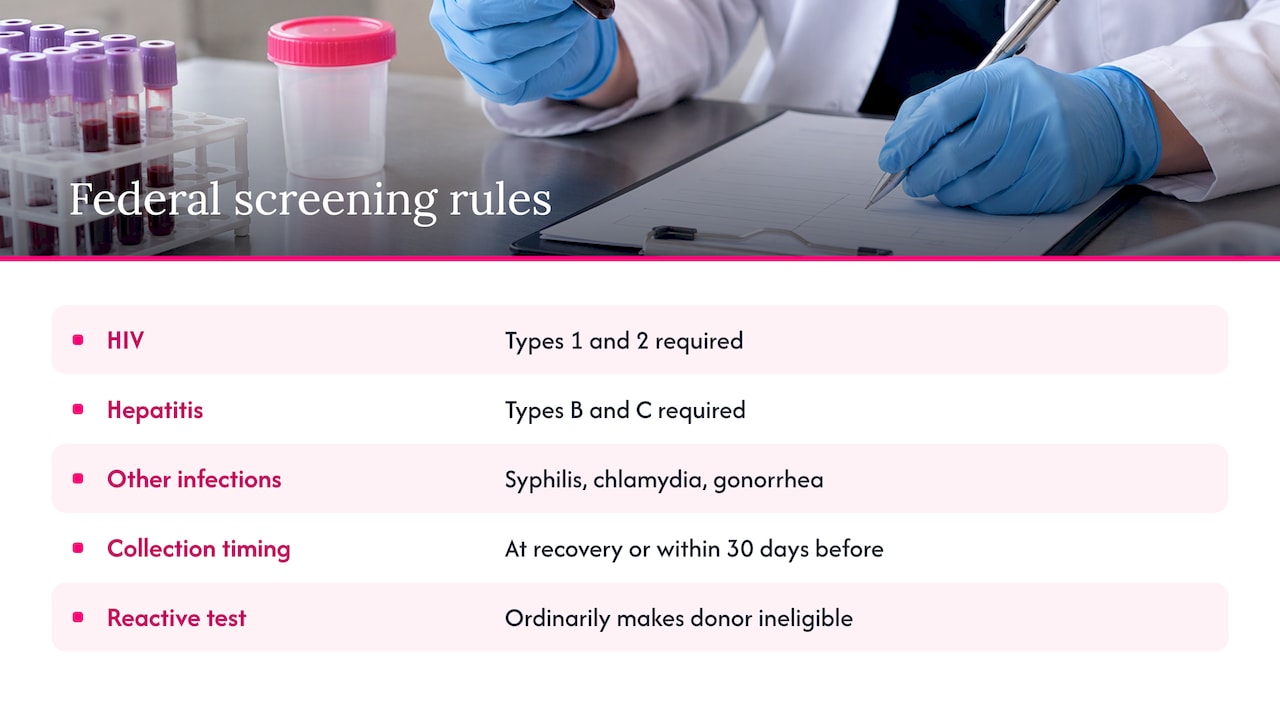
The FDA states that reproductive tissue donors must be screened for risk factors and clinical evidence of communicable disease. Donor specimens must also be tested for HIV types 1 and 2, hepatitis B, hepatitis C, syphilis, chlamydia, and gonorrhea. Many programs add HTLV-1 and 2.
Timing matters. Under 21 CFR Part 1271, Subpart C (Donor Eligibility), an oocyte donor specimen is generally collected at the time of recovery or within 30 days before it. A donor is ordinarily ineligible when a required infectious disease screening test is reactive, with a narrow exception for syphilis when a confirmatory test is negative. In practice, this is why programs commonly repeat infectious disease tests close to the start of a stimulation cycle, since earlier results can become outdated.
Drug testing and the physical exam
The physical exam typically includes blood pressure, weight, a pelvic exam, and blood work. Some programs also drug test donors during screening and the donation process. Donors should expect this and be told about it in advance.
Body mass index, medication use, and menstrual history are also reviewed, because they affect how a candidate may respond to ovarian stimulation. Each program sets its own thresholds, so a candidate who is turned away by one program should ask which criterion applied.
How the tests are performed
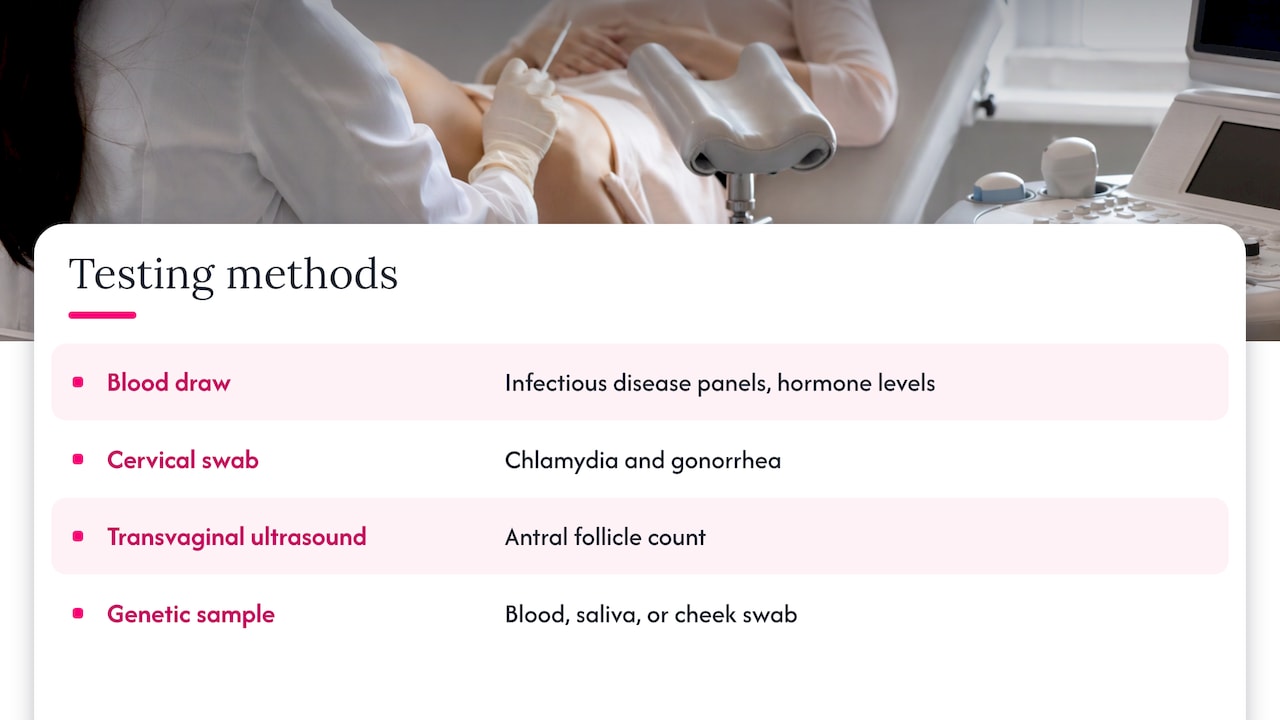
Most of the testing is simple for the donor. Blood is drawn for infectious disease panels and hormone levels. A cervical swab checks for chlamydia and gonorrhea. A transvaginal ultrasound counts antral follicles, which helps estimate how the ovaries may respond to medication. Genetic samples come from blood, saliva, or a cheek swab.
Results are interpreted by the program’s medical team and, for genetic results, ideally by a genetic counselor. For an intended parent, a result is not a simple pass or fail. A negative infectious disease panel means the donor met the testing requirement at that time. A negative carrier screen lowers, but never eliminates, the chance that the donor carries a variant, because no panel covers every gene or every variant.
Genetic carrier screening
What ASRM recommends
Carrier screening looks for variants linked to inherited conditions that a person can carry without having symptoms. The ASRM’s 2024 gamete and embryo donation guidance recommends that all oocyte donors be screened for cystic fibrosis, spinal muscular atrophy, and thalassemia/hemoglobinopathy carrier status. Routine fragile X syndrome carrier screening may be considered for all donors, and it is mandatory for a donor with a family history of fragile X-related disorders or intellectual disability.
Many programs go well beyond that minimum with an expanded panel covering dozens or hundreds of genes. Conditions often named in donor materials include Tay-Sachs disease and sickle cell disease alongside the ones above. There is, however, no agreement on which panel of genes should be included in expanded carrier screening, so two donors tested at two labs may not have been tested for the same conditions.
Karyotyping and what it adds
A karyotype looks at the number and structure of a person’s chromosomes. It is described as standard practice in most European and North American programs, and it can uncover chromosomal rearrangements that carrier panels do not detect.
Carrier screening is not diagnostic testing
Carrier screening estimates risk in someone who is healthy. Diagnostic genetic testing is different: it is tied to a specific clinical presentation and is not part of routine preconception screening for donor candidates. A clean carrier report is reassuring information, not a guarantee of a healthy child.
Who reviews the results
The science moves faster than the reporting systems. A 2023 review in Fertility and Sterility Reports found no standardized protocol or central mechanism for sharing reported genetic screening results, reclassifications, or updates. A variant considered uncertain today may be reclassified later, and the donor may never be told.
That is why ASRM stresses that when different laboratories perform carrier screening on the donor and the recipient, a professional should review the combined results to evaluate and disclose reproductive risk accurately. The Royal College of Obstetricians and Gynaecologists notes that understanding expanded carrier screening results is complicated and requires support from appropriately trained professionals. Laboratory services with broad genomic test panels show how wide the testing menu has become, and a genetic counselor is the person who turns that breadth into a clear answer for your situation.
What if the donor and the recipient carry the same variant?
When both people carry a variant in the same gene for a recessive condition, a child could inherit both copies. This is the situation that combined review is meant to catch before a donor is selected. Typical next steps, to be discussed with a genetic counselor and your physician, include choosing a different donor or testing embryos for the specific condition before transfer. The right choice depends on the condition, how severe it is, and how reliable the testing is for that gene.
Psychological evaluation
A donor commits to medication, injections, monitoring, and a medical procedure. A psychological evaluation checks that she understands this and is choosing it freely. It usually includes an interview with a mental health professional and may include standardized questionnaires, and it covers motivation, support, and her understanding of the implications of donating.
ASRM lists relative exclusion criteria that include serious mental illness, significant psychopathology, current psychoactive medication, substance disorders, and abuse without professional treatment. The same list covers excessive stress, relationship instability, inadequate cognitive functioning, and high-risk sexual practices. These are relative criteria, meaning they prompt careful clinical judgment, not automatic rejection in every case.
What can disqualify a donor
Common reasons a candidate does not move forward fall into four groups:
| Area | Examples of findings that can end candidacy |
|---|---|
| Infectious disease | A reactive required test, such as HIV or hepatitis B or C, subject to the regulation’s narrow syphilis confirmatory-test exception |
| Genetic | A carrier or family history result a program considers too high risk, or a fragile X family history without a clear result |
| Psychological | Significant psychopathology, substance disorders, or untreated abuse history, among the ASRM relative criteria |
| Medical and lifestyle | A history, medication, or ovarian response that makes stimulation unsafe or unlikely to work, and a failed drug screen |
Programs also apply their own rules on age, body mass index, and smoking. If you are an intended parent, ask the program for its written criteria rather than assuming they match another program’s.
Ethnicity matching and what screening can tell you
Many intended parents want a donor who resembles them or shares a cultural background. That is a valid preference, and appearance and heritage can be part of the choice. It is a different question from genetic risk.
ASRM notes that genetic results help match donors by identifying the potential for recessive conditions, but matching by self-reported ethnicity is increasingly discouraged in favor of pan-ethnic expanded carrier screening. Self-reporting is often inaccurate, and rare recessive conditions can exist in any population. A donor who reports one ancestry may carry variants more common in another, and a screening panel designed around one ethnic group may miss them.
A practical approach is to treat ethnicity as one criterion among several and to rely on the genetic data for risk:
- Ask whether the donor was screened with an expanded panel and which conditions it covered.
- Ask whether the recipient (and the partner, if there is a partner with sperm) has been screened too, since risk depends on both sides.
- Ask who will review the donor’s results alongside yours.
- Ask how the program handles updates if a variant is reclassified after the donation.
How to assess a donor program’s screening labs
You do not need to evaluate laboratory methods yourself. You do need to understand who is doing what. Useful questions include:
- Which tests were run on this donor, when, and by which laboratory?
- Were the infectious disease tests repeated close to the cycle start?
- Does the program have a genetic counselor or physician who reviews the donor’s results with yours?
- What happens if a genetic result changes after the donation?
- Which psychological screening tools and which professionals were involved?
Programs with their own laboratories can answer many of these directly, because testing, handling, and records sit under one roof.
Our perspective
Screening is a safety process for everyone involved, and we believe the quality of a donor cycle depends on how the results are interpreted, not only on how many tests were run.
At Life IVF Center, our approach to care is built around the individual. Precision IVF® customizes treatment based on each patient’s biology, medical history, and goals, and that principle applies to donor egg cycles as well. A donor’s genetic report only becomes useful when it is read alongside the recipient’s own testing and history.
We also welcome patients with complex histories and second-opinion cases, including people who have been told elsewhere that their options are limited. For these patients, the combined review of donor and recipient screening, with a clear explanation in plain language, is often the most valuable step before any donor is chosen.
Our in-house laboratories give us greater control over testing and handling, and our team offers multi-language support, travel coordination, and financial guidance so that the practical side of treatment is as clear as the medical side.
Preparing as an intended parent
If you are planning to use donor eggs, your own evaluation matters as much as the donor’s. Our pre-IVF testing menu lists published prices for several of the tests that support that evaluation:
| Test | Published price |
|---|---|
| Infectious Disease (ID) Panel | $550-$750 |
| Carrier Screening for Genetic Disease | $349 |
| Karyotype Chromosomal Analysis | $595 |
| Saline Infusion Sonohysterogram (SIS) | $450 |
| Endometrial Receptivity Assay (ERA) | $975 |
These are one-time prices as listed on our pre-IVF testing price page. Carrier screening of the recipient is what makes combined review with the donor’s results possible, and the uterine evaluation checks that the cavity is ready for a transfer.
Explore your donor egg options with Life IVF Center
If you are weighing a donor egg pathway, our team can walk you through the screening results that matter for your situation and explain how they fit with your own history. We offer genetic testing and donor programs as part of our fertility care services, and our published treatment package prices show what a cycle involves, including The Advanced IVF Package at $13,500 and Embryo Transfer from $2,950.
To discuss your history and next steps, start at Life IVF Center and book a consultation.
FAQ
What will disqualify you from egg donation?
A reactive required infectious disease test, a significant psychological finding, a substance use disorder, or a medical or genetic history a program considers too high risk can each end candidacy. ASRM lists psychological relative exclusions such as serious mental illness and untreated abuse. Programs also set their own age, BMI, and lifestyle criteria.
Will my baby have my DNA if I use a donor egg?
The child’s genetic material from the egg comes from the donor, not from you. If the child is carried by you, the pregnancy still involves your body, and a partner’s sperm would contribute the other half of the DNA. Questions about genetics and your family are worth discussing with your physician and a genetic counselor.
How often are infectious disease tests repeated?
The donor specimen is generally collected at recovery or within 30 days before it under federal regulation. Programs commonly repeat the infectious disease tests close to the start of a stimulation cycle so the results are current.
Does a negative carrier screen mean the donor carries nothing?
No. A negative result lowers the chance of carrying a tested variant, but no panel covers every gene or variant, and panels differ between labs. A genetic counselor can explain what a specific report did and did not cover.
Sources
- FDA: What You Should Know About Reproductive Tissue Donation
- eCFR: 21 CFR Part 1271 Subpart C, Donor Eligibility
- RCOG Scientific Impact Paper: The Use of Expanded Carrier Screening in Reproductive Medicine
- Fertility and Sterility Reports: Genetic Carrier Screening in Donors, a Challenging Frontier
- Egg Donor Screening: What Is Tested, What Is Not, What to Ask
- A Guide to Genetic Testing for Recipients and Donor Conception Professionals
This article is for general educational purposes only and is not a substitute for personalized medical advice, diagnosis, or treatment. Fertility care is highly individual; please consult a qualified healthcare professional about your specific circumstances.
Ready to take the next step?
Life IVF Center specializes in individualized Precision IVF® care for complex cases—including diminished ovarian reserve, prior failed cycles, and advanced maternal age. Our in-house labs and dedicated physicians are ready to help.
Book a Free Consultation →