
In the United States, sperm donors go through a medical history interview, a physical exam and laboratory testing for infectious disease, and most programs add genetic carrier screening, semen analysis and a psychological evaluation. The FDA sets the legal minimum for infectious disease testing. Professional guidance from the American Society for Reproductive Medicine (ASRM) describes the broader standard of care. This guide explains each layer in plain terms, so you can read a donor profile with confidence and ask better questions of your clinic.
TL;DR
- The FDA requires donor blood and urine testing for HIV-1 and HIV-2, hepatitis B, hepatitis C, syphilis, chlamydia, gonorrhea, HTLV types I and II, and CMV.
- Anonymous (nondirected) donors are tested again at least 6 months after donation, which is why samples are quarantined first.
- Genetic screening is a professional recommendation rather than an FDA mandate. ASRM advises cystic fibrosis, spinal muscular atrophy and hemoglobinopathy screening for all donors.
- A “CMV positive” label usually reflects a past infection, and it does not automatically disqualify a donor.
- Screening lowers risk. It cannot remove it entirely, so recipient counseling and testing matter too.
Table of Contents
- The infectious disease tests the FDA requires
- When the tests happen and why donors are retested
- Genetic screening of sperm donors
- Medical, physical, semen and background evaluation
- What a CMV-positive result means
- What screening cannot do
- Our perspective on donor screening
- Plan your donor sperm treatment with a team that explains the results
- FAQ
- Sources
The infectious disease tests the FDA requires
Federal rules treat donor sperm as a human cell and tissue product. The FDA’s reproductive tissue donation guidance for patients says specimens from reproductive tissue donors must be tested for:
- HIV types 1 and 2
- Hepatitis B virus (HBV)
- Hepatitis C virus (HCV)
- Treponema pallidum (the bacterium that causes syphilis)
- Chlamydia trachomatis
- Neisseria gonorrhea
Sperm donors must also be tested for human T-lymphotropic virus (HTLV) types I and II and for cytomegalovirus (CMV). The legal basis is 21 CFR 1271.85 in the Code of Federal Regulations, which lists the required communicable disease agents.
The chlamydia and gonorrhea tests have a specific standard. The FDA’s specific testing requirements for donors of human cells and tissues says they must use tests that are FDA-licensed, approved or cleared and labeled for detecting infection in people without symptoms and in low-prevalence populations. Donors who feel perfectly well are the people these tests are built for.
The tests must also be run at the right laboratories. ASRM’s guidance on gamete and embryo donation notes that donor infectious labs must be done at FDA-approved laboratories, including CMV and HTLV-I and -II IgM and IgG testing.
West Nile virus testing
West Nile virus (WNV) is part of the picture for part of the year. The FDA’s guidance on handling common donor eligibility scenarios states that WNV testing with an FDA-licensed nucleic acid test is required for donors residing in the US from June 1 through October 31. Outside that window, WNV testing is not part of the federal requirement, although individual programs may test year-round.
When the tests happen and why donors are retested
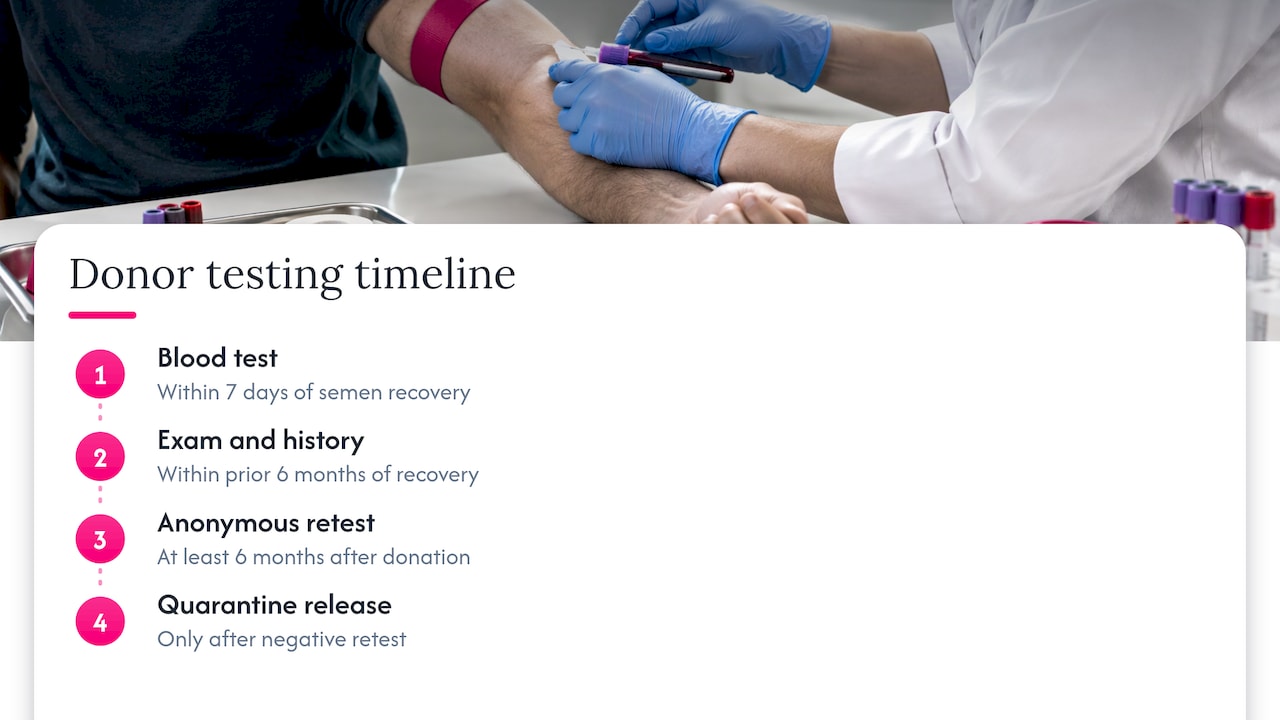
Timing matters as much as the test list. Under the FDA’s common scenarios guidance, blood specimens for infectious disease testing in semen donors must be collected up to 7 days before or after the semen is recovered. The donor must also have had a physical exam and a medical history interview within 6 months of recovery.
A single clean test does not cover every possible exposure. Infections can take time to become detectable, so the rules add a waiting period for anonymous donors. According to 21 CFR 1271.85, at least 6 months after the date of donation, a new specimen must be collected from an anonymous donor and tested for the required agents. In practice this means anonymous donor samples are frozen and held in quarantine. They are released only after the donor retests negative.
Anonymous donors versus known donors
The rules differ when the donor is known to the recipient. ASRM’s 2024 gamete and embryo donation guidance describes both pathways.
| Anonymous (nondirected) donor | Known (directed) donor | |
|---|---|---|
| Physical exam, questionnaire, medical history | Required | Required |
| Infectious labs within 7 days of collection | Required | Required |
| Six-month quarantine and repeat testing | Required by the FDA | Excepted from the federal retesting rule; ASRM recommends a quarantine of more than 35 days followed by repeat testing |
| Ineligible donor tissue | Not used | May be used only with proper labeling and consent |
| Psychological and genetic screening | Recommended by ASRM | Recommended by ASRM |
If you are considering a known donor, such as a friend or family member, ask your clinic how it handles the shorter quarantine and the labeling and consent steps. Our team walks intended parents through these decisions as part of treatment planning.
Genetic screening of sperm donors
The FDA does not mandate genetic testing of sperm donors. The standard comes from professional guidance, and it is widely followed. ASRM’s gamete and embryo donation guidance recommends that all sperm donors be screened for carrier status of:
- Cystic fibrosis
- Spinal muscular atrophy
- Thalassemia and other hemoglobinopathies
ASRM also recommends pan-ethnic expanded carrier screening over panels based on a donor’s ethnicity. An expanded panel looks at many recessive conditions at once, whatever the donor’s background. A 2010 survey of practices, Genetic testing of sperm donors: survey of current practices, found that cystic fibrosis carrier screening, chromosome analysis and hemoglobin evaluation were already performed on most donor applicants at that time.
What a carrier result means
Most people carry a few recessive gene variants without knowing it. Being a carrier of an autosomal recessive condition usually causes no illness. A child is affected only if both biological parents carry a variant in the same gene. For that reason, the ASRM guidance says a donor who is a heterozygous carrier need not be excluded when carrier status poses no health risk to the donor.
The practical consequence is that the recipient’s own status matters. ASRM recommends genetic screening and infectious disease testing of recipients and their sexually intimate partners. If a donor carries a variant, matching that against the recipient’s carrier results shows whether the combination carries risk.
The same guidance says recipients should be counseled about five things:
- The natural history of the condition
- How common carriers are
- How the condition is inherited
- The detection rate of the screening test
- The residual risk that remains after a negative result
That last point deserves attention. A negative carrier screen lowers the chance of a variant being present. It does not bring the chance to zero, because no panel covers every gene or every variant.
Family history and chromosome analysis
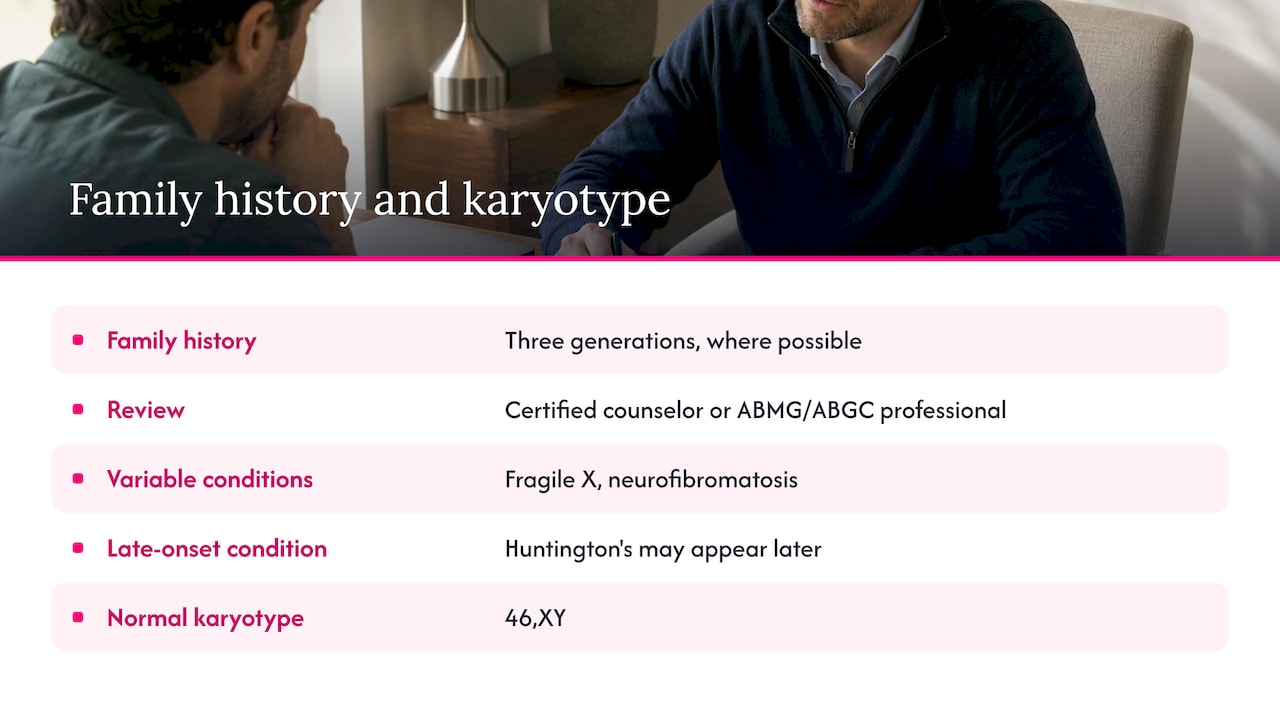
Two other pieces sit alongside carrier testing. The first is family history. ASRM says donors should provide a detailed three-generation family history where possible, reviewed by a certified genetic counselor or a professional certified by the American Board of Medical Genetics and Genomics (ABMG) or the American Board of Genetic Counseling (ABGC). The guidance explains why this review adds value beyond lab tests: some dominant or X-linked conditions, such as Fragile X syndrome and neurofibromatosis, vary in how strongly they show up. Others, such as Huntington’s disease, may not appear until after the donor and his close relatives reach an age when the history looks clear.
The second is karyotype, or chromosome analysis, which checks the number and structure of chromosomes. ASRM lists it among the genetic tests a donor program may include. For donors, a normal result is 46,XY.
Medical, physical, semen and background evaluation
Beyond infection and genetics, ASRM’s guidance describes a broader evaluation that may include:
- A review of personal and family medical history
- A complete physical examination
- Semen analysis, including morphology and post-thaw evaluation
- A complete blood count and blood chemistry panel
- Urinalysis
- ABO and Rh blood typing
- Drug testing
- A criminal background check
- Psychoeducational counseling with a licensed therapist
The semen analysis deserves a note. It measures sperm count, movement and shape. The post-thaw evaluation checks how well sperm survive freezing and thawing, which is directly relevant to donor sperm because it is shipped and stored frozen. Passing an infectious disease screen says nothing about whether the sample will perform well in treatment.
If you are a prospective patient looking at your own sperm quality instead, the basic test is the same. A semen analysis is one of the evaluations in the pre-IVF testing list on our pre-IVF testing price page, where a sperm count is listed at $185.
The ASRM Ethics Committee’s opinion on interests, obligations and rights in gamete and embryo donation adds a duty of communication. Programs should tell donors and recipients which health screening they may undergo. They should share the results, explain what any finding means, and offer referral when more counseling or care is warranted. Donors and recipients should also be strongly encouraged to send medical updates if they learn of a serious genetic or other condition relevant to genetically related people.
What a CMV-positive result means
CMV is a common virus, and many healthy adults have been exposed to it at some point. A donor test for CMV looks for antibodies (IgG and IgM). The FDA requires the test because CMV can be present in the cells that make up semen.
A positive result does not mean what many readers assume. The AABB’s donor eligibility page on screening and testing notes that a donor who tests positive or reactive for CMV is not necessarily ineligible to donate. The result should be communicated to the physician responsible for accepting the tissue. In donor catalogs, a CMV-positive label generally signals a past exposure rather than an active infection. If you are a CMV-negative recipient, or you are pregnant or planning pregnancy, ask your physician how the donor’s CMV status should factor into your choice.
What screening cannot do
Donor screening is thorough, and it is not a guarantee. ASRM states that no method can completely ensure that infectious agents will not be transmitted by donor insemination. The same logic applies to genetics: carrier panels reduce risk and leave residual risk, and family history review cannot capture what a family does not know.
Several steps help you work with that reality:
- Ask which infectious disease tests were run and on what dates, and whether the sample has completed the 6-month quarantine.
- Ask which genetic panel was used, how many conditions it covers and what its detection rate is.
- Have your own carrier screening done, and your partner’s if you have one, so results can be matched.
- Review the donor’s family history summary with a genetic counselor when anything is unclear.
- Report any new diagnosis in your child or family to the program, as ASRM encourages.
Our perspective on donor screening
Donor screening is a layered system. The FDA sets a floor for infectious disease testing. Professional guidance adds genetic, psychological and medical evaluation on top. Each layer answers a different question, and none of them replaces the others.
At Life IVF Center, we believe screening results are most useful when they are read against the recipient’s own biology. Our Precision IVF® approach is built on that idea: protocols are designed around each patient’s biological profile, medical history and goals. A donor’s carrier results mean one thing for one recipient and something different for another, which is why we pair donor information with your own testing, such as carrier screening and karyotype analysis, before treatment decisions are made.
We also work with patients on complex paths, including donor egg and sperm programs and gestational surrogacy. Our team explains each result in plain language, with the aim that you understand it fully before moving forward.
Plan your donor sperm treatment with a team that explains the results
If you are considering donor sperm, your own evaluation comes first. Our pre-IVF testing includes an infectious disease panel at $550 to $750, carrier screening for genetic disease at $349 and karyotype chromosomal analysis at $595, as listed on our pre-IVF testing prices. You can also read about our genetic testing and IUI services, or learn more about Precision IVF® at Life IVF Center.
Book a consultation and our team will review your history, explain which tests apply to you, and outline treatment options.
FAQ
What tests are required for all sperm donors in the US?
The FDA requires testing for HIV types 1 and 2, hepatitis B, hepatitis C, syphilis, chlamydia, gonorrhea, HTLV types I and II, and CMV. West Nile virus testing is added for donors residing in the US between June 1 and October 31. Donors also need a physical exam and a medical history interview.
How long is donor sperm quarantined?
For anonymous donors, federal rules require a new specimen to be tested at least 6 months after donation, so samples are held until the donor retests negative. For known donors, the federal retesting rule does not apply. ASRM recommends a quarantine of more than 35 days followed by repeat testing.
Is genetic testing of sperm donors required by law?
No. Genetic screening comes from professional guidance rather than an FDA mandate. ASRM recommends that all donors be screened for cystic fibrosis, spinal muscular atrophy and hemoglobinopathy carrier status. It also favors expanded carrier screening that does not depend on ethnicity.
Can a donor who tests CMV positive still donate?
Yes, in many cases. A CMV-positive or reactive result does not automatically make a donor ineligible, but it must be communicated to the physician accepting the sample. Talk with your physician about how it applies to your situation, especially if you are CMV negative or planning pregnancy.
Sources
- What You Should Know About Reproductive Tissue Donation (FDA)
- 21 CFR 1271.85: What Donor Testing Is Required (eCFR)
- Testing Donors of HCT/Ps: Specific Requirements (FDA)
- How to Handle Common Donor Eligibility Scenarios (FDA)
- Donor Eligibility: Screening and Testing (AABB)
- Genetic Testing of Sperm Donors: Survey of Current Practices (PubMed)
This article is for general educational purposes only and is not a substitute for personalized medical advice, diagnosis, or treatment. Fertility care is highly individual; please consult a qualified healthcare professional about your specific circumstances.
Ready to take the next step?
Life IVF Center specializes in individualized Precision IVF® care for complex cases—including diminished ovarian reserve, prior failed cycles, and advanced maternal age. Our in-house labs and dedicated physicians are ready to help.
Book a Free Consultation →