
A uterine septum is a band of tissue that divides part of the uterine cavity. It is present from birth, and it is more clearly tied to miscarriage and pregnancy complications than to an inability to conceive. The American Society for Reproductive Medicine (ASRM) states that evidence is insufficient to recommend on a link between a septate uterus and infertility, while it does recommend counseling patients about the association with miscarriage and obstetric complications. The right plan depends on your history, your age and what you have already tried, which is why we build treatment around each patient’s own biology and not around a single answer for every septum.
TL;DR
- A uterine septum is a congenital wall of tissue inside the uterus. Many women have no symptoms and learn about it during a fertility workup or after pregnancy loss.
- The strongest evidence links a septum to first-trimester miscarriage, preterm birth and abnormal fetal position, more than to difficulty getting pregnant.
- ASRM’s 2024 guideline recommends 3D transvaginal ultrasound as the first-line test and shared decision-making about hysteroscopic surgery.
- Surgery is clearly recommended to be offered after recurrent miscarriage. For infertility alone, the evidence is mixed and the decision is individual.
- If you are over 35, have a complex history, or have had losses, a precise diagnosis early saves time.
Table of Contents
- What a uterine septum is
- Does a septum cause infertility?
- How a septum is diagnosed
- When surgery is considered
- Who should think about a septum first
- A septum and IVF
- Questions to ask at your consultation
- Why a personalized plan matters
- Our perspective
- Take the next step
- FAQ
- Sources
What a uterine septum is
The uterus forms in the fetus from two tubes that fuse and then dissolve the wall between them. When that wall does not fully dissolve, a septum remains. The septum is made of fibrous or muscular tissue and hangs down from the top of the uterus (the fundus) into the cavity.
A septum can be partial or complete. A partial, or subseptate, uterus is one in which a longitudinal septum extends from the fundus but does not reach the internal cervical os, the opening of the cervix into the uterus. Lengths and widths vary. The same NCBI entry notes that it is frequently asymptomatic, although an increased risk of poor reproductive outcome has been observed.
The outside of the uterus looks normal, or nearly so. That is why a septum is easy to miss on a routine exam and is often found only when you are being evaluated for infertility or recurrent pregnancy loss.
Septate, bicornuate and heart-shaped uteri
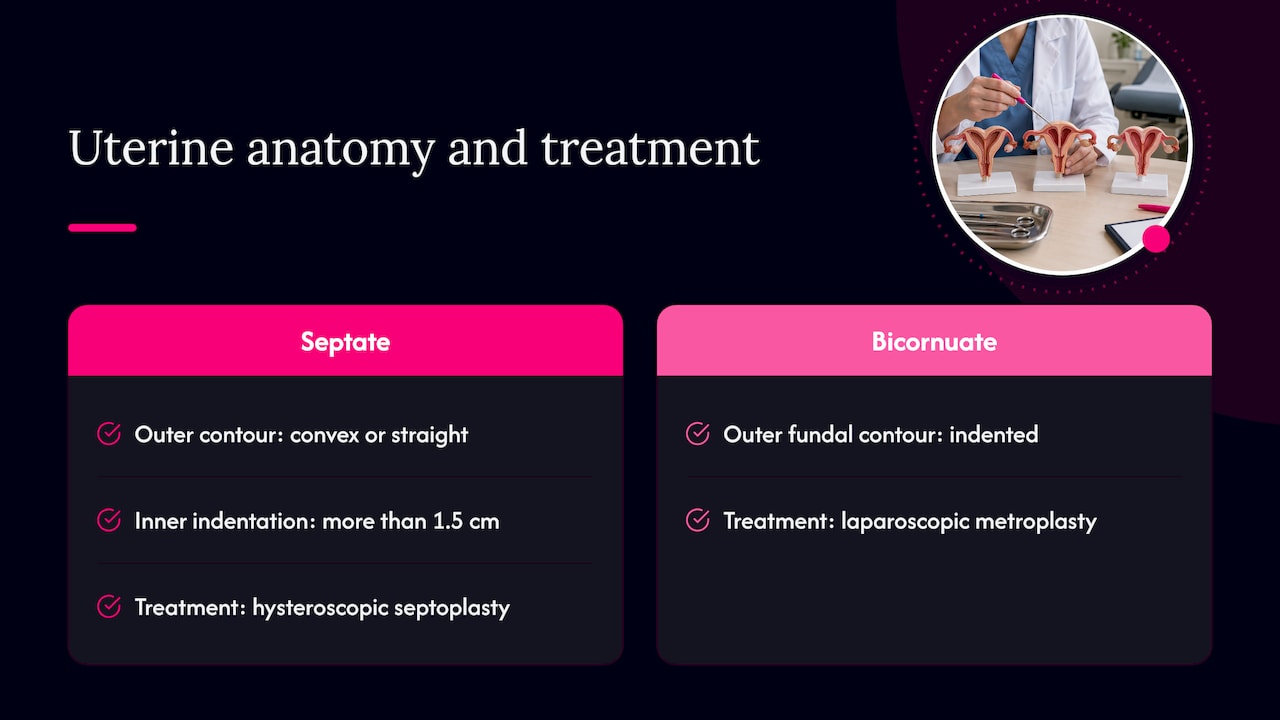
These terms are often mixed up, and the difference matters because the treatment differs. A 2025 Insights into Imaging review of Müllerian anomalies explains that a bicornuate uterus has an indented outer fundal contour, while a septate uterus has a convex or straight outer contour with an internal indentation of more than 1.5 cm (the ASRM criterion). A septate uterus is treated with hysteroscopic septoplasty, a procedure done through the cervix. A bicornuate uterus is treated by laparoscopic metroplasty, a more involved operation.
“Heart-shaped” is a description of how the cavity looks on imaging, not a diagnosis. It can describe either condition, so the label alone tells you very little. You need imaging that shows both the inside and the outside of the uterus.
Does a septum cause infertility?
The honest answer is: possibly in some women, and the evidence is not settled. Several findings point in different directions.
- A 2022 review of uterine septum and reproductive outcome reports a septate uterus in 3% of infertile women, 5.3% of women with miscarriages and 15.4% of women who have both miscarriage and infertility.
- The same review cites a meta-analysis showing slightly decreased spontaneous pregnancy (relative risk 0.86, 95% CI 0.77 to 0.96), so the effect on conceiving on your own appears modest.
- Tissue in the septum has fewer glandular cells and cilia and a reduced blood supply, which may make it a poor place for an embryo to implant, according to that review.
- Some people with a septum conceive and deliver without difficulty, as the authors of a 2021 meta-analysis on hysteroscopic septum resection note.
In practice, this means a septum is one factor among several. For a 29-year-old with regular cycles and a normal partner evaluation, it may not be the main issue. For a 38-year-old with diminished ovarian reserve, or someone who has had two losses, it deserves a closer look because every cycle counts.
How a septum affects pregnancy
The stronger evidence concerns what happens after conception. The ASRM 2024 guideline cites a meta-analysis in which pregnant patients with a septate uterus had higher odds of:
| Outcome | Odds ratio compared with controls | 95% confidence interval |
|---|---|---|
| Preterm birth | 4.06 | 2.89 to 5.70 |
| Malpresentation (baby not head-down) | 13.76 | 5.52 to 34.32 |
| Cesarean delivery | 5.19 | 1.84 to 14.62 |
| Fetal growth restriction | 2.99 | 1.19 to 7.51 |
| Placental abruption | 10.70 | 4.01 to 28.53 |
Source: ASRM guideline on evidence-based diagnosis and treatment for uterine septum, 2024. An odds ratio above 1 means the outcome is more likely than in women with a typical uterus. These are group averages, not a prediction for your own pregnancy.
When miscarriages happen
Most losses linked to a septum happen early. The ASRM guideline cites a prospective study in which 42% of reported pregnancies in 29 women with a septate uterus ended in first-trimester miscarriage, compared with 12% in women without an anomaly. Second-trimester losses were similar in both groups (3.6% and 3.5%). If you have had repeated early losses and no other explanation has been found, the shape of the uterus is a reasonable thing to check.
How a septum is diagnosed
Many women first hear about a possible septum after a hysterosalpingogram (HSG), an X-ray test in which dye is passed through the uterus and tubes. HSG can suggest that the uterus is an unusual shape, but the ASRM guideline notes it has low accuracy for telling a septate from a bicornuate uterus. A suggestion on HSG is a reason for a better test, not a final diagnosis.
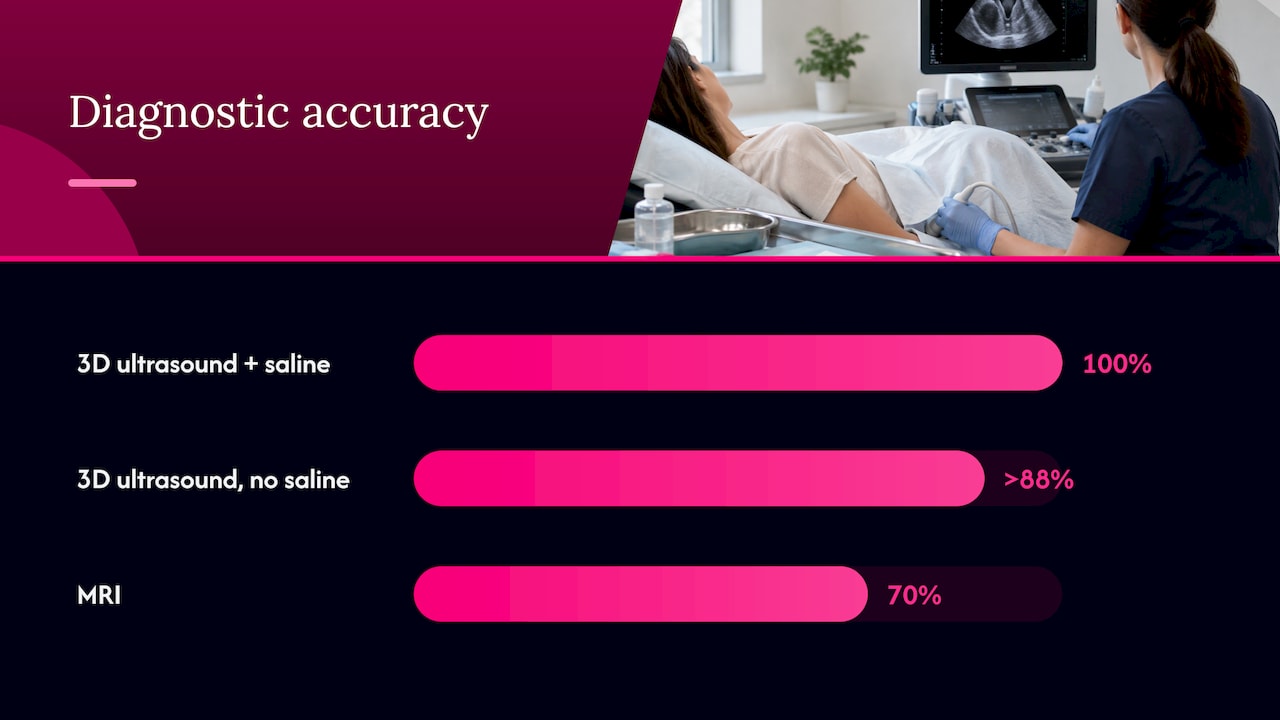
ASRM recommends 3D transvaginal ultrasound, with or without saline infusion as the first-line noninvasive test. In a 117-patient study it had 100% accuracy with saline compared with laparoscopy and hysteroscopy, and over 88% accuracy without saline in three studies. MRI is accurate overall but was only 70% accurate for septum in one study, so it is usually kept for unclear cases.
A 2026 review of modern hysteroscopic management describes how 3D imaging shows the outer contour and the inner cavity at once, allowing measurement of indentation depth, angle, cavity width and the thickness of the muscle beneath the septum. Those measurements help classify the septum and plan any treatment.
Tests that fit into a pre-IVF evaluation
A septum is rarely the only thing worth checking. A complete pre-IVF workup also looks at the tubes, the lining, genetics and the male partner. Published prices at Life IVF Center for relevant tests include:
- Saline Infusion Sonohysterogram (SIS): $450
- Endometrial Receptivity Assay (ERA): $975
- Karyotype Chromosomal Analysis: $595
- Carrier Screening for Genetic Disease: $349
- Sperm Count: $185
The full list is on our pre-IVF pricing page. Evaluating the male partner at the same time matters, because a uterine finding rarely explains everything. Questions about nutrients and sperm health are common, and a review of CoQ10 and male fertility evidence is one place to read about that topic before you discuss it with your care team.
When surgery is considered
The surgery for a septum is hysteroscopic septum incision (also called resection or septoplasty). A thin camera is passed through the cervix and the septum is cut away, with no abdominal incision. The ASRM 2024 guideline, which replaces its 2016 version, gives guidance that depends on your situation:
- Recurrent miscarriage with a septum: ASRM recommends offering hysteroscopic incision, in a shared decision-making model, meaning you and your physician weigh the options together.
- Infertility or fertility treatment with a septum: resection may or may not increase live births, and it may be offered through shared decision-making.
- A septum found incidentally, with no attempt at conception yet: there is insufficient evidence to recommend resection.
- After surgery: the guideline suggests resuming fertility treatment 1 to 2 months later, and not repeating surgery for a residual septum under 1 cm.
What the studies show about results
The research on outcomes is genuinely mixed, and it helps to see why.
- A November 2025 Cochrane-style review of septum resection found one randomized trial of 79 participants. It showed little to no difference in live birth between resection and expectant management (odds ratio 0.83, 95% CI 0.32 to 2.11), with low-certainty evidence.
- A July 2024 meta-analysis in Frontiers in Endocrinology of 468 patients also found no improvement in live birth rate (relative risk 0.84, 95% CI 0.56 to 1.25).
- A meta-analysis of hysteroscopic metroplasty covering 1,589 patients found miscarriage odds were roughly halved (pooled odds ratio 0.45), with fewer preterm births after partial resection and fewer malpresentations.
- The 2021 meta-analysis on hysteroscopic resection likewise found a lower miscarriage rate (odds ratio 0.25) and fewer malpresentations after resection.
- A 2025 retrospective cohort study of infertile women in Iran reported a clinical pregnancy rate of 42.8% and a live birth rate of 36.7% after resection. It is a single-center study without a comparison group.
The pattern across these studies is that resection appears to help most with miscarriage and fetal position, and that its effect on live birth is harder to prove because the randomized trials are small. That is exactly why ASRM frames the choice as a shared decision and why your own history, especially prior losses, should drive it.
Surgery also carries risks. In the Cochrane-style review above, two complications occurred among 39 resections: one uterine perforation and one residual septum. Discuss these openly with your surgeon, along with anesthesia and recovery.
Who should think about a septum first
You do not need to worry about a septum because of a general fertility concern. It is worth investigating if any of these describe you:
- You have had two or more miscarriages, particularly in the first trimester.
- You have had a preterm delivery or a baby in a breech or transverse position without another explanation.
- An HSG or ultrasound suggested an unusual uterine shape.
- You are about to start IVF and want the uterine cavity assessed before transferring an embryo.
- You have been told previously that you have an arcuate, heart-shaped or bicornuate uterus and are unsure which it is.
The last point is common in second-opinion cases. A vague label from an earlier scan can lead to the wrong treatment or no treatment, so clarifying the anatomy is worth doing before any further cycle.
A septum and IVF
IVF bypasses the tubes and many of the barriers to fertilization, but it does not change the uterus the embryo has to implant in. For people having IVF, the questions are usually about timing: whether to correct the septum first, how long to wait after surgery, and whether to transfer an embryo in the same cycle that you would otherwise have used.
If an embryo transfer is part of your plan, our published price for Embryo Transfer starts at $2,950, and The Advanced IVF Package is listed at $13,500. Freezing embryos is also an option when surgery or recovery has to come before a transfer: Precision Embryo Freezing is listed at $8,950 and Precision Egg Freezing at $7,500, with storage at $750 per year, $70 per month or $2,000 for three years prepaid, all on our freezing pricing and storage pages. Freezing lets you separate the egg or embryo stage from the uterine stage of treatment, so each can be done at the right time.
When the uterus is not the right place
For a few people, repeated loss or a complex anatomy that has not responded to treatment leads to a different conversation. Gestational surrogacy, where another woman carries an embryo created from your eggs or from donor eggs, is a path some patients consider. We support patients through donor and surrogacy pathways, and it is a decision to make once you have a clear diagnosis and have talked through the alternatives.
Questions to ask at your consultation
A focused list makes a consultation more productive:
- Which imaging was used to diagnose my uterine shape, and was it 3D ultrasound?
- Is the septum partial or complete, and how long is it?
- Given my history, do you recommend resection, and what does the evidence say for someone like me?
- How long should I wait after surgery before a transfer or an attempt at conception?
- What else in my evaluation (ovarian reserve, tubes, sperm, genetics) could be limiting my chances?
Why a personalized plan matters
The research above shows that averages hide a lot. A septum that matters greatly to one woman may matter little to another. That is the reasoning behind Precision IVF®, our approach that tailors the treatment protocol to each patient’s biological profile, medical history and goals, with the aim of reducing the number of trial cycles. For a patient with a uterine anomaly, that means the anatomy is considered alongside age, ovarian reserve and previous results and not treated as a stand-alone item. We also welcome second-opinion cases and patients who feel they have been turned away elsewhere.
Our perspective
A uterine septum is one of the more hopeful findings in a fertility evaluation, because it is an anatomical factor that can be identified and discussed openly. The published evidence is not uniform, and we think patients deserve to hear that plainly: resection looks most useful for pregnancy loss, and the decision for infertility alone is individual.
What we focus on is putting the septum in context. A precise diagnosis, a complete evaluation of both partners and a treatment plan written for your biology save time, especially when age is a factor. Our in-house laboratories and Precision IVF® approach exist so that each decision about your cycle rests on your own results.
If your history is complicated, we want to hear it. Patients come to us for second opinions, with prior losses, with a diagnosis they do not fully understand, or after being told there were no options. We will review it with you and explain each step and its cost before you commit.
Take the next step
If you have a suspected or confirmed uterine septum, or recurrent losses with no explanation, a consultation with Life IVF Center is the place to organize a plan. We publish our prices, support patients traveling from other cities, and offer multi-language support and financial guidance. See our treatment packages and published prices or learn more about Precision IVF®.
You can also review our care and services overview, which covers genetic testing and intrauterine insemination (IUI), to see which services fit your situation.
FAQ
Can a septate uterus cause infertility?
It may in some women, but the evidence is not conclusive. ASRM states that evidence is insufficient to recommend on an association between a septate uterus and infertility. The better-documented link is with miscarriage and pregnancy complications such as preterm birth.
What does it mean if my uterus is subseptate?
It means a band of tissue extends down from the top of the uterus but does not reach the cervix. It is often found without any symptoms. A 3D ultrasound can confirm its size and show whether it is relevant to your pregnancy history.
When do most miscarriages occur with a septum?
Most occur in the first trimester. In a study cited by the ASRM guideline, 42% of pregnancies in women with a septate uterus ended in first-trimester loss, compared with 12% in women without an anomaly. Second-trimester loss rates were similar between the groups.
Is a uterine septum the same as a heart-shaped uterus?
No. “Heart-shaped” describes how the cavity looks on imaging and can apply to a septate or a bicornuate uterus. They are told apart by the outer contour of the uterus, and they are treated differently, so imaging that shows both the inside and outside is important.
Do I need surgery if I have a septum and want to conceive?
Not always. ASRM recommends offering hysteroscopic incision after recurrent miscarriage, and says it may be offered for infertility through shared decision-making. There is insufficient evidence to recommend surgery for someone who has not yet tried to conceive.
Sources
- Uterine Septum and Reproductive Outcome: From Diagnosis to Treatment, 2022 Review
- Does Hysteroscopic Resection of Uterine Septum Improve Reproductive Outcome? 2021 Meta-Analysis
- NCBI MedGen: Partial Septate Uterus
- Müllerian Anomalies: Revisiting Imaging and Classification, Insights into Imaging 2025
- Modern Hysteroscopic Management of Congenital Uterine Anomalies, 2026 Review
- Septum Resection for Women of Reproductive Age: Cochrane-Style Review, 2025
- Frontiers in Endocrinology: Does Septum Resection Improve Reproductive Outcomes? 2024 Meta-Analysis
- Effect of Hysteroscopic Metroplasty on Reproductive Outcomes: Meta-Analysis
- Reproductive Outcomes Following Hysteroscopic Uterine Septum Resection, BMC Pregnancy and Childbirth 2025
- CoQ10 and Male Fertility: The Evidence
This article is for general educational purposes only and is not a substitute for personalized medical advice, diagnosis, or treatment. Fertility care is highly individual; please consult a qualified healthcare professional about your specific circumstances.
Ready to take the next step?
Life IVF Center specializes in individualized Precision IVF® care for complex cases—including diminished ovarian reserve, prior failed cycles, and advanced maternal age. Our in-house labs and dedicated physicians are ready to help.
Book a Free Consultation →