

Fertility grants are gift-based funds from nonprofits that pay part of the cost of treatment such as IVF, IUI, egg freezing, donor care or surrogacy. They are not loans, and most are paid directly to your clinic. Awards are usually a fraction of the total bill, and every program has its own rules on residency, income, diagnosis and timing. The strongest applications start with a clear treatment plan and a transparent price list. At Life IVF Center, we publish the prices of our treatment packages, so you can show a grant committee exactly what you are asking it to fund.
TL;DR
- Most US fertility grants range from about $5,000 to $20,000, are paid to the clinic, and cover only treatment that starts after the award.
- Eligibility varies widely: residency, household income, diagnosis, insurance status, faith or cancer history can all decide whether you qualify.
- Many programs have a small application fee, a limited number of lifetime applications and fixed cycles, so apply once, carefully, with a written treatment plan.
- Do not begin a cycle before you are awarded: nearly all programs refuse to reimburse treatment already started.
- A clinic with published pricing makes it easier to match a grant to a specific package.
Table of Contents
- What a fertility grant is, and what it is not
- Grant programs and what they fund
- Who qualifies: the questions committees ask
- How to apply, step by step
- Timing: do not start the cycle too early
- What a grant leaves uncovered
- Before you rely on a grant
- Perspective: why a clear plan and clear pricing improve a grant request
- How Life IVF Center can help
- FAQ
- Sources
What a fertility grant is, and what it is not
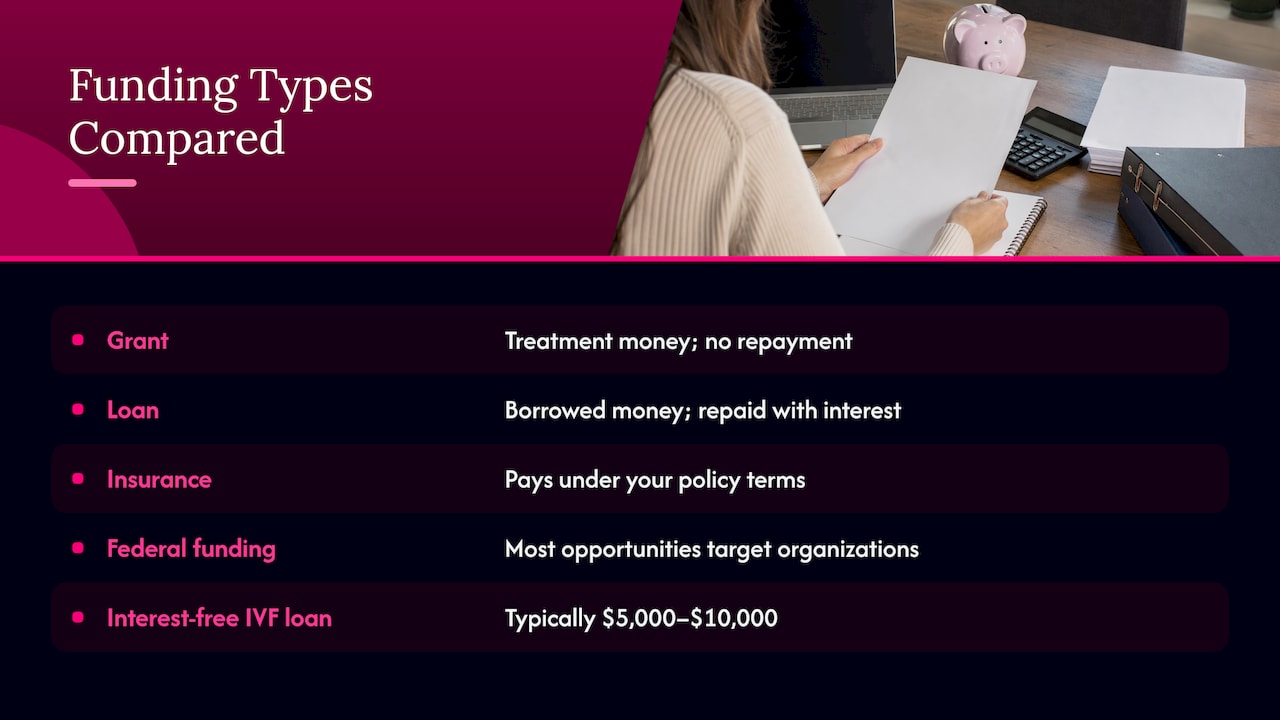
A fertility grant is money given to you for treatment with no repayment. A loan is borrowed money you pay back with interest. A few organizations blend the two: one national program offers grants and interest-free loans for IVF and related expenses, typically between $5,000 and $10,000.
A grant is also different from insurance. Insurance pays under the terms of your policy. A grant is a charitable award that usually applies to what remains after insurance. One program states that applicants with insurance must bill it first, and the grant applies to remaining costs. Majority coverage can disqualify you.
It also helps to know that federal grant money is not a realistic route for personal medical bills. According to Grants.gov’s grant eligibility page, individuals may apply for opportunities open to individuals, but most federal funding opportunities are meant for organizations. Fertility grants come from private nonprofits.
Grant programs and what they fund
The programs below are national or regional examples. Each one publishes its own criteria, so read the current page before you apply.
| Program type | Typical award | What it covers | Key conditions |
|---|---|---|---|
| Quarterly national grant | Up to $20,000 per family | IVF, IUI, surrogacy, adoption | U.S. resident, 21 or older, licensed provider’s treatment plan, one application per quarter |
| National IVF and donor grant | Varies by program | Egg and sperm donation, egg freezing, IVF, embryo donation, gestational surrogacy | Permanent U.S. residency, accredited U.S. fertility facility, $75 fee, up to 2 applications |
| Infertility foundation grant | Up to $15,000 | IVF, IUI, cryopreservation, cycle medications, embryo testing, donor material | Both partners legal U.S. residents, household income $150,000 or less |
| Family building grant | Up to $10,000 | Family building treatment | Main cycle in April, second cycle in November and December |
| Regional New England grant | Varies | IVF and related treatment | Residents of Maine, Massachusetts, New Hampshire or Rhode Island, household income under $200,000, $25 fee |
| Faith-based grants | Up to $15,000 (core grant) | IVF, IUI, donor materials, surrogacy | Jewish individuals and couples in NY, NJ and CT, quarterly cycle |
| Cancer fertility preservation | Varies | Egg freezing | Women 18 to 40 with a new cancer diagnosis, listed states, income limits |
Grants for fertility preservation
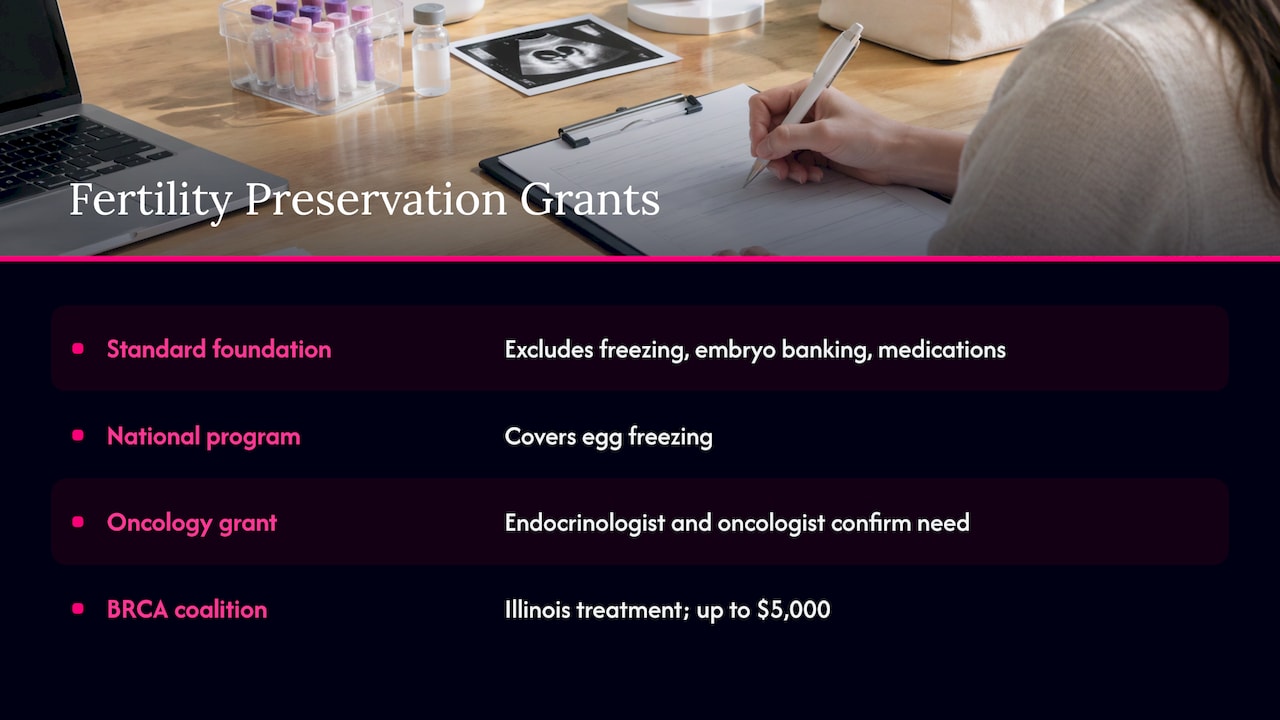
If you are interested in freezing eggs or embryos, check the exclusions before you plan around a grant. One foundation’s standard grant excludes egg freezing, embryo banking and fertility medications, offering medication discounts instead. Others do fund it: one national program lists egg freezing among its covered treatments, and oncology-focused grants support women newly diagnosed with cancer. One of those requires that both a reproductive endocrinologist and an oncologist confirm fertility preservation is medically appropriate. Its grants do not cover medication, and the clinic is paid on the final invoice.
Some state programs are narrower still. A coalition grant for BRCA1 and BRCA2 carriers provides up to $5,000 for PGT-M/IVF-PGT or egg freezing, for Illinois residents treated in Illinois, reviewed year-round.
Grants for donor care and gestational surrogacy
Donor egg, donor sperm and surrogacy journeys cost more and carry more steps, so check the program’s wording. Some funders cover donor material directly, and a few have separate surrogacy programs. One surrogacy track requires that applicants have paid the initial installment, be matched with a surrogate, and show combined income under $500,000 annually. Ask yourself where you are in the process and whether you would be eligible yet.
Who qualifies: the questions committees ask
Grant committees look for the same handful of factors. Review each before you pay an application fee.
- Residency. Many require U.S. residency or permanent residency. Regional programs require you to live in specific states.
- Income. Ceilings range widely. Examples include $150,000 or less, under $200,000, and for the cancer program below $150,000 single or $200,000 married.
- Diagnosis. A formal infertility diagnosis is often required, with exceptions for same-sex couples, single applicants or a recent cancer diagnosis.
- Insurance. Some programs ask for basic health insurance but not fertility coverage. Others want you to bill insurance first.
- Stability. One national program asks for adequate living arrangements, at least one partner employed and no other charity financial aid.
- Community or faith. Some funders serve specific communities, such as the Jewish Fertility Foundation, which asks for at least one Jewish parent and treatment at a partner clinic.
- Family structure. Programs vary. At least one national grant is open to singles and couples, same-sex and heterosexual, and another is open to all individuals over 18 regardless of gender, marital status or sexual orientation.
If you are a woman over 35 or have a complex history such as diminished ovarian reserve, endometriosis or an immune disorder, a physician’s documentation matters. Some committees assess whether a candidate has a reasonable likelihood of success. One says it uses a healthcare review committee for this purpose and requires full Jewish genetic screening. Another may decline applicants without a reasonable likelihood of success or financial stability. A written, individualized treatment plan from your clinic is the strongest supporting document you can bring.
How to apply, step by step
- Get a diagnosis and a plan first. Most programs want a licensed provider’s treatment plan. Ours begins with a reproductive health evaluation built around your own biology and history, which is the basis of our Precision IVF® approach.
- Price the plan. A grant committee wants a specific figure. Published prices help you request the right amount. Our treatment package pricing lists the Advanced IVF Package at $13,500 and embryo transfer from $2,950.
- Shortlist programs you meet on residency, income and diagnosis. Do not pay fees for programs you cannot qualify for. Fees are usually modest, such as $75 per application with up to two applications or a $25 nonrefundable fee.
- Gather documents. Expect medical records, lab results, income documentation and a treatment plan. Programs that require testing may refuse applicants who do not complete it within set timeframes, and one requires testing completed within 12 months.
- Apply within the cycle. Cycles run quarterly, annually or twice a year, so build your timeline around them. Check each organization’s page for the current deadline, since dates change every year.
- Confirm the payment route. Many grants are paid directly to the clinic, so your clinic needs to be able to accept it. Some programs also require an accredited facility or an onboarded partner clinic.
- Start treatment only after the award. Grants generally apply only to treatment that begins on or after the award date.
Timing: do not start the cycle too early
The most expensive mistake is starting treatment before the funds are approved. One national program does not reimburse treatment already begun, and another states that its funds cover only future services and payments. IVF and embryo transfer applicants there must also intend to transfer an embryo within one year.
Cycles are usually fixed. A national quarterly program accepts one application per person each quarter and posts results some weeks after each closing date. A family-building program runs a main round in April, timed to National Infertility Awareness Week, and a second round in November and December. A foundation for Jewish applicants reviews quarterly. If you are over 35 and time matters medically, ask your physician how long you can reasonably wait for a decision, and consider combining a grant with other planning rather than waiting on a single round.
What a grant leaves uncovered
Grants rarely pay everything. A typical award of $5,000 to $20,000 can sit next to a package price of many thousands more, plus testing, medication and storage. Some awards exclude medications altogether. Build a full budget with these line items:
- Pre-IVF testing. Our pre-IVF testing prices list carrier screening at $349, a karyotype at $595, a saline infusion sonohysterogram at $450 and an endometrial receptivity assay at $975.
- Freezing. Precision Egg Freezing is $7,500 and Precision Embryo Freezing is $8,950.
- Storage. Annual storage is $750 per year, monthly storage is $70 per month, and a 3 year prepaid option is $2,000.
- Medication, monitoring and any donor or surrogacy costs, which depend on your plan.
Those figures are published prices from our site and may be updated, so confirm them on the linked pages when you plan.
Before you rely on a grant
Run through this list before you count on the money:
- Does the program fund your exact treatment, whether IVF, IUI, freezing, donor or surrogacy?
- Do your residency, income and insurance status fit the stated limits?
- Is your clinic eligible, for example accredited, a partner or onboarded?
- Does the award cover medication, or only procedures?
- Is a decision due before your planned start date?
- How many applications can you submit, and what are the fees?
If any answer is unclear, the program’s own page or administrator is the place to confirm it. Your clinic’s financial coordinator can help you fit what you learn to your treatment plan.
Perspective: why a clear plan and clear pricing improve a grant request
Grants are competitive, and committees fund what they can understand. In our experience of how patients plan care, the applicants best prepared are those who can state a diagnosis, a recommended protocol and a total cost.
That is the thinking behind Precision IVF®. Our approach builds each treatment plan around the patient’s biological profile, medical history and goals, with the aim of reducing trial cycles. A plan written that specifically is easier to present to a funder than a generic estimate.
We also welcome second-opinion cases and patients with complex histories, including diminished ovarian reserve, endometriosis, advanced age and immune disorders. Our in-house labs, transparent pricing and travel-friendly logistics are meant to let you focus on the decision, not the paperwork. We also provide financial guidance, so you can match a grant award to the right package.
How Life IVF Center can help
We offer Precision IVF®, IUI, genetic testing, egg and embryo freezing, and donor egg and sperm programs, along with gestational surrogacy support across multiple Southern California locations. Our team also provides multi-language support, travel coordination and financial guidance. See our treatment packages and prices to size a grant request, or visit Life IVF Center to book a consultation and start your plan.
FAQ
Can I use a fertility grant for egg freezing?
Some programs do. One national foundation lists egg freezing among its covered treatments, and cancer-focused programs fund it for newly diagnosed patients. Others exclude it, so read each program’s covered services first.
Do I need to be married to get a fertility grant?
Not always. At least one national grant is open to singles and couples, same-sex and heterosexual, and another is open to all adults over 18 regardless of marital status. Other programs add their own conditions, so check each one.
Can a grant reimburse a cycle I already completed?
Generally no. Programs describe their funds as applying only to treatment that begins on or after the award date. Wait for the decision before starting a cycle that you want a grant to fund.
Will my income disqualify me?
It can. Published ceilings include $150,000 and $200,000 for household income, and one surrogacy track uses $500,000 combined. Check the current limit on each program’s page.
Sources
- Grant Program | Gift of Parenthood
- Applying for a Grant | BabyQuest Foundation
- Jewish Fertility Grants for IVF, IUI & FET | JFF
- Hope Grant Program | The Chick Mission
- Fertility & IVF Grants | BIVF Foundation
- Frequently Asked Questions | Hasidah
- About Our Grants | Stardust Fertility Foundation
- Frequently Asked Questions | The Stork Foundation
- Family Building Grant | The Coalition for Family Building
- Grant Eligibility | Grants.gov
This article is for general educational purposes only and is not a substitute for personalized medical advice, diagnosis, or treatment. Fertility care is highly individual; please consult a qualified healthcare professional about your specific circumstances.
Ready to take the next step?
Life IVF Center specializes in individualized Precision IVF® care for complex cases—including diminished ovarian reserve, prior failed cycles, and advanced maternal age. Our in-house labs and dedicated physicians are ready to help.
Book a Free Consultation →