
In the United States, preimplantation genetic testing (PGT) for chromosome counts (PGT-A) typically adds about $5,000 to an IVF cycle, according to FertilityIQ’s cost guide for PGT-A. That is a planning figure, not a quote. The final amount depends on how many embryos are biopsied, which laboratory your clinic uses and whether the clinic bills the biopsy and the lab analysis separately. Insurance rarely pays for it, so it usually comes out of pocket on top of the cycle itself. At Life IVF Center, we publish prices for many of the tests that surround an IVF cycle, and we walk patients through the testing budget before a cycle starts.
TL;DR
- PGT-A is commonly estimated at about $5,000 per IVF cycle in the US, usually split roughly in half between the clinic’s biopsy and an outside laboratory’s analysis.
- Another U.S. cost analysis puts PGT-A at $4,800 to $6,000 as a separate add-on, and says the choice of laboratory can change the price.
- PGT-A is seldom reimbursed, and is almost always excluded even when a plan covers IVF.
- The fee is worth weighing against your age, your number of embryos and what each additional transfer would cost you.
- Ask for an itemized quote that lists the biopsy fee, the laboratory fee, per-embryo charges, any retesting charge and storage.
Table of Contents
- What PGT is, in plain terms
- How much PGT costs in the United States
- What a PGT quote includes, and what can push it higher
- The surrounding costs: where the PGT fee sits in a full budget
- Does insurance pay for PGT?
- Is PGT worth the money? A way to weigh it
- How to build your PGT budget in five steps
- Where Life IVF Center fits
- Our perspective on PGT cost
- FAQ
- Sources
What PGT is, in plain terms
Preimplantation genetic testing means checking an embryo’s genetic material before it is transferred to the uterus. There are three main types:
- PGT-A (aneuploidy) counts chromosomes. An embryo with the wrong number of chromosomes is less likely to implant or may end in miscarriage. The American Society for Reproductive Medicine (ASRM) describes the main focus of testing as analysis of all 24 chromosomes so that only chromosomally normal (euploid) embryos are transferred, in its 2024 committee opinion on PGT-A.
- PGT-M (monogenic) looks for a specific inherited condition that you or your partner carry, such as cystic fibrosis.
- PGT-SR (structural rearrangements) checks for chromosome pieces that are swapped or moved, which can happen when a parent carries a rearrangement.
All three need an embryo biopsy. ASRM’s 2022 laboratory committee opinion states that biopsy is required for PGT-A, PGT-M and PGT-SR. A few cells are taken from the outer layer of a blastocyst (an embryo that has grown for about five to seven days), and those cells are sent for analysis. The same opinion notes that blastocyst biopsy has essentially replaced earlier-stage biopsy, in part because it removes a smaller proportion of the embryo’s cells.
That biopsy step is why PGT has a price at all: it involves skilled embryology work in the lab, and then a separate genetic analysis.
How much PGT costs in the United States
Published U.S. estimates cluster in a fairly narrow band, but the range you see online is wider because some pages quote per-embryo fees and others quote a whole cycle.
| Source | Estimate | What it covers |
|---|---|---|
| Costs of PGT-A, FertilityIQ | About $5,000 per IVF cycle | About $2,500 for the clinic’s biopsy and about $2,500 for reference-laboratory analysis and reporting |
| The Cost of IVF by City, FertilityIQ | $4,800 to $6,000 | PGT-A as a separate add-on to the IVF cycle |
The first guide is undated, and costs change, so treat both as a starting point for your own quote. If you search for “PGT cost” you will also see much wider ranges, from roughly $3,000 to well over $10,000. Those wider numbers usually reflect clinics that charge per embryo, cycles that produce many embryos, or packages that bundle other services. A single headline figure rarely tells you what is in the quote.
PGT-A, PGT-M and PGT-SR are not priced the same
The published estimates above are for PGT-A, the most common type. PGT-M and PGT-SR generally involve more laboratory work because the lab may need to build a test around the specific variant or rearrangement in your family. For that reason, a quote for either one should be requested directly and in writing. We do not publish a flat price for genetic testing, because the right test depends on your history; our genetic testing and IUI care page explains what is offered.
What a PGT quote includes, and what can push it higher
The single most useful thing to know is that a PGT charge often has two parts. FertilityIQ’s guide says patients generally pay the clinic for the biopsy and often pay a reference lab separately for testing the sample and issuing the report, with the two charges roughly equal in its estimate.
When you compare quotes, check for each of these:
- Biopsy fee. Is it per cycle, or per embryo? Does it cover every blastocyst that develops, or only up to a set number?
- Laboratory fee. Is it billed by the clinic or sent to you directly by the genetic lab? A bill that arrives separately is easy to miss in a budget.
- Per-embryo charges. A cycle that produces eight blastocysts can cost very differently from one that produces two, depending on the structure.
- No-result embryos. Occasionally the lab cannot read a sample. Ask whether retesting is included, what it costs and whether it requires a second biopsy. ASRM’s laboratory opinion treats a low no-result rate as an important quality measure for PGT laboratories, so it is fair to ask what your lab’s rate is.
- Freezing and storage. Embryos are biopsied and then usually frozen while results are pending, so the freezing and storage costs belong in the same budget.
- The transfer itself. Testing selects embryos. Transferring one is a separate procedure and a separate charge.
According to the same FertilityIQ guide, clinic workflows and laboratory compatibility can limit your ability to choose the reference lab. Where there is a choice, it considers comparing cost and services worthwhile.
The surrounding costs: where the PGT fee sits in a full budget
PGT looks different once you see it next to the rest of the bill. FertilityIQ’s PGT-A guide estimates it at 20% to 30% of overall treatment costs, using examples of IVF cycles at $18,000 to $23,000. A separate FertilityIQ page on the cost of IVF reported $22,000 per cycle as of 2019, and it stresses that this is an older figure and that treatment and medication together drive the total. The city cost analysis puts medical treatment (monitoring, egg retrieval, anesthesia, laboratory fees and transfer) at $8,000 to $14,000.
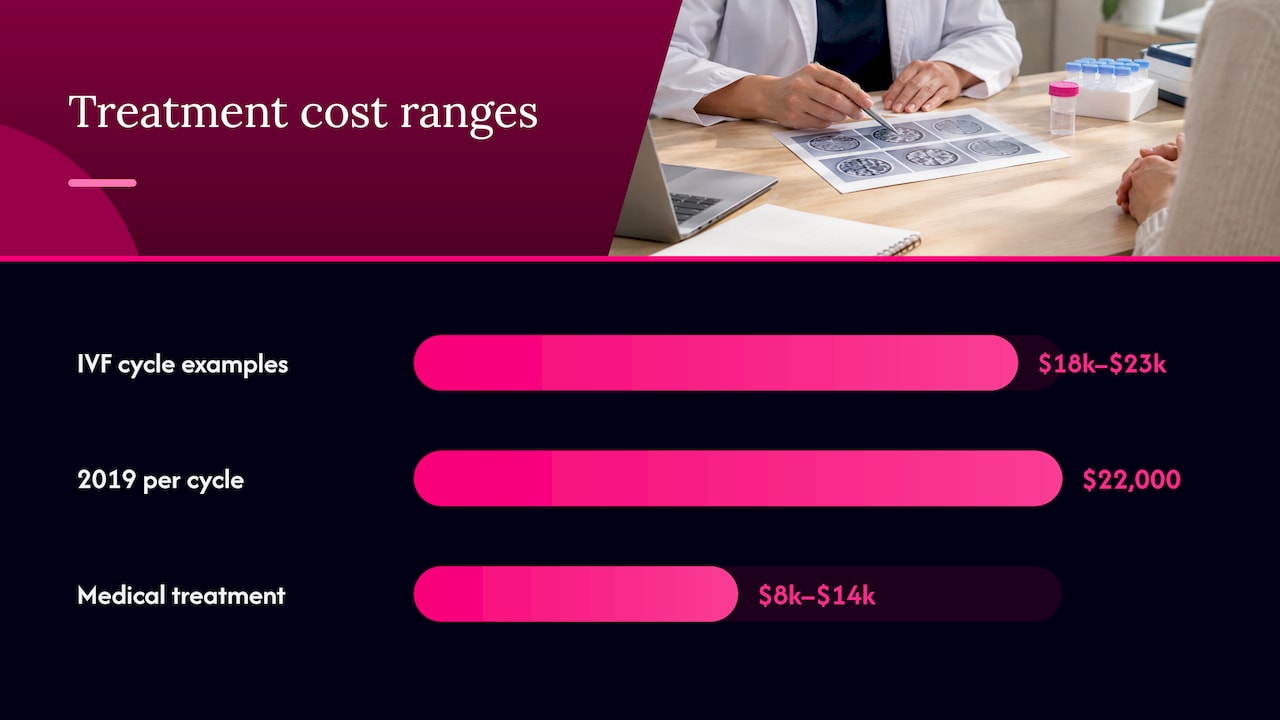
Those ranges show why quotes are hard to compare. One clinic’s price may include monitoring and the transfer; another’s may not include medication or testing at all. The only reliable way to compare is to build your own line-by-line list.
Here are the Life IVF Center published prices for items that often appear around a testing cycle, as listed on our site:
| Item | Published price |
|---|---|
| Advanced IVF Package | $13,500 |
| Embryo Transfer | from $2,950 |
| Precision Embryo Freezing | $8,950 |
| Annual embryo or egg storage | $750 per year |
| Monthly storage | $70 per month |
| 3 Year Prepaid storage | $2,000 |
| Carrier Screening for Genetic Disease | $349 |
| Karyotype Chromosomal Analysis | $595 |
| Endometrial Receptivity Assay (ERA) | $975 |
The full lists are on our treatment packages, freezing pricing, storage and pre-IVF testing pages. The tests on that last page are not embryo PGT. Carrier screening and karyotype analysis check the parents, and they are often what tells a couple whether PGT-M or PGT-SR is worth discussing at all.
Does insurance pay for PGT?
Usually not. FertilityIQ reports that PGT-A is seldom reimbursed and is almost always excluded, even when a patient’s insurance covers IVF. That means you should budget for PGT as an out-of-pocket cost unless your plan documents say otherwise in writing.
To find out where your plan stands, you can:
- Call the member services number on your card and ask about “preimplantation genetic testing” and about the specific procedure codes your clinic gives you.
- Ask your employer’s benefits administrator whether the plan is self-funded, since that affects which state mandates apply.
- Ask whether coverage differs for PGT-M, which targets a known inherited condition, compared with PGT-A. Plans sometimes treat these differently.
- Get any answer in writing, with the name of the person you spoke to and the date.
Our financial guidance team can help you sort out what your plan does and does not cover for your treatment. Coverage rules vary by plan and by state, so your insurer’s written answer is the one that counts.
Is PGT worth the money? A way to weigh it
The honest answer depends on you, and the published evidence frames it as a trade-off rather than a rule. FertilityIQ’s guide uses a theoretical example: if each additional embryo transfer costs $3,000, then two or three extra transfers would cost $3,000 to $6,000, which approaches the roughly $5,000 PGT-A fee. Testing would break even in that scenario if it spared you those extra transfers. It also notes that this example may not fit every patient, and that emotional considerations, storage costs and the availability of alternative labs belong in the decision.
FertilityIQ’s IVF cost page adds two points: PGT-A does not improve the odds that any given IVF cycle will work, but it describes a potential reduction in miscarriage for older patients and encouragement of single-embryo transfer. In other words, the value of testing lies in which embryo you transfer first and how many transfers it takes, not in producing more embryos.
A practical way to apply this:
- Estimate your transfer cost. Use your clinic’s actual fee. Our Embryo Transfer starts from $2,950, for example, so the $3,000 in the example above is in a realistic range.
- Count the likely embryos. If you expect only one or two blastocysts, a per-embryo biopsy and lab fee takes a larger share of the budget than if you expect several.
- Consider your history. Age over 35, previous miscarriages, a known inherited condition or a chromosome rearrangement are the situations in which people most often discuss testing with their specialist.
- Add the emotional cost. For some people, a miscarriage or a transfer that does not work carries a weight that a spreadsheet cannot capture. That is a legitimate part of the decision.
- Decide before the cycle, not during it. Biopsy happens at the blastocyst stage, so the choice, the lab and the price should be settled before retrieval.
ASRM’s 2024 committee opinion also states that PGT-A should not be used on the basis of male factor infertility alone, so a sperm result by itself is not a reason to add testing. If you want to look at that side of the picture, a sperm count at Life IVF Center is $185.
How to build your PGT budget in five steps
- Request an itemized written quote. Ask the clinic to separate biopsy, laboratory analysis, freezing, storage and transfer.
- Ask who bills the lab fee. Find out whether it comes through the clinic or directly from the genetic laboratory.
- Ask about retesting. Get the policy for no-result embryos in writing before you commit.
- Check insurance for the specific codes. Do not assume that IVF coverage includes testing.
- Plan storage. Frozen embryos carry an ongoing cost. Our storage runs $750 per year, $70 per month, or $2,000 for three years prepaid, so a longer horizon changes which option is cheapest.
Where Life IVF Center fits
If you are comparing testing options as part of a larger plan, you can see how our packages and pre-IVF testing are priced, and book a consultation to talk through whether PGT belongs in your cycle. We welcome second-opinion cases, including patients who have been told elsewhere that their options are limited.
Our treatment packages page lists the Advanced IVF Package at $13,500 and Embryo Transfer from $2,950, and our Precision IVF® approach builds each protocol around your own biology and history. Our team works with in-house labs, which gives us direct control over embryo handling from fertilization to freezing.
Our perspective on PGT cost
We think the most useful question is not “what does PGT cost?” but “what does PGT change for this patient’s plan?” A fee that is a small part of a well-chosen cycle can feel very large if it was never explained.
At Life IVF Center, our Precision IVF® approach starts with your biological profile and history. That is where a testing decision should begin too: age, ovarian reserve, previous losses, known genetic conditions and how many embryos are realistically expected.
We publish pricing for packages, freezing, storage and pre-IVF testing because patients tell us the hardest part of budgeting is the unknown line items. Our in-house labs give our team direct oversight of the embryology steps that precede any biopsy, and we welcome patients who bring a quote from elsewhere for a second look.
Testing, freezing, storage and transfer are connected costs. We believe they are best planned together, with one team, before the cycle starts.
FAQ
How much does PGT cost in the USA?
A commonly cited estimate for PGT-A is about $5,000 per IVF cycle, split between the clinic’s biopsy and a laboratory’s analysis. Another analysis puts it at $4,800 to $6,000 as a separate add-on. Your own quote may differ with the number of embryos and the laboratory used.
Does insurance pay for PGT-A?
Seldom. FertilityIQ reports that PGT-A is almost always excluded, even when a plan covers IVF. Ask your insurer in writing about the specific procedure codes, and ask separately about PGT-M if you carry a known inherited condition.
Is PGT embryo testing worth it?
It depends on your situation. Published analysis frames it as weighing a fee of about $5,000 against the possibility of fewer transfers or miscarriages, with age, embryo numbers and transfer costs all part of the calculation. Discuss it with your fertility specialist before the cycle begins.
How expensive is IVF in the United States?
FertilityIQ reported $22,000 per cycle as of 2019 and notes that medication and add-ons such as PGT-A can raise the total. Its city analysis puts medical treatment at $8,000 to $14,000 before medication. At Life IVF Center, the Advanced IVF Package is listed at $13,500.
Sources
This article is for general educational purposes only and is not a substitute for personalized medical advice, diagnosis, or treatment. Fertility care is highly individual; please consult a qualified healthcare professional about your specific circumstances.
Ready to take the next step?
Life IVF Center specializes in individualized Precision IVF® care for complex cases—including diminished ovarian reserve, prior failed cycles, and advanced maternal age. Our in-house labs and dedicated physicians are ready to help.
Book a Free Consultation →