
If you have a disability and want IVF, you are entitled to meaningful access to fertility care, and a clinic should be able to tell you in plain terms how it will provide it. In the United States, federal law treats fertility clinics as places of public accommodation, so they may not turn you away or treat you differently because of a disability. At Life IVF Center, treatment starts from your own biology and history through Precision IVF®, and that same individualized planning is the right frame for access: your needs belong in the treatment plan from the first consultation, not as an afterthought.
This guide explains what the barriers look like, which laws protect you, which accommodations to request, and how to raise a concern if a clinic falls short.
TL;DR
- The Americans with Disabilities Act (ADA) and Section 504 of the Rehabilitation Act require clinics to provide reasonable modifications and effective communication. A clinic may not charge you extra for them.
- In one national study, 69.0% of people with disabilities who sought reproductive care reported barriers in the previous three years, versus 43.0% of people without disabilities.
- Common requests: a height-adjustable exam table, interpreters or alternative-format materials, flexible scheduling, help with medications and injections, and a plan for travel and monitoring visits.
- Ask about access before you book, put requests in writing, and expect a specific answer for each one.
- If a clinic refuses or ignores a request, you can complain to the provider, to a state or federal agency, or in court. Some deadlines are short.
Table of Contents
- What barriers people with disabilities meet in IVF
- Your legal protections
- Accommodations to ask for
- How to request accommodations, step by step
- If a clinic does not meet your needs
- Cost and coverage
- Our perspective
- Start with a consultation
- FAQ
- Sources
What barriers people with disabilities meet in IVF
IVF is a demanding process for anyone. It involves frequent monitoring visits, daily medications, several procedures and a lot of paperwork. Each of these can be harder when a clinic has not planned for different bodies and ways of communicating.
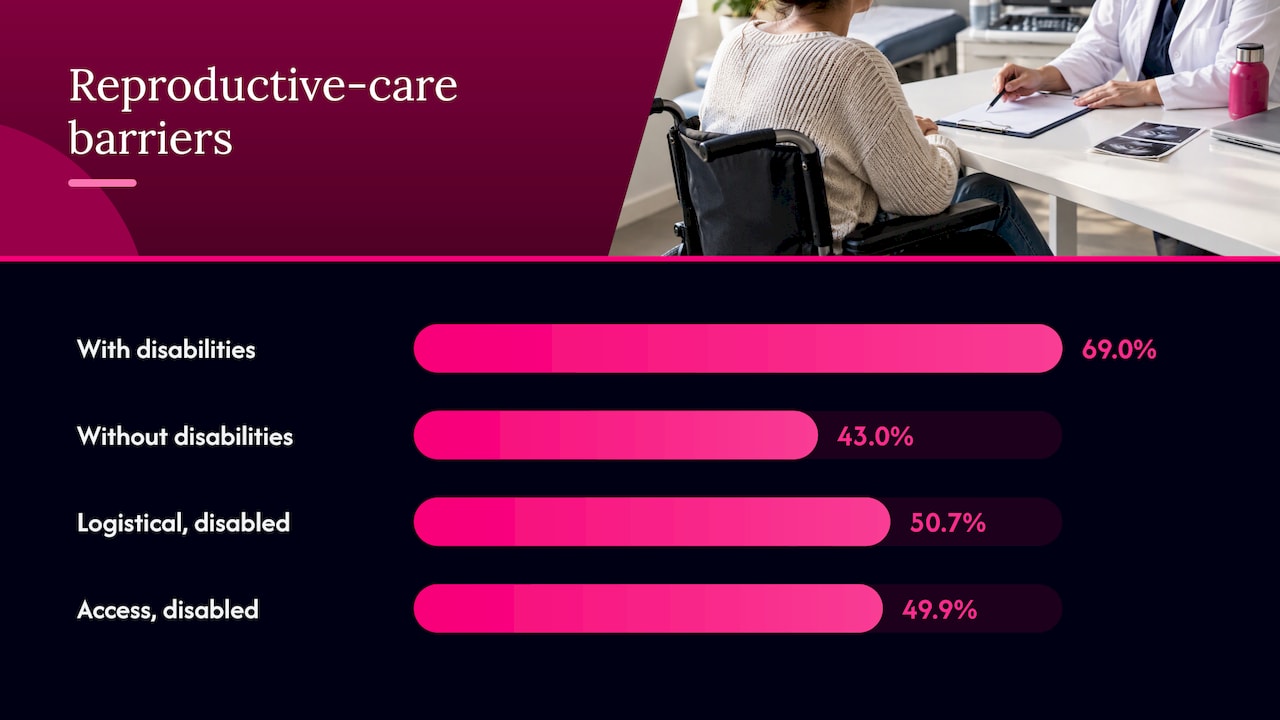
A 2023 national survey of 6,956 people assigned female at birth, published in JAMA Network Open, put numbers on this. Of those who tried to get reproductive health care, 69.0% of people with disabilities reported barriers in the past three years, compared with 43.0% of people without disabilities. The most common were logistical barriers (50.7%) and access barriers (49.9%). The same study found that people with disabilities were more likely to live below the federal poverty level (27.3% versus 10.7%) and to have experienced medical mistreatment (49.6% versus 36.5%).
A separate 2023 review of reproductive health and disability lists the practical causes: no accessible transportation, trouble scheduling care around those limits, referrals to places that are not accessible, inflexible office procedures, and workups that require many separate steps. It also describes assumptions some clinicians make about a disabled person’s sexuality, ability to consent or ability to parent.
The Autistic Self Advocacy Network’s guide to reproductive health care adds barriers that are specific to assisted reproduction: finding a fertility doctor nearby, traveling often and on short notice, taking many medications including self-administered shots (some of which can affect certain disabilities), the stress of treatment, and the high cost when insurance such as Medicaid does not cover it.
None of this means IVF is out of reach. It means the questions you ask a clinic matter, and you should expect specific answers.
Your legal protections
You do not have to rely on a clinic’s goodwill. Several federal laws apply.
The Americans with Disabilities Act
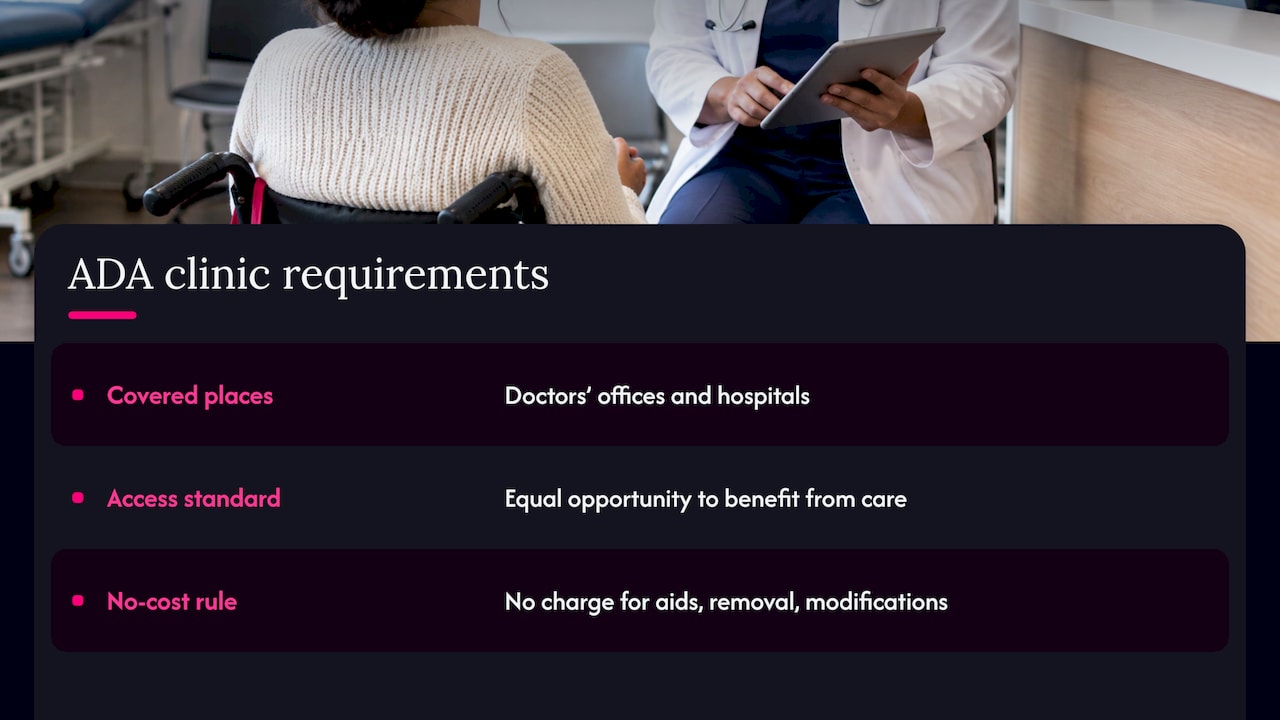
Title III of the ADA prohibits disability discrimination by businesses open to the public, and that includes doctors’ offices and hospitals. According to the AMA Journal of Ethics, the ADA requires clinics to provide meaningful access to their services for people with disabilities who meet the essential eligibility requirements, with or without accommodations. “Meaningful access” is a practical test: do you get an equal opportunity to benefit from the care, such as speech-output medication directions for a patient with a visual impairment or a sign language interpreter for a Deaf patient?
The same state guidance explains that a business may not charge you for the cost of an auxiliary aid, barrier removal or a reasonable modification. An interpreter or an alternative-format consent form should not appear as a line on your bill.
Section 504 and Section 1557
Section 504 of the Rehabilitation Act applies to programs that receive federal financial assistance. Section 1557 of the Affordable Care Act likewise bars discrimination in health programs that receive federal funds and requires reasonable modifications and effective communication, including aids such as sign language interpreters or written materials in alternative formats.
The U.S. Department of Health and Human Services has also adopted a rule under Section 504 on accessible medical equipment. Recipients that use exam tables must have at least one accessible table within two years of the rule’s effective date. The rule applies to recipients of HHS funding, so check the official fact sheet for how it applies to a particular practice and for current compliance dates.
Fertility services and stereotypes
The American Society for Reproductive Medicine’s patient fact sheet states that it is against the law to deny fertility services to a disabled person because of stereotypes or unproven doubts about their ability to care for a child. Services should be withheld only with good reason, after careful assessment by the clinical team. A treatment recommendation that rests on your medical picture is normal clinical practice. A refusal that rests on assumptions about disability is not.
What the law does not settle
Legal scholars note gaps. One 2025 Columbia Law Review article argues that the ADA has not been read to broadly cover people with unexpressed genetic indicators for disability, which can leave patients denied assisted reproduction on that basis with little recourse. If this affects you, a disability rights attorney is the right person to consult.
Accommodations to ask for
The law sets a floor. Accessibility standards for buildings do not cover every accommodation a person may need. The 2023 review by Fletcher and colleagues notes that the ADA Standards for Accessible Design do not guarantee things like height-adjustable exam tables for self-transfer, trained staff and communication accommodations, and that their absence can inhibit care and increase apprehension. So ask directly.
Physical access
- A height-adjustable exam table, so you can transfer from a wheelchair yourself or with the help you choose. The AMA Journal of Ethics describes the lack of lowering tables as a common problem that leaves wheelchair users with limited, substandard care.
- Step-free entry, accessible restrooms, accessible parking and enough room to maneuver in procedure and recovery areas.
- Assistance with positioning during ultrasounds, egg retrieval and embryo transfer, and a clear explanation of each step beforehand.
- Space and time for a service animal.
Communication
Brandeis University’s disability resource on reproductive care lists equally effective communication options such as sign language interpreters, captioning, videophones, readers, Braille and audio recordings. In IVF, this matters most for consent forms, medication schedules, trigger-shot timing and results. Clear, accessible patient communication is a topic in its own right, and these practical guidelines on effective communication with patients cover the principles that clinics apply when they choose interpreters and alternative formats.
Ask for every document you must sign in the format you can read, and ask how time-sensitive instructions, like the exact hour of an injection, will reach you.
Medications and monitoring
IVF stimulation usually means daily self-injected medication for a stretch of days, plus frequent ultrasound and blood-test visits. If hand dexterity, vision, pain, fatigue or a medication interaction makes this difficult, say so at the first visit. Useful questions:
- Can injection teaching be adapted to how I communicate and use my hands?
- Can a partner, aide or nurse be taught to give injections, and what is the plan if I need help?
- Will my current medications or my condition change the stimulation protocol?
- Can monitoring visits be scheduled to fit my transportation and energy?
- Who do I contact the same day if something goes wrong?
The medical questions in this list, especially about how your condition and medications interact with fertility drugs, belong with your own physician and the fertility team together.
Scheduling, travel and cost
Transportation and scheduling are among the barriers the research names. A study of insured women who stopped IVF after one cycle found that 47.4% suggested evening and weekend hours and 39.4% wanted easy access to a mental health professional. The same study found that treatment stress (40.2%) and out-of-pocket cost (25.1%) were leading reasons for stopping. Those are logistics and support questions, and you can ask about them before you commit.
If you would travel for care, ask how visits can be combined or consolidated. Life IVF Center offers travel coordination and multi-language support, and financial guidance for patients planning a cycle.
How to request accommodations, step by step
- List what you need. Write down physical, communication, medication and scheduling needs. Include what has gone wrong at past appointments.
- Ask before you book. Phone or message the clinic and ask who handles accommodation requests. Ask the same questions about the building and equipment every time, so you can compare answers.
- Put requests in writing. Email your list and keep the reply. If the clinic offers an online form, use it and save a copy.
- Ask for specifics. “We are accessible” is not an answer. A good answer names the equipment, the format or the person responsible.
- Confirm before each procedure. Retrieval and transfer involve different rooms, staff and equipment than routine monitoring visits. Confirm the plan a few days beforehand.
- Bring a support person if you want one. You decide who attends and what role they play.
- Note the response. If a request is refused, ask for the reason in writing.
A clinic’s website can also tell you something. Life IVF Center’s website includes accessibility features designed for people with disabilities, and information about treatments, consultations and patient support, so you can read before you call.
If a clinic does not meet your needs
You have several options, and they are not mutually exclusive. The California Attorney General’s guidance says patients can complain to the provider or plan, contact the entity’s ADA or Section 504 coordinator, file with state or federal agencies, or bring a private lawsuit, and that complaints may have strict timeframes. For Title III violations, you can file with the U.S. Department of Justice or bring a private lawsuit.
Because of those deadlines, speak with a disability rights organization or an attorney soon after an incident if you are considering a formal complaint.
A second opinion is also a normal step. If a clinic has told you that you are not a candidate, or that your history is too complex, you may want another team to review your records. Life IVF Center welcomes second-opinion cases and patients who have been turned away elsewhere.
Cost and coverage
Access is not only physical. The cost of IVF is a barrier for many patients, and the research notes that people with disabilities are more likely to live on low incomes. Coverage varies by plan and state, and Medicaid often does not cover assisted reproduction.
For veterans, VA policy changed in 2024. The VA announced it would expand IVF to eligible unmarried Veterans and Veterans in same-sex marriages, and allow donated sperm, eggs and embryos for the first time. Veterans must be unable to procreate without treatment because of a service-caused health condition. Check the VA page for the current rules and your eligibility.
When you compare clinics, look for published prices so you can plan. Life IVF Center publishes several of its fees, as of its site in September 2026:
| Service | Published price |
|---|---|
| Advanced IVF Package | $13,500 |
| Embryo Transfer | from $2,950 |
| Precision Egg Freezing | $7,500 |
| Precision Embryo Freezing | $8,950 |
| Annual storage | $750 per year |
| Pre-IVF tests such as carrier screening | $349 |
The pre-IVF page also lists the infectious disease panel ($550 to $750), the Sperm Count ($185), the Karyotype Chromosomal Analysis ($595), the saline infusion sonohysterogram ($450) and the endometrial receptivity assay ($975). Check each page for what a price includes.
Our perspective
Access to IVF should not depend on how easily your body fits a standard exam room. We think the best fertility care begins with the person: your biology, your history, your goals and the practical conditions that will make a treatment plan workable.
That is the idea behind Precision IVF®. We build each plan around the individual rather than a template, because patients with complex histories, advanced maternal age, endometriosis or immune disorders have long been told that standard protocols are all there is. The same reasoning applies to disability. A protocol that ignores how you will travel, communicate, take medication or recover is not individualized.
We welcome second-opinion cases and patients who have been turned away elsewhere, and we work with in-house labs so that more of the process stays under one team’s control. We also offer multi-language support, travel coordination and financial guidance, because logistics and cost decide whether treatment is actually reachable. We encourage you to tell us what you need at the start, so the plan reflects it from the first visit.
Start with a consultation
If you are weighing IVF, egg or embryo freezing, donor or surrogacy pathways, or a second opinion, a consultation is the place to put your access needs next to your medical history. Life IVF Center offers Precision IVF® and a full range of services, and you can see the treatment packages and published fees before you call. Bring your written list of accommodations and your questions.
FAQ
Can a fertility clinic refuse me because I have a disability?
Not because of the disability itself or stereotypes about it. ASRM’s patient fact sheet says denying services based on stereotypes or unproven doubts about parenting ability is illegal under the ADA. A clinical team may still make medical recommendations after a careful assessment of your health and the safety of treatment.
Can a clinic charge me extra for an interpreter or accessible equipment?
No. Under ADA Title III, a business open to the public may not pass on the cost of auxiliary aids, barrier removal or reasonable modifications to the person with a disability. If you receive a bill for one, raise it in writing with the clinic.
What should I ask a clinic about accessibility before booking?
Ask whether the exam tables adjust in height, how the clinic handles interpreters and alternative-format documents, who teaches injections and how, how monitoring visits can be scheduled around your transportation, and who coordinates accommodation requests. Ask for the answers in writing.
Does insurance cover IVF if I am on Medicaid?
Often not. Medicaid frequently does not cover assisted reproductive treatment, and coverage differs by state and plan. Ask your plan about fertility benefits, and ask a clinic about its published prices and financial guidance before you start.
Sources
- Access to Reproductive Health Services Among People With Disabilities (JAMA Network Open, 2023)
- Centering Disability Visibility in Reproductive Health (2023 review)
- Autistic Self Advocacy Network: Sexual and Reproductive Health Care
- AMA Journal of Ethics: Reproductive Rights and Access to Reproductive Services for Women With Disabilities
- California Attorney General: Access to Healthcare for People with Disabilities
- California Department of General Services: Access to Businesses and Other Public Accommodations
- HHS: Section 504 Part 84 Final Rule Fact Sheet
- Brandeis Heller School: Access to Reproductive Health Care for Parents and Prospective Parents with Disabilities
- Columbia Law Review: Embryos Are Not People, But Disability Is Difference (2025)
- Burden of Care Is the Primary Reason Why Insured Women Terminate IVF Treatment (2018)
- VA News: VA Expands In Vitro Fertilization for Veterans (2024)
- Guidelines on Effective Communication with Patients
This article is for general educational purposes only and is not a substitute for personalized medical advice, diagnosis, or treatment. Fertility care is highly individual; please consult a qualified healthcare professional about your specific circumstances.
Ready to take the next step?
Life IVF Center specializes in individualized Precision IVF® care for complex cases—including diminished ovarian reserve, prior failed cycles, and advanced maternal age. Our in-house labs and dedicated physicians are ready to help.
Book a Free Consultation →