

How to request a fertility specialist referral from your doctor

Getting a fertility specialist referral starts with one direct conversation with your primary care provider. Ask explicitly for a referral and request the standard diagnostic fertility workup by name. Vague hints rarely move the process forward. A clear, specific request does.
Here is what to cover in that appointment:
- State exactly how long you have been trying to conceive, using the clinical thresholds your provider recognizes (12 months if you are under 35, 6 months if you are 35–39, and immediately if you are 40 or older).
- Ask for cycle day 3 bloodwork covering FSH, LH, estradiol, and AMH, plus TSH and prolactin, a hysterosalpingogram (HSG), a transvaginal ultrasound, and a semen analysis for any male partner.
- Request that the referral be sent to more than one fertility clinic at the same time to reduce wait times.
- Bring your full medical history, a list of current medications and supplements, and a written timeline of your attempts to conceive.
A scripted approach works better than improvising. Try: “We have been trying to conceive for [X months]. I would like a fertility referral and the standard diagnostic workup. Could you order cycle day 3 bloodwork, TSH, prolactin, an HSG, and a semen analysis for my partner? Please send the referral to multiple clinics.”
When should you seek a fertility specialist referral?
Clinical guidelines set clear age-based thresholds for when a referral is appropriate. Knowing these thresholds before your appointment gives you a factual basis for the request rather than relying on a provider’s discretion alone.
- Under 35: Seek a referral after 12 months of trying without conception.
- Ages 35–39: Referral is recommended after 6 months of unsuccessful attempts.
- Age 40 and above: Immediate referral is the standard recommendation. Do not wait.
- Known fertility factors: Conditions such as endometriosis, tubal disease, irregular or absent periods, or a history of male subfertility warrant expedited referral regardless of how long you have been trying.
- Planned medical treatments: If you are about to undergo cancer treatment or another therapy that may affect fertility, ask for an expedited specialist referral at your very next appointment.
NICE guidelines confirm that delays in referral to specialist services can negatively affect patient care and treatment outcomes. Age-related fertility decline is real and measurable, which is precisely why the clinical thresholds exist. Waiting longer than the guidelines suggest does not improve your chances.
What tests will your provider review before the referral?
Primary care providers typically conduct an initial screening before issuing a fertility referral. This baseline workup helps the specialist start from an informed position rather than repeating tests you have already completed. Arriving at your appointment with these results ready can meaningfully speed up your evaluation.
The standard diagnostic workup before referral includes:
- Cycle day 3 bloodwork: FSH, LH, estradiol, and AMH to assess ovarian reserve.
- TSH and prolactin: To rule out thyroid dysfunction and hyperprolactinemia, both of which can disrupt ovulation.
- Hysterosalpingogram (HSG): An X-ray procedure that checks for blocked or damaged fallopian tubes.
- Transvaginal ultrasound: Evaluates the uterus and ovaries for structural abnormalities.
- Semen analysis: Assesses sperm count, motility, and morphology for any male partner.
Some patients choose to order an AMH test privately before seeing their provider. This can give you a concrete data point to bring into the referral conversation and may accelerate the process. Your provider should still order the full workup, but having AMH results in hand signals that you are prepared and informed.
Pro Tip: Bring a written list of every medication, supplement, and herbal product you currently take. Certain supplements can affect hormone levels and may influence how your provider interprets early test results.

What to do if your provider resists the referral
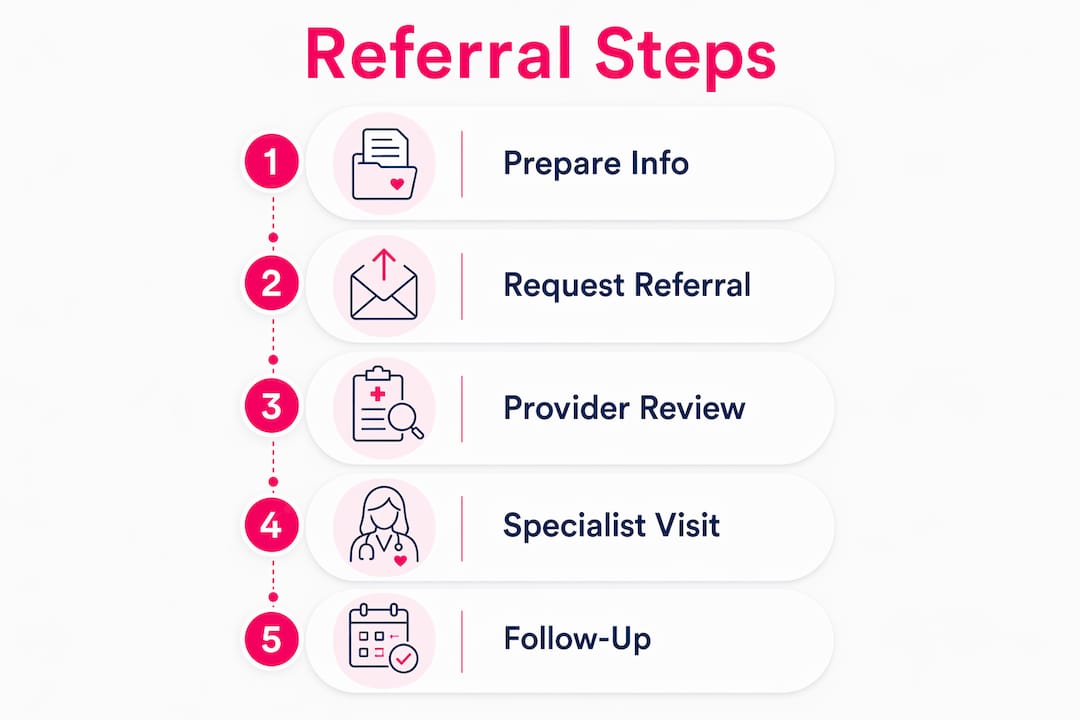
Referral resistance is not uncommon, but it is addressable. Patients who ask directly and specifically are far more likely to receive timely referrals than those who wait for a provider to suggest one. Tarun Jain, MD, a reproductive endocrinologist at Northwestern Medicine, advises patients to advocate for early referral rather than waiting to be offered one.
If you encounter pushback, these steps can help:
- Ask for written reasons. If a referral is denied, request the reason in writing. This creates a record and often prompts reconsideration.
- Seek a second opinion. Another provider within the same practice, or a different primary care physician, may assess your situation differently.
- Use precise clinical language. Mentioning specific thresholds (“I am 37 and have been trying for 7 months, which meets the 6-month guideline”) demonstrates that your request is grounded in clinical standards, not anxiety.
- Contact a regulatory body if necessary. If you believe a referral is being unjustly withheld, your state medical board is a formal avenue for escalation.
Pro Tip: Ask your provider to send the referral to three or four fertility clinics simultaneously. There is no clinical restriction against multiple concurrent referrals, and doing so can cut weeks off your wait time.
What to expect after you receive your referral
Receiving the referral is the beginning of a more detailed clinical process, not the end of one. The fertility specialist will review everything your primary care provider ordered, and the first consultation typically covers your full medical history, prior test results, and an initial assessment of treatment options.
- The specialist will review your diagnostic workup and may order additional tests, such as a saline infusion sonogram or more detailed hormone panels.
- A personalized treatment plan is developed based on your specific results, age, and fertility history.
- Timeline from referral to first specialist appointment varies by clinic and location, but organizing your records in advance reduces delays on your end.
- Bring all prior test results, imaging reports, a medication list, and your written timeline to the first appointment.
Understanding fertility treatment options before your first specialist visit helps you ask better questions and participate more actively in the planning process. The specialist’s role is to build on the foundation your primary care provider established, not to start from scratch.
Key Takeaways
Requesting a fertility specialist referral requires a direct ask, clinical knowledge of age-based timing thresholds, and a complete diagnostic workup to give the specialist a strong foundation from day one.
| Point | Details |
|---|---|
| Know your timing threshold | Referral is recommended after 12 months under 35, 6 months at 35–39, and immediately at 40 or older. |
| Use a specific script | Name the exact tests you need and ask for referrals to multiple clinics in the same conversation. |
| Prepare your documentation | Bring medical history, medication lists, prior test results, and a written timeline to every appointment. |
| Advocate if denied | Request written reasons, seek a second opinion, or contact your state medical board if a referral is withheld. |
| Life IVF Center’s approach | Life IVF Center uses its Precision IVF® protocol to build personalized treatment plans from the initial specialist workup. |
Why patients who prepare get better outcomes
Most fertility patients underestimate how much the referral conversation itself shapes their care. The clinical thresholds exist precisely because fertility declines with age in ways that are not always visible or symptomatic. Waiting until a provider suggests a referral, rather than asking for one, can cost months that matter biologically.
The preparation piece is equally undervalued. Patients who arrive at a primary care appointment with a written timeline, a list of specific tests to request, and the names of clinics they want to be referred to move through the system faster. Fertility clinicians appreciate patients who have done this groundwork. It compresses the diagnostic phase and gets to treatment planning sooner.
There is also a practical case for requesting multiple clinic referrals at once. Wait times at fertility clinics vary considerably, and a patient who is on three waiting lists simultaneously is in a much stronger position than one waiting on a single clinic’s schedule. No clinical rule prevents this, and most primary care providers will accommodate the request when asked directly.
The broader point is that the fertility specialist referral process rewards preparation and directness in equal measure. Knowing the guidelines, naming the tests, and asking clearly are not aggressive moves. They are the behaviors that lead to better, faster care.
Life IVF Center offers personalized fertility care from your first consultation
Once you have your referral in hand, the quality of your first specialist appointment depends heavily on where you go. Life IVF Center, based across multiple Southern California locations, is built for exactly this moment. The clinic’s Precision IVF® approach means your initial workup does not produce a generic treatment plan. It produces one calibrated to your specific hormone profile, medical history, and reproductive goals.
Patients who arrive with prior diagnostic results, a clear history, and specific questions get the most from their first visit. Life IVF Center’s clinical team is experienced in working with complex cases, including age-related fertility challenges, endometriosis, and immune-related factors, so the depth of your preparation is matched by the depth of the evaluation. To learn more about what the IVF process looks like from consultation through treatment, visit Life IVF Center’s website and schedule your first appointment.
Recommended
- Your fertility evaluation checklist: Steps, tests, and benchmarks
- The Fertility Consultation Process: What to Expect
- Prospective Insurance Patients – Life IVF Center
- Essential questions to ask your fertility doctor
Ready to take the next step?
Life IVF Center specializes in individualized Precision IVF® care for complex cases—including diminished ovarian reserve, prior failed cycles, and advanced maternal age. Our in-house labs and dedicated physicians are ready to help.
Book a Free Consultation →