
Secondary infertility is the inability to conceive or carry a pregnancy to term after previously achieving a pregnancy and delivery without fertility assistance. If you have had a child before and are now struggling to conceive again, you are not alone, and you are not imagining it. According to Cleveland Clinic, clinicians typically recommend seeking evaluation after 12 months of unprotected intercourse if you are under 35, or after 6 months if you are 35 or older.
Quick next steps to take right now:
- Start tracking your menstrual cycles, ovulation signs, and timing of intercourse in a dedicated calendar or app.
- Note any new symptoms: irregular periods, pelvic pain, or changes in cycle length since your last pregnancy.
- Schedule an appointment with your OB-GYN or primary care provider to discuss a referral if you meet the timeline above.
- Ask your provider to order first-line tests for both partners simultaneously: a semen analysis for your partner and an ovulation assessment and hormone panel for you.
Pro Tip: Do not wait until you have “tried long enough” to start documenting. A detailed cycle log from day one gives your clinician months of useful data and can shorten the diagnostic process significantly.
Table of Contents
- What is secondary infertility, and how common is it?
- What signs or symptoms point to secondary infertility?
- What causes secondary infertility in women and men?
- What risk factors increase the chance of secondary infertility?
- How is secondary infertility diagnosed?
- When should you see a fertility specialist?
- How is secondary infertility treated?
- The emotional impact of secondary infertility and where to find support
- What is the outlook for conceiving again?
- What specialized fertility centers offer for complex cases
- Key Takeaways
- Secondary infertility deserves the same attention as any fertility challenge
- Personalized fertility care for secondary infertility at Life IVF Center
- Useful sources and further reading
What is secondary infertility, and how common is it?
Secondary infertility is defined clinically as the failure to conceive or sustain a pregnancy after at least one prior successful pregnancy, without the use of fertility treatments. The World Health Organization distinguishes it from primary infertility, which applies when no pregnancy has ever been achieved. That distinction matters practically: secondary infertility often goes unrecognized because people assume a prior pregnancy guarantees future fertility.
Secondary infertility is not a rare edge case. According to Penn Medicine, up to about 14% of women may experience secondary infertility. Many go undiagnosed for months or years because they, and sometimes their providers, assume the prior birth rules out a fertility problem.
The diagnostic threshold follows maternal age. Under 35, clinicians apply a 12-month rule. At 35 or older, the threshold drops to 6 months, because advancing maternal age accelerates egg decline and reduces the window for successful treatment. Rates of secondary infertility appear to be rising as more people delay subsequent pregnancies, which means more women are attempting a second or third pregnancy at an older biological age than their first.
Key differences between primary and secondary infertility:
- Primary infertility: No prior pregnancy has been achieved.
- Secondary infertility: At least one prior pregnancy occurred; difficulty arises with subsequent conception or pregnancy maintenance.
- Shared diagnostic workup: Both types use the same evaluation tools and treatment ladder.
- Unique emotional layer: Secondary infertility carries a specific social complexity because others may minimize the struggle given the existing child.
What signs or symptoms point to secondary infertility?
The most common presenting sign is simply not getting pregnant after the expected period of trying. Many people have no obvious symptoms beyond that. When symptoms do appear, they usually reflect an underlying medical condition rather than infertility itself.
Symptoms that may accompany secondary infertility:
- Irregular or absent menstrual cycles, which can signal ovulatory dysfunction.
- Painful periods or new pelvic pain, which may indicate endometriosis or uterine fibroids.
- Recurrent miscarriage (two or more losses), which warrants earlier evaluation regardless of age.
- Significant changes in cycle length or flow compared to cycles before or after the prior pregnancy.
Red flags that warrant faster evaluation, regardless of how long you have been trying:
- No menstrual period for three or more months (amenorrhea).
- Two or more consecutive pregnancy losses.
- Acute or worsening pelvic pain.
- A known history of pelvic inflammatory disease, sexually transmitted infections, or prior uterine surgery.
Pro Tip: Track cycle length, flow, and any mid-cycle pain for at least two to three months before your first appointment. A pattern of irregular cycles or spotting gives your clinician a concrete starting point rather than a verbal estimate.

What causes secondary infertility in women and men?
A prior healthy pregnancy does not freeze your reproductive biology in place. Age, weight, new health conditions, infections, and surgical history can all alter fertility between pregnancies. Causes split roughly across female-factor, male-factor, and mixed or unexplained categories, with approximately one-third attributable to each broad group.
Female-factor causes
- Age-related egg decline: Egg quantity and quality fall steadily after the mid-30s, making this one of the most common contributors when pregnancies are spaced several years apart.
- Ovulatory disorders: Polycystic ovary syndrome (PCOS), thyroid dysfunction, and hyperprolactinemia can disrupt ovulation even in people who ovulated normally before.
- Tubal damage or scarring: Pelvic inflammatory disease, a prior C-section, or a dilation and curettage (D&C) can leave adhesions or partial blockages that impair egg transport.
- Uterine factors: Submucosal fibroids, endometrial polyps, and adenomyosis can interfere with implantation or early pregnancy maintenance.
- Endometriosis: Can develop or worsen between pregnancies, affecting tubal function and the uterine environment.
For a fuller breakdown of infertility causes, including less common hormonal and anatomical contributors, Life IVF Center’s resource library covers each category in detail.
Male-factor causes
Sperm parameters are not static. Age, weight gain, new medications (antihypertensives, testosterone supplements, certain antidepressants), varicocele, and new infections can all reduce sperm count, motility, or morphology after a man has already fathered a child. Both partners should be tested simultaneously rather than assuming the previously fertile partner is unaffected.
Mixed and unexplained causes
When testing reveals abnormalities in both partners, the case is classified as mixed-factor. When all standard tests return normal results, the diagnosis is unexplained infertility. That label is frustrating, but it does not mean nothing is wrong. It means current testing has not identified the cause, and empiric treatment steps often succeed.
| Cause category | Common examples | Primary partner affected |
|---|---|---|
| Ovulatory dysfunction | PCOS, thyroid disease, hyperprolactinemia | Female |
| Tubal or uterine factor | Adhesions, fibroids, polyps, endometriosis | Female |
| Age-related egg decline | Diminished ovarian reserve | Female |
| Sperm factor | Low count, poor motility, abnormal morphology | Male |
| Mixed or unexplained | Combined or no identifiable cause | Both |
What risk factors increase the chance of secondary infertility?
Some risk factors are fixed; others are modifiable. Knowing which category a factor falls into helps you and your clinician prioritize next steps.
Nonmodifiable risk factors:
- Advancing maternal age, particularly 35 or older, which accelerates age-related fertility decline.
- Prior pelvic or abdominal surgery, including C-section, appendectomy, or myomectomy, which can create adhesions.
- Prior obstetric complications such as postpartum hemorrhage, uterine infection, or retained placenta.
- A prior diagnosis of endometriosis or PCOS that was managed but not resolved.
Modifiable risk factors:
- Significant weight gain or loss since the prior pregnancy, which disrupts hormonal signaling.
- Smoking, which accelerates ovarian aging and impairs sperm DNA integrity.
- Untreated thyroid disease or newly diagnosed chronic conditions (diabetes, autoimmune disorders).
- New medications that affect hormone levels or sperm production.
- Untreated sexually transmitted infections, particularly chlamydia and gonorrhea, which can cause tubal scarring.
Pro Tip: Before your first fertility appointment, compile a list of every medication both partners have started since the prior pregnancy. Some common drugs, including testosterone supplements and certain blood pressure medications, directly suppress sperm production and are easy to overlook.
The longer the interval between pregnancies, the more time there is for any of these factors to emerge. A couple who conceived easily at 28 and is now trying at 36 is working with a meaningfully different biological picture, even if nothing else has changed.
How is secondary infertility diagnosed?
The diagnostic workup for secondary infertility evaluates both partners and follows a logical sequence from least to most invasive. Most of the core testing can be completed within four to six weeks of an initial appointment.
Standard first-line tests:
- Semen analysis: Evaluates sperm count, motility, and morphology. This is the single most important test to order early, given how often male-factor issues go undetected.
- Ovulation assessment: Urinary LH kits at home, combined with a mid-luteal serum progesterone draw, confirm whether ovulation is occurring.
- Day-3 hormone panel: FSH, LH, and estradiol on cycle day 3 assess ovarian reserve and pituitary function.
- Anti-Müllerian hormone (AMH): Can be drawn on any cycle day and provides a reliable estimate of remaining egg supply.
- Pelvic ultrasound: Evaluates the uterus for fibroids or polyps, and the ovaries for antral follicle count and cyst formation.
- Hysterosalpingography (HSG) or saline sonohysterography: Assesses tubal patency and the uterine cavity for structural abnormalities.
These standard fertility evaluation tests form the backbone of the initial workup at both OB-GYN and specialist levels.
| Test | What it checks | Typical timing | Abnormal result suggests |
|---|---|---|---|
| Semen analysis | Count, motility, morphology | Any time | Male-factor infertility |
| Day-3 FSH/LH/estradiol | Ovarian reserve, pituitary function | Cycle day 3 | Diminished reserve or ovulatory disorder |
| AMH | Remaining egg supply | Any cycle day | Low reserve (low AMH) or PCOS (very high AMH) |
| Progesterone | Confirms ovulation occurred | mid-luteal phase | Anovulation or luteal phase defect |
| Pelvic ultrasound | Uterine and ovarian anatomy | Early follicular phase | Fibroids, polyps, cysts |
| HSG | Tubal patency, uterine cavity | early follicular phase | Tubal blockage, uterine abnormality |
| Laparoscopy | Endometriosis, adhesions | When indicated | Endometriosis, pelvic adhesions |
Laparoscopy is reserved for cases where imaging suggests endometriosis or adhesions, or when other testing is inconclusive. It has the advantage of being both diagnostic and therapeutic: a surgeon can remove endometrial implants or adhesions in the same procedure.
When should you see a fertility specialist?
Your OB-GYN can order first-line tests and manage straightforward cases. A reproductive endocrinologist (fertility specialist) is the appropriate next step when:
- You are under 35 and have been trying for 12 months without success.
- You are 35 or older and have been trying for 6 months without success.
- Any first-line test returns an abnormal result, including an abnormal semen analysis.
- You have had two or more miscarriages.
- You have a known history of tubal damage, uterine surgery, or endometriosis.
- Ovulation testing confirms you are not ovulating regularly.
Immediate referral is appropriate (do not wait for the standard timeline) if you have a known genetic condition, a single functioning ovary, or a prior cancer treatment that may have affected fertility.
Pro Tip: Bring your complete obstetric records to the first specialist appointment, including delivery notes, any operative reports from a C-section or D&C, and pathology results if applicable. These documents help clinicians identify scar tissue or structural changes that standard intake forms miss.
What to bring to your first fertility specialist visit:
- Prior pregnancy and delivery records, including operative reports.
- A three-month menstrual and intercourse calendar.
- A complete medication list for both partners.
- Results of any prior fertility or hormone testing.
- Records of prior pelvic surgeries or imaging studies.
How is secondary infertility treated?
Treatment follows a stepwise sequence, starting with the least invasive options and escalating based on diagnosis, age, and ovarian reserve. The standard treatment ladder mirrors what is used for primary infertility, with adjustments for the specific cause identified.
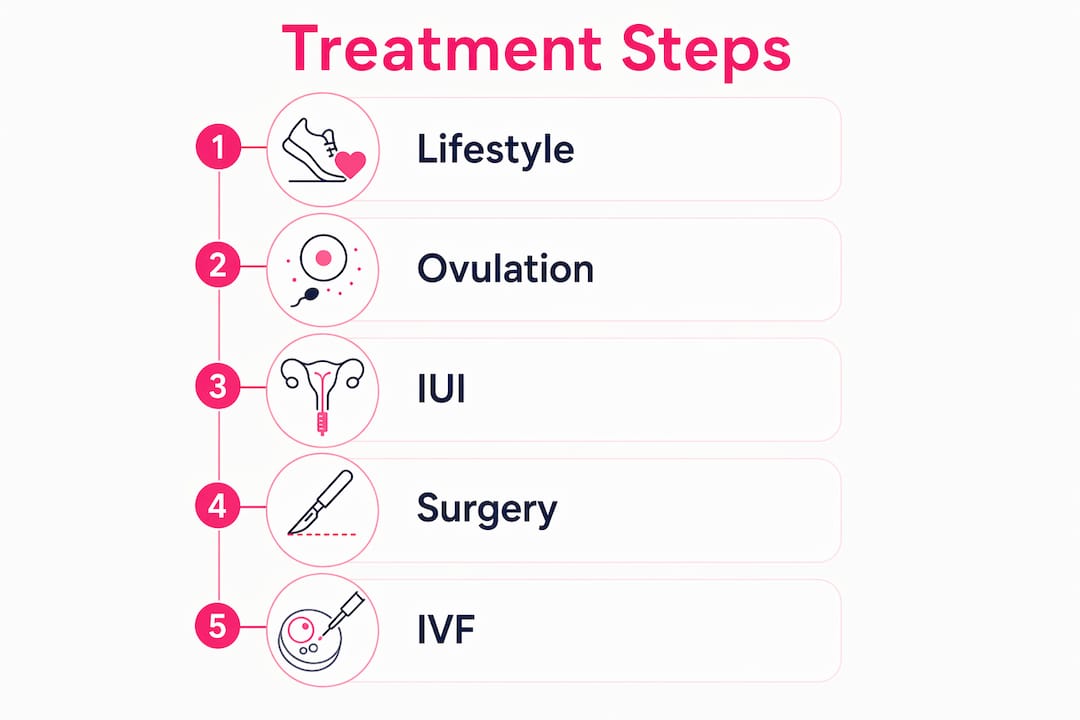
Step 1: Address modifiable factors first. Weight normalization, smoking cessation, thyroid optimization, and discontinuing fertility-affecting medications can restore ovulation or improve sperm parameters without any additional intervention.

Step 2: Ovulation induction. For people with ovulatory dysfunction, oral agents such as clomiphene citrate or letrozole stimulate follicle development. Letrozole has become the preferred first-line agent for PCOS-related anovulation. These medications are typically used for three to six cycles before escalating.
Step 3: Intrauterine insemination (IUI). IUI places washed, concentrated sperm directly into the uterus at the time of ovulation. It is most appropriate for mild male-factor issues, unexplained infertility, or cervical-factor problems. Success rates per cycle are modest, and most clinicians recommend two to three cycles before moving on.
Step 4: Surgical correction. Hysteroscopic polypectomy removes endometrial polyps. Myomectomy addresses submucosal fibroids. Laparoscopy treats endometriosis and pelvic adhesions. Surgery is appropriate when a structural cause has been identified and the patient’s age and ovarian reserve support waiting for natural conception afterward. For a detailed comparison of fertility treatment options, including when to move from IUI to IVF, Life IVF Center’s treatment guide covers the decision points clearly.
Step 5: IVF or ART. In vitro fertilization is indicated for tubal factor, significant male-factor (often combined with intracytoplasmic sperm injection, or ICSI), diminished ovarian reserve, failed prior treatments, or advanced maternal age. IVF with ICSI is the most effective single intervention for male-factor infertility.
| Treatment pathway | Best suited for | Approximate timeline | Invasiveness |
|---|---|---|---|
| Lifestyle modification | Modifiable risk factors (weight, smoking, thyroid) | 1–3 months | None |
| Ovulation induction (oral) | Ovulatory dysfunction, unexplained | 1–6 months | Low |
| IUI | Mild male factor, unexplained, cervical factor | 1–3 cycles | Low |
| Surgical correction | Structural causes (fibroids, polyps, endometriosis) | Variable | Moderate |
| IVF/ICSI | Tubal factor, significant male factor, failed prior treatment | 4 weeks per cycle | High |
Pro Tip: If you are 37 or older and your AMH is low, ask your specialist directly whether proceeding to IVF sooner rather than cycling through IUI makes sense for your ovarian reserve. Time spent on lower-success-rate treatments can matter significantly at that age.
The emotional impact of secondary infertility and where to find support
Secondary infertility carries a grief that is real and often invisible. Clinicians at Northwestern Medicine note that social assumptions, specifically the idea that having one child means you should feel grateful enough, can reduce empathy from friends and family and deepen isolation. People with secondary infertility frequently report feeling caught between two worlds: not quite belonging in primary-infertility spaces, yet not fitting the image of the “complete” family they had envisioned.
Emotional healing is as important as medical treatment. Providers recommend early integration of counseling and peer support because social minimization of secondary infertility is common and can compound the psychological toll of each failed cycle.
Practical steps for managing the emotional weight:
- Name what you are experiencing. Secondary infertility is a recognized medical condition, and the grief it produces is legitimate.
- Communicate openly with your partner. Fertility stress strains relationships; supporting each other through the process requires deliberate conversation, not just shared appointments.
- Be thoughtful about what you share with your existing child. Age-appropriate honesty works better than vague explanations that children fill in with worry.
- Seek a mental health professional who specializes in reproductive health. Counseling integrated into fertility care improves both emotional outcomes and, in some studies, treatment adherence.
- Connect with RESOLVE: The National Infertility Association (resolve.org), which offers peer-led support groups specifically for secondary infertility, online forums, and a helpline.
Additional resources:
- RESOLVE: resolve.org: peer support groups, secondary infertility-specific resources, and advocacy.
- Mental Health Professional Network: RESOLVE maintains a directory of therapists who specialize in infertility.
- Workplace considerations: The Family and Medical Leave Act (FMLA) may apply to fertility-related medical appointments; check with your HR department.
What is the outlook for conceiving again?
Many people with secondary infertility do achieve pregnancy, either with expectant management or after treatment. The most important variables are maternal age, ovarian reserve (AMH and antral follicle count), the specific cause identified, and how quickly evaluation and treatment begin.
Age has the most consistent effect on outcomes. Fertility declines with age in a nonlinear way, with the steepest drop occurring after 37. For IVF specifically, success rates by age vary substantially, and reviewing clinic-level data by age group gives the most realistic picture of what to expect.
Factors that improve prognosis:
- Younger maternal age and adequate ovarian reserve.
- An identifiable and treatable cause (ovulatory dysfunction, correctable structural problem, treatable male factor).
- Early evaluation and prompt initiation of appropriate treatment.
- Normal or near-normal semen parameters.
Factors that reduce prognosis:
- Advanced maternal age combined with low ovarian reserve.
- Bilateral tubal occlusion without surgical correction.
- Severe male-factor infertility without ICSI.
- Multiple prior failed IVF cycles.
When initial testing is normal, the diagnosis of unexplained infertility is common. In those cases, specialists typically proceed with empiric steps: ovulation optimization, timed IUI cycles, and, if those fail, IVF. Unexplained does not mean untreatable.
Pro Tip: Ask your specialist to explain your prognosis in terms of cumulative live birth rate over multiple treatment cycles, not just per-cycle success rates. A single IVF cycle may have a 40% success rate, but two or three cycles can bring cumulative odds considerably higher depending on your age and reserve.
What specialized fertility centers offer for complex cases
When secondary infertility involves multiple contributing factors, failed prior treatments, or advanced maternal age, a specialized fertility center provides capabilities that general OB-GYN practices cannot match. The workflow at a dedicated center integrates evaluation of both partners from the first visit, advanced diagnostic imaging, and individualized treatment planning rather than a one-size protocol.
Precision matters in complex cases. Individualized protocols based on each patient’s ovarian reserve, hormonal profile, and prior treatment history consistently outperform standard stimulation approaches in patients with diminished reserve or prior cycle failures.
What to expect from a specialized fertility center:
- Comprehensive evaluation of both partners at the initial visit, including advanced hormone panels and ultrasound.
- On-site embryology laboratory with capabilities for extended embryo culture and preimplantation genetic testing (PGT).
- Surgical capabilities for hysteroscopy, laparoscopy, and myomectomy within the same clinical system.
- Coordinated mental health support integrated into the treatment plan, not offered as an afterthought.
- Multi-disciplinary case review for complex presentations.
Life IVF Center’s Precision IVF® approach customizes stimulation protocols based on each patient’s unique biological profile, including ovarian reserve, prior response data, and medical history. The goal is to reduce unnecessary treatment cycles and improve the probability of a successful outcome from the first attempt. Life IVF Center operates across multiple Southern California locations and provides detailed educational resources, accessibility features, and transparent consultation processes for patients at every stage of evaluation.
| Feature | What to look for | Why it matters |
|---|---|---|
| Embryology lab | On-site, accredited | Reduces transfer delays and quality variability |
| Genetic testing | PGT-A/PGT-M available | Identifies chromosomally normal embryos |
| Surgical integration | Hysteroscopy/laparoscopy on-site | Avoids referral delays for structural causes |
| Mental health support | In-house or coordinated referral | Improves adherence and emotional outcomes |
| Individualized protocols | Adjusted per patient profile | Reduces failed cycles from standard dosing |
Key Takeaways
Secondary infertility is a diagnosable, treatable medical condition, and most people who pursue a structured evaluation and appropriate treatment have a realistic path to another pregnancy.
| Point | Details |
|---|---|
| Clinical definition | Inability to conceive or carry a pregnancy after a prior delivery; diagnosed after 12 months (under 35) or 6 months (35 or older). |
| Prevalence | Up to about 14% of women may experience secondary infertility, according to institutional estimates. |
| Test both partners | Causes split roughly one-third female, one-third male, one-third mixed or unexplained; semen analysis should be ordered early. |
| Emotional support matters | RESOLVE and reproductive mental health counseling are recommended as part of care, not optional add-ons. |
| Life IVF Center’s approach | Life IVF Center’s Precision IVF® customizes protocols by individual biological profile to reduce unnecessary cycles and improve outcomes. |
Secondary infertility deserves the same attention as any fertility challenge
People with secondary infertility sometimes hear, implicitly or directly, that they should be grateful for the child they have. That message is not only unhelpful. It delays evaluation, discourages people from seeking support, and ignores the fact that secondary infertility is a medical condition with identifiable causes and effective treatments.
What stands out in the clinical literature is how often secondary infertility goes unaddressed for too long because of that social minimization. The 6-month and 12-month evaluation timelines exist precisely because time matters, particularly for ovarian reserve. Waiting an extra year out of guilt or social pressure is not neutral. It has real consequences for treatment options.
The other thing worth saying plainly: the emotional experience of secondary infertility is distinct. It is not the same as primary infertility, and it is not the same as parenting without fertility challenges. It occupies its own difficult space, and the people navigating it deserve both medical attention and genuine emotional support, not a comparison to someone else’s situation.
Personalized fertility care for secondary infertility at Life IVF Center
Secondary infertility often involves more than one contributing factor, and the most effective path forward is a thorough evaluation followed by a treatment plan built around your specific biology, not a standard protocol applied to everyone.

Life IVF Center specializes in exactly this kind of individualized care. The clinic’s Precision IVF® approach tailors stimulation protocols, diagnostic sequencing, and treatment timelines to each patient’s hormonal profile, ovarian reserve, and prior reproductive history. For couples dealing with secondary infertility, that means fewer cycles spent on approaches that are unlikely to work for their specific situation. Life IVF Center’s Southern California locations offer on-site embryology, surgical capabilities, coordinated mental health support, and transparent treatment packages designed to make the financial side of care as clear as the medical side. If you are ready to move from uncertainty to a concrete plan, schedule a consultation with Life IVF Center to review your evaluation results and discuss the treatment pathway most appropriate for your case.
Useful sources and further reading
The following sources informed this article and are recommended for deeper reading on secondary infertility, diagnosis, and treatment.
- Cleveland Clinic: Secondary Infertility: Comprehensive patient-education page covering definition, causes, symptoms, diagnostic tests, and treatment options. One of the most thorough publicly available clinical overviews.
- Penn Medicine: Secondary Infertility: Useful for prevalence estimates and a clear explanation of the diagnostic threshold and unexplained infertility management.
- University of Utah Health: Secondary Infertility: Strong on age-related risk and the connection between delayed subsequent pregnancies and rising secondary infertility rates.
- WebMD: What to Know About Secondary Infertility: Accessible overview with practical guidance on testing both partners and understanding cause distribution.
- Northwestern Medicine: Facing Secondary Infertility: Focused on the emotional and psychosocial dimensions, with specific guidance on counseling and peer support.
- World Health Organization: Infertility: Primary international definition distinguishing primary from secondary infertility.
- RESOLVE: The National Infertility Association: The leading U.S. patient advocacy and peer-support organization for infertility, including secondary infertility-specific resources, support groups, and a mental health provider directory.
- Mayo Clinic: Widely referenced for clinical definitions and treatment standards in reproductive medicine; consult their patient education library for additional detail on ovulation disorders and ART.
This article is intended as general health information, not medical advice. Consult a qualified reproductive endocrinologist or your healthcare provider to evaluate your specific situation and determine the appropriate course of care.
Recommended
- Female Infertility Explained: Causes, Diagnosis, and Treatment
- Blog – Life IVF Center
- Male Infertility Overview: Causes, Diagnosis, and Treatment
- Uncategorized Archives – Life IVF Center
Ready to take the next step?
Life IVF Center specializes in individualized Precision IVF® care for complex cases—including diminished ovarian reserve, prior failed cycles, and advanced maternal age. Our in-house labs and dedicated physicians are ready to help.
Book a Free Consultation →