

Travel during fertility treatment is commonly possible, but the treatment stage decides whether it is wise, not the itinerary. Do not book anything until you have a written treatment timeline and explicit clearance from your care team. Ask for the clinic’s written plan, your full prescription list, and a recommended post-procedure stay before you touch a booking site.
TL;DR: Travel may be possible during fertility treatment, but timing depends on monitoring, medication, procedures, symptoms, and clinic instructions. Do not rely on a general rule about flying after retrieval or transfer; obtain individualized clearance and know where to seek urgent care.
Table of Contents
- How Do You Turn a Treatment Timeline Into Travel Dates?
- How Do You Pack and Manage Fertility Medications While Traveling?
- What Happens if You Miss a Monitoring Appointment?
- Is It Safe to Fly After Retrieval or Embryo Transfer?
- What Does Recovery Actually Look Like After These Procedures?
- What Documents Should You Carry for Follow-Up Care?
- How Do You Manage Stress and Logistics While Traveling for Treatment?
- How Does Life IVF Center Support Travel-Friendly Fertility Care?
- Why Medical Timing Should Always Outrank Travel Convenience
- Book Your Travel-Coordinated Fertility Consultation
- Sources
- FAQ
How Do You Turn a Treatment Timeline Into Travel Dates?
Your protocol dictates the calendar, not the other way around. Two patterns cover most cycles: a single trip built around one clinic visit for retrieval or transfer, or a split trip where stimulation monitoring happens locally and travel resumes only after a freeze or a confirmed transfer date.
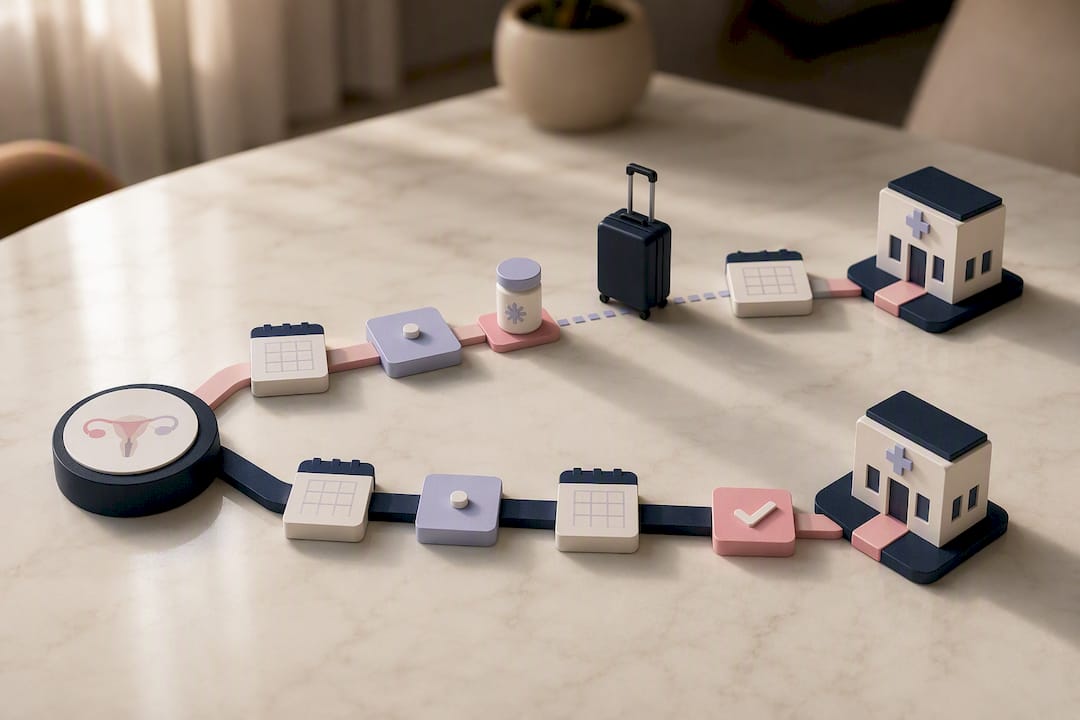
Monitoring-intensive windows, usually the last five to seven days of stimulation, require staying within reach of a lab and ultrasound machine. If your plan includes embryo freezing or PGT genetic testing, expect the timeline to stretch, since results can take one to two weeks before a transfer date is even set.
Before booking anything, confirm with your clinic:
- The exact dates you must be physically present for bloodwork or ultrasounds
- Whether your protocol allows a “freeze-all” cycle that decouples travel from the transfer date
- How much notice the clinic needs to reschedule a monitoring appointment
- Whether your destination has a partner lab that can send results back electronically
How Do You Pack and Manage Fertility Medications While Traveling?
Keep every medication in its original packaging inside a clearly labeled carry-on, never in checked luggage. Bring your prescriptions and a signed clinic letter describing your medications, dosages, and any needles involved.
Temperature-sensitive drugs like gonadotropins usually tolerate brief room-temperature exposure, but ask your pharmacist for the exact safe window and travel with a soft cooler and gel packs as backup. The TSA outlines procedures for travelers carrying medications, syringes, and medical devices, and separate guidance on the liquids rule exceptions for medically necessary items confirms you can carry cold packs and injectable medication through security when declared.
- Declare syringes and medications to the security officer before screening begins
- Keep a written dosing chart with times converted to your destination’s time zone
- Set phone alarms for every dose, especially across time zones
- Confirm with your clinic how much timing flexibility your protocol actually allows
Pro Tip: Photograph your medication labels and clinic letter before you leave home. If a bag gets searched or delayed, you have proof of what you’re carrying and why, right on your phone.
What Happens if You Miss a Monitoring Appointment?
Most stimulation cycles require bloodwork and ultrasound every two to three days, and these appointments are rarely optional once you start injectable medication.
- Ask your clinic whether a local lab or imaging center near your destination can run the same panels and forward results electronically.
- If no local option exists, ask whether the appointment can shift by a day or two without disrupting the protocol.
- Send results to your clinic the same day, with a phone call to confirm receipt rather than relying on email alone.
- If you do miss a window entirely, call your clinic immediately. Some protocols tolerate a short delay; others require restarting the cycle.
Is It Safe to Fly After Retrieval or Embryo Transfer?
A retrospective study of 2,135 embryo transfers found flying after embryo transfer did not negatively affect implantation, pregnancy, or miscarriage rates compared with patients who stayed local. That is reassuring, but it is not a blanket clearance. Most clinics still recommend waiting for a few days after transfer before flying, and longer after retrieval if sedation or bloating from stimulation is involved.
- Choose direct flights when possible to reduce total travel time
- Get up and walk every hour or two on flights longer than three hours
- Wear compression stockings on long-haul flights
- Keep medications in your carry-on, never in overhead storage you cannot access mid-flight
Avoid flying entirely if you have signs of ovarian hyperstimulation syndrome (OHSS), significant abdominal pain, or you are still recovering from retrieval sedation. Your clinic’s clearance overrides any general guideline.
What Does Recovery Actually Look Like After These Procedures?
Retrieval sedation lingers longer than most people expect. Plan to rest for the remainder of that day and avoid traveling alone until the anesthesia has fully cleared, usually by the next morning.
After transfer, gentle activity is fine, but skip heavy lifting, hot tubs, and high-impact exercise per your clinic’s specific advice. Watch for OHSS warning signs: rapid weight gain, severe bloating, shortness of breath, or fever, and contact your clinic or the nearest emergency room immediately if they appear.
- Pack wheeled luggage and ask a travel companion to handle heavy bags
- Wear loose, comfortable clothing for the flight home
Pro Tip: Book an aisle seat after retrieval. Bloating makes frequent bathroom trips and position changes far more comfortable than being wedged against a window.
What Documents Should You Carry for Follow-Up Care?
Leaving with the right paperwork prevents most travel-related treatment headaches.
- A written cycle timeline listing every test date, medication change, and decision point
- A complete medication list with dosages, prescriptions, and your clinic letter
- Direct contact information for your care team, including after-hours instructions
- A plan for local beta-hCG or hormone testing, with clear instructions on how to send quantitative results back to your clinic
This kind of documented planning matters even more for gestational carrier arrangements, where coordinated screening and written agreements govern travel across state or clinic lines.
How Do You Manage Stress and Logistics While Traveling for Treatment?
Book a companion for retrieval, transfer, and any sedation days, and choose refundable travel options whenever your budget allows.
- Build slack into your schedule for the two-week wait rather than cramming in sightseeing
- Confirm with your insurance who covers out-of-town lab work before you leave
- Keep one flexible day in reserve in case a monitoring appointment shifts
How Does Life IVF Center Support Travel-Friendly Fertility Care?
Life IVF Center builds cycles around Precision IVF®, an approach that individualizes stimulation and transfer timing based on each patient’s biology rather than a fixed calendar. That flexibility is what makes travel planning realistic in the first place.
Patients coordinating travel can expect:
- A written treatment timeline covering monitoring dates and expected windows for retrieval or transfer
- Medication counseling that addresses storage, dosing, and time-zone adjustments
- Multi-language support for patients and partners coordinating care across regions
- Remote follow-up options for sending lab results after you have left the area
Ask your care team for a travel-focused consultation before you finalize any dates.
Why Medical Timing Should Always Outrank Travel Convenience
Booking around your clinic’s timeline instead of your own calendar cuts down on cycle disruptions and last-minute stress. Bring three questions to your next appointment: what is my written timeline, when can I safely fly, and what happens if I miss a monitoring date? Then ask for that plan in writing before you buy a single ticket.
Book Your Travel-Coordinated Fertility Consultation
Patients can ask Life IVF Center for an individualized treatment timeline and travel guidance before booking. Confirm required in-person visits, medication transport, and what to do if travel is delayed or symptoms develop.
Coordinated support for patients balancing treatment with travel may include medication counseling and multi-language communication for out-of-town patients and partners. For those weighing a freeze-first strategy to create scheduling flexibility, Precision Egg Freezing and Precision Embryo Freezing lets you separate the retrieval trip from the transfer trip entirely. Patients ready to move forward with a full cycle can review treatment package options, including The Advanced IVF Package at $13,500. Request a written travel timeline at your next consultation and plan your trip around dates your clinic has already confirmed.
Sources
- Does flying after embryo transfer impact implantation? – PMC
- TSA: Special Procedures for Travelers with Disabilities and Medical Conditions
- CDC: Zika travel information
- ASRM: Recommendations for practices using gestational carriers, committee opinion (2022)
This article is for general educational purposes and is not medical or travel advice. Follow your clinic’s instructions and seek urgent care for severe pain, heavy bleeding, shortness of breath, fainting, or rapidly increasing abdominal swelling.
FAQ
What Should I Consider When Traveling While Trying to Conceive?
Confirm your monitoring schedule first, since bloodwork and ultrasound appointments during stimulation are usually not flexible, and check destination-specific health risks like those covered in CDC Zika guidance before booking.
Can I Get a Pedicure While I’m on IVF Medication?
Most clinics allow pedicures during stimulation as long as you avoid extremely hot water and prolonged sitting; check with your care team if you have any vascular or clotting concerns.
Is It Safe to Use a Hot Tub Before Egg Retrieval?
Clinics generally advise avoiding hot tubs during stimulation and after retrieval or transfer, since elevated core temperature and prolonged heat exposure are discouraged during active cycles.
Can I Drive Myself After a Frozen Embryo Transfer?
Yes, driving yourself after a frozen embryo transfer is typically fine since no sedation is involved, unlike after retrieval, when you will need someone else to drive you home.
Does Life IVF Center Provide Written Timelines for Traveling Patients?
Life IVF Center’s Precision IVF® approach includes individualized treatment planning, and patients can request a written timeline and travel-focused consultation directly from the treatment packages page.
This article is for general educational purposes only and is not a substitute for personalized medical advice, diagnosis, or treatment. Fertility care is highly individual; please consult a qualified healthcare professional about your specific circumstances.
Ready to take the next step?
Life IVF Center specializes in individualized Precision IVF® care for complex cases—including diminished ovarian reserve, prior failed cycles, and advanced maternal age. Our in-house labs and dedicated physicians are ready to help.
Book a Free Consultation →