
For embryos frozen by modern vitrification, published survival after thawing is typically around 90% or higher, and some sources report up to 99%. Survival is only the first step. The chance of pregnancy and live birth depends on the embryo’s stage and quality, your age when the eggs were retrieved, and how the uterus is prepared. This guide separates those numbers so you can read them accurately.
TL;DR
- Thaw survival and transfer success are two different measures. Survival asks whether the embryo came through warming intact. Success asks whether a transfer led to a pregnancy or a baby.
- Vitrification (ultra-rapid freezing) has raised survival well above older slow-freezing methods. Studies report roughly 87% to 99% depending on stage and lab.
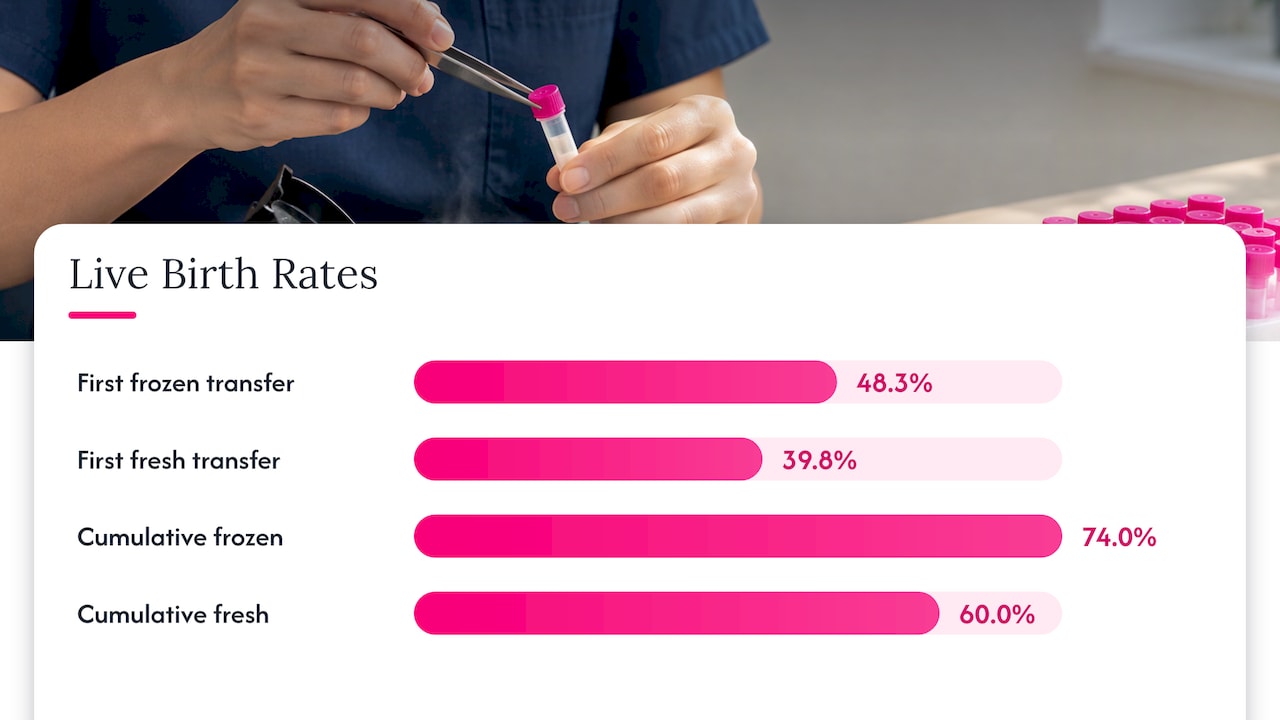
- In a large US registry analysis, first frozen transfers had a 48.3% live birth rate, compared with 39.8% for first fresh transfers.
- Age at retrieval, embryo quality, day of blastocyst development and endometrial preparation all shift your individual odds.
- Published averages are not a forecast for you. Ask your clinic how the figures apply to your age, diagnosis and embryos.
Table of Contents
- Thaw survival and transfer success are different numbers
- How many frozen embryos survive thawing
- What survival looks like for biopsied and lower-grade embryos
- Pregnancy and live birth after a frozen transfer
- What changes your individual odds
- What happens if an embryo does not survive thawing
- How to read a clinic’s numbers for your own case
- Our perspective
- What a frozen embryo path can cost at Life IVF Center
- Plan your transfer with our team
- FAQ
- Sources
Thaw survival and transfer success are different numbers
Patients often see “success rate” used for three different things, and the figures are not interchangeable.
- Survival after thawing: the share of frozen embryos that are intact and viable after warming.
- Clinical pregnancy per transfer: the share of transfers that lead to a confirmed pregnancy.
- Live birth per transfer: the share of transfers that lead to a baby.
The CDC’s surveillance reporting defines success as live-birth deliveries per ART transfer procedure. It also stresses that no single measure tells the whole story. Treatments need to be split by egg source and by whether embryos are fresh or thawed, because results vary with patient age, diagnosis and number of previous procedures.
A clinic that says “95% of embryos survive” and a registry that says “about half of transfers result in a baby” are both reporting correctly. They are answering different questions.
How many frozen embryos survive thawing
Vitrification replaced slow freezing in most laboratories, and the survival data reflect that change.
- The ASRM’s 2021 committee opinion says current vitrification systems work well, with embryo survival rates approaching 100% when quality control and operator training are in place.
- A 2024 review of frozen embryo safety notes that vitrification and extended culture to day 5 to 7 have produced post-cryopreservation survival of up to 99%.
- A randomized controlled trial of cleavage-stage embryos found 89.4% survival with one vitrification method and 87.6% with another, against 63.8% for slow freezing.
- A meta-analysis found that vitrification improved cryosurvival compared with slow freezing, with a risk ratio of 1.59.
- An Iranian study of cleaved embryos reported 96.9% survival with vitrification versus 82.8% with slow freezing, along with higher clinical pregnancy rates in the vitrification group (40.5% versus 21.4%).
The spread across these studies, from the high 80s to the high 90s, is not noise. It reflects different embryo stages, protocols and laboratories. The ASRM’s emphasis on training and quality control is a reminder that the freezing and warming technique matters as much as the technology.
Table: survival figures at a glance
| Source | Embryo type | Method | Reported survival |
|---|---|---|---|
| Randomized trial (Belgium) | Cleavage stage | Vitrification, two systems | 89.4% and 87.6% |
| Randomized trial (Belgium) | Cleavage stage | Slow freezing | 63.8% |
| Iranian cohort | Cleaved embryos | Vitrification | 96.9% |
| Iranian cohort | Cleaved embryos | Slow freezing | 82.8% |
| 2024 review | Extended culture, day 5 to 7 | Vitrification | Up to 99% |
What survival looks like for biopsied and lower-grade embryos
Survival is not identical for every embryo in the same freezer. A 2024 Spanish study of embryos that had a biopsy for genetic testing before vitrification found that excellent-quality embryos survived at 92.26%, good-quality at 92.47%, and poor-quality at 84.61%. Embryos biopsied on day 5 did better than those biopsied on day 6 (93.71% versus 83.69%). The authors also noted that fully hatched blastocysts survived less well.
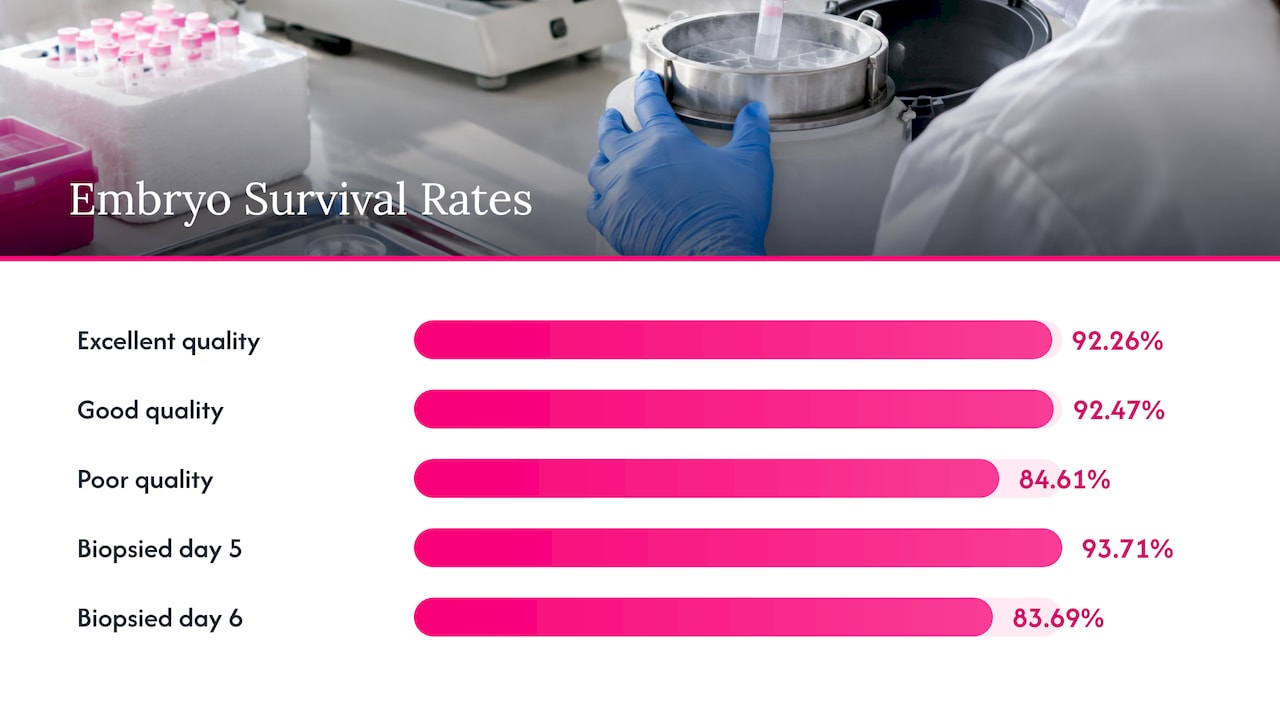
The practical reading: the day an embryo reaches blastocyst stage and its morphology when frozen both matter. A slower-growing embryo is not unusable, but its numbers sit lower on average.
Pregnancy and live birth after a frozen transfer
Once an embryo has survived, the next question is whether it implants. Here the best US data come from national registry analyses.
A 2024 study using SART CORS data from 2014 to 2020 found that first frozen embryo transfers had a 48.3% live birth rate versus 39.8% for first fresh transfers, and a cumulative live birth rate of 74.0% versus 60.0%. The ASRM’s 2018 committee opinion on blastocyst culture likewise reports that vitrification has provided excellent survival and implantation of thawed blastocysts, with equivalent success rates and improved neonatal outcomes compared with fresh transfers.
Results from single-center cohorts are lower and vary more. A Thai retrospective study of frozen cycles reported an overall clinical pregnancy rate of 34.2%, which includes all ages and all embryo stages. This is a useful reminder that a blended average can look modest even when blastocyst transfers in younger patients perform better.
What changes your individual odds
Age when the eggs were retrieved
Age remains the strongest factor. In the Thai study, women aged 35 to 40 and over 40 were significantly less likely to achieve a clinical pregnancy than women under 35 (adjusted odds ratios of 0.523 and 0.260). In the US registry analysis, patients with diminished ovarian reserve aged 35 and older had a greater chance of live birth with a first frozen transfer than with a fresh one, and the advantage grew past age 42. The authors suggest that stimulation in older cycles may be less favorable to the uterine lining, which a frozen cycle avoids.
Embryo stage and development day
The Thai study also found that blastocyst transfer was associated with higher clinical pregnancy than day 3 or day 4 transfer. Among euploid (chromosomally normal) blastocysts, a 2024 study in Frontiers in Endocrinology found that day 5 blastocysts reached 58.4% clinical pregnancy and 52.5% live birth, against 49.2% and 45% for day 6. The same study found that blastocyst quality, endometrial preparation protocol and the number of blastocysts transferred each independently affected live birth.
Storage time
A 2026 meta-analysis found that storage of 12 months or less was associated with higher odds of live birth (OR 1.19) and clinical pregnancy (OR 1.24). The authors noted substantial heterogeneity between studies and cautioned that storage duration alone should not decide when to transfer. If your embryos have been stored for a few years, this finding is not a reason to rush. Timing is better set around your health, your uterine preparation and your goals.
Your health before the transfer
Some medications and conditions deserve attention before a transfer is scheduled. If you take a GLP-1 medication, for example, ask your prescriber and fertility team about timing, and read the evidence on stopping semaglutide before conceiving. Bring a full medication list to your pre-transfer visit.
What happens if an embryo does not survive thawing
A failed thaw is uncommon with vitrification, but it can happen, and it is hard news. The usual path is simple. Your clinic will tell you whether the embryo, or part of it, did not survive, and the transfer for that embryo is cancelled. If you have other embryos in storage, the team can plan a thaw of the next one, often within the same prepared cycle if the timing and your clinical situation allow. If it was your only embryo, the conversation turns to next steps: another stimulation and retrieval cycle, or other options suited to your diagnosis.
Ask your clinic in advance how it handles this situation. Useful questions are whether embryos are thawed one at a time, when you are told the outcome, and what the plan would be if the thaw does not go as hoped. Knowing the answers beforehand makes the day less stressful.
How to read a clinic’s numbers for your own case
Published figures are a starting point. To apply them to yourself:
- Match the measure. Compare live birth per transfer with live birth per transfer, not with survival after thaw.
- Match the age group. Use the figure for your age at egg retrieval, not an all-ages average.
- Match the embryo. Blastocyst versus cleavage stage, day 5 versus day 6, tested versus untested embryos.
- Match the denominator. Per transfer, per retrieval and cumulative rates are different things.
- Ask about the lab. The ASRM stresses that consistent results depend on quality control and trained operators, so ask how the lab thaws embryos and how its team is trained.
The CDC’s guidance supports this approach: a single measure is not informative, and success varies by egg source, embryo status, age and diagnosis.
Our perspective
Numbers on a page cannot tell you what your own thaw and transfer will look like. At Life IVF Center, we start from that point. Our Precision IVF® approach is designed to build a plan around your biology, history and goals, so that decisions about stimulation, embryo testing, freezing and transfer timing fit you rather than an average.
We run in-house laboratories, which is designed to give our team direct control over how embryos are handled. We welcome second-opinion cases and patients who have been told elsewhere that their situation is too complex.
If you are weighing a frozen transfer, we encourage you to bring your age at retrieval, your embryo details and your questions to a consultation. Our team will walk through what the published research means for your circumstances and what a personalized protocol could look like.
What a frozen embryo path can cost at Life IVF Center
Costs are part of planning a frozen transfer, so here are the figures we publish.
| Service | Published price |
|---|---|
| Precision Embryo Freezing | $8,950 one-off |
| Embryo Transfer | from $2,950 one-off |
| Annual Storage | $750 per year |
| 3 Year Prepaid Storage | $2,000 one-off |
| Monthly Storage | $70 per month |
| Endometrial Receptivity Assay (ERA) | $975 one-off |
See the full freezing pricing, storage costs and treatment packages for what each includes. Pre-treatment tests such as the ERA and carrier screening are listed on our pre-IVF pricing page.
Plan your transfer with our team
If you have embryos in storage, or you are deciding whether to freeze embryos, Life IVF Center offers evaluations for complex cases, including advanced age, diminished ovarian reserve, endometriosis and immune disorders. We also provide multi-language support, travel coordination and financial guidance. Learn how Precision IVF® works and book a consultation to review your embryos and your options.
FAQ
What is the survival rate of frozen embryos after thawing?
For vitrified embryos, studies report survival from about 87% to 99%, depending on embryo stage and laboratory. The ASRM states that well-run vitrification systems approach 100%. Biopsied, lower-grade or day 6 embryos tend to sit at the lower end of the range.
Is a frozen embryo transfer more successful than a fresh one?
In a US registry study covering 2014 to 2020, first frozen transfers had a higher live birth rate than first fresh transfers (48.3% versus 39.8%). The advantage was larger for older patients with diminished ovarian reserve. The ASRM describes success as equivalent overall, with better neonatal outcomes after frozen blastocyst transfer.
Does the length of storage affect success?
A 2026 meta-analysis linked storage of 12 months or less with somewhat higher odds of pregnancy and live birth. The authors warned that the studies differ widely and that storage time should not alone determine transfer timing. Your age at freezing and embryo quality matter more for most people.
What if my embryo does not survive thawing?
Your clinic will cancel that transfer and review options. If other embryos are stored, the team can plan to thaw another. If not, the next step may be another retrieval cycle, depending on your diagnosis and goals.
Sources
- CDC MMWR: Assisted Reproductive Technology Surveillance, United States
- ASRM Committee Opinion 2021: Best Practices of Rapid-Cooling Vitrification for Oocytes and Embryos
- Randomized Controlled Trial Comparing Two Vitrification Methods
- Meta-Analysis: Oocyte, Embryo and Blastocyst Cryopreservation in ART
- Study: Vitrification Versus Slow Freezing of Cleaved Embryos
- Review: Safety of Children Born After Frozen Embryo Transfer
- SART CORS Study: Age-Related Live-Birth Rates of First Frozen Embryo Transfers
- ASRM Committee Opinion 2018: Blastocyst Culture and Transfer
- Study: Predictive Factors in Preimplantation Genetic Testing for Aneuploidy
- Study: Factors Influencing Successful Frozen Embryo Transfer in Thailand
- Frontiers in Endocrinology: Day 5 Versus Day 6 Euploid Blastocyst Transfer
- Frontiers in Endocrinology 2026: Optimal Timing for Frozen-Thawed Embryo Transfer
- Guide: Stopping Semaglutide Before Conceiving
This article is for general educational purposes only and is not a substitute for personalized medical advice, diagnosis, or treatment. Fertility care is highly individual; please consult a qualified healthcare professional about your specific circumstances.
Ready to take the next step?
Life IVF Center specializes in individualized Precision IVF® care for complex cases—including diminished ovarian reserve, prior failed cycles, and advanced maternal age. Our in-house labs and dedicated physicians are ready to help.
Book a Free Consultation →