
Yes, you can have IVF with fibroids. Whether they matter depends on three things: where the fibroid sits, how large it is, and whether it changes the shape of the uterine cavity. Fibroids that press into the cavity are the ones most likely to lower IVF success and are usually dealt with first. Fibroids on the outside of the uterus rarely change the plan.
If you have just learned you have fibroids while trying to conceive, the uncertainty can feel heavy. This guide explains what the research shows, how fibroids are evaluated, when removal is considered, and how to sequence surgery and IVF so you lose as little time as possible.
TL;DR
- Fibroids do not rule out IVF. Their type and location matter far more than their number or the fact that they exist.
- Fibroids inside the uterine cavity (submucosal) have the strongest documented negative effect on implantation and delivery, and removal is the standard approach.
- Fibroids on the outer wall (subserosal) are generally not removed before IVF. Intramural fibroids are a case-by-case decision.
- After surgery, expect a wait of roughly 1 to 6 months before trying to conceive, depending on the procedure and your surgeon’s guidance.
- A personalized evaluation of imaging, history, and prior cycles is what decides whether to operate first or proceed with IVF.
Table of Contents
- Is IVF possible with fibroids?
- How fibroids can affect implantation and pregnancy
- Which fibroids matter most for IVF
- How fibroids are evaluated before IVF
- When removal before IVF is considered
- Risks and recovery: how long can it delay IVF?
- Non-surgical options and fertility
- Planning your care at Life IVF Center
- Questions to bring to your appointment
- FAQ
- Sources
Is IVF possible with fibroids?
In most cases, yes. Fibroids are very common: uterine leiomyomas are present in an estimated 30 to 70% of women of reproductive age. A 2018 review in Fertility and Sterility reports that over 75% of women develop fibroids before menopause. Most of them conceive without trouble.
The American College of Obstetricians and Gynecologists notes that fibroids may cause infertility, although other causes are more common, and that many women are able to get pregnant after fibroids are treated. A review of fibroids and infertility estimates that fibroids may be the only cause of infertility in 2 to 3% of women. That means your evaluation should also look for other factors, such as ovarian reserve, sperm quality, and tubal health, before fibroids are blamed.
Small fibroids that do not change the uterine cavity may have little or no effect on an IVF cycle. Submucosal fibroids and large intramural fibroids are typically evaluated before a cycle begins.
How fibroids can affect implantation and pregnancy
Fibroids are not simply a physical obstacle. A review of fibroids and infertility describes several proposed mechanisms:
- Increased uterine contractions
- Changes in the cytokine (immune signaling) profile
- Abnormal blood vessel formation
- Chronic inflammation of the lining
The Fertility and Sterility review adds that the effect on the endometrium appears to be transmitted through molecular signaling, and that it fades quickly with distance from the cavity. A fibroid right beside the lining is predicted to matter a lot. One even slightly removed from it is predicted to matter much less. This is why location is the first question a specialist asks.
Fibroids can also interfere in other ways: distorting the cavity, blocking the tubal openings, or making the ovaries harder to reach during egg retrieval when pelvic anatomy is significantly distorted.
Which fibroids matter most for IVF
The table below summarizes how the main types are generally viewed in the literature. These are population-level findings, not predictions for any one patient.
| Fibroid type | Where it sits | What the research shows | Usual approach before IVF |
|---|---|---|---|
| Submucosal | Bulges into the uterine cavity | Relative risk of 0.3 for pregnancy and 0.28 for implantation with assisted reproduction | Removal is the standard of care |
| Intramural | Within the muscular wall | Odds ratios of 0.62 for implantation and 0.7 for delivery per transfer | Individualized: size, location, and prior cycles guide the decision |
| Subserosal | On the outer surface | Negligible impact on fertility with assisted reproduction | Typically left alone |
Submucosal fibroids
Fibroids that distort the cavity are the clearest case. A clinical review describes a consensus of negative impact on both clinical pregnancy and delivery rates, with an odds ratio of 0.3, and reports an increased risk of miscarriage. The same review cites a delivery rate reduction of about 70% with submucosal fibroids, compared with about 30% for intramural fibroids.
Intramural fibroids
This is where the decision gets nuanced. A 2018 meta-analysis of 28 studies and 9,189 IVF cycles found that intramural fibroids that do not distort the cavity were associated with a lower live birth rate (RR 0.82), clinical pregnancy rate (RR 0.86), and implantation rate (RR 0.90), and a higher miscarriage rate (RR 1.27) than in women without fibroids.
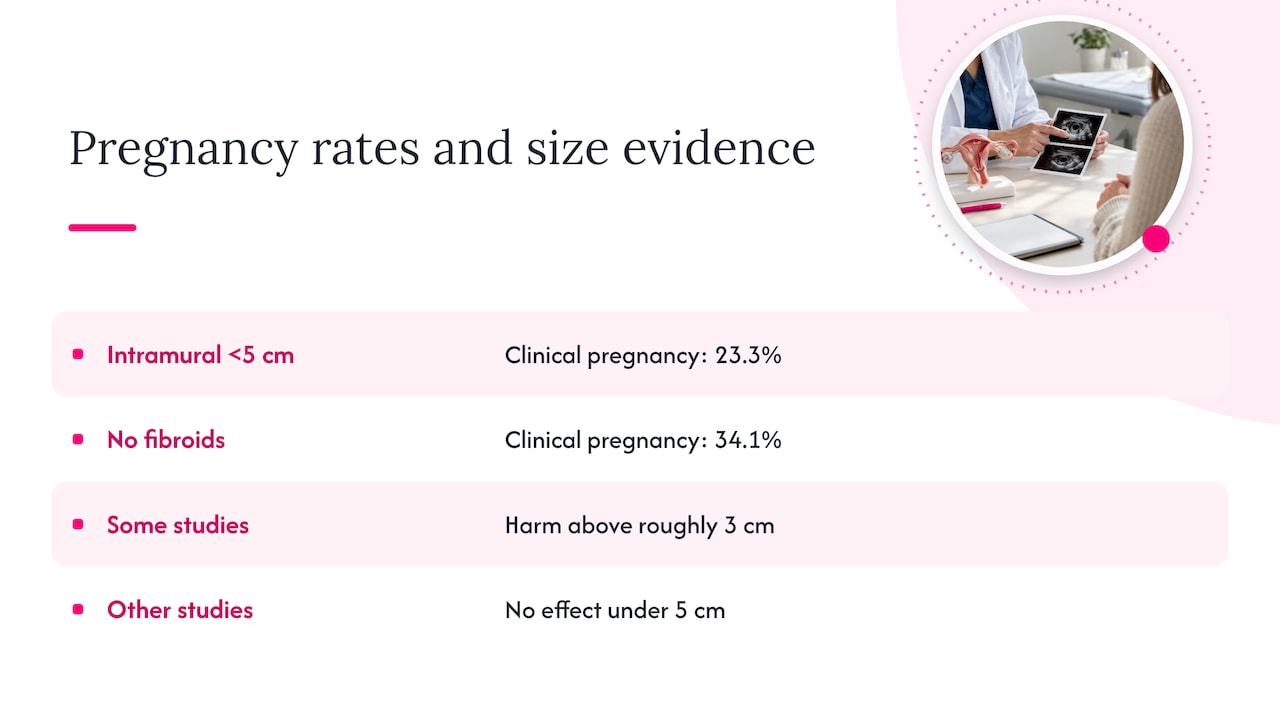
Size matters too, but the evidence is mixed. The American Society for Reproductive Medicine’s 2017 guideline reports a clinical pregnancy rate per embryo transfer of 23.3% in women with intramural fibroids under 5 cm, compared with 34.1% in women without fibroids. It also notes conflicting data on size thresholds, with some studies pointing to harm above roughly 3 cm and others finding no effect under 5 cm. Because patient groups differ so much between studies, the guideline says no single recommendation fits every case.
The Fertility and Sterility review found that type 3 intramural fibroids of at least 2 cm, those touching the cavity lining, were linked to lower implantation and live birth rates (21% versus 34% in women without fibroids). Its conclusion: large intramural fibroids close to the cavity warrant removal before IVF. The patient fact sheet from ASRM’s Reproductive Facts says fibroids that often decrease fertility include those inside the cavity or very large ones (over 6 cm) in the uterine wall, and that most women with fibroids will not be infertile.
Subserosal fibroids
Fibroids on the outer surface, away from the cavity, do not affect fertility and are typically not removed before IVF. A large one may still be monitored, especially if it causes symptoms or complicates access to the ovaries.
How fibroids are evaluated before IVF
A good plan starts with a precise map: how many fibroids, what type, how big, and how close to the cavity. A 2023 comparison of international guidelines summarizes the tools:
- MRI is considered the most reliable imaging method for relating fibroids to the cavity.
- Transvaginal ultrasound, hysterosonography, hysterosalpingography, and hysteroscopy each add information and are chosen patient by patient.
- Hysterosalpingography and ultrasound alone can lack sensitivity or specificity, and hysteroscopy may under-evaluate some submucosal fibroids because the fluid pressure alters the outline of the uterus.
In practice, this is why a combination of tests is often used. At Life IVF Center, the pre-IVF workup includes a Saline Infusion Sonohysterogram (SIS) at $450, which outlines the uterine cavity, and an Endometrial Receptivity Assay (ERA) at $975 when the timing of transfer is a question. Which tests you need depends on your history, and our team decides that with you after reviewing prior records.
When removal before IVF is considered
The 2023 guideline comparison lists three situations where myomectomy (surgical removal of fibroids while preserving the uterus) may be considered:
- Fibroids that distort the uterine cavity.
- Several unsuccessful IVF cycles despite an adequate ovarian response and good-quality embryos.
- Severe pelvic distortion that complicates reaching the ovaries for egg retrieval.
The Australian and New Zealand guideline on fibroids in infertility recommends myomectomy for women undergoing assisted reproduction with submucosal fibroids, and for couples with multiple failed cycles when the woman has intramural fibroids. It also stresses that the best management remains debated and depends on fibroid size, position, number, and your prior treatment history.
A practical way to think about intramural fibroids
One pragmatic approach published in 2019 tries to avoid surgery for intramural fibroids under 5 cm when the cavity is regular, tends to offer surgery first for fibroids of 7 cm or more, and proceeds with a first IVF attempt without surgery for fibroids of 5 to 6 cm. The aim is to keep the number of surgeries needed per extra pregnancy as low as possible. This is one published strategy, not a rule, and your own decision should come from your specialist’s review of your case.
There is also evidence that surgery can help when it is warranted: a 2019 study of myomas and myomectomy in IVF found that the cumulative incidence of clinical pregnancy improved significantly after myomectomy.
More surgery is not better surgery
Surgeons sometimes feel pressure to remove every visible fibroid. A 2025 review cautions that extensive removal can harm fertility outcomes, likely through disrupted blood supply, adhesions, and endometrial ischemia. It cites pregnancy rates of 70.8% when fewer than six myomas were removed in abdominal myomectomy versus 22.9% when six or more were removed. The goal is to remove what is harming implantation, not everything that can be seen.
Risks and recovery: how long can it delay IVF?
Surgery brings its own considerations, and they belong in your timeline. According to the ASRM patient fact sheet on fibroid treatment:
- All uterine surgery carries a risk of scarring and adhesions that may affect future fertility.
- Heavy bleeding may require transfusion or, if life-threatening, hysterectomy.
- Recovery from abdominal myomectomy can take up to 4 to 6 weeks, laparoscopic recovery is usually 2 to 7 days, and normal activities may resume within a few days after hysteroscopic myomectomy.
- It may be 1 to 6 months before you are cleared to try to conceive.
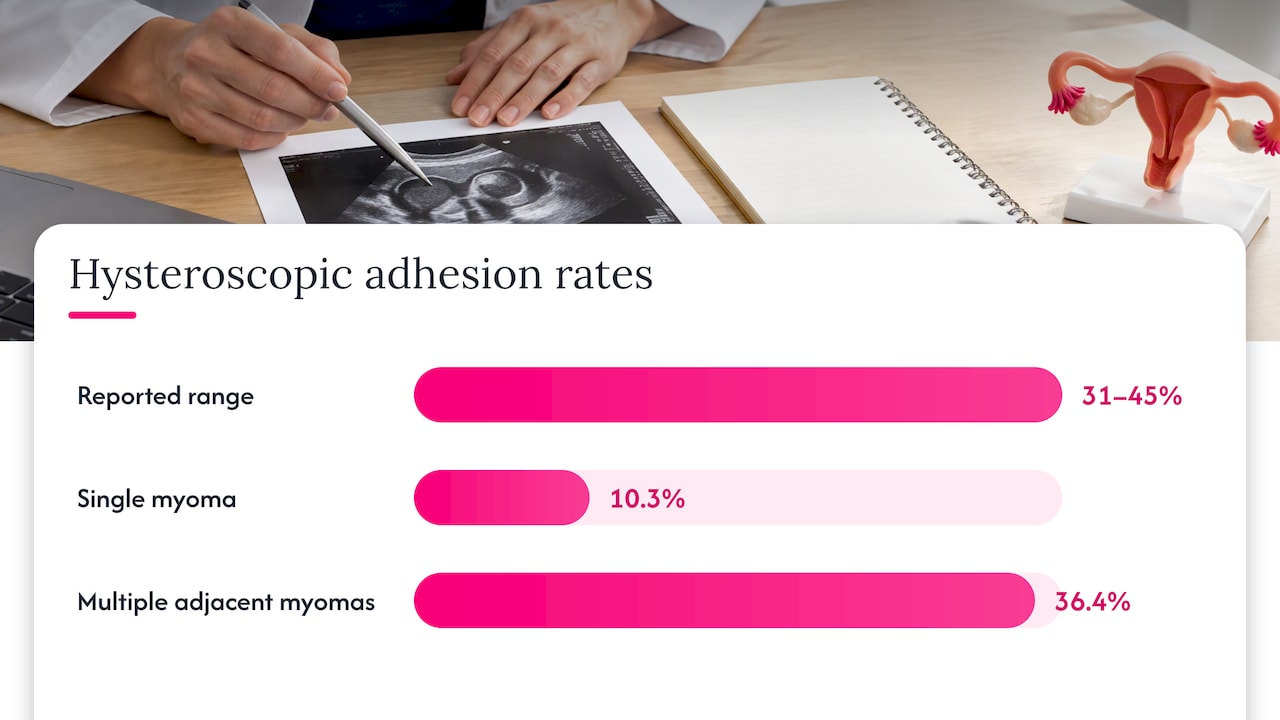
Intrauterine adhesions are a specific concern after hysteroscopic surgery. A 2026 study in Frontiers in Medicine notes reported adhesion rates of 31% to 45% after hysteroscopic myomectomy, with higher bleeding risk for deeper fibroids or those over 3 cm. A review of hysteroscopic myomectomy found adhesions in 10.3% of women after removal of a single myoma and 36.4% after removal of more than one adjacent myoma. For this reason, a follow-up check of the cavity is often part of the plan before transfer.
Waiting time protects you. Many doctors suggest waiting about 3 to 6 months after myomectomy so the uterine scar can heal, because pregnancy on an unhealed scar raises the risk of uterine rupture, particularly in labor. Follow your own surgeon’s timeline; it depends on how deeply the incision went into the uterine wall.
Using the waiting period well
The healing window does not have to be lost time. Some patients use it to complete genetic carrier screening, finish the rest of the pre-IVF workup, or create embryos so that a frozen embryo transfer can happen once the uterus is cleared. Whether banking embryos first makes sense for you depends on your age, ovarian reserve, and the surgeon’s recommendation, so raise it early in your consultation.
Non-surgical options and fertility
Procedures that treat fibroids without removing them are often discussed, but they are not a match for everyone who wants to conceive.
- Uterine artery embolization is contraindicated in women who want future pregnancy under a Canadian guideline, because it has been linked to reduced ovarian reserve and worse pregnancy and miscarriage rates.
- The Australian and New Zealand, French, and American societies recommend against uterine artery embolization, focused ultrasound, radiofrequency ablation, myolysis, and uterine artery ligation outside clinical trials for women hoping to become pregnant.
- A 2020 review approximated the fertility rate after embolization at 38.3%, versus 53.6 to 55.9% after myomectomy.
If you are planning a pregnancy, tell every provider before agreeing to any fibroid procedure, so the choice protects your fertility.
Our perspective on fibroids and IVF
Fibroids are one of the most common reasons patients arrive worried that IVF is no longer an option. In our experience, the more useful question is not whether you have fibroids, but what they are doing inside your particular uterus and in what order each step should happen.
That is the thinking behind Precision IVF®, our approach of building each treatment plan from your biology, medical history, and goals rather than from a standard protocol. For a patient with fibroids, that means reading imaging carefully, reviewing prior cycles, and weighing whether removal, a different transfer strategy, or proceeding as planned gives you the best chance with the fewest repeated cycles.
We welcome second-opinion cases, including patients who were told elsewhere that fibroids made treatment too complicated. Our in-house labs give our team close control over each stage of your cycle, and we aim to be clear about costs from the first visit.
Planning your care at Life IVF Center
If you want a plan that accounts for your fibroids, the first step is a consultation where our team reviews your imaging, history, and any previous cycles. Precision IVF® is built to customize protocols to each patient, including complex cases.
Published pricing helps you budget alongside any surgery. Our Advanced IVF Package is $13,500, and Embryo Transfer starts from $2,950. If you would like to bank embryos while you recover, Precision Embryo Freezing is $8,950, and storage options are listed on our cryo storage pricing page. Insurance coverage and financial guidance can be discussed with our team.
Questions to bring to your appointment
A short list keeps the consultation focused:
- What type are my fibroids (submucosal, intramural, subserosal), and how close are they to the cavity?
- Do I need MRI, a saline sonogram, or hysteroscopy to confirm?
- Is there a cavity distortion, and would removal change my odds on the next transfer?
- If surgery is advised, how many fibroids need to be removed, and by which method?
- How long should I wait afterward, and when should the cavity be rechecked?
- Can I freeze embryos first and transfer later?
- Are other factors, such as age, ovarian reserve, or sperm quality, a bigger part of the picture?
FAQ
Can fibroids stop IVF from working?
They can lower the chance of implantation, mainly when they bulge into the uterine cavity or when large intramural fibroids sit close to it. Many women with fibroids still have successful cycles. A pre-cycle evaluation shows whether yours need treatment first.
Do I always need surgery before IVF if I have fibroids?
No. Subserosal fibroids are typically not removed before IVF, and small intramural fibroids with a normal cavity may be left in place. Surgery is most often considered for cavity-distorting fibroids, repeated failed cycles, or anatomy that blocks egg retrieval.
How long after fibroid surgery can I start IVF?
It varies by procedure. The ASRM fact sheet says it may be 1 to 6 months before you are cleared to try to conceive. Your surgeon sets the exact timing after looking at how deeply the uterine wall was involved.
Can I get pregnant with fibroids and without treatment?
Yes, many women do, because most fibroids do not interfere with conception. If you have been trying for a while, particularly over age 35, an evaluation can tell you whether fibroids or another factor is involved.
Sources
- Uterine Fibroids and Infertility (PMC review, 2021)
- Fibroids: When Should They Be Removed to Improve IVF Outcomes? (Fertility and Sterility, 2018)
- Uterine Fibroids FAQ (ACOG)
- Management of Uterine Fibroids in the Patient Pursuing Fertility (PMC)
- The Impact and Management of Fibroids for Fertility (PMC, 2012)
- Impact of Noncavity-Distorting Intramural Fibroids on IVF Outcomes (PMC meta-analysis, 2018)
- Uterine Leiomyomas and Infertility: A Comparison of Guidelines (PMC, 2023)
- RANZCOG Guideline: Fibroids in Infertility (2018)
- Management of Fibroids Prior to IVF (PMC, 2019)
- Effects of Myomas and Myomectomy on IVF Outcomes (ScienceDirect, 2019)
- Gynecologic Surgery for Benign Disease: Preserving Fertility (PMC, 2025)
- Pregnancy Outcomes Following Hysteroscopic Myomectomy (Frontiers in Medicine, 2026)
- Uterine Fibroid Treatments and Getting Pregnant After Surgery (Premom, 2026)
- Pregnancy Success and Outcomes After Uterine Fibroid Embolization (PMC, 2020)
This article is for general educational purposes only and is not a substitute for personalized medical advice, diagnosis, or treatment. Fertility care is highly individual; please consult a qualified healthcare professional about your specific circumstances.
Ready to take the next step?
Life IVF Center specializes in individualized Precision IVF® care for complex cases—including diminished ovarian reserve, prior failed cycles, and advanced maternal age. Our in-house labs and dedicated physicians are ready to help.
Book a Free Consultation →