
Karyotype testing may be considered when history or prior results suggest a chromosome rearrangement. Current guidance favors selective testing based on individual risk rather than automatic testing after every second miscarriage.
TL;DR: Parental karyotyping can be useful after an unbalanced pregnancy-tissue result, with severe male-factor infertility, relevant family history, or selected recurrent-loss cases. Guidance differs on routine testing after two losses, so use individualized risk assessment and genetic counseling.
Table of Contents
- What Karyotype Testing for Infertility Actually Detects
- When Clinicians Recommend Karyotype Testing in an Infertility Workup
- How Karyotype Results Change Your Fertility Treatment Plan
- What to Expect: Sample, Timeline, Cost, and Risk
- Reading Your Report and What Comes Next
- The Evidence Behind Current Testing Guidelines
- Coping After an Abnormal Karyotype Result
- How Common Are Chromosomal Abnormalities in Infertility?
- Life IVF Center’s Approach to Genetic Testing Within Precision IVF®
- Ready to Talk Through Your Fertility Genetics Options?
- Where These Findings Come From
- Sources
- FAQ
What Karyotype Testing for Infertility Actually Detects
A karyotype test looks at the number and structure of a person’s chromosomes under a microscope, using a lab technique called G-banding that stains each chromosome into a pattern a trained cytogeneticist can read. It catches large-scale problems, not tiny genetic misprints. A parental karyotype test can flag recurrent miscarriage, severe male-factor infertility, or an unbalanced result found in fetal or pregnancy tissue.
The findings that matter most for fertility include:
- Reciprocal translocations: two chromosomes swap segments, which can be balanced (no missing material) or unbalanced.
- Robertsonian translocations: two chromosomes fuse, common in certain recurrent loss cases.
- Inversions: a chromosome segment flips end to end.
- Numerical changes like 47,XXY (Klinefelter syndrome) in men.
- Mosaicism: a mix of normal and abnormal cell lines in the same person.
Here’s the part that surprises most patients: a balanced carrier is usually completely healthy. The risk shows up in their embryos, not in their own body.
When Clinicians Recommend Karyotype Testing in an Infertility Workup
Testing is not offered to every patient walking through a fertility clinic. It is targeted, because research on parental karyotyping shows the diagnostic yield rises sharply when specific risk factors are present, rather than testing everyone by default. The main triggers are:
- Recurrent pregnancy loss, generally after two or more losses, since a subset of these couples carry a balanced structural rearrangement.
- Severe oligospermia or azoospermia on semen analysis, particularly sperm counts under 5 million per milliliter, which carry a meaningfully higher rate of chromosomal abnormality than the general male population.
- An abnormal product-of-conception or fetal karyotype, where an unbalanced finding in the pregnancy prompts a look at both parents to find the source.
- Family history of a known structural rearrangement, or a previous child born with a chromosomal condition.
If your situation matches one of these, testing tends to change the conversation with your care team. If it doesn’t, blind testing rarely adds useful information.
How Karyotype Results Change Your Fertility Treatment Plan
A balanced carrier result does not mean pregnancy is impossible. It means a higher share of that person’s embryos are likely to be chromosomally unbalanced, which raises miscarriage risk and can contribute to unexplained infertility. Once a couple knows which partner carries the rearrangement, three paths usually come up in a consultation:
- IVF with PGT-SR (preimplantation genetic testing for structural rearrangements), which screens embryos for unbalanced chromosome content before transfer.
- Prenatal diagnostic testing during a natural or treated pregnancy, for couples who choose to conceive without PGT-SR.
- Donor egg or donor sperm, an option some couples consider after weighing carrier status, age, and prior loss history.
PGT-SR narrows the odds meaningfully, but it does not guarantee a transferable embryo in every cycle. Balanced carriers can still produce a batch of embryos where none are usable, which is worth knowing before starting a cycle emotionally.
For men, a numerical finding like 47,XXY often redirects the plan entirely, sometimes toward testicular sperm extraction (TESE) combined with ICSI, alongside a referral for broader endocrine follow-up.
Pro Tip: Karyotyping has real limits. Conventional G-banding can miss smaller copy-number variants and single-gene mutations, so if your karyotype comes back normal but the clinical picture still points to a genetic cause, ask whether chromosomal microarray or targeted gene sequencing makes sense next.
What to Expect: Sample, Timeline, Cost, and Risk
The test itself is simple: a standard blood draw into a heparin tube, no fasting or special preparation required. The wait is longer than most blood work because the lab has to grow your cells in culture before technicians can view and photograph the chromosomes.
- Sample: peripheral blood draw.
- Turnaround: commonly 2 to 4 weeks, driven by the culture step, not the analysis itself.
- Insurance: often covered when there’s a documented medical indication, such as recurrent loss or an abnormal semen analysis, but preauthorization requirements vary by plan.
- Physical risk: minimal, on par with any routine blood draw.
- Interpretive risk: results can include variants of uncertain significance or low-level mosaicism that are genuinely hard to counsel on.
One nuance worth flagging: while the blood test itself carries negligible procedural risk, that is not true of every genetic test in a fertility workup. If your plan moves toward prenatal diagnostic testing like amniocentesis, that procedure does carry a small miscarriage risk, and your care team should walk you through it separately before you consent.
Before scheduling, call your insurance plan directly and ask specifically about medical-necessity documentation for cytogenetic testing. That single call can save weeks of billing back-and-forth later.
Reading Your Report and What Comes Next
A normal report reads as something like 46,XX or 46,XY, meaning the standard number and visible structure of chromosomes with no rearrangement detected. That’s reassuring, but it isn’t the same as ruling out every genetic cause of infertility, since resolution limits mean smaller changes stay invisible.
A balanced result on your report is different from an unbalanced one, and the distinction drives everything downstream:
- Balanced carrier: you’re healthy, but your embryos have an elevated chance of inheriting an unbalanced version, raising recurrence risk for miscarriage.
- Unbalanced result: typically found in pregnancy tissue rather than in a living adult, and it usually explains a specific loss directly.
- Numerical finding (like 47,XXY): reshapes the fertility plan and often triggers a referral for additional medical evaluation.
This is exactly where a genetics professional earns their place on your care team. Genetic counseling before and after testing helps convert a lab report into an actual numeric recurrence risk, weighs PGT-SR against prenatal diagnosis for your specific rearrangement, and flags when relatives should consider testing too.
The Evidence Behind Current Testing Guidelines
Professional guidance does not support testing every infertile couple’s chromosomes as a blanket screen. It supports testing the ones whose history or lab findings put them at meaningfully higher risk, because routine karyotyping of unselected couples is low yield relative to its cost and turnaround time.
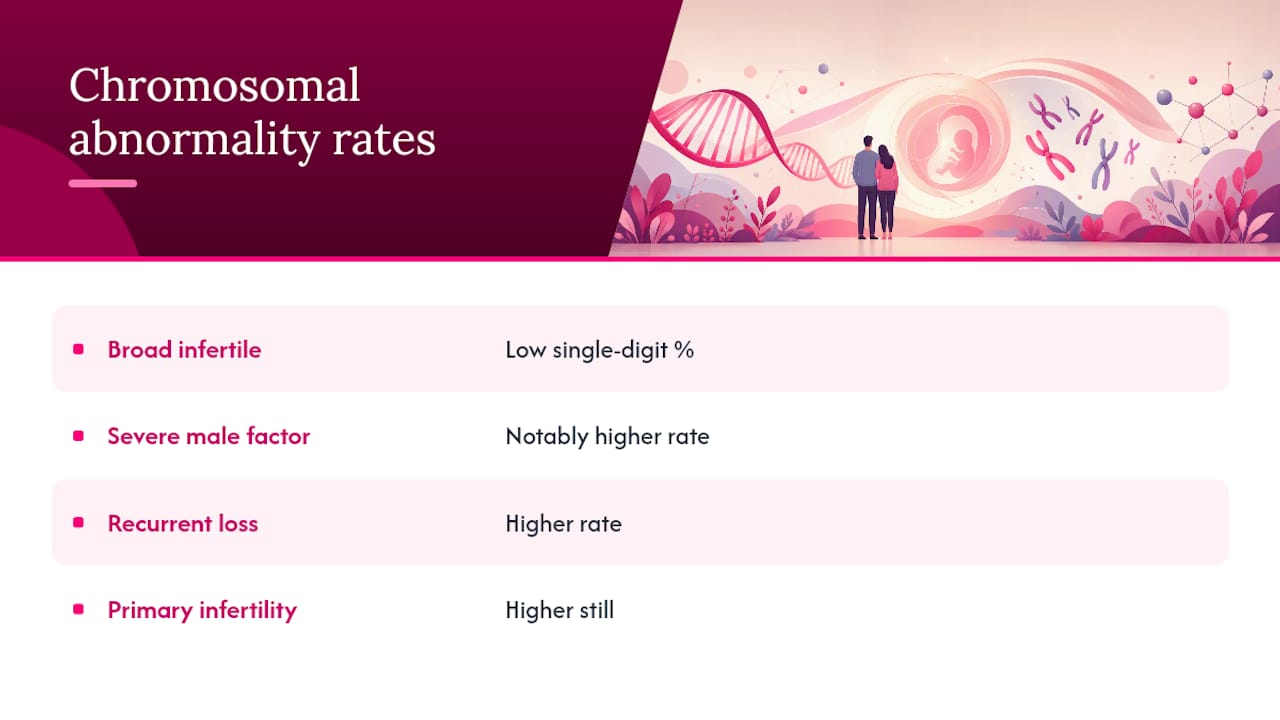
Large cytogenetic cohort data put clinically significant chromosomal abnormalities at a low single-digit percentage across infertile populations overall, but that rate climbs noticeably in men with severe sperm abnormalities and in couples with recurrent pregnancy loss. Reciprocal and Robertsonian translocations show up as the most commonly identified structural findings in these groups.
That pattern, drawn from a cytogenetic analysis of 62,587 infertile couples undergoing assisted reproduction, is the backbone of risk-based testing strategy: cast a wide net and you mostly waste time and money; target the net at RPL, severe male-factor cases, and abnormal pregnancy tissue, and the hit rate goes up substantially.
Coping After an Abnormal Karyotype Result
Getting a call that says “balanced translocation” or “47,XXY” lands hard, even when the explanation itself is medically useful. Many patients describe a strange double reaction: relief at finally having an answer after months or years of unexplained infertility, paired with grief over what the answer implies for future pregnancies.
That reaction is normal, and it does not mean something is wrong with how you’re coping. A few things tend to help patients move from shock to a workable plan:
- Separate the diagnosis from your worth as a partner or parent. A balanced translocation is a chromosomal fact, not a reflection of anything you did.
- Ask your genetic counselor for the actual numbers, not just the label. Recurrence risk varies enormously depending on which chromosomes are involved, and vague statements (“high risk”) are far less useful than a specific percentage for your rearrangement.
- Give yourself time before deciding on PGT-SR, prenatal diagnosis, or donor gametes. These are significant decisions, and there is rarely a clinical reason to choose in the same appointment where you get the news.
- Consider connecting with a mental health professional experienced in fertility or genetic diagnoses. This is a distinct category of grief from a single miscarriage, because it often reframes an entire reproductive history.
- Loop in family members thoughtfully when relevant. A structural rearrangement can appear in siblings or parents, and a counselor can help you decide who needs to know and how to say it.
Couples who process the result with support, rather than alone with a search engine at midnight, tend to move into treatment planning with a clearer head and less second-guessing later.
How Common Are Chromosomal Abnormalities in Infertility?
Chromosomal abnormalities are not the most common cause of infertility, but they are far more common than most patients assume once you look at the right subgroup. Across broad infertile populations, large cohort data put clinically significant findings at a low single-digit percentage, which sounds small until you narrow the lens.
That rate is not evenly spread. It climbs in men with azoospermia or severe oligospermia, where chromosomal abnormalities appear at notably higher rates than in men with normal semen parameters. It climbs again in couples with recurrent pregnancy loss, and higher still in couples experiencing primary infertility (never having achieved a pregnancy) compared with secondary infertility.
Reciprocal translocations and Robertsonian translocations turn out to be the most frequently identified structural abnormalities in these higher-risk groups, which is part of why guidelines steer testing toward RPL and severe male-factor cases specifically rather than everyone with a fertility diagnosis. Numerical abnormalities like Klinefelter syndrome (47,XXY) show up almost exclusively in the male infertility population, rarely in the general RPL group, which is one more reason a one-size-fits-all testing strategy doesn’t hold up against the data.
Life IVF Center’s Approach to Genetic Testing Within Precision IVF®
Life IVF Center’s team reviews reproductive history, prior pregnancy losses, and any existing lab work before recommending a specific genetic test, rather than defaulting to a single standard panel for every patient. That review shapes how Precision IVF® gets built around each case.
When a patient’s history points toward a structural rearrangement, targeted karyotyping is the logical starting point. When the picture suggests something broader, the conversation shifts toward chromosomal microarray or other molecular testing. Life IVF Center coordinates directly with genetics laboratories, offers multi-language support for patients navigating results, helps arrange travel logistics for those coming from outside the immediate area, and refers patients to genetic counseling before major decisions get made.
Ready to Talk Through Your Fertility Genetics Options?
If your history includes recurrent loss, an abnormal semen analysis, or a prior pregnancy with an unexpected chromosome finding, the next real step is a conversation, not another round of solo research. A consultation lets Life IVF Center’s team review what you’ve already been through and map out whether karyotype testing, broader molecular testing, or a different workup entirely makes sense for your case.
Bring what you have: any prior pregnancy loss testing or pathology results, a recent semen analysis if applicable, and notes on family history of genetic or chromosomal conditions. Even partial records help the team avoid repeating tests you’ve already had done elsewhere. Life IVF Center supports patients through the entire process, from lab coordination to genetic counseling referrals to explaining results in plain language once they come back.
Book a consultation with Life IVF Center to start mapping your genetics-informed path toward treatment.
Where These Findings Come From
The clinical guidance in this article draws on peer-reviewed literature and patient-facing resources from established medical institutions.
- Parental karyotype test: Infertility, miscarriage, translocations, and results (NCBI Bookshelf): foundational explainer on what the test detects and why it’s ordered.
- Genetic causes and management of male infertility (PMC article): covers chromosomal findings tied to severe sperm abnormalities.
- Retrospective cytogenetic analysis and recommendations for parental karyotyping (PMC article, 2024): supports risk-based rather than universal testing.
- Karyotype genetic test (MedlinePlus): patient-facing guidance on indications and counseling.
- Karyotype test: Test & what it is (Cleveland Clinic): overview of the testing process and counseling recommendations.
- Karyotypic analysis of 62,587 infertile couples undergoing ART (BMC Genomics, 2025): large cohort prevalence data.
This article is for general educational purposes and is not medical or genetic advice. Discuss testing, consent, limitations, and reproductive options with qualified fertility and genetics professionals.
Sources
- Parental karyotype test: Infertility, miscarriage, translocations, and results (NCBI Bookshelf)
- Genetic causes and management of male infertility (PMC article)
- Retrospective cytogenetic analysis and recommendations for parental karyotyping (PMC article, 2024)
- Karyotype genetic test (MedlinePlus)
- Karyotypic analysis of 62,587 infertile couples undergoing ART (BMC Genomics, 2025)
FAQ
Is a karyotype test worth it for infertility?
It’s worth it when your history includes recurrent pregnancy loss, severe male-factor infertility, or an abnormal pregnancy tissue result, since testing directly explains a mechanism and reshapes treatment choices in those groups. It’s less useful as a blanket test for every infertility diagnosis.
Will insurance cover karyotype testing?
Coverage is common when there’s a clear medical indication documented, such as recurrent loss or an abnormal semen analysis, though preauthorization rules vary by plan. Call your insurer directly before scheduling to confirm requirements.
What are the risks of a karyotype test?
The blood draw itself carries minimal physical risk, similar to routine lab work. The real risk is interpretive: results can include variants of uncertain significance or mosaicism that need a genetic counselor to translate accurately.
What genetic testing is done for infertility?
Karyotype testing is the standard first step when a structural chromosome rearrangement is suspected. Depending on the clinical picture, clinicians may add chromosomal microarray, targeted gene panels, or PGT-SR during IVF to screen embryos for unbalanced chromosome content, and Life IVF Center helps determine which combination fits a given case.
How does karyotype testing help couples with unexplained infertility?
It can uncover a balanced translocation or inversion that explains repeated pregnancy loss even when every other test looks normal. Once identified, that finding opens up options like PGT-SR or prenatal diagnosis that a couple wouldn’t otherwise know to pursue.
This article is for general educational purposes only and is not a substitute for personalized medical advice, diagnosis, or treatment. Fertility care is highly individual; please consult a qualified healthcare professional about your specific circumstances.
