
Most healthy women between 21 and 34 can donate eggs in the United States, and the fastest next step is to complete an online prescreen with a fertility clinic. Before you go further, check these three fastest disqualifiers:
- Age outside the clinic’s window (most U.S. programs accept donors from 21 to 34, though some extend to 35 with strong ovarian reserve results)
- Major medical conditions such as uncontrolled diabetes, autoimmune disorders, or a history of certain cancers
- Recent substance use including tobacco, marijuana, or recreational drugs within the past several months
If none of those apply to you, you are likely eligible to move forward. You can start the process as an egg donor at Life IVF Center to begin your prescreen today.
Key Takeaways
Donating eggs in the United States requires meeting age and health eligibility criteria, completing a multi-stage screening process, and committing to 4 to 8 monitoring visits plus a retrieval day across a 6 to 10 week timeline.
| Point | Details |
|---|---|
| Eligibility window | Most U.S. programs accept donors aged 21 to 34 with regular cycles and no major chronic illness. |
| Screening sequence | Prescreen, medical history, infectious-disease testing, genetic screening, and psychological evaluation are all required before stimulation. |
| Time commitment | Expect 4 to 8 monitoring visits during stimulation plus a full retrieval day, spanning 6 to 10 weeks total. |
| Key risks | Severe OHSS occurs in roughly 1%–2% of cycles; acute procedural complications are under 0.5% per ASRM data. |
| Next step with Life IVF Center | Complete the online prescreen at Life IVF Center to begin the donor application and confirm your eligibility. |
Table of Contents
- What egg donation is and the main donation types
- Who can donate: typical U.S. eligibility criteria and common exceptions
- Screening and testing: what you’ll be asked to complete before donation
- The donation process, step by step
- Medical and psychological risks donors should understand
- Pay, reimbursements, and costs: what donors typically receive
- Consent, parental rights, anonymity, and future contact
- Typical timeline, number of visits, and time off you should plan for
- How to choose a clinic or agency and exact questions to ask
- Recovery, follow-up care, and what evidence shows about future fertility
- Evidence summary: what major professional guidance says about safety and ethics
- What donors commonly report and what clinics recommend
- Life IVF Center supports donors from prescreen through recovery
- Sources
What egg donation is and the main donation types
Egg donation, clinically called oocyte donation, is the process by which a woman undergoes ovarian stimulation, has her eggs retrieved, and those eggs are then used by a recipient through in vitro fertilization (IVF). The retrieved eggs may be fertilized immediately in a fresh cycle or vitrified (frozen) for later use. Reproductivefacts describe both the stimulation and monitoring steps and note that donor-egg embryo transfers consistently achieve higher success rates than standard IVF.
The main donation arrangements you will encounter include:
- Anonymous donation: You are matched with a recipient through a clinic or agency, and identifying information is not shared between parties.
- Known or directed donation: You donate to a specific person you know, such as a family member or friend.
- Egg sharing: Your retrieved eggs are split between your own fertility preservation and a recipient’s cycle, sometimes offered as a cost-offset arrangement.
- Research donation: Eggs are donated to scientific research rather than reproductive use; consent requirements are distinct from clinical donation.
Fresh cycles require tighter coordination between donor and recipient, while frozen egg banks allow donors to complete a cycle independently of any specific recipient’s schedule.
Who can donate: typical U.S. eligibility criteria and common exceptions
U.S. programs generally set the age window at 21 to 34. The lower limit reflects legal consent capacity and psychological maturity; the upper limit reflects egg quality and ovarian reserve, both of which decline with age. Some programs will consider donors up to 35 if antral follicle counts and AMH (anti-Müllerian hormone) levels are strong.
Beyond age, typical eligibility criteria include:
- Regular menstrual cycles (roughly 25 to 35 days, consistent)
- BMI within program guidelines (most programs use a range of 18 to 28, though this varies)
- Non-smoker and free from recreational drug use
- No major chronic illness affecting reproductive function (e.g., uncontrolled thyroid disease, active autoimmune conditions)
- No history of certain hereditary genetic conditions in a three-generation family history
- Up-to-date vaccinations per program requirements, and willingness to complete required testing
- No recent hormonal contraceptive injections (Depo-Provera typically requires a waiting period)
- Psychological stability and no current major psychiatric diagnosis requiring medication
Previous donation is generally permitted, though ASRM’s 2020 committee opinion on repetitive oocyte donation recommends limiting total donation cycles to six to reduce cumulative risk. Programs will ask about prior cycles during your intake.
Screening and testing: what you’ll be asked to complete before donation
The egg donor screening process follows a defined sequence under ASRM’s 2024 guidance, which specifies medical history, physical and gynecologic evaluation, infectious-disease testing, and psychological evaluation as standard components. Here is how that sequence typically unfolds:
- Online prescreen: A brief questionnaire covering age, health history, BMI, and lifestyle factors. Programs use this to filter obvious ineligibility before investing clinical time.
- Medical history review: A detailed intake covering personal and family medical history, reproductive history, prior surgeries, and current medications.
- Physical and gynecologic evaluation: A pelvic exam, transvaginal ultrasound to assess antral follicle count, and baseline hormone testing (FSH, LH, estradiol, AMH).
- Infectious-disease testing: Blood and urine tests for HIV, hepatitis B and C, syphilis, gonorrhea, chlamydia, and other FDA-required markers. These tests are mandated under federal tissue-banking regulations for donor eligibility.
- Genetic screening: Carrier screening for conditions such as cystic fibrosis, spinal muscular atrophy, and fragile X, with the panel varying by program. Karyotype testing may also be included.
- Psychological evaluation: A structured interview and standardized testing conducted by a mental health professional trained in third-party reproduction. New York State DOH guidance frames psychological screening as essential because donation involves complex ethical and emotional considerations. This is not a pass/fail IQ test; it assesses your understanding of the process, your motivations, and your emotional readiness.
Screening results lead to one of three outcomes: acceptance, temporary deferral (e.g., a borderline lab value that needs retesting), or permanent exclusion. Test results are kept confidential under HIPAA, and you are entitled to receive a copy of your own results.
The donation process, step by step
ASRM’s 2024 guidance makes clear that donation involves ovarian stimulation with monitoring and oocyte retrieval, not just a simple match. Here is the full sequence:
- Prescreen and acceptance: Complete the online prescreen, pass initial review, and receive a formal acceptance letter from the program.
- Recipient matching: In anonymous programs, the clinic matches you with a recipient based on physical characteristics, blood type, and other criteria. In frozen-bank cycles, no specific match is required before stimulation begins.
- Cycle synchronization: You may be placed on oral contraceptives for 2 to 4 weeks to align your cycle with the recipient’s schedule or to time the stimulation start.
- Ovarian stimulation: You self-administer daily injectable gonadotropins for approximately 8 to 12 days. These medications stimulate multiple follicles to develop simultaneously.
- Monitoring visits: Every 2 to 3 days during stimulation, you return to the clinic for blood draws and transvaginal ultrasounds to track follicle growth and estrogen levels. Expect 4 to 8 visits during this phase.
- Trigger injection: When follicles reach the target size, you administer a trigger shot (hCG or a GnRH agonist) approximately 36 hours before retrieval.
- Egg retrieval day: The procedure uses transvaginal ultrasound aspiration under IV sedation or light anesthesia. A thin needle passes through the vaginal wall into each follicle to aspirate the eggs. The procedure itself takes 20 to 30 minutes. You will need a driver; you cannot leave alone.
- Recovery: Most donors rest at the clinic for 1 to 2 hours post-procedure and are discharged the same day. Light spotting and mild cramping are normal for 1 to 3 days. Full activity typically resumes within a week.
For detailed preparation steps, Life IVF Center’s egg retrieval preparation guide covers what to bring, what to avoid eating, and what to expect during recovery.
Cycle cancellation can happen at any stage. Poor ovarian response, excessive response (hyperstimulation risk), or a newly identified infectious finding can all prompt a program to cancel before retrieval. This is disclosed during informed consent and is not a reflection of personal failure.
Pro Tip: Plan for at least 4 to 8 clinic visits during the stimulation phase, plus retrieval day. Schedule these in advance and arrange a trusted person to drive you home from retrieval. Out-of-area donors should confirm whether the clinic offers remote monitoring coordination before committing.
Medical and psychological risks donors should understand
Egg donation is a medical procedure, and understanding the risks is part of making an informed decision.
Common short-term side effects include abdominal bloating, pelvic pressure, injection-site bruising, mood changes from hormonal fluctuation, and fatigue during stimulation. These typically resolve within days of retrieval.
Ovarian hyperstimulation syndrome (OHSS) is the most significant medical risk. Mild OHSS (bloating, nausea, mild discomfort) is relatively common. Severe OHSS, which can involve fluid accumulation, blood clots, and hospitalization, is less frequent.
Risk estimate: ASRM’s 2020 committee opinion estimates severe OHSS at approximately 1% to 2% per retrieval cycle, with acute procedural complications (infection, hemorrhage, ovarian torsion) at under 0.5%.
Symptoms requiring urgent care include severe abdominal pain, rapid weight gain (more than 2 pounds per day), decreased urination, shortness of breath, or leg pain. Contact your clinic immediately if any of these develop.
Additional risks to understand:
- Infection from the retrieval procedure, though rare with proper technique
- Ovarian torsion (twisting of the ovary), a surgical emergency occurring in a small fraction of stimulated cycles
- Hemorrhage at the aspiration site, also rare
- Anesthesia reactions, which your clinic will screen for in advance
Psychological risks are real and often underestimated. Some donors experience unexpected emotional responses after donation, particularly if they later have difficulty conceiving themselves or if they think about donor-conceived children. Counseling before and after donation, with a mental health professional who specializes in third-party reproduction, is strongly recommended, not optional.
Pay, reimbursements, and costs: what donors typically receive
Compensation for egg donation in the United States varies by program, donor profile, and geographic market.
Compensation range: First-time donors in the U.S. typically receive compensation per cycle within a range set by programs. Repeat donors with a documented successful prior cycle may receive higher compensation. Some programs in high-demand markets offer more, though ASRM’s ethics committee opinion cautions that compensation should not be set at a level that unduly influences donors to accept risks they would otherwise decline.
All medical costs associated with the donation cycle, including medications, monitoring visits, and the retrieval procedure itself, are typically covered by the recipient or the program. You should not pay out of pocket for any clinical component of the donation. Key financial points to confirm in writing:
- Payment schedule: When is compensation paid? Most programs pay after retrieval, not after a confirmed pregnancy.
- Expense reimbursements: Travel, lodging, parking, and childcare costs incurred for clinic visits are generally reimbursable. Get the reimbursement policy in writing before your first monitoring visit.
- Medication coverage: Confirm that injectable medications are covered and who the pharmacy contact is.
- Tax treatment: Compensation is generally treated as taxable income in the U.S. Consult a tax professional before your first cycle, particularly if you donate more than once.
- Insurance during the cycle: Ask the program whether they carry a short-term insurance policy covering you for complications during the donation cycle.
For questions about billing and insurance interactions, Life IVF Center’s prospective insurance patients page explains how coverage is handled for donors and recipients.
Consent, parental rights, anonymity, and future contact
Legal protection starts with the paperwork. Before stimulation begins, you will sign two distinct types of documents: clinical informed consent forms (covering medical risks, procedures, and your right to withdraw) and a legal donor contract (covering parental rights, compensation, anonymity, and future contact). These are not the same document, and they carry different legal weight.
Key legal points every donor should confirm:
- Parental rights: A properly drafted donor contract in the U.S. typically terminates any parental rights or obligations you might otherwise have to donor-conceived children. The specific language and enforceability vary by state. Independent legal counsel, separate from the clinic’s attorney, is advisable before signing.
- Anonymity: Many U.S. programs historically offered anonymous donation, but the landscape is shifting. Consumer DNA testing (23andMe, AncestryDNA) has made true anonymity difficult to guarantee regardless of what a contract states. Ask the program directly how they handle identifying information and what their policy is if a donor-conceived person seeks contact.
- Future contact: Some programs offer open-ID or identity-release arrangements, where the donor’s identity can be shared with donor-conceived individuals when they reach adulthood. Understand which model the program uses before you agree.
- Medical billing: Request written confirmation that all cycle-related medical bills will be directed to the recipient or program, not to you or your personal insurance.
- Data privacy: Ask how your medical records and genetic data are stored, who has access, and how long they are retained. HIPAA protections apply to your medical records at any covered entity.
New York State DOH guidance confirms that donation proceeds only after acceptance, matching, and informed consent, reinforcing that no stimulation should begin before all consent documents are signed. The ASRM ethics committee opinion also recommends that consent documents address future contact and potential fertility impacts explicitly.
For a broader overview of third-party reproductive arrangements and what consent processes look like, Life IVF Center’s intro to third-party services provides useful context.
Typical timeline, number of visits, and time off you should plan for
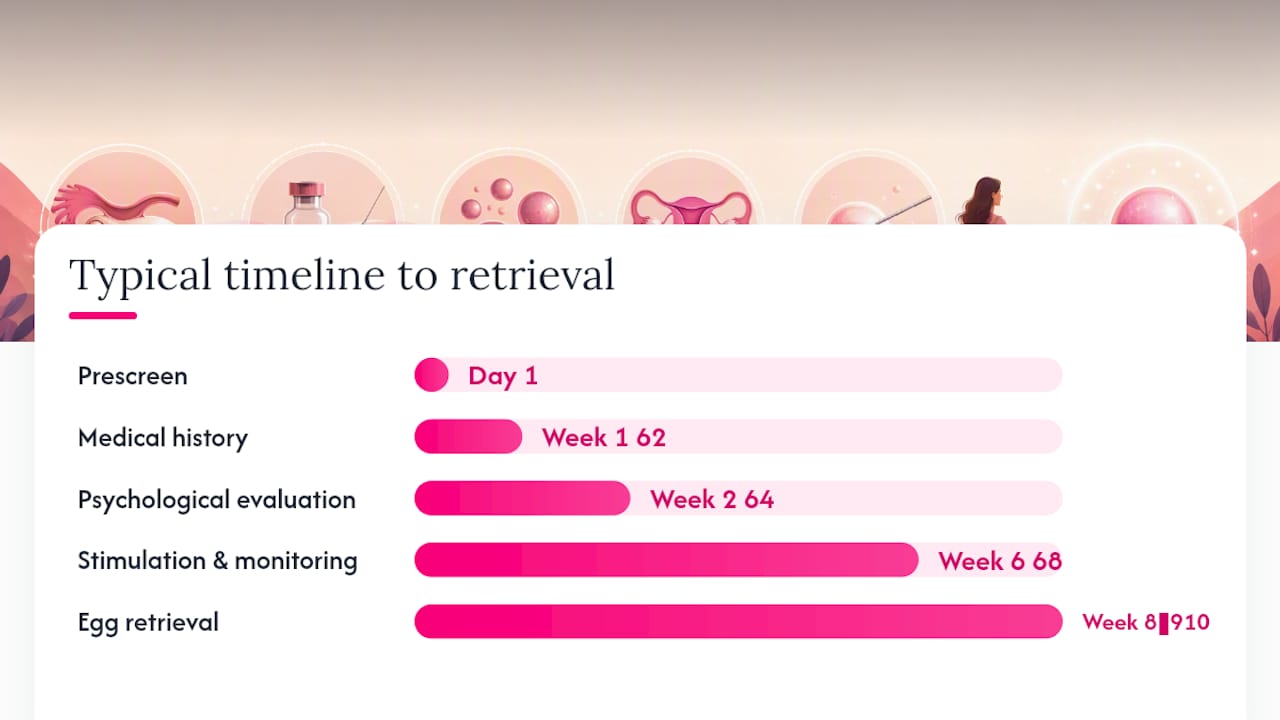
From the day you submit a prescreen to the day of egg retrieval, the full process typically spans 6 to 10 weeks. The table below outlines the main milestones and approximate timing.
| Milestone | Typical Timing |
|---|---|
| Online prescreen submission | Day 1 |
| Medical history and initial labs | Week 1–2 |
| Infectious-disease and genetic testing | Week 2–3 |
| Psychological evaluation | Week 2–4 |
| Formal acceptance and matching | Week 3–5 |
| Cycle synchronization (birth control) | Week 4–6 |
| Stimulation injections begin | Week 6–8 |
| Monitoring visits (4–8 visits) | Days 2–12 of stimulation |
| Trigger injection | ~36 hours before retrieval |
| Egg retrieval day | Week 8–10 |
| Post-retrieval follow-up visit | 1–2 weeks after retrieval |
Plan for the following time commitments:
- Monitoring visits: Early morning blood draws and ultrasounds, typically before 9 AM, on short notice. Flexibility in your work schedule during the 8 to 12 stimulation days is important.
- Retrieval day: Block the full day. You will be sedated and cannot drive or make legal decisions for 24 hours afterward.
- Recovery: Most donors return to desk work within 1 to 3 days. Physical labor or intense exercise should wait until your follow-up clearance.
Out-of-area donors should ask the clinic whether initial prescreening and psychological evaluations can be completed remotely, and whether monitoring visits can be coordinated with a local clinic before traveling for retrieval.
How to choose a clinic or agency and exact questions to ask
Selecting the right program matters as much as meeting the eligibility criteria. Look for these features when evaluating any clinic or agency:
- A reproductive endocrinologist (REI) overseeing the donor program medically
- On-site or affiliated mental health professional trained specifically in third-party reproduction
- Clearly written compensation and expense policies provided before you sign anything
- Genetic testing options that meet or exceed ASRM recommendations
- Transparent cycle cancellation policy and what compensation (if any) applies if a cycle is canceled after stimulation begins
Questions to ask at first contact:
- What is the complete screening sequence, and how long does it take?
- Who performs the psychological evaluation, and is independent counseling available?
- Can I see a sample consent form before I commit?
- When exactly is compensation paid, and what happens if the cycle is canceled?
- Who handles medical billing, and how do I confirm I will not receive a bill?
- What insurance coverage is in place for me during the donation cycle?
- How many donation cycles has this program completed, and what is the retrieval complication rate?
Red flags to watch for:
- Recruiters who promise a specific payment amount before screening is complete
- Pressure to skip or shorten the psychological evaluation
- Vague or verbal-only answers to questions about billing and insurance
- Consent forms that do not address future contact or parental rights explicitly
Life IVF Center’s donor program page outlines the clinic’s donor pathway, and the donor egg IVF overview explains what recipients experience, which gives donors useful context about how their contribution is used.
Recovery, follow-up care, and what evidence shows about future fertility
Immediate aftercare after retrieval is straightforward but specific. Rest for the remainder of retrieval day, avoid strenuous activity for 3 to 5 days, stay well hydrated, and avoid intercourse until your follow-up visit clears you. Call the clinic immediately for fever above 101°F, heavy vaginal bleeding, severe or worsening abdominal pain, or signs of OHSS described earlier.
Most programs schedule a follow-up visit 1 to 2 weeks after retrieval to confirm ovarian recovery and address any lingering symptoms. Some programs also offer a psychological check-in at this stage, which is worth requesting even if it is not automatically scheduled.
On the question of long-term fertility, the available evidence is reassuring but not absolute. Egg donation does not deplete your lifetime egg supply in a clinically meaningful way; the follicles stimulated during a donation cycle would otherwise have been lost in that month’s natural cycle. ASRM guidance supports this position, though it also recommends baseline ovarian reserve testing (AMH, antral follicle count) before donation so you have a personal reference point.
If you are considering your own family planning in the future, discuss the timing of donation cycles with your primary care provider or an REI. Donating in your mid-20s and planning your own pregnancy in your early 30s is a common and well-supported sequence, but individual ovarian reserve varies.
Evidence summary: what major professional guidance says about safety and ethics
The authoritative framework for egg donation in the United States comes primarily from the American Society for Reproductive Medicine (ASRM), with supplementary state-level guidance from health departments such as New York’s.
ASRM’s 2024 gamete and embryo donation guidance sets the standard for screening, counseling, and informed consent. It specifies that donors must complete medical history review, physical and gynecologic evaluation, infectious-disease testing, and psychological evaluation before any stimulation begins. Counseling about medications, monitoring, and retrieval risks is explicitly required, not optional.
On compensation, the ASRM ethics committee is direct:
For process comparison, the HFEA’s donor guidance illustrates how screening, counseling, and consent requirements appear in another regulated jurisdiction, useful for understanding what a well-structured program looks like even though UK compensation rules differ from U.S. practice.
The practical takeaway: programs that follow ASRM guidance on screening, counseling, and consent offer the strongest protection for donors. If a program cannot tell you which guidelines it follows, that is a meaningful gap.
What donors commonly report and what clinics recommend
Donors who complete the process frequently describe a sense of genuine contribution, particularly when they understand that donor-egg IVF often represents a recipient’s last viable path to parenthood. The logistics, however, tend to surprise first-time donors more than the medical aspects do. The monitoring schedule during stimulation, the early morning appointment times, and the need to arrange transportation for retrieval day require more planning than many donors anticipate.
Clinics consistently recommend three things before you apply: gather your complete medical and reproductive history, identify a support person who can accompany you to retrieval, and plan your work schedule around the stimulation monitoring window. These are practical steps, not formalities.
On counseling: if you have any doubts about your emotional readiness, or if you have unresolved questions about donor-conceived children and future contact, seek independent counseling before committing. A mental health professional who works specifically in third-party reproduction can help you think through scenarios that generic therapy may not address. Ask any program you consider how they support donors after the cycle ends, not just during it.
Life IVF Center supports donors from prescreen through recovery
Life IVF Center’s donor program at its Southern California locations covers the full cycle medically and administratively, from your initial prescreen through post-retrieval follow-up. Donors receive coordinated care under experienced reproductive endocrinologists, with access to counseling resources and clear written policies on compensation, expense reimbursement, and medical billing.
The clinic handles all cycle-related medical costs and provides guidance on financial paperwork, including reimbursement documentation for travel and related expenses. For donors coming from outside Southern California, Life IVF Center offers travel coordination support to reduce the logistical burden of monitoring visits and retrieval day.
To get started, visit the Life IVF Center donor program page to complete your online prescreen, or review the clinic’s treatment and donor program options to understand what the program covers. Have your medical history, a list of current medications, and your availability for the next 8 to 10 weeks ready for your first intake conversation.
Sources
- Becoming An Egg Donor
- Repetitive oocyte donation: a committee opinion (2020)
- ASRM ethics committee opinion (2021)
- Reproductivefacts
- Donating your eggs | HFEA
This article is general information, not a substitute for advice from a qualified doctor. Consult a qualified healthcare professional about your own circumstances before acting on anything here.
Recommended
- Working with Donor Eggs – Life IVF Center
- Egg Donation in Tampa: How to Apply and What You Earn
- Blog – Life IVF Center
Ready to take the next step?
Life IVF Center specializes in individualized Precision IVF® care for complex cases—including diminished ovarian reserve, prior failed cycles, and advanced maternal age. Our in-house labs and dedicated physicians are ready to help.
Book a Free Consultation →