
Preimplantation genetic testing (PGT) is the analysis of genetic material from embryos created through IVF before those embryos are transferred to the uterus. It can meaningfully reduce the risk of transferring embryos with certain chromosomal or genetic problems, but it does not guarantee a healthy pregnancy or baby. Understanding what PGT can and cannot do is the foundation for any informed conversation with your care team.
The field uses three distinct clinical types, each with a different purpose:
- PGT-A screens embryos for aneuploidy (abnormal chromosome number), the most common cause of IVF failure and miscarriage.
- PGT-M tests for a specific single-gene disorder when one or both parents carry a known pathogenic variant.
- PGT-SR identifies chromosomal structural rearrangements when a parent carries a translocation or inversion.
Each type is explained in detail below, along with who qualifies, how the process works, and what to realistically expect from results.
Table of Contents
- What are the three types of PGT, and what does each test for?
- Who is a good candidate for PGT?
- How does PGT fit into the IVF process, step by step?
- What are the real benefits and limitations of PGT?
- How do you read PGT results, and what comes next?
- What risks and practical considerations should you plan for?
- How Life IVF Center approaches PGT within Precision IVF®
- Key Takeaways
- The weight of a result: what patients often underestimate about PGT
- Ready to discuss PGT with a specialist at Life IVF Center?
- Trusted sources for further reading
What are the three types of PGT, and what does each test for?
PGT is classified into three types by clinical objective: PGT-A for aneuploidy, PGT-M for monogenic disorders, and PGT-SR for structural rearrangements. The differences in purpose, test design, and patient profile are significant enough that choosing the right type requires a careful clinical conversation.

PGT-A: screening for chromosome number errors
PGT-A examines whether an embryo has the correct number of chromosomes (46 in humans). Embryos with extra or missing chromosomes, called aneuploid embryos, are the leading cause of failed IVF cycles and early pregnancy loss. PGT-A is most commonly used for patients with recurrent implantation failure, recurrent miscarriage, or advanced maternal age, groups in which aneuploidy rates in embryos are higher. It was previously called preimplantation genetic screening (PGS), a term you may still encounter in older literature.
PGT-M: testing for a known single-gene disorder
PGT-M applies when one or both partners carry a pathogenic variant in a specific gene. Common examples include cystic fibrosis, Huntington’s disease, sickle cell disease, and thalassemia. Unlike PGT-A, which uses a standardized panel, PGT-M requires a custom test designed around the specific mutations in the intended parents, a process that can take several months before an IVF cycle even begins. Couples with normal fertility sometimes pursue IVF solely to access PGT-M.
PGT-SR: identifying structural chromosomal rearrangements
PGT-SR is used when a parent carries a chromosomal rearrangement such as a balanced translocation or inversion. These parents are typically healthy themselves, but their embryos have a high probability of inheriting an unbalanced chromosomal arrangement, which can cause miscarriage or serious developmental problems. PGT-SR identifies which embryos carry a balanced or normal arrangement so that only those are considered for transfer.
| PGT Type | What It Tests | Typical Patient | Test Design |
|---|---|---|---|
| PGT-A | Chromosome number (aneuploidy) | Recurrent loss, failed IVF, advanced maternal age | Standardized panel |
| PGT-M | Specific single-gene variant | Known carrier(s) of inherited disorder | Custom-designed per family |
| PGT-SR | Chromosomal structural rearrangements | Parent with balanced translocation or inversion | Tailored to rearrangement |
Key differences at a glance:
- PGT-M is the only type that requires months of custom laboratory preparation before the IVF cycle starts.
- PGT-A and PGT-SR use the same embryo biopsy process but analyze different chromosomal features.
- Patient motivation differs: PGT-A is primarily about improving IVF outcomes, while PGT-M and PGT-SR are primarily about preventing the transmission of a known genetic condition.
Who is a good candidate for PGT?
Not every IVF patient needs PGT, and PGT itself requires IVF even for couples with no fertility problem, which adds medical risk and cost. Candidacy depends on clinical indications and personal reproductive goals.
Common clinical indications include:
- Known carrier status for a single-gene disorder (e.g., cystic fibrosis, spinal muscular atrophy, BRCA variants with high penetrance)
- Parental chromosomal rearrangement such as a balanced translocation confirmed by karyotype
- Recurrent pregnancy loss (typically two or more losses), where chromosomal causes are suspected
- Repeated failed IVF cycles despite good embryo quality by morphology
- Advanced maternal age (generally 35 and older), where embryo aneuploidy rates rise
- Previous child born with a chromosomal or genetic condition
Some patients pursue PGT for additional reasons, including HLA matching for a sibling who needs a stem cell donor, or to avoid sex-linked conditions. When PGT is requested for non-medical reasons, clinical and ethical review is typically part of the process.
PGT is generally not recommended as a routine add-on for all IVF patients without a specific indication. Clinical guidelines and professional bodies emphasize that the decision should be individualized.

Pro Tip: Genetic counseling is widely recommended before deciding on PGT. A genetic counselor can review your family history, explain which type of PGT applies to your situation, and help you understand what results will and will not tell you. Schedule this consultation before your IVF cycle begins, not after.
How does PGT fit into the IVF process, step by step?
PGT does not replace IVF. It is a laboratory step added within an IVF cycle, and understanding the sequence helps you plan realistically.
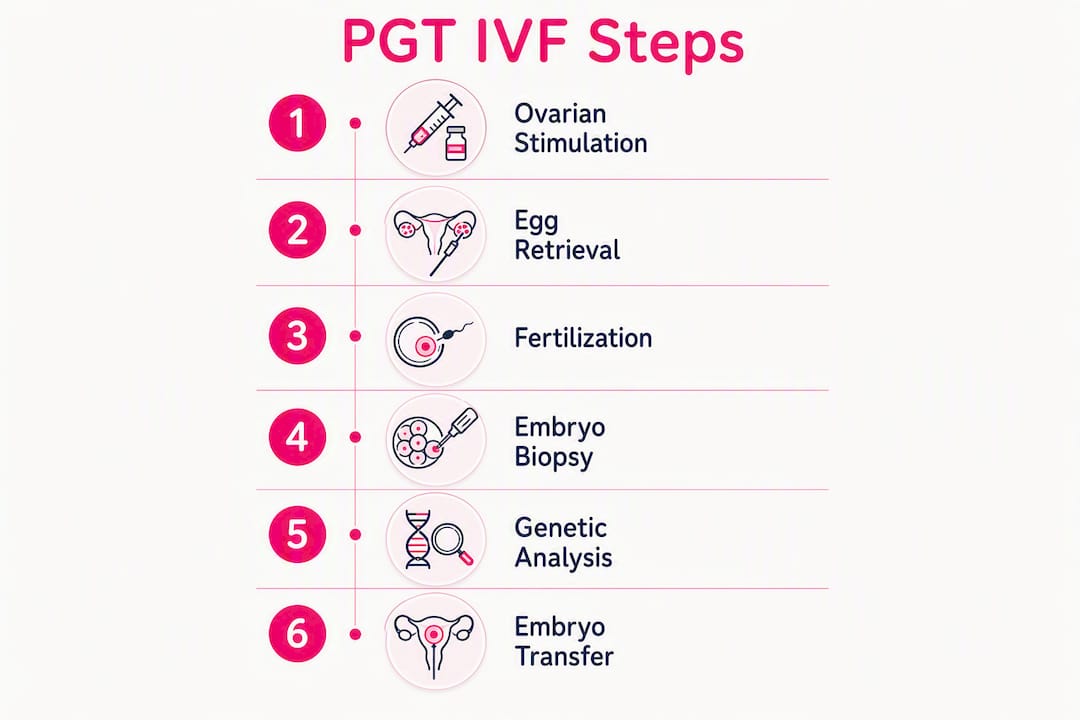
The standard IVF-with-PGT sequence:
- Egg retrieval: Eggs are collected under sedation in a brief outpatient procedure. You can review what to expect during retrieval to prepare for this step.
- Trophectoderm biopsy: A small number of cells (typically several) are removed from the outer layer of the blastocyst. This is the current standard approach because it minimizes impact on the inner cell mass, which becomes the fetus.
- Embryo freezing: All biopsied embryos are cryopreserved immediately while testing is completed.
- Laboratory analysis: Biopsied cells are sent to a genetics laboratory. Testing methods include next-generation sequencing (NGS), which detects chromosomal copy number changes across the whole genome; PCR-based assays, used for targeted single-gene mutations in PGT-M; and chromosomal microarray, which can also detect copy number variants.
Because PGT is performed on just one or a few cells, it must be more sensitive than standard diagnostic genetic tests, and results carry a small but real margin of uncertainty that standard blood-based genetic tests do not face.
| Stage | Typical Timeframe |
|---|---|
| Ovarian stimulation to retrieval | about two weeks |
| Embryo culture to blastocyst | about five to six days post-retrieval |
| Biopsy to results (PGT-A/SR) | one to two weeks |
| Biopsy to results (PGT-M) | a few weeks after the custom test is ready |
| PGT-M test design (pre-cycle) | months before IVF starts |
Pro Tip: If you are planning PGT-M, start the process well before your intended IVF cycle. The custom test design, which involves parental haplotyping and family-marker analysis, can take several months to complete. Beginning this preparation early prevents delays once your cycle is ready to start.
What are the real benefits and limitations of PGT?
PGT offers genuine clinical advantages for the right patients, but it is not a guarantee of success, and understanding where its limits lie prevents disappointment and supports better decision-making.
Benefits
- Reduces the likelihood of transferring embryos with chromosomal abnormalities, which are a leading cause of implantation failure and miscarriage.
- Can shorten the overall time to a successful pregnancy for specific patient groups, such as those with recurrent implantation failure, by avoiding transfers of embryos unlikely to implant.
- Allows couples who carry known single-gene disorders to select embryos unaffected by that condition, reducing the risk of passing it to a child.
- Provides information that helps prioritize which embryos to transfer when multiple are available.
Limitations
- PGT has inherent technical limitations: false positives and false negatives are possible, meaning an embryo may be incorrectly classified as normal or abnormal.
- PGT cannot screen for all genetic conditions. It tests only what it is designed to test.
- A normal PGT result does not predict all aspects of a child’s health. Many conditions have no genetic basis detectable by current methods.
- The clinical benefit of PGT-A for all IVF patients is less certain and remains an active area of research; PGT-M and PGT-SR have stronger established utility for their specific indications.
Mosaicism: a complicating factor
Mosaicism occurs when an embryo contains a mixture of chromosomally normal and abnormal cells. Because the biopsy samples only the trophectoderm (the outer cell layer), it may not perfectly represent the chromosomal status of the inner cell mass. A mosaic result means the embryo is neither clearly euploid nor clearly aneuploid, and its developmental potential is uncertain. Clinics handle mosaic embryos differently, and policies on whether to transfer them vary. This is one reason why genetic counseling before and after testing is so important.
How do you read PGT results, and what comes next?
PGT reports use specific terminology that can feel unfamiliar. Knowing what each term means helps you have a more productive conversation with your care team.
Common result terms:
- Euploid: The embryo has the expected number of chromosomes. This is generally considered suitable for transfer.
- Aneuploid: The embryo has an abnormal chromosome number. These embryos are typically not transferred because they carry a high risk of failed implantation, miscarriage, or chromosomal conditions.
- Mosaic: The embryo contains a mix of euploid and aneuploid cells. Transfer decisions for mosaic embryos are made case by case, in consultation with the genetics laboratory and your clinical team.
- Inconclusive / failed test: The sample did not produce a result of sufficient quality. A repeat biopsy may be possible in some cases, but not always.
| Result | Typical Next Step |
|---|---|
| Euploid | Plan frozen embryo transfer |
| Aneuploid | Embryo not transferred; discuss remaining options |
| Mosaic | Detailed counseling; possible targeted transfer based on type and degree |
| Inconclusive | Discuss re-biopsy feasibility or alternative options with care team |
One point that surprises many patients: a euploid result from PGT does not eliminate the need for prenatal testing. Prenatal diagnostic testing, specifically CVS or amniocentesis, should be offered to confirm results during pregnancy. The reason is straightforward: mosaicism and the technical limits of single-cell analysis mean that PGT results, while highly informative, are not infallible. Prenatal confirmation adds a critical layer of certainty.
What risks and practical considerations should you plan for?
PGT is a medically and emotionally significant decision. Planning for the full range of considerations, clinical, financial, and personal, before the cycle begins leads to better outcomes.
Medical and technical risks
- Trophectoderm biopsy carries a small risk of embryo damage, though this risk is low with experienced embryology teams using current techniques.
- Misdiagnosis, while uncommon, is possible due to the technical constraints of testing a small number of cells.
- Mosaic results can create difficult transfer decisions with no clear right answer.
Emotional and ethical considerations
- Receiving a result showing that most or all embryos are aneuploid can be deeply distressing, particularly after a demanding IVF cycle.
- PGT-M results may reveal information about parental carrier status or family members that has implications beyond the immediate reproductive decision.
- Some patients face ethical questions about what to do with aneuploid or mosaic embryos, including decisions about disposition.
Practical planning in the U.S.
In the United States, PGT is typically an out-of-pocket expense. Insurance coverage for genetic testing in IVF is limited and varies significantly by plan and state. Costs generally include the biopsy procedure, the laboratory analysis fee, and, for PGT-M, the custom test design fee. Checking your benefits early, before the cycle begins, is strongly advisable. Many clinics offer financial counseling to help patients understand their options and explore financing.
Pro Tip: Ask your clinic about insurance coverage for PGT before your cycle starts. Some plans cover genetic counseling even when they do not cover the testing itself. Genetic counseling, mental health support, and patient navigation services are resources worth requesting regardless of coverage status.
How Life IVF Center approaches PGT within Precision IVF®
At Life IVF Center, PGT is integrated into the clinic’s Precision IVF® approach, which customizes each treatment protocol based on a patient’s unique biological profile, medical history, and reproductive goals. PGT is not offered as a generic add-on; it is recommended when there is a clear clinical indication and when the patient has had the opportunity to understand what testing will and will not provide.
The clinical workflow includes:
- Genetic counseling coordination before the cycle, so patients understand which PGT type applies and what results will mean for their transfer decisions.
- PGT-M planning support, including early coordination with the genetics laboratory to allow adequate time for custom test design.
- Blastocyst biopsy performed by experienced embryologists, with all biopsied embryos cryopreserved to allow time for results and a planned frozen embryo transfer.
- Result review and transfer planning with the clinical team, including discussion of mosaic or inconclusive results and next steps.
Patient support at Life IVF Center extends beyond the laboratory. Financial counseling, multi-language support, and travel coordination are available for patients coming from outside the immediate Southern California area. For a detailed overview of genetic testing options used in IVF at the clinic, the blog provides additional context on how different testing approaches are applied in practice.
When preparing for a first PGT consultation, bring your family history (at least three generations if possible), any prior genetic test results or carrier screening reports, existing fertility records, and your insurance information.
Key Takeaways
Preimplantation genetic testing reduces the risk of transferring chromosomally abnormal embryos during IVF, but it requires genetic counseling, carries technical limitations, and does not replace prenatal confirmatory testing.
| Point | Details |
|---|---|
| PGT tests embryos before transfer | Genetic analysis is performed on IVF embryos before they are placed in the uterus. |
| Three distinct types exist | PGT-A screens for aneuploidy; PGT-M targets single-gene disorders; PGT-SR addresses structural rearrangements. |
| Results are not a guarantee | False positives, false negatives, and mosaicism mean prenatal confirmation (CVS or amniocentesis) is still recommended. |
| Genetic counseling is essential | Clinical guidance recommends counseling before and after PGT to interpret results and understand family implications. |
| Life IVF Center integrates PGT into Precision IVF® | The clinic coordinates genetic counseling, biopsy, and transfer planning as part of a personalized treatment protocol. |
The weight of a result: what patients often underestimate about PGT
Most conversations about PGT focus on the science, and rightly so. But what patients often underestimate is the emotional weight of receiving results, particularly when those results are mosaic, inconclusive, or show that no euploid embryos are available for transfer.
The clinical data is clear: PGT-M and PGT-SR have well-established utility for preventing the transmission of specific inherited conditions. PGT-A is genuinely useful for certain patient groups, especially those with recurrent implantation failure or advanced maternal age. What the data cannot prepare you for is sitting with a report that says every embryo from your cycle is aneuploid, or that your only available embryo is mosaic, and having to make a decision under that pressure.
The most important thing a care team can do is prepare patients for every possible scenario before the cycle begins, not just the best-case outcome. Shared decision-making, grounded in honest counseling about what each result type means and what options follow, is what separates a good PGT experience from a traumatic one. The science is a tool. How it is used, and how patients are supported through it, determines whether it actually helps.
Ready to discuss PGT with a specialist at Life IVF Center?
Life IVF Center offers PGT-aware consultations as part of its Precision IVF® program, with genetic counseling coordination built into the process from the start. Rather than adding testing as an afterthought, the clinic’s approach is to evaluate whether PGT is appropriate for your specific situation and, if so, to plan the timing and type of testing before your cycle begins.
To make the most of your first consultation, bring the following:
- Three-generation family history, including any known genetic conditions or carrier status
- Prior genetic or carrier screening results
- Existing fertility records, including any previous IVF cycle summaries
- Insurance information, so financial counseling can begin early
Financial guidance and travel support are available for patients coordinating care from outside Southern California. Review treatment package options to understand what is included, and schedule a consultation to discuss whether PGT belongs in your plan.
This article provides general medical information and is not a substitute for professional medical advice. Confirm current clinical guidelines and your individual eligibility with a qualified reproductive specialist or genetic counselor.
Trusted sources for further reading
The following resources provide authoritative, patient-accessible information on PGT and genetic testing in reproductive medicine:
- ACOG Committee Opinion on Preimplantation Genetic Testing: Clinical guidance from the American College of Obstetricians and Gynecologists; the primary professional standard for PGT practice in the U.S.
- Learn Genetics Utah: How PGT Works: A patient-friendly technical overview of how PGT is performed, including biopsy methods and testing sensitivity.
- MedlinePlus Genetics: Genetic Testing: A plain-language overview from the National Library of Medicine covering genetic testing types, counseling, and what results mean.
- CDC: Genetic Testing and Genomics: Public health context for genetic testing, including how results inform medical care decisions.
- UpToDate: Preimplantation Genetic Testing: Clinician-level detail on PGT indications, methods, and evidence; useful for patients who want a deeper technical reference.
- ISRG Guidelines on PGT: International Society of Reproductive Genetics voluntary guidelines covering recommended practices for PGT methods, counseling, and laboratory quality standards.
Recommended
- The Role of Genetics in IVF: What Patients Need to Know
- Examples of Genetic Testing for IVF and Fertility
- C. Getting Ready with Pre-IVF Archives – Life IVF Center
Ready to take the next step?
Life IVF Center specializes in individualized Precision IVF® care for complex cases—including diminished ovarian reserve, prior failed cycles, and advanced maternal age. Our in-house labs and dedicated physicians are ready to help.
Book a Free Consultation →