
Technology is defined as the primary driver reshaping reproductive health outcomes, from fertility tracking to AI-assisted IVF. The role of technology in reproductive health now spans hormone analyzers with 99% lab-grade accuracy, AI systems trained on data from over 1.2 million patients, and digital counseling tools that measurably improve family planning knowledge. These advances give individuals and couples more information, more personalized care, and more control over their reproductive futures than any previous generation. Understanding what each tool actually does, and where its limits lie, is the foundation for making sound decisions about your fertility care.
How does the role of technology in reproductive health improve fertility tracking?
Digital tools for reproductive care have moved well beyond simple calendar apps. Today’s consumer-grade devices measure multiple hormone biomarkers directly, giving patients data that was previously available only in a clinical lab.

At-home hormone analyzers now measure luteinizing hormone (LH), estrogen metabolite (E3G), and progesterone metabolite (PdG) simultaneously. These devices predict a 6-day fertile window with 99% accuracy. That level of precision closes a meaningful gap between what patients can learn at home and what a lab visit would reveal.
Wearables add another layer by collecting continuous physiological data, including basal body temperature, heart rate variability, and sleep patterns. This longitudinal data stream does something a single clinic visit cannot: it captures how your body changes across multiple cycles, not just one snapshot in time. Femtech devices that collect this kind of data can close knowledge gaps about hormonal changes across a woman’s lifespan, enabling genuinely personalized care.
Digital counseling tools also show measurable results. Tablet-based programs improve family planning awareness among patients with a median age of 26, with 52% of married participants reporting enhanced knowledge after use. Better-informed patients ask better questions and make more confident decisions during clinical consultations.
There is one important caveat. Many popular fertility apps rely on population averages and may miss individual medical nuances, creating a gap between general fertility literacy and an actual clinical diagnosis. An app that predicts ovulation based on average cycle data will not detect polycystic ovary syndrome (PCOS) or a luteal phase defect. That distinction matters enormously when you are trying to conceive.
- Hormone analyzers: measure LH, E3G, and PdG for a 6-day fertile window prediction
- Wearables: track temperature, heart rate, and sleep across multiple cycles
- Digital counseling platforms: improve patient knowledge and decision-making
- Fertility apps: useful for general tracking but not a substitute for clinical hormone testing
Pro Tip: Bring your hormone analyzer data to your first fertility consultation. Quantitative biomarker readings give your specialist far more to work with than a symptom diary or a prediction-only app.
What is the impact of artificial intelligence on fertility treatments?
AI’s impact on fertility treatments is real, measurable, and growing. The most significant applications appear inside IVF laboratories and diagnostic imaging, where pattern recognition at scale produces results no single clinician could replicate manually.
Generative AI models trained on data from over 1.2 million patients significantly improve menstrual health forecasting compared to earlier statistical methods. In IVF labs, AI assists with embryo grading, sperm analysis, and follicle measurement during ultrasound, reducing the variability that comes from manual assessment. These are not marginal improvements. They translate directly into more consistent embryo selection and better-timed transfer decisions.
The critical finding from recent research is that AI combined with clinical expertise produces better outcomes than AI alone. This means AI functions best as a decision-support tool, not a replacement for a specialist’s judgment. A physician reviewing AI-generated embryo scores alongside a patient’s full medical history will make a better decision than either the algorithm or the physician working independently.
The practical implications for patients are significant:
- Ask about AI-assisted embryo grading. Clinics using validated AI grading systems reduce subjective variability in embryo selection, which can improve transfer success rates.
- Confirm AI tools are FDA-cleared or CE-marked. Regulatory clearance signals that a tool has been evaluated for safety and performance in a clinical context.
- Expect AI to inform, not decide. Your specialist should be able to explain how AI outputs influenced a recommendation, not simply cite the algorithm’s output as the final word.
- Understand that AI has training data limits. A model trained predominantly on one demographic may perform less accurately for patients from underrepresented groups.
The advanced reproductive technology landscape in 2026 integrates AI at multiple points in the IVF cycle. Patients who understand where AI enters the process are better positioned to ask the right questions and evaluate clinic capabilities accurately.
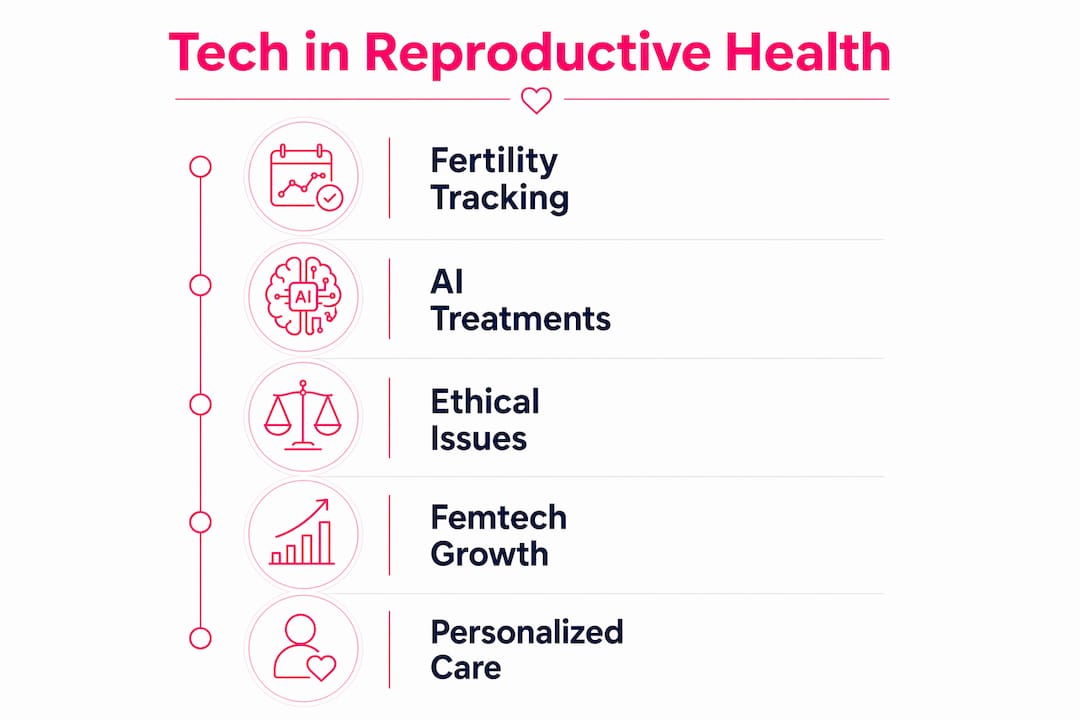
What ethical and privacy challenges come with reproductive health technology?
Reproductive health data is among the most sensitive personal information a person can generate. The ethical and governance challenges surrounding digital reproductive tools are not theoretical. They affect patients right now.
Consumer reproductive health apps often fall outside HIPAA protections, meaning the privacy rules that govern your doctor’s office do not apply to the app on your phone. These apps may share sensitive fertility data with third parties under terms buried in lengthy user agreements. Patients who track ovulation, pregnancy attempts, or miscarriages through consumer apps may be sharing that data with advertisers, data brokers, or researchers without fully understanding the terms.
Algorithmic bias is a second, less-discussed risk. AI systems trained on datasets that underrepresent certain racial, ethnic, or socioeconomic groups may produce less accurate predictions for those patients. In reproductive medicine, a biased algorithm could influence embryo selection, cycle timing, or diagnostic conclusions in ways that disadvantage already-underserved populations.
“AI in reproductive health raises ethical issues including lack of transparency, risk of bias, privacy concerns, and limited accountability, especially in resource-constrained settings. Algorithmic reproductive health tools currently lack standardized governance, increasing risks that undermine patient autonomy and informed consent.”
Frontiers in Reproductive Health, 2026
Transparency is the third pillar of responsible technology use in this space. Patients deserve to know when an algorithm influenced a clinical recommendation, what data that algorithm was trained on, and who is accountable if the recommendation causes harm. Clinics that cannot answer those questions clearly have not yet integrated AI responsibly. The privacy risks in reproductive health tech demand that patients read data-sharing policies carefully before using any consumer app for fertility tracking.
How are emerging technologies shaping women’s health beyond fertility?
Technology in women’s health now extends well beyond conception and pregnancy. Femtech, a category covering digital health products designed specifically for female physiology, addresses hormonal health, contraception, menopause, and chronic conditions like endometriosis.
The most significant shift is from symptom tracking to physiological insight. Femtech innovations that collect longitudinal physiological data via wearables generate the kind of continuous hormone profiles that move care from reactive to proactive. A patient who has six months of basal temperature and heart rate variability data arrives at a specialist appointment with objective evidence, not a memory of how she felt last cycle.
Next-generation contraceptive options are also becoming more personalized. Long-acting reversible contraceptives (LARCs) and intravaginal biosensors that monitor hormone levels in real time give patients and clinicians more precise control over contraceptive timing and effectiveness. These tools reduce reliance on population-average dosing schedules and move toward individualized protocols.
| Technology category | Primary application | Key benefit |
|---|---|---|
| Wearable biosensors | Continuous hormone and temperature monitoring | Longitudinal data for personalized treatment |
| Intravaginal sensors | Real-time hormone level detection | Precise contraceptive and cycle management |
| Digital counseling platforms | Family planning education and decision support | Improved patient knowledge and autonomy |
| AI diagnostic tools | Ultrasound analysis and embryo grading | Reduced variability in clinical assessment |
Equitable access remains an unresolved challenge. Many femtech products carry price points that exclude lower-income patients, and most have been designed and validated using data from predominantly white, Western populations. Culturally sensitive design and subsidized access programs are necessary for these tools to deliver broad public health benefits, not just benefits for patients who can afford premium devices.
Pro Tip: When evaluating a femtech device or app, check whether its clinical validation studies included participants who match your demographic background. Validation on a narrow population does not guarantee accuracy for everyone.
Key Takeaways
Technology improves reproductive health outcomes most reliably when objective data from digital tools is combined with personalized clinical judgment, not used as a substitute for it.
| Point | Details |
|---|---|
| Hormone analyzers deliver lab-grade data | At-home devices measuring LH, E3G, and PdG predict a 6-day fertile window with 99% accuracy. |
| AI works best alongside clinicians | AI combined with specialist expertise produces better fertility outcomes than either approach alone. |
| Consumer apps carry privacy risks | Many fertility apps fall outside HIPAA, meaning sensitive reproductive data may be shared with third parties. |
| Femtech generates longitudinal insight | Continuous physiological monitoring moves care from symptom tracking to genuine hormonal understanding. |
| Clinical testing remains irreplaceable | Apps relying on population averages cannot diagnose conditions like PCOS; clinical hormone testing is required. |
Why I think the technology conversation in reproductive health is missing something important
Patients come to me having done serious research. They arrive with hormone graphs from wearables, cycle predictions from apps, and AI-generated embryo scores from previous clinics. The data is often genuinely useful. But I have noticed a pattern that concerns me.
The more impressive the technology, the more patients trust it uncritically. A 99% accuracy claim on a hormone analyzer is real and meaningful. But 99% accuracy for predicting a fertile window is not the same as a diagnosis. When a patient with irregular cycles and elevated androgens relies on an app’s ovulation prediction instead of getting a clinical workup, she may spend months optimizing around a window that does not reflect her actual physiology.
Quantitative hormone data from digital devices provides far more value to a fertility specialist than subjective logs. That is true. But the data needs a clinician to interpret it in context. An LH surge on a monitor means something different for a patient with PCOS than for a patient with regular cycles. Technology surfaces the signal. The specialist reads it correctly.
My honest view is that the best use of reproductive health technology is as preparation for a clinical conversation, not a replacement for one. Bring your data. Use your devices. But treat every number as a question to ask your doctor, not an answer you already have. The role of counseling in IVF is precisely to help patients interpret what their data actually means for their specific situation.
— Ben
Precision fertility care at Lifeivfcenter
Lifeivfcenter integrates the technologies discussed in this article into a structured, personalized treatment model called Precision IVF®. The approach customizes every protocol based on your biological profile, hormone data, medical history, and reproductive goals, reducing the number of cycles needed and improving the accuracy of each decision along the way.
Patients at Lifeivfcenter benefit from AI-assisted embryo grading, advanced hormone monitoring, and specialist oversight at every stage of treatment. The clinic’s Southern California locations serve patients across a wide range of fertility challenges, from age-related concerns to complex conditions like endometriosis and immune disorders. Explore Precision IVF treatment options or review affordable fertility packages to understand what a technology-supported, clinician-led approach looks like in practice.
FAQ
What is the role of technology in reproductive health?
Technology in reproductive health covers digital tools, AI systems, and telemedicine platforms that improve fertility tracking, diagnosis, and treatment. These tools increase accuracy, personalize care, and expand access to reproductive health services.
How accurate are at-home hormone analyzers for fertility tracking?
At-home hormone analyzers measuring LH, E3G, and PdG predict a 6-day fertile window with 99% lab-grade accuracy. They provide objective biomarker data that is significantly more useful to a fertility specialist than prediction-only apps.
Can AI replace a fertility specialist in IVF treatment?
AI cannot replace a fertility specialist. Research confirms that AI combined with clinical expertise produces better outcomes than AI alone, making it a decision-support tool rather than a substitute for personalized medical judgment.
Are fertility apps private and HIPAA-compliant?
Many consumer fertility apps fall outside HIPAA protections and may share sensitive reproductive data with third parties. Patients should review each app’s data-sharing policy carefully before entering personal health information.
What is femtech and how does it affect women’s health?
Femtech refers to digital health products designed for female physiology, including wearables, biosensors, and diagnostic platforms. These tools collect longitudinal hormone data that enables personalized care across fertility, contraception, and hormonal health beyond the reproductive years.
Recommended
- The Role of Technology in IVF: What Really Works
- Advanced Reproductive Technology Guide for 2026
- The Role of Accessibility in Fertility Care
- Signs of Reproductive Health: What to Watch in 2026
Ready to take the next step?
Life IVF Center specializes in individualized Precision IVF® care for complex cases—including diminished ovarian reserve, prior failed cycles, and advanced maternal age. Our in-house labs and dedicated physicians are ready to help.
Book a Free Consultation →