

The surrogate matching process pairs intended parents with a screened gestational carrier whose medical profile, availability and expectations for the pregnancy fit theirs. It ends in a facilitated joint meeting, then legal agreements, then medical preparation for embryo transfer. Matching usually happens after the carrier has been medically and psychologically cleared, and before any contract is signed or any treatment begins. This guide walks through each stage in order, explains what you will be asked to discuss, and shows where Life IVF Center’s medical team fits in.
TL;DR
- A carrier is screened first (medical, psychological, infectious disease), then matched. Matching is followed by a professionally led joint session.
- The topics to settle before agreeing: timing, travel, embryo number, prenatal testing, reduction or termination, communication, lifestyle expectations and the relationship after birth.
- Disagreement on these points is a reason to decline a match. It is not something to defer until pregnancy.
- Separate, independent attorneys and a fully executed agreement come before embryo transfer.
- Your embryos, testing and cycle plan can be prepared in parallel, so the medical side is ready when the match is.
Table of Contents
- What the matching process is, and where it sits in the journey
- Step 1: Intended parents prepare first
- Step 2: How a carrier is screened before she can be matched
- Step 3: How the match is made
- Step 4: The joint match meeting and what to discuss
- Step 5: When a match should not go forward
- Step 6: Legal steps between the match and the transfer
- Step 7: Medical preparation and embryo transfer to the carrier
- Ways to keep the process moving
- Our perspective on matching
- Starting with Life IVF Center
- FAQ
- Sources
What the matching process is, and where it sits in the journey
A gestational carrier is a woman who carries a pregnancy created with another person’s or couple’s embryo. She has no genetic link to the child. Matching is the step where intended parents and a carrier agree to work together. It is not the first step and not the last.
The American Society for Reproductive Medicine (ASRM) describes a U.S. gestational-carrier arrangement as a multistep process. It begins with evaluation of the carrier and, when applicable, her partner, plus a separate psychoeducational consultation for the intended parents. It culminates in a joint session (ASRM Committee Opinion: Recommendations for Practices Using Gestational Carriers).
In practice, the order looks like this:
- Intended parents complete their own medical review and decide how embryos will be created.
- A carrier is screened medically and psychologically.
- A proposed match is made based on the criteria each side has set.
- A facilitated joint session takes place.
- Each side retains independent legal counsel and the agreement is executed.
- The medical cycle is planned and the embryo transfer is scheduled.
Many readers who search for a way of finding a gestational carrier assume they must choose a person from a catalog. More often, a program or professional proposes a match from the preferences you both supply, and you each have the right to say no.
Step 1: Intended parents prepare first
Before a carrier is identified, you need to know what you are bringing to the match. That generally means a clear medical picture and a plan for the embryos.
New York’s public fact sheet says intended parents are screened to ensure they are physically, mentally and legally capable of parenting, and able to afford the potential costs of surrogacy (New York State Department of Health: Gestational Surrogacy Fact Sheet). Requirements differ by state, but the principle is common: both sides are evaluated, not only the carrier.
On the medical side, intended parents often complete a baseline evaluation before a match is made. At Life IVF Center, our published pre-IVF testing prices include:
| Test | Published price |
|---|---|
| Infectious Disease (ID) Panel | $550 to $750 |
| Sperm Count | $185 |
| Karyotype Chromosomal Analysis | $595 |
| Carrier Screening for Genetic Disease | $349 |
These appear on our pre-IVF testing price page. Which tests apply to you depends on your history and on the plan for creating embryos, whether with your own eggs and sperm or with donor gametes. If you are still deciding on the embryo source, a consultation is the place to settle it before matching begins, because the answer affects timing.
If you want embryos created and stored while you wait for a match, our published price for Precision Embryo Freezing is $8,950, and storage is $750 per year, $70 per month, or $2,000 for a three-year prepaid option. Details are on our freezing pricing and storage cost pages.
Step 2: How a carrier is screened before she can be matched
A carrier is generally not matched until she has been approved. ASRM recommends medical evaluation and infectious-disease testing of carriers and their partners before embryo transfer, plus a mental-health evaluation that includes an interview and validated testing (ASRM Committee Opinion: Recommendations for Practices Using Gestational Carriers).
Medical screening
The carrier should have a medical evaluation, preconception counseling and an evaluation of the uterine cavity before she is accepted. New York’s fact sheet adds that screening includes blood tests and other laboratory work, a physical examination, a psychosocial examination and consultation with a healthcare provider, and that specialists may order further testing (New York State Department of Health: Gestational Surrogacy Fact Sheet).
New York guidance also recommends pregnancy clearance, psychosocial counseling and infectious-disease testing of the carrier and her partner within 30 days before transfer. That timing matters for planning: some results expire, so they are often repeated close to the cycle.
Psychological screening
The mental-health interview is not a formality. ASRM says it should examine psychiatric history, perinatal mood and anxiety disorders, depression, anxiety, bipolar disorder, psychosis, eating disorders, prior hospitalizations or suicide attempts, counseling, current relationships and support systems. New York Department of Health guidance recommends a similar psychosocial evaluation covering motivation, substance use, legal history, abuse history and the anticipated effects on the carrier’s own family (New York State Clinical Guidelines for Assisted Reproductive Technology and Gestational Surrogacy).
For intended parents, this is reassuring. A carrier who reaches the matching stage has already been through a structured review of her health, her support at home and her reasons for doing this.
Step 3: How the match is made
Matching is built on the preferences both sides provide. Typical criteria include:
- Location and state law. The state where the carrier lives and where the baby will be born shapes the legal path. Being open to more than one state generally widens your options.
- Medical profile. Prior pregnancies, delivery history and health status as reviewed by the medical team.
- Timing. When each side is ready to begin.
- Embryo and pregnancy decisions. The number of embryos to transfer and views on prenatal testing.
- Communication style. How often you want updates, and how.
- Values and lifestyle. Expectations about activities, travel and diet during pregnancy.
A match is a proposal, not a commitment. Each side reviews the other’s profile and decides whether to meet. If you are working with an agency or a program, ask how they present profiles, how many matches they expect you to review, and what happens to your fees if a match does not proceed. Those are business terms to clarify in writing before you sign anything.
Step 4: The joint match meeting and what to discuss
ASRM calls for a professionally facilitated joint session after matching. A trained mental-health professional meets with the carrier, her partner where applicable, and the intended parents to align expectations (ASRM Committee Opinion: Recommendations for Practices Using Gestational Carriers, full text).
The topics ASRM lists for that conversation make a useful agenda:
- Availability and travel. Where will appointments take place, and who travels?
- Timing and cycle plans. The expected treatment timeline and the agreed number of cycles.
- Medical protocol and embryo number. How many embryos will be transferred.
- Prenatal testing and pregnancy decisions. Testing, multifetal reduction and termination.
- Communication. Frequency, method and who is included.
- Intended-parent involvement. Attendance at appointments and the birth.
- Lifestyle expectations. Day-to-day behavior during pregnancy.
- Conflict resolution. How disagreements will be handled.
- Identity and values. What each person cares about most.
- The relationship afterward. Contact during and after pregnancy.
Questions worth asking out loud
- If testing showed a serious fetal anomaly, what would each of us want to happen?
- How many embryos are we each comfortable transferring, and why?
- How much contact do you want during the pregnancy, and after the birth?
- What would help you feel supported, and what would feel intrusive?
- Who do we call first if something goes wrong?
On medical decision-making, be clear-eyed. ACOG states that during pregnancy the gestational carrier is the person empowered to make independent decisions about screening, testing, invasive procedures, multifetal reduction, termination, and continuation of pregnancy when her health is at risk (ACOG Committee Opinion: Family Building Through Gestational Surrogacy). That is why the match meeting asks for a real conversation about values rather than a signature on a form. You are looking for a person whose approach you can respect, because you will both live with her decisions.
Step 5: When a match should not go forward
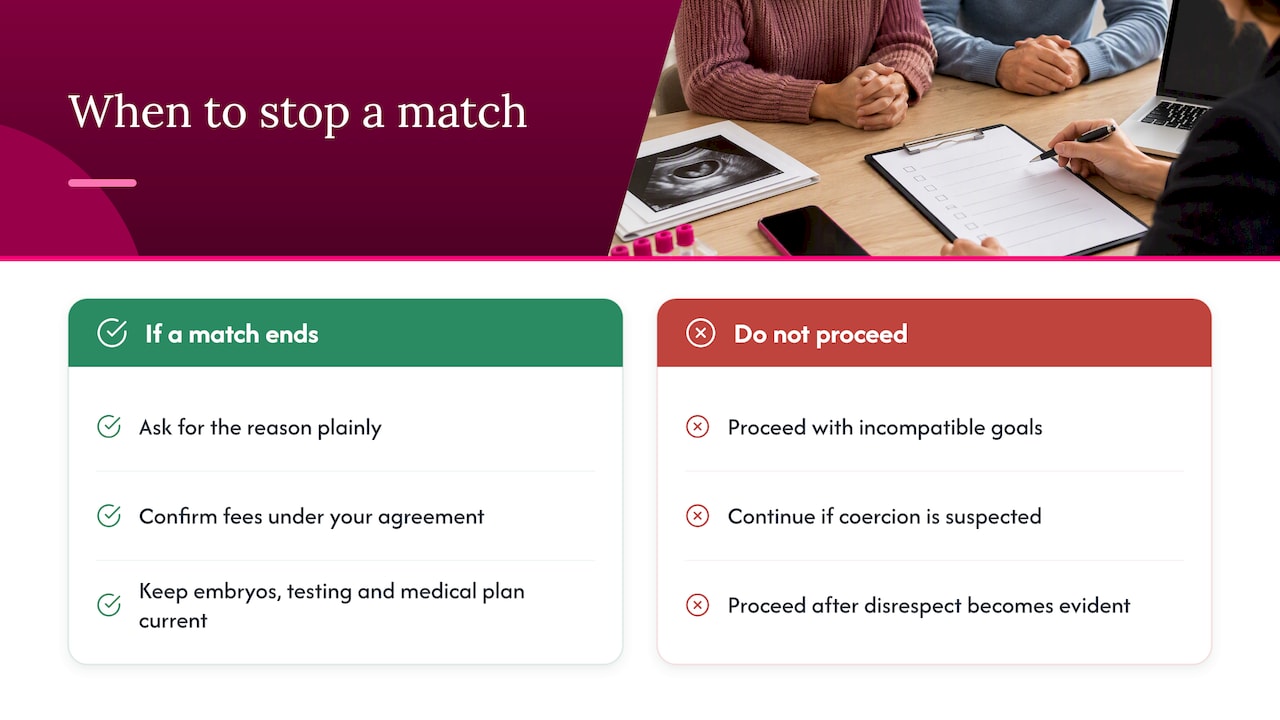
A proposed match can end at the meeting, or later, and that is part of the process working. ASRM identifies disagreement about treatment timing, medical treatment or embryo number, prenatal decisions, communication, pregnancy behavior or relationship expectations as reasons to reject a match (ASRM Committee Opinion, full text). Carrier unavailability, schedule conflicts or travel problems may also stop a match.
ASRM’s 2023 ethics opinion goes further: participants should discontinue an arrangement before embryo transfer if misalignment, lack of congruency or lack of respect becomes evident, and parties should not proceed where goals are incompatible. It also stresses that informed, voluntary participation is a prerequisite, and that suspected coercion should prevent an arrangement from proceeding (ASRM Ethics Committee Opinion: Consideration of the Gestational Carrier (2023)).
If a match ends, it is not a verdict on you. Ask for the reason in plain terms, confirm what happens with any fees under your agreement, and keep your embryos, testing and medical plan current so the next match can move quickly.
Step 6: Legal steps between the match and the transfer
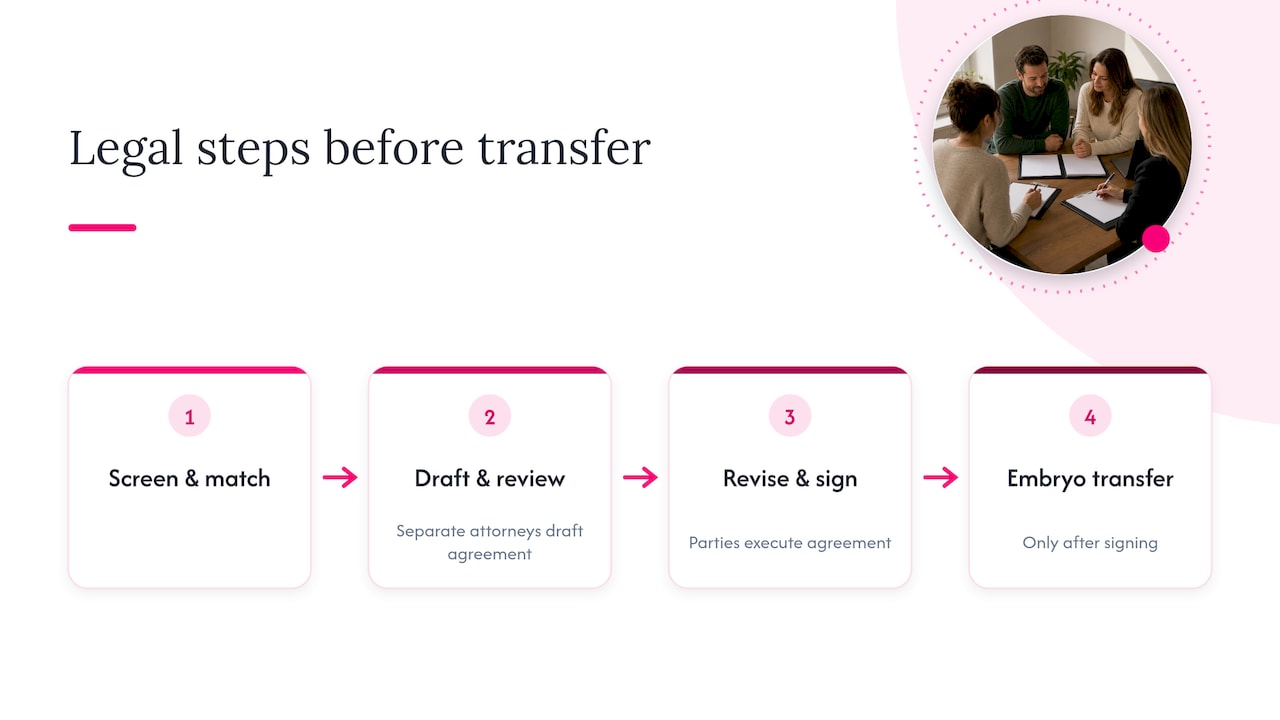
The medical team does not begin a transfer cycle on a handshake. ASRM says each intended parent and the carrier, with her spouse or partner where applicable, must have independent counsel licensed in the applicable state before entering into and executing the agreement. Before treatment, the parties should have a fully executed agreement, a legal-clearance letter, informed-consent documents and a medical release (ASRM Committee Opinion: Recommendations for Practices Using Gestational Carriers).
New York’s fact sheet describes the same order: after screening and matching, separate attorneys draft, review, revise and sign the agreement before any medical procedure other than screening, and only after signing may an embryo be transferred (New York State Department of Health: Gestational Surrogacy Fact Sheet).
ACOG notes that preconception counseling and the signed written agreement should address embryo number, high-order pregnancy, serious fetal anomaly, prenatal testing and unexpected birth defects, while recognizing the carrier’s autonomous decision-making over her own body and health (ACOG Committee Opinion: Family Building Through Gestational Surrogacy).
State law changes the details
There is no single national surrogacy law, so the carrier’s state and yours both matter. Delaware’s code, for example, lists conditions before a gestational-carrier agreement is executed: the carrier must be at least 21, have given birth to at least one child, complete medical and mental-health evaluations, obtain independent Delaware counsel, and have qualifying health insurance before embryo transfer (Delaware Code, Title 13, Gestational Carrier Agreements). Other states set different rules, and some are more restrictive. Ask your attorney, before you start matching, which state’s law will govern and whether your family structure is fully supported there.
Parentage documentation is another conversation for your attorney. Some families also look into surrogacy DNA testing for intended parents as part of understanding what the process involves for legal documentation.
Step 7: Medical preparation and embryo transfer to the carrier
Once the agreement is signed and clearances are in place, the focus returns to medicine. A typical sequence:
- Final carrier clearance. Updated infectious-disease testing and pregnancy clearance close to the cycle.
- Cycle planning. The carrier’s uterine lining is prepared with a medication schedule set by the treating team, and the embryo thaw is timed to it.
- Endometrial assessment, if recommended. Some patients and clinicians add testing such as an Endometrial Receptivity Assay. Our published price for the ERA is $975, and for a Saline Infusion Sonohysterogram it is $450.
- Embryo transfer. Our published price for embryo transfer starts at $2,950 (see our treatment package pricing).
- Monitoring and handoff. Early pregnancy monitoring, then a transition to the carrier’s obstetric care.
How long all of this takes varies. ASRM says matching discussions should include an expected treatment timeline and the agreed number of cycles, and that carrier unavailability, schedule conflicts or travel can affect whether a match proceeds (ASRM Committee Opinion, full text). The honest planning answer is that matching, legal work and medical clearance run in sequence, and delays in one push back the next. Starting your own testing and embryo planning early is the part you control.
Ways to keep the process moving
- Settle your embryo plan first. Knowing whether you will use your own gametes or donor eggs or sperm avoids stalls after a match is made.
- Write down your non-negotiables. Prenatal testing, embryo number and communication are the issues most likely to end a match, so name them early.
- Stay flexible where it is safe to do so. Openness about the carrier’s state or timing can widen your options, but never relax medical or legal requirements to save time.
- Hire your attorney before matching. You will have questions about state law before you meet anyone.
- Keep paperwork current. Infectious-disease and other tests have windows, so ask your clinic when each result will need repeating.
Our perspective on matching
Matching is the point where the medical plan and the human relationship meet, and we think each deserves equal attention. A match that looks perfect on paper can still fail if the people involved have not talked honestly about testing, embryo number and communication.
At Life IVF Center, our approach is built around the individual. Our Precision IVF® approach tailors treatment protocols to each patient’s biology, history and goals, and that same thinking applies to surrogacy planning: the embryos you bring to a carrier should be the best that your own situation allows. Our in-house labs give us direct control over that stage, and we welcome second-opinion cases and patients who have been told elsewhere that their situation is too complex.
We also believe in practical support. Multi-language support, travel coordination and financial guidance are part of how we work, because families pursuing surrogacy often coordinate across states and time zones. Our pricing is published so that you can plan before you commit.
Starting with Life IVF Center
If you are considering a gestational carrier, the strongest first move is a clear medical plan for your embryos. Our team can review your history, recommend the pre-IVF testing that applies to you, and plan embryo creation and freezing so you are ready when a match is made. You can see our published package prices on the treatment packages page, or learn about Precision IVF® and our other services to decide where to begin.
FAQ
How long does the surrogate matching process take?
There is no fixed timeline. It depends on how quickly screened carriers are available, how well your criteria align with theirs, and whether the joint session confirms the match. ASRM says discussions should cover an expected treatment timeline and an agreed number of cycles, and that scheduling conflicts or travel can stop a match from proceeding.
Can I say no to a proposed match?
Yes, and so can the carrier. ASRM treats disagreement about timing, embryo number, prenatal decisions, communication or relationship expectations as reasons to reject a match. Its 2023 ethics opinion says parties should not proceed when goals are incompatible.
Who is in the room at a match meeting?
A trained mental-health professional leads a joint session with the carrier, her partner if she has one, and the intended parents. The purpose is to align expectations on availability, testing, communication, lifestyle and the relationship after the pregnancy.
When can the embryo transfer to the surrogate happen?
Only after the match, medical and psychological clearance, and a fully executed legal agreement with independent counsel for each side. New York’s fact sheet states that an embryo may be transferred only after the agreement is signed. Your clinic will confirm the schedule once all clearances are complete.
Sources
- ASRM Committee Opinion: Recommendations for Practices Using Gestational Carriers, full text
- ACOG Committee Opinion: Family Building Through Gestational Surrogacy
- New York State Department of Health: Gestational Surrogacy Fact Sheet
- New York State Clinical Guidelines for Assisted Reproductive Technology and Gestational Surrogacy
- Delaware Code, Title 13, Gestational Carrier Agreements
This article is for general educational purposes only and is not a substitute for personalized medical advice, diagnosis, or treatment. Fertility care is highly individual; please consult a qualified healthcare professional about your specific circumstances.
Ready to take the next step?
Life IVF Center specializes in individualized Precision IVF® care for complex cases—including diminished ovarian reserve, prior failed cycles, and advanced maternal age. Our in-house labs and dedicated physicians are ready to help.
Book a Free Consultation →