
ReceptivaDx measures BCL6 expression in an endometrial biopsy. Elevated BCL6 has been studied as a marker associated with endometriosis and inflammation, but it is not a stand-alone diagnosis and does not establish disease stage.
TL;DR: A positive BCL6 result may raise suspicion for endometriosis or inflammation, but it does not confirm either condition by itself. Evidence is conflicting, and testing or treatment decisions should follow individualized counseling rather than an automatic pathway.
Table of Contents
- What Is ReceptivaDx and How Does It Work?
- Who Should Consider Receptiva Testing?
- How Is the Test Performed and What Should You Expect?
- What Do Positive and Negative Results Actually Mean?
- What Does the Research Say About Treating BCL6-Positive Patients?
- How Do You Order the Test and What Will It Cost?
- How Life IVF Center Uses Endometrial Testing in Precision IVF®
- Ready to Talk Through Your Testing Options?
- Sources
- FAQ
What Is ReceptivaDx and How Does It Work?
ReceptivaDx is a molecular test that looks for BCL6, a protein that shows up in excess when the endometrium is chronically inflamed, often because of endometriosis lesions that never got diagnosed. B-cell lymphoma 6 (BCL6) is its full name, and it is best known in medicine as a marker in certain lymphomas.
The mechanism researchers describe is progesterone resistance. Progesterone is supposed to prepare the uterine lining for an embryo, switching on the genes that make the tissue receptive. When BCL6 is overexpressed, the endometrium doesn’t respond normally to progesterone, so the window during which implantation can succeed narrows or shifts unpredictably. That’s the theoretical link between a positive BCL6 result and the kind of “unexplained” implantation failure that leaves patients and doctors without a clear answer.
Labs quantify BCL6 using something called HSCORE, a semiquantitative measure that combines the intensity of staining with the percentage of cells that stain positive. A pathologist reviews the biopsy tissue under a microscope and generates a numerical value. The commonly used threshold for calling a result positive is an HSCORE above 1.4, though some researchers argue the number itself, not just the yes/no cutoff, carries information worth discussing with your specialist.
A few things are worth keeping straight about what this test actually is:
- It is a tissue biomarker test, not an imaging study or a blood test.
- It flags a biological pattern associated with endometriosis; it does not visualize lesions the way a laparoscopy does.
- A positive result raises the probability of pelvic endometriosis. It does not confirm stage, location, or extent of disease.
- It cannot replace direct visualization when surgical diagnosis is the goal.
That last point matters because ReceptivaDx testing gets described in some clinic materials as an “endometriosis test,” which is true in a limited, statistical sense. It detects a molecular signature correlated with endometriosis, and for many patients that correlation is strong enough to change the treatment plan. But it is a detection tool built to flag risk and guide the next diagnostic step, not a surgical or histopathologic diagnosis on its own.
Who Should Consider Receptiva Testing?
Not every fertility patient needs this test, and ordering it reflexively adds cost without necessarily adding clarity. The clearest candidates fall into a handful of overlapping categories.
- Unexplained infertility. When a full workup, ovarian reserve, tubal patency, semen analysis, hormone panels, comes back normal and pregnancy still isn’t happening, silent endometriosis is one of the more commonly overlooked explanations.
- Recurrent pregnancy loss. Patients who have had two or more losses with no chromosomal, anatomic, or clotting explanation sometimes have an inflammatory endometrium that BCL6 testing can flag.
- Recurrent implantation failure. If good-quality embryos have failed to implant across multiple transfers, an inflamed endometrial environment is a reasonable variable to rule in or out.
- Suspected silent endometriosis. Some patients have pelvic pain, painful periods, or a family history of endometriosis but no formal diagnosis, since diagnostic delays for endometriosis commonly run seven to ten years. A positive BCL6 result can accelerate that timeline.
The test is less likely to add value in a few situations. If a patient already has a confirmed, staged endometriosis diagnosis from prior surgery, testing may simply confirm what’s already known. If there’s a clear alternate explanation for infertility, severe male factor, uncorrected tubal blockage, testing BCL6 first doesn’t change the priority order of the workup. And a biopsy taken outside the correct window, or too soon after a pelvic infection that hasn’t fully resolved, can produce a result that doesn’t reflect the patient’s baseline endometrial environment.
Age, prior pelvic surgery, and IVF history all factor into how a specialist weighs the test. A patient in her late 30s with a ticking clock on ovarian reserve and three failed transfers behind her has a different risk-benefit calculation than a 28-year-old just starting her first IVF cycle. Prior laparoscopic surgery for endometriosis also changes the picture, since recurrence after excision is common enough that a repeat biomarker check can be clinically reasonable.
How Is the Test Performed and What Should You Expect?
Timing is the single most important variable in getting a usable result. The biopsy has to be taken during what reproductive specialists call the window of implantation, roughly 7 to 10 days after ovulation, when the endometrium is in the same hormonal state it would be in during an embryo transfer. Because that window shifts slightly from patient to patient and cycle to cycle, testing protocols typically include an ovulation predictor kit so the biopsy can be scheduled off a confirmed ovulation date rather than a generic calendar guess.
The procedure itself is a standard office endometrial biopsy, similar to what many patients have already experienced during an ERA (Endometrial Receptivity Assay) or other pre-cycle testing. A thin catheter is passed through the cervix to collect a small tissue sample from the uterine lining. Most patients describe it as a sharp cramp lasting a few seconds to a minute, comparable to a strong menstrual cramp, and it’s over quickly. Taking an over-the-counter pain reliever beforehand and having a heating pad ready afterward covers most of what patients need for recovery. Light spotting for a day or two is normal; heavy bleeding, fever, or worsening pain afterward is not and warrants a call to your provider.
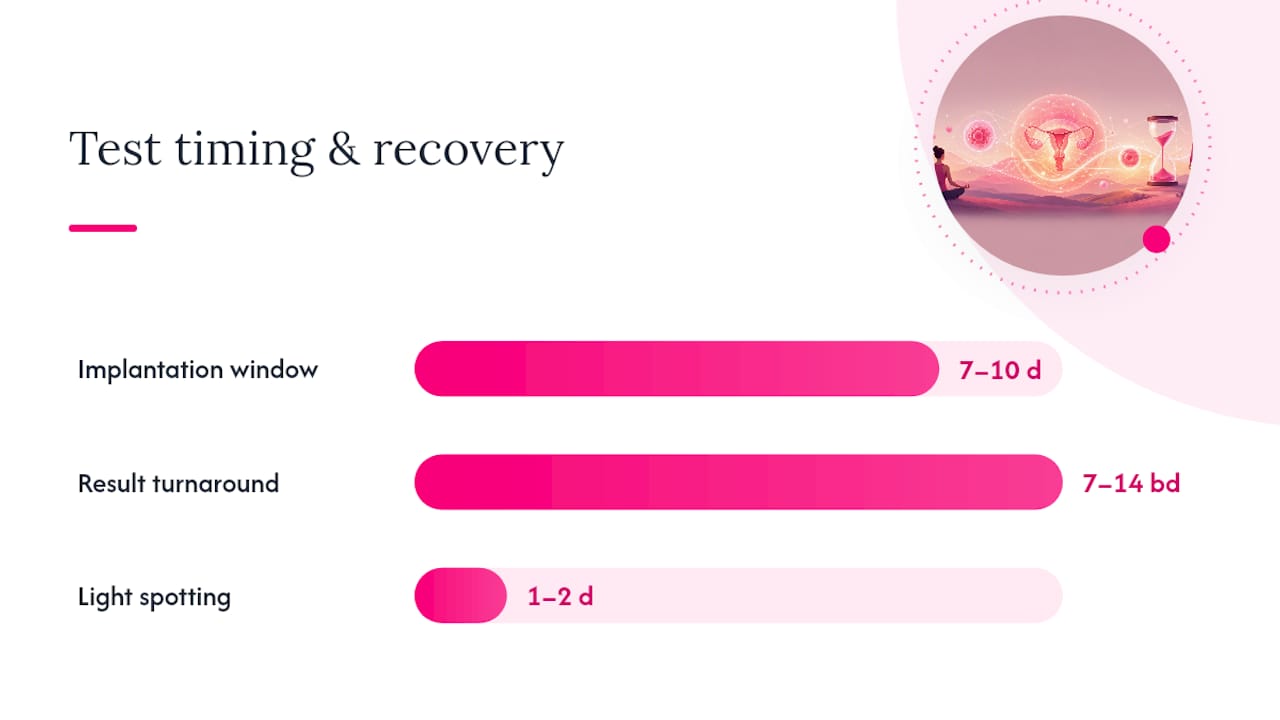
Results typically take 7 to 14 business days to come back, since the sample goes to a specialized lab for immunohistochemical staining and pathologist review before the HSCORE is calculated and reported to your ordering physician. Your fertility specialist receives the full report and interprets it in the context of your history, not just as a number in isolation.
Some providers pair the BCL6 test with CD138 staining in the same biopsy. CD138 identifies plasma cells associated with chronic endometritis, a different but sometimes coexisting inflammatory condition. Ordering both from a single sample is efficient when a specialist suspects either issue could be contributing to implantation problems.
- Confirm ovulation before scheduling, using an ovulation predictor kit or bloodwork your clinic provides.
- Ask whether your clinic recommends pairing CD138 testing with the same biopsy.
- Plan for mild cramping and light spotting; clear your schedule for rest that day if you tend to feel it strongly.
- Ask specifically how and when results will be communicated, since some clinics call and others route reports through a patient portal.
Pro Tip: Track your ovulation for at least one full cycle before your biopsy is scheduled. A single miscalculated ovulation date can push the sample outside the implantation window and produce a result that doesn’t reflect your true endometrial environment, which sometimes means repeating the entire process.
What Do Positive and Negative Results Actually Mean?
A positive result carries real statistical weight, but it’s worth understanding exactly what that weight is based on. According to figures published by the test’s manufacturer, a positive BCL6 result is associated with a probability above 90% that endometriosis would be found on laparoscopy, while a negative result corresponds to a probability under 7%. Those numbers come from the company’s own reported data, and they’re widely cited in patient materials.
Independent peer-reviewed research complicates a simple reading of those numbers. A 2026 analysis of 172 patients with concurrent ERA and ReceptivaDx testing found that BCL6 positivity did not correlate with a pre-receptive ERA result, even though single-nucleus transcriptomic analysis showed genuine gene-expression differences across thousands of genes in BCL6-positive tissue.
That finding doesn’t invalidate the test. It shows that BCL6 and ERA are measuring different biological signals, endometrial inflammation versus transcriptomic receptivity timing, and clinicians shouldn’t treat a positive BCL6 result and a normal ERA result as contradictory. They’re answering different questions.
In practice, an HSCORE above 1.4 is the conventional line for a positive call, but some researchers suggest the magnitude of BCL6 expression above that threshold may carry additional information, not just a binary yes or no. That’s a nuance worth raising with your specialist rather than assuming every “positive” result carries identical clinical weight.
When a result comes back positive, the conversation usually moves toward a short list of next steps:
- Referral to a specialist experienced in endometriosis management, if your current provider isn’t one.
- Discussion of GnRH agonist suppression, a medication approach that quiets ovarian hormone production and, by extension, the inflammatory activity linked to endometriosis, typically used for a defined period before an embryo transfer attempt.
- Consideration of laparoscopic evaluation and treatment, particularly if you also have pelvic pain, painful periods, or other signs that point toward surgically treatable disease.
- Reassessment of your overall IVF or fertility treatment timeline, since suppression protocols add weeks to months before a transfer.
A negative result shifts the workup in a different direction. It lowers the likelihood that silent endometriosis explains your infertility or losses, which means your specialist will look harder at other factors: uterine anatomy, clotting disorders, immunologic causes, sperm quality, or embryo-level chromosomal issues. A negative BCL6 result is reassuring on that specific question, but it’s not a green light that rules out every uterine factor. It should be read alongside imaging, hormone panels, and your full reproductive history rather than as a stand-alone clearance.
What Does the Research Say About Treating BCL6-Positive Patients?
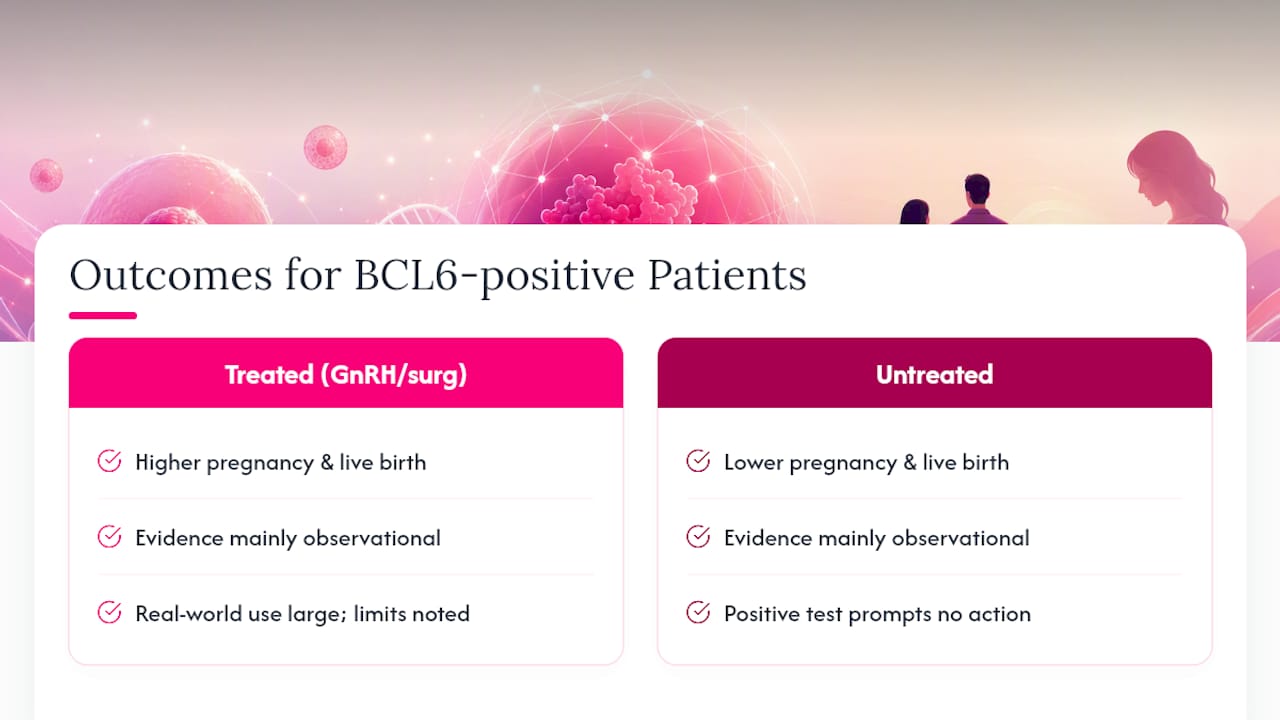
Some observational studies report improved outcomes after treatment in BCL6-positive patients, but they do not establish causation. More recent studies have found uncertain or conflicting relationships among BCL6 status, endometriosis, and reproductive outcomes. Randomized evidence remains limited.
The practical read on that data, and one worth sitting with, is that BCL6 testing seems most valuable when a positive result actually changes what happens next. If a positive test doesn’t lead to a concrete treatment plan, whether that’s medical suppression or surgery, the test hasn’t done much clinical work. Its value is tied to the action it prompts.
That said, the strength of this evidence has real limits. Sample sizes across these studies tend to be modest. Study designs are largely observational rather than randomized, which means patients weren’t assigned to treatment versus no treatment by chance, they self-selected or were selected by their physicians, and that introduces bias that’s hard to fully account for. Some of the data comes from registries with self-reported outcomes, which is useful for generating hypotheses but weaker for proving cause and effect. Receptiva-type BCL6 testing has been used across many fertility centers and applied to thousands of patients, so the volume of real-world use is substantial, but volume of use isn’t the same as volume of rigorous trial evidence.
The discordance findings between BCL6 and ERA testing add another layer of caution. If two tests marketed as informing “endometrial health” don’t agree with each other, that’s a signal that the underlying science is still maturing, not that either test is meaningless. Researchers analyzing that discordance has suggested clinicians avoid treating BCL6 and ERA results as interchangeable measures of the same thing.
Given all that, shared decision-making matters more here than in areas of reproductive medicine with deeper trial data behind them. A positive result and a reasonable treatment option in front of you is a genuinely useful piece of information. It just deserves a conversation about what’s proven, what’s promising, and what’s still being studied, rather than a purely automatic next step.
How Do You Order the Test and What Will It Cost?
Getting tested starts with your fertility specialist, since ReceptivaDx and similar BCL6-based tests are ordered through a physician rather than purchased directly by patients. Your provider requests the biopsy kit, which typically includes the collection materials along with an ovulation predictor kit to help you time the procedure correctly, then schedules your office visit for roughly 7 to 10 days after you detect ovulation.
Cost varies more than most patients expect. Publicly listed price points for BCL6-based endometrial testing range from several hundred dollars for a standalone version to over a thousand dollars when combined with CD138 testing for chronic endometritis, and clinics sometimes bundle the test into a broader pre-IVF workup rather than billing it separately. Insurance coverage is inconsistent and often limited, so confirming out-of-pocket cost with your specific clinic before scheduling saves you from a billing surprise later.
Before your biopsy appointment, a short list of questions can save you a follow-up call:
- How will we confirm ovulation timing, and who provides the ovulation kit?
- Will this biopsy also test for CD138 and chronic endometritis, or is that a separate order?
- How long will results take, and how will they be communicated to me?
- If the result comes back positive, what is the plan, medical suppression, surgical referral, or both, and how does that affect my treatment timeline?
- Does this test replace or complement other testing I’ve already had, like ERA?
Pro Tip: Ask your clinic whether pre-IVF testing like this can be scheduled in the same cycle as other diagnostic bloodwork or imaging. Consolidating appointments around your ovulation window cuts down on the number of cycles you spend testing rather than treating.
How Life IVF Center Uses Endometrial Testing in Precision IVF®
The fertility clinic treats endometrial biomarker data as one input among many, not a stand-alone verdict. The Precision IVF® approach is built around the idea that patients with similar diagnoses may need different protocols, and inflammatory markers like BCL6 are the kind of biological detail considered in treatment planning.
When a patient’s history includes unexplained infertility, recurrent loss, or failed transfers, our team walks through whether endometrial testing, timed carefully to the window of implantation, adds useful information to the picture. That evaluation happens alongside a review of ovarian reserve, uterine anatomy, and prior cycle data, so no single result gets over-weighted.
If a result comes back positive, our clinicians discuss the realistic pathways: medical suppression before a transfer attempt, surgical referral when pain or exam findings support it, or adjusting the overall treatment sequence. Those conversations happen in the context of your full biological profile and treatment goals, which is the core of what individualized planning at Life IVF Center means in practice. We don’t treat a single lab value as the whole story, and we don’t skip the conversation about what the evidence does and doesn’t support.
Ready to Talk Through Your Testing Options?
If unexplained infertility or recurrent loss has left you without answers, a structured evaluation beats another cycle of guessing. A specialized fertility clinic’s team reviews your history, discusses whether endometrial testing fits your specific situation, and builds a Precision IVF® plan based on individual biological findings rather than applying a standard protocol.
A consultation typically covers your prior testing and treatment history, a discussion of whether additional diagnostics like endometrial evaluation make sense for you, and a walk-through of how Precision IVF® tailors protocols to individual findings rather than applying the same approach to every patient. For patients also considering fertility preservation or additional pre-cycle diagnostics, Life IVF Center’s pre-IVF testing options and treatment package pricing are both listed with current details. You can book a consultation directly to start that conversation.
Sources
The clinical evidence behind BCL6 testing is still developing, and reading the primary literature alongside patient-facing materials gives a fuller picture than either source alone.
- A positive ReceptivaDx result for BCL6 does not correlate with abnormal ERA results or decreased expression of receptivity-associated markers
- Outcomes in women with IVF failure who tested positive for BCL6 using ReceptivaDx testing: Effect of treatment on subsequent embryo transfer – Fertility and Sterility
This article is for general educational purposes and is not medical advice. BCL6 testing does not independently diagnose or exclude endometriosis. Discuss testing, alternatives, risks, and treatment decisions with a qualified fertility specialist.
FAQ
How Much Does the ReceptivaDx Test Cost?
Published clinic price points for BCL6-based endometrial testing range from several hundred dollars for a standalone test to over a thousand dollars when combined with CD138 testing for chronic endometritis. Actual cost depends on your clinic and whether the test is bundled into a broader pre-IVF workup, so confirm current pricing directly with your provider before scheduling.
How Painful Is a Receptiva Test?
The biopsy involves passing a thin catheter through the cervix to collect a small tissue sample, and most patients describe it as a sharp cramp lasting a few seconds to a minute. Taking an over-the-counter pain reliever beforehand and using a heating pad afterward manages most of the discomfort, and light spotting for a day or two afterward is normal.
Is the Receptiva Test Worth It?
For patients with unexplained infertility, recurrent pregnancy loss, or repeated implantation failure, the test can surface a treatable inflammatory pattern that a standard workup misses. Its value depends on whether a positive result would actually change your treatment plan, since nonrandomized outcome data shows better pregnancy and live birth rates in treated versus untreated positive patients, though that evidence isn’t yet backed by large randomized trials.
What Happens if Receptiva Is Positive?
A positive result typically leads to a referral for specialized endometriosis evaluation and a discussion of two main pathways: medical suppression with a GnRH agonist before your next embryo transfer, or laparoscopic evaluation and treatment. Your fertility specialist will weigh which path fits your pain history, prior surgeries, and overall treatment timeline before deciding on next steps.
This article is for general educational purposes only and is not a substitute for personalized medical advice, diagnosis, or treatment. Fertility care is highly individual; please consult a qualified healthcare professional about your specific circumstances.
