
Personalized IVF means your treatment plan is built from your own data (age, ovarian reserve, medical history, prior cycles and goals) instead of a standard protocol applied to everyone. In practice, that shows up in four places: the starting medication dose, the type of stimulation, how closely your cycle is monitored, and which tests are run before and after egg retrieval. This guide explains each one, what the evidence says, what to ask a clinic, and what the related testing costs at Life IVF Center.
TL;DR
- Personalized IVF adjusts the drug dose, stimulation style, monitoring schedule and testing to your biology and history, rather than using one template.
- Lower-dose (mild) stimulation is an evidence-based option for many patients and can reduce medication burden, cost and the risk of ovarian hyperstimulation syndrome (OHSS).
- Markers such as AMH and antral follicle count guide the starting dose, but the final decisions rest on clinical judgment and your goals.
- Life IVF Center’s Precision IVF® approach is built around this idea, and several pre-treatment tests have published prices, listed below.
Table of Contents
- What personalized IVF actually means
- How your starting dose is chosen
- Low-dose and mild stimulation
- Why OHSS risk shapes protocol design
- Cycle preparation: the role of hormonal contraception
- Tailored monitoring: what happens during stimulation
- Testing that informs the plan
- Where AI fits in personalization
- Our perspective: personalization is a process, not a label
- Personalization for patients over 35 and complex histories
- What personalized IVF costs at Life IVF Center
- How to start: a short plan
- FAQ
- Sources
What personalized IVF actually means
Every IVF cycle follows the same broad sequence: ovarian stimulation, egg retrieval, fertilization in the lab, embryo culture, and transfer. Personalization is about how each step is set for you.
A useful test: could your plan have been written without looking at your results? If a clinic would prescribe the same dose to a 29-year-old with polycystic ovaries and a 41-year-old with diminished ovarian reserve, the plan is not personalized. Clinicians quoted by the American College of Obstetricians and Gynecologists (ACOG) describe care in which your values, goals and biological markers such as AMH shape the path, rather than a generalized protocol.
The main variables a clinic can tailor:
- Starting dose and drug choice. Which gonadotropins, how much, and whether to add other medications.
- Stimulation intensity. Conventional, mild (lower dose), or a different approach altogether for specific situations.
- Cycle preparation and timing. For example, whether hormonal contraception is used to schedule the cycle.
- Trigger choice. The medication that matures the eggs before retrieval, which affects OHSS risk.
- Monitoring. How often you have ultrasounds and bloodwork, and how the plan changes in response.
- Lab and transfer decisions. Fertilization method, genetic testing of embryos, single versus multiple embryo transfer, and timing of transfer.
How your starting dose is chosen
The starting dose of stimulation medication is one of the most consequential choices in a cycle. Too low and you may produce too few eggs. Too high and you risk an excessive response.
Clinics commonly use age, anti-Müllerian hormone (AMH), antral follicle count on ultrasound, body weight and the response in any earlier cycle. A systematic review and network meta-analysis in PMC examined algorithm-based individualization of the starting gonadotropin dose together with a freeze-all strategy in normal responders, in the context of preventing OHSS, a rare but dangerous complication of stimulation.
The reasoning is straightforward. AMH and antral follicle count estimate how many follicles are likely to respond. A higher expected response calls for caution. A low expected response calls for a different conversation, about whether to push the dose, change the approach, or bank eggs or embryos across more than one cycle.
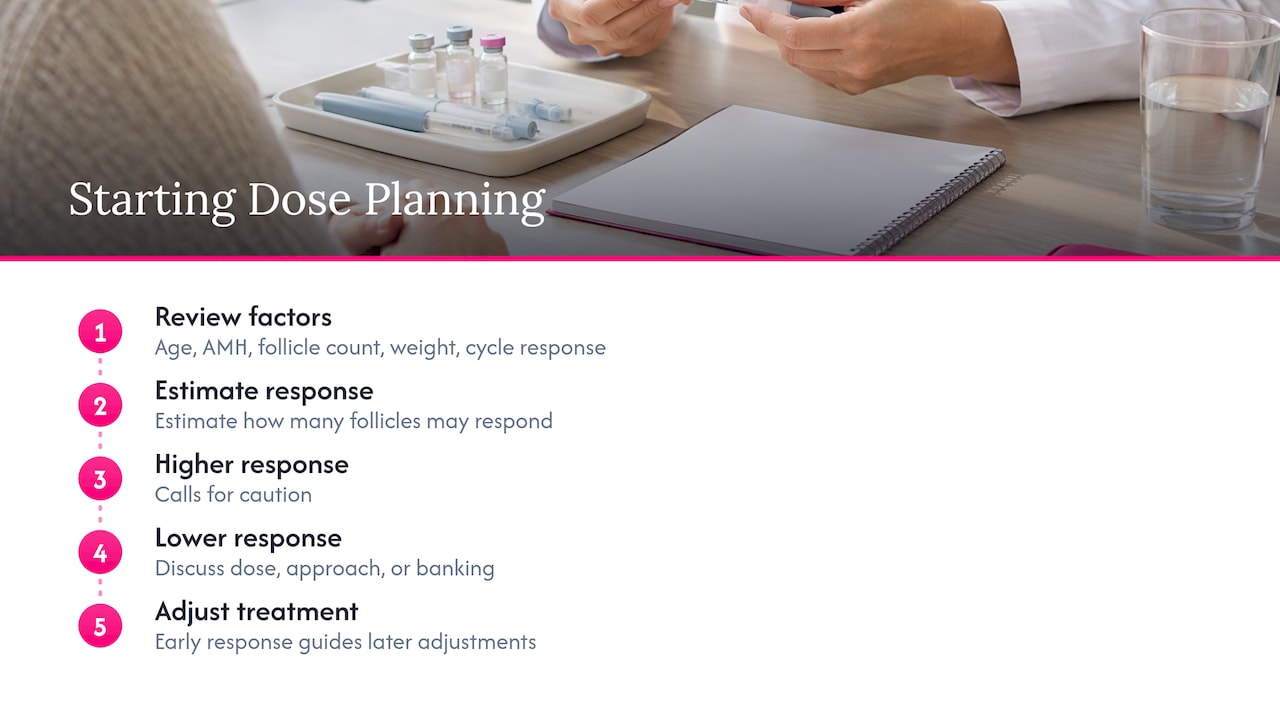
Numbers are inputs, not verdicts. They guide the starting point, and the way your body responds in the first days of stimulation guides every adjustment after that.
Low-dose and mild stimulation
Many patients search for low-dose IVF after hearing that high doses are not always better. The question deserves a precise answer.
Mild stimulation generally uses a lower daily gonadotropin dose, often 150 IU or less. A review in Human Reproduction Update on mild versus conventional stimulation reports that this dose can be as effective as higher doses for poor responders, normal responders and non-PCOS hyper-responders, often with comparable cumulative live birth rates while using less medication. It may be associated with a higher cycle cancellation rate in some studies.
What that means for you:
- Potential advantages: fewer injections and less medication, a lower drug bill, and a lower chance of OHSS.
- Potential trade-offs: fewer eggs per cycle, and in some studies more cancelled cycles. Patients who want to bank many embryos in one cycle may prefer a different approach.
- Who it fits: it depends on ovarian reserve and history. It is not the right answer for everyone, and it is not automatically the wrong answer for older patients or those with low reserve.
The point of personalization is not that lower is better or higher is better. It is that the dose is matched to your ovaries and your goals, and reviewed after each cycle.
Why OHSS risk shapes protocol design
OHSS is the best-known medical risk of stimulation. According to the research summarized in ASRM’s committee opinion on repetitive oocyte donation, it occurs in roughly 1% to 2% of retrieval cycles, and the risk is lowered by individualized stimulation and by using a GnRH agonist trigger in place of hCG for suitable patients.
Other risks matter too. Multiple pregnancy, often the result of transferring more than one embryo, carries risks for both the pregnant patient and babies, which is why elective single embryo transfer is the preferred approach in many situations. Ask any clinic how it decides the number of embryos to transfer, and what would change that plan.
If you have had a very high response before, or a diagnosis such as polycystic ovary syndrome, tell your team early. These details change the protocol.
Cycle preparation: the role of hormonal contraception
Some protocols use hormonal contraception before stimulation. ASRM’s 2024 committee opinion on hormonal contraceptives in fertility treatments covers this use. It can help synchronize timing and lab scheduling, and it can reduce the chance of an ovarian cyst at the start of a cycle.
There is a detail worth raising with your specialist: longer use can temporarily lower ovarian reserve markers, which may affect baseline testing. If you take contraception now, ask when to stop it before testing so your AMH and antral follicle count reflect your real baseline.
Tailored monitoring: what happens during stimulation
Monitoring is where a plan becomes personal in real time. During stimulation you will typically have transvaginal ultrasounds to measure follicles and blood tests to check hormone levels. The results determine whether to continue the dose, raise it, lower it, or adjust the trigger timing.
Questions to ask about monitoring:
- How many visits should I expect, and at what times of day?
- Who reviews my results, and how quickly will I hear about dose changes?
- What findings would lead you to cancel, convert, or freeze all embryos?
- If I live outside the area, can some monitoring be done closer to home?
That last question matters for patients traveling for care. Life IVF Center offers travel coordination, and our OB monitoring visits and coordination service exists for this kind of split care. We do not publish a price for it.
Testing that informs the plan
The more your team knows before the cycle starts, the more precisely it can plan. Typical pre-treatment evaluations include semen analysis, a check of the uterine cavity, infectious disease screening and genetic carrier screening. Life IVF Center publishes prices for several of these on its pre-IVF testing price page:
| Test | Published price |
|---|---|
| Sperm count | $185 |
| Pap smear | $185 |
| Carrier screening for genetic disease | $349 |
| Saline infusion sonohysterogram (SIS) | $450 |
| Karyotype chromosomal analysis | $595 |
| Endometrial Receptivity Assay (ERA) | $975 |
| Infectious disease (ID) panel | $550 to $750 |
Not everyone needs every test. Your physician decides which are relevant to your history, so a consultation should come before spending money on a long list. Clinics also differ in whether they offer these in-house, and in-house laboratories give a team more control over timing and quality. Life IVF Center operates in-house labs.
Where AI fits in personalization
AI and machine learning are increasingly discussed as ways to personalize IVF. A paper in npj Digital Medicine on AI to personalize assisted reproductive technology notes that infertility affects about one in six couples and that many need repeated intensive cycles. It describes how predictive models could support decisions that currently depend on clinician judgment, such as drug dosing and gamete selection. A ScienceDirect review of AI in IVF takes a similar view of the field.
The practical reading for patients: these tools are promising aids for processing complex data, but they are not a substitute for an experienced team making final decisions and supporting you through the process. When a clinic advertises AI, ask what it is used for, what evidence supports it, and who makes the final call.
Our perspective: personalization is a process, not a label
At Life IVF Center, we think the word “personalized” has been stretched until it can mean almost anything. A website banner is not a protocol. For us, personalization means the plan is built from your biology and history, written down in a form you can understand, and revised when your body responds differently than expected.
That is the idea behind Precision IVF®, our approach to customizing treatment protocols to each patient’s biological profile, medical history and goals, with the aim of reducing the number of trial cycles. We see patients with diminished ovarian reserve, endometriosis, advanced maternal age and immune disorders, and we welcome second-opinion cases, including patients who have been told elsewhere that treatment is not possible.
Three principles guide how we talk to patients:
- Data first, then judgment. Test results set the starting point. Clinical experience decides what to do with them.
- Honest trade-offs. A lower-dose cycle may mean fewer eggs. A higher-dose cycle may mean more risk and cost. We would rather explain both than promise one.
- Transparent pricing. Where we publish prices, we publish them in full, so you can plan before you commit.
We do not quote success rates for our own results in articles like this one. Rates depend heavily on age and diagnosis and are best discussed in a consultation, alongside the national data that clinics report.
Personalization for patients over 35 and complex histories
Age is among the strongest factors in fertility, which is why timing matters. According to ACOG’s guidance for patients in their late 30s and 40s, an evaluation is generally recommended after six months of trying if you are 35 or older. Infertility is diagnosed after one year of unprotected intercourse under 35. Those over 40 may be referred to a specialist before trying to conceive, to discuss options such as fertility preservation or donor pathways.
The same ACOG piece makes a point many patients find reassuring: a “high-risk” label is a clinical designation meant to prompt closer, tailored monitoring, not a prediction of failure. It also treats anxiety and grief during treatment as a normal part of care. ACOG’s page on mental health and infertility advises talking to your doctor about treating depression and anxiety with medication and therapy.
For complex histories, personalization often extends beyond stimulation:
- Diminished ovarian reserve: the plan may involve a different stimulation approach, or collecting eggs or embryos over several cycles.
- Endometriosis: treatment planning may account for how the condition affects egg quality, the uterine environment, or both.
- Recurrent failed cycles: a second look at the whole workflow, from stimulation to lab to transfer timing, is often more useful than repeating the same protocol. Tests such as the ERA are used by some clinics to evaluate transfer timing.
- Donor egg or surrogacy paths: medical screening of the recipient or carrier matters. ASRM’s ethics opinion on oocyte or embryo donation at advanced reproductive age notes adverse obstetrical events associated with advanced age, which is why comprehensive health screening before treatment is advised.
What personalized IVF costs at Life IVF Center
Personalization is not free, but it should not be opaque. We publish the following on our site:
- The Advanced IVF Package: $13,500 (one-time).
- Embryo transfer: from $2,950 (one-time).
- Precision Egg Freezing: $7,500 (one-time).
- Precision Embryo Freezing: $8,950 (one-time).
- Storage: $750 per year, $70 per month, or $2,000 for a three-year prepaid plan.
Our IVF Package, Egg Cryo Package and Precision IVF® do not have a published price, because the plan depends on your evaluation. Package contents and what is included are on the treatment packages page, and freezing costs are on the freezing pricing page. Storage options are listed on the storage costs page. Before you decide, ask for a written estimate that separates medication, monitoring, lab, genetic testing and transfer, since medication is often billed apart from clinic fees.
How to start: a short plan
- Gather your records. Prior cycle summaries, medication doses, AMH results, semen analyses and imaging.
- Book a consultation. Ask the team to explain, in plain language, why the plan fits your data.
- Complete the relevant tests. Only the ones your physician says apply to you.
- Agree on the protocol and the decision points. For example, what happens if the response is high or low.
- Plan logistics. Monitoring visits, travel, time off work, and storage if you will freeze.
If you are considering Precision IVF® or want a second opinion on a previous protocol, you can start at Life IVF Center and see the care and services overview for genetic testing and IUI.
FAQ
What is the biggest risk of IVF?
OHSS is the best-known medical risk of stimulation, occurring in roughly 1% to 2% of retrieval cycles according to ASRM’s committee opinion on repetitive oocyte donation. Individualized stimulation and GnRH agonist triggers can lower that risk. Multiple pregnancy from transferring more than one embryo is another major risk, so ask how your clinic decides on embryo number.
When should I see a fertility specialist?
According to ACOG, evaluation is recommended after six months of trying if you are over 35, and after one year if you are under 35. If you are over 40, you may be referred before trying. If you have known conditions such as endometriosis, ask your ob-gyn about going sooner.
Is low-dose IVF as effective as standard stimulation?
For many patients, the evidence suggests comparable cumulative live birth rates, as reported in a Human Reproduction Update review of mild stimulation. It may mean fewer eggs per cycle and, in some studies, more cancellations. Whether it suits you depends on your ovarian reserve and goals, so discuss it with your specialist.
Does personalized IVF cost more?
Not necessarily. A personalized plan can use more or less medication than a standard one, and lower-dose approaches may lower drug costs. Ask for an itemized estimate, and review our published prices on the treatment packages page before your consultation.
Sources
- ACOG: Thinking About Having a Baby in Your Late 30s or 40s
- ACOG: IVF, Expanding Possibilities for Pregnancy
- ACOG: What I Tell My Patients About Mental Health and Infertility
- ASRM Committee Opinion: Repetitive Oocyte Donation (2020)
- ASRM Committee Opinion: The Use of Hormonal Contraceptives in Fertility Treatments (2024)
- ASRM Ethics Committee Opinion: Oocyte or Embryo Donation to Women of Advanced Age (2016)
- Human Reproduction Update: Mild Versus Conventional Ovarian Stimulation
- Systematic Review and Network Meta-Analysis: Individualized Starting Gonadotropin Dose and Freeze-All to Prevent OHSS (PMC)
- npj Digital Medicine: The Prospect of Artificial Intelligence to Personalize Assisted Reproductive Technology
- Artificial Intelligence in In-Vitro Fertilization: A New Era of Precision and Personalization (ScienceDirect)
This article is for general educational purposes only and is not a substitute for personalized medical advice, diagnosis, or treatment. Fertility care is highly individual; please consult a qualified healthcare professional about your specific circumstances.
Ready to take the next step?
Life IVF Center specializes in individualized Precision IVF® care for complex cases—including diminished ovarian reserve, prior failed cycles, and advanced maternal age. Our in-house labs and dedicated physicians are ready to help.
Book a Free Consultation →