
A complex IVF protocol for PCOS is defined as a tailored ovarian stimulation and embryo transfer plan designed to maximize egg yield while preventing ovarian hyperstimulation syndrome (OHSS). Knowing how to address a PCOS complex IVF protocol matters because PCOS patients produce more follicles than average, which raises OHSS risk significantly. The good news is that current clinical standards, including GnRH antagonist protocols, GnRH agonist triggers, and freeze-all embryo strategies, give physicians precise tools to manage that risk without sacrificing success rates. Life IVF Center applies its Precision IVF® approach to build each protocol around a patient’s specific hormonal profile, ovarian reserve, and metabolic health, reducing the need for repeat cycles.
How to address a PCOS complex IVF protocol: prerequisites and preparation
Preparation before stimulation determines how well the body responds to treatment. Patients who enter an IVF cycle with uncontrolled insulin resistance, elevated androgens, or excess body weight face higher rates of cycle cancellation and poor embryo quality. Addressing these factors first is not optional. It is the foundation of a safe and effective cycle.

Lifestyle optimization is the first clinical priority. A modest weight loss of 5–10% in overweight PCOS patients improves egg quality and restores hormonal balance before stimulation begins. Clinical guidance recommends 150 minutes of moderate exercise per week as a standard preconception target. These changes reduce circulating androgens and improve insulin sensitivity, both of which directly affect follicle quality.
Baseline testing gives the care team the data needed to individualize the protocol. The key assessments include:
- Anti-Müllerian hormone (AMH): Measures ovarian reserve and predicts follicle response. High AMH in PCOS signals elevated OHSS risk.
- Antral follicle count (AFC): An ultrasound count of resting follicles. An AFC above 20 requires a conservative stimulation dose.
- Fasting insulin and glucose: Identifies insulin resistance that needs correction before stimulation.
- Testosterone and LH/FSH ratio: Elevated LH or testosterone signals the need for protocol adjustment.
- Body mass index (BMI): Guides gonadotropin dosing and informs OHSS risk stratification.
Pro Tip: Ask your care team for your AMH and AFC results before your protocol is finalized. These two numbers are the strongest predictors of how your ovaries will respond, and they should drive the starting gonadotropin dose.
Metabolic control and lifestyle optimization correlate directly with better IVF success and fewer pregnancy complications in PCOS patients. Addressing insulin resistance with dietary changes or, when indicated, metformin therapy is a standard preconception step at specialized fertility centers.
Which stimulation protocols reduce OHSS risk in PCOS IVF?
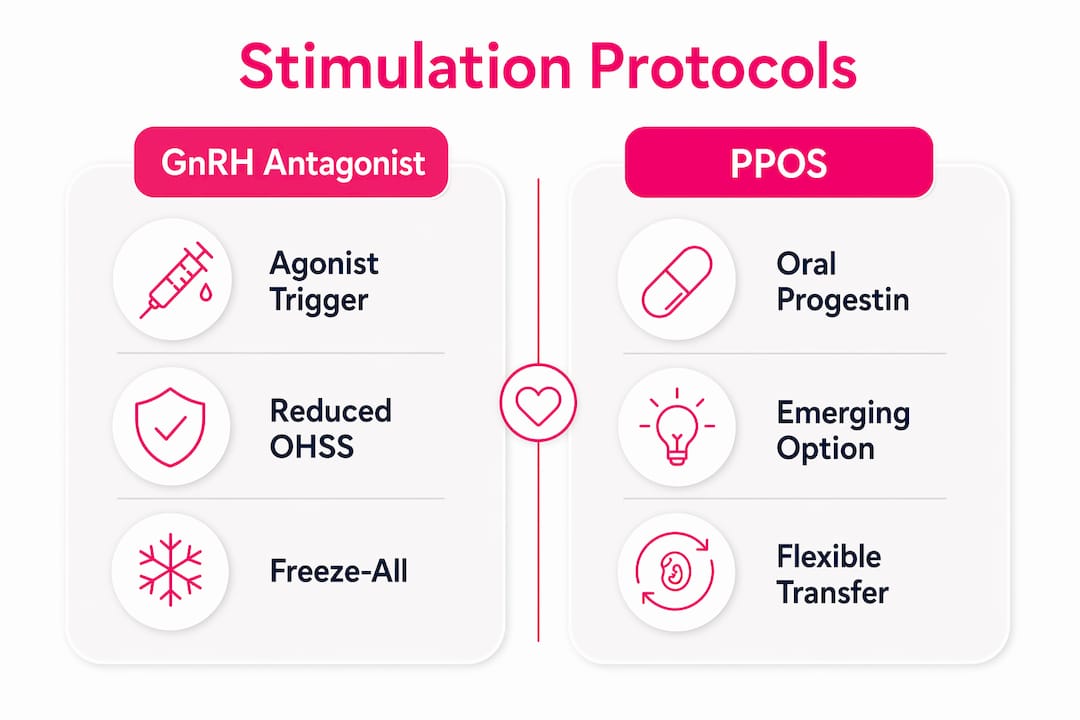
Ovarian stimulation is the highest-risk phase of IVF for PCOS patients. The goal is to recruit enough follicles for a good egg yield without triggering OHSS. GnRH antagonist protocols combined with GnRH agonist triggers and freeze-all strategies are now the standard of care for PCOS IVF cycles. This combination delivers lower rates of moderate to severe OHSS compared to older agonist-based protocols, with comparable pregnancy rates.
The table below summarizes the main protocol options and their risk profiles.
| Protocol | How it works | OHSS risk | Embryo transfer |
|---|---|---|---|
| GnRH antagonist + agonist trigger | Antagonist suppresses premature LH surge; agonist trigger replaces hCG for final maturation | Low | Freeze-all recommended |
| GnRH antagonist + hCG trigger | Standard antagonist suppression with hCG for final maturation | Moderate | Fresh or frozen |
| Progestin-primed (PPOS) | Oral progestin suppresses LH surge during stimulation | Low to moderate | Freeze-all required |
| Minimal stimulation | Low-dose gonadotropins, fewer follicles targeted | Very low | Fresh or frozen |
The GnRH agonist trigger is the most important single tool for OHSS prevention. It causes a brief, self-limiting LH surge that matures the eggs without the prolonged luteotropic effect of hCG. This dramatically shortens the window of OHSS risk. When paired with a freeze-all strategy, the risk of late OHSS drops further because no fresh embryo transfer occurs to sustain early pregnancy hormones.
Gonadotropin dosing requires careful calibration. High stimulation doses in non-obese PCOS patients can increase oocyte yield and embryo quality when paired with antagonist protocols and agonist triggers, without raising OHSS rates. However, exceeding the follicle recruitment threshold does not produce more mature eggs. It only accelerates follicle maturation and raises complication risk. The dose must be individualized, not maximized.
Progestin-primed ovarian stimulation (PPOS) is an emerging option that uses an oral progestin instead of injectable antagonists to suppress the LH surge. PPOS reduces injection burden and shows comparable OHSS reduction. Because it prevents natural ovulation, all embryos must be frozen for a later transfer cycle.
Pro Tip: If your AFC is above 20 or your AMH is very high, ask specifically about the GnRH agonist trigger and freeze-all plan before stimulation starts. Agreeing on this in advance prevents last-minute decisions under pressure during the cycle.
For patients interested in lower-intensity options, mild stimulation IVF uses reduced gonadotropin doses to target fewer follicles deliberately, which suits patients who prioritize safety over maximum egg numbers in a single cycle.
How are freeze-all and frozen embryo transfer used in PCOS IVF?
The freeze-all strategy is the single most effective way to eliminate late OHSS in PCOS cycles. High-quality evidence supports cryopreserving all embryos and deferring transfer to a separate cycle. This approach removes the hormonal environment of a fresh cycle, which is the primary driver of late OHSS, and gives the uterine lining time to recover before an embryo is placed.
The frozen embryo transfer (FET) cycle typically begins four to eight weeks after egg retrieval. Endometrial preparation options include:
- Natural cycle FET: Relies on the patient’s own ovulation to prepare the lining. Works well for patients with regular cycles.
- Hormone replacement therapy (HRT) FET: Uses estrogen to build the lining, followed by progesterone to prepare for implantation. Offers more scheduling control.
- Modified natural cycle: Combines natural ovulation monitoring with a small progesterone supplement. A middle-ground option for patients with irregular cycles.
Endometrial preparation for frozen cycles in PCOS patients follows the same evidence base used in endometriosis IVF protocols, where lining quality and timing are equally critical. The lining thickness target is typically 7mm or greater before transfer is confirmed.
Fresh transfer is not automatically ruled out for every PCOS patient. If the stimulation response was mild, the estrogen level at trigger is low, and fewer than 15 follicles developed, a fresh transfer may be considered with close monitoring. The decision requires a real-time clinical judgment, not a blanket policy.
Pro Tip: If you are doing a freeze-all cycle, use the waiting period productively. Confirm your endometrial preparation plan, discuss progesterone delivery options (oral, vaginal, or injectable), and ask about transfer timing so you can plan around your schedule.
Detailed information on embryo freezing and storage is available for patients who want to understand the cryopreservation process before their retrieval date.
What are the step-by-step monitoring procedures during a PCOS IVF cycle?
A well-monitored PCOS IVF cycle follows a structured sequence from stimulation start to embryo freezing. Each step has specific clinical checkpoints that protect against OHSS while keeping the cycle on track.
- Day 1–2: Baseline ultrasound and blood work. Confirm AFC, estradiol, and LH levels before starting gonadotropins. A high resting estradiol may indicate a cyst that needs to resolve first.
- Day 1: Start gonadotropins and early antagonist. Starting GnRH antagonists on day 1 of stimulation in PCOS patients produces superior oocyte yield and top-quality embryos compared to starting on day 5 or 6. This is a meaningful protocol difference that affects outcomes.
- Day 5–6: First monitoring ultrasound. Measure follicle sizes and check estradiol. Adjust gonadotropin dose if follicles are growing too fast or too slowly.
- Day 8–10: Second monitoring visit. Confirm lead follicle cohort. Watch for estradiol rising above 3,000–4,000 pg/mL, which signals elevated OHSS risk.
- Trigger day: GnRH agonist trigger. Administer when the lead follicles reach 17–18mm. The agonist trigger replaces hCG to minimize OHSS risk.
- 36 hours post-trigger: Egg retrieval. Performed under light sedation. The embryologist fertilizes mature eggs using conventional IVF or intracytoplasmic sperm injection (ICSI).
- Day 3 or Day 5: Embryo assessment. Embryos are graded. Day 5 blastocyst culture is preferred for better selection accuracy.
- Freeze-all: Vitrification. All viable embryos are vitrified using rapid-freeze technology. Luteal phase support is minimal since no transfer occurs.
Common pitfalls to avoid during monitoring:
- Skipping a monitoring visit because “everything feels fine.” OHSS can develop rapidly between appointments.
- Waiting too long to trigger. Follicles that grow past 20mm produce lower-quality eggs.
- Assuming more follicles always means better outcomes. Egg quality matters more than quantity.
- Underestimating luteal phase symptoms. Bloating and mild discomfort after retrieval are normal, but worsening pain or rapid weight gain requires immediate contact with your care team.
Key Takeaways
A PCOS complex IVF protocol succeeds when it combines individualized gonadotropin dosing, GnRH antagonist suppression, an agonist trigger, and a freeze-all embryo strategy to protect safety and maximize live birth rates.
| Point | Details |
|---|---|
| Prepare before stimulation | Address weight, insulin resistance, and AMH before starting any IVF cycle. |
| Use antagonist protocols | GnRH antagonist cycles with agonist triggers are the standard of care for PCOS IVF. |
| Freeze all embryos | Freeze-all with deferred FET is the most effective way to prevent late OHSS. |
| Start antagonist on day 1 | Early antagonist initiation improves oocyte yield and embryo quality in PCOS patients. |
| Monitor closely | Frequent ultrasound and hormone checks during stimulation prevent dangerous over-response. |
What I have learned from treating PCOS patients through complex IVF cycles
The most common mistake I see is treating PCOS as a single condition with one standard fix. PCOS is a spectrum. A lean patient with a very high AMH and regular cycles needs a completely different protocol than a patient with insulin resistance, irregular cycles, and a moderately elevated AFC. Applying a one-size approach to both is how cycles fail.
The second thing I have learned is that patients who understand their own numbers do better. When a patient knows her AFC is 28 and understands why that means we are starting with a conservative dose and planning a freeze-all, she is less anxious during monitoring and more likely to follow through on the plan. Education is not a courtesy. It is part of the treatment.
The freeze-all strategy still surprises some patients. They expect to transfer an embryo immediately after retrieval and feel disappointed when the plan calls for waiting. What I tell them is this: the waiting cycle is not a delay. It is the cycle where the uterus gets the best possible chance. The data on live birth rates and neonatal outcomes supports that position clearly.
One misconception worth correcting directly: more eggs do not always mean a better outcome. PCOS patients often retrieve 20 or more eggs in a single cycle. But egg quality, fertilization rate, and blastocyst development matter far more than raw numbers. A patient with 12 high-quality blastocysts has better prospects than one with 25 eggs and poor fertilization. Chasing numbers with higher doses only raises OHSS risk without improving the odds.
If you have had a failed cycle elsewhere and are wondering whether a protocol adjustment could change your outcome, a second opinion from a specialist is worth pursuing before starting again.
Personalized PCOS IVF care at Life IVF Center
Life IVF Center builds every PCOS IVF cycle around the patient’s specific AMH, AFC, metabolic profile, and reproductive history. The Precision IVF® approach means no two protocols are identical, and no standard template is applied without review.
Patients with PCOS benefit from transparent pricing and a clear treatment plan before the first injection. Life IVF Center’s fertility treatment packages include PCOS-specific IVF options with individualized stimulation protocols, freeze-all support, and frozen embryo transfer planning. Scheduling a consultation is the first step toward a protocol built specifically for your biology, not a general template. Contact Life IVF Center to speak with a specialist and review your options.
FAQ
What makes a PCOS IVF protocol “complex”?
A complex IVF protocol for PCOS involves individualized gonadotropin dosing, GnRH antagonist suppression, a GnRH agonist trigger, and a freeze-all embryo strategy to manage the elevated OHSS risk that PCOS patients face.
Is the freeze-all strategy always required for PCOS patients?
Freeze-all is strongly recommended for most PCOS patients because it eliminates late OHSS risk and supports better uterine conditions for implantation. Fresh transfer may be considered when the stimulation response is mild and estrogen levels remain low at trigger.
How does starting antagonists on day 1 improve outcomes?
Starting GnRH antagonists on day 1 of stimulation in PCOS patients produces superior oocyte yield and higher-quality embryos compared to starting on day 5 or 6, with better cumulative pregnancy rates.
Can lifestyle changes actually improve IVF success in PCOS?
A weight loss of 5–10% before IVF improves egg quality and hormonal balance in overweight PCOS patients. Combined with 150 minutes of moderate exercise per week, these changes reduce androgen levels and improve insulin sensitivity before stimulation begins.
What is PPOS and who is it for?
Progestin-primed ovarian stimulation (PPOS) uses an oral progestin to suppress the LH surge during stimulation instead of injectable antagonists. It suits patients who prefer fewer injections and are comfortable with a mandatory freeze-all cycle.
Recommended
- Endometriosis IVF Process: What You Need to Know
- IVF Process Explained: Personalize Your Path to Success
- How to Navigate the Mini IVF Protocol Step by Step
- Top 6 westcoastfertility.com Alternatives Providers 2026
Ready to take the next step?
Life IVF Center specializes in individualized Precision IVF® care for complex cases—including diminished ovarian reserve, prior failed cycles, and advanced maternal age. Our in-house labs and dedicated physicians are ready to help.
Book a Free Consultation →