
IVF at 45 is possible, but it is a different conversation than IVF at 35. With your own eggs, the chance of a live birth per cycle is low, and many U.S. clinics set an age limit near this point. With donor eggs, outcomes are much closer to those of younger patients. This guide explains what the published numbers show, how clinics decide who to treat, which tests come first, what the costs look like, and which options deserve a conversation with a specialist.
If you are 45 and reading this, you may already have been told it is too late, or that your odds are “1%.” The reality is more specific than either of those statements. Below, we separate what the evidence supports from what is rumor.
TL;DR
- Many U.S. clinics cap IVF with a patient’s own eggs at a median age of 45, so access depends on the clinic as much as on your biology.
- Large studies of own-egg IVF at 45 and older report live birth rates in the low single digits per transfer, and most pregnancies that do occur end in loss.
- Donor eggs change the picture: CDC data show live birth rates above 50% per transfer for donor-egg cycles, and recipient age had little effect in the prior data the CDC cites.
- Testing before treatment (ovarian reserve, uterine evaluation, genetic and infectious disease screening) tells you what is realistic and avoids wasted cycles.
- At 45 and above, a specialist consultation should happen immediately, not after months of trying.
Table of Contents
- Can you do IVF at 44 or 45?
- What happens to fertility between 35 and 45
- IVF success at 45 with your own eggs
- IVF at 45 with donor eggs or frozen embryos
- What our team recommends testing first
- Genetic testing of embryos at 45
- Our perspective: personalizing treatment at 45
- Risks and alternatives to consider
- What IVF costs at Life IVF Center
- Start with a personalized plan
- FAQ
- Sources
Can you do IVF at 44 or 45?
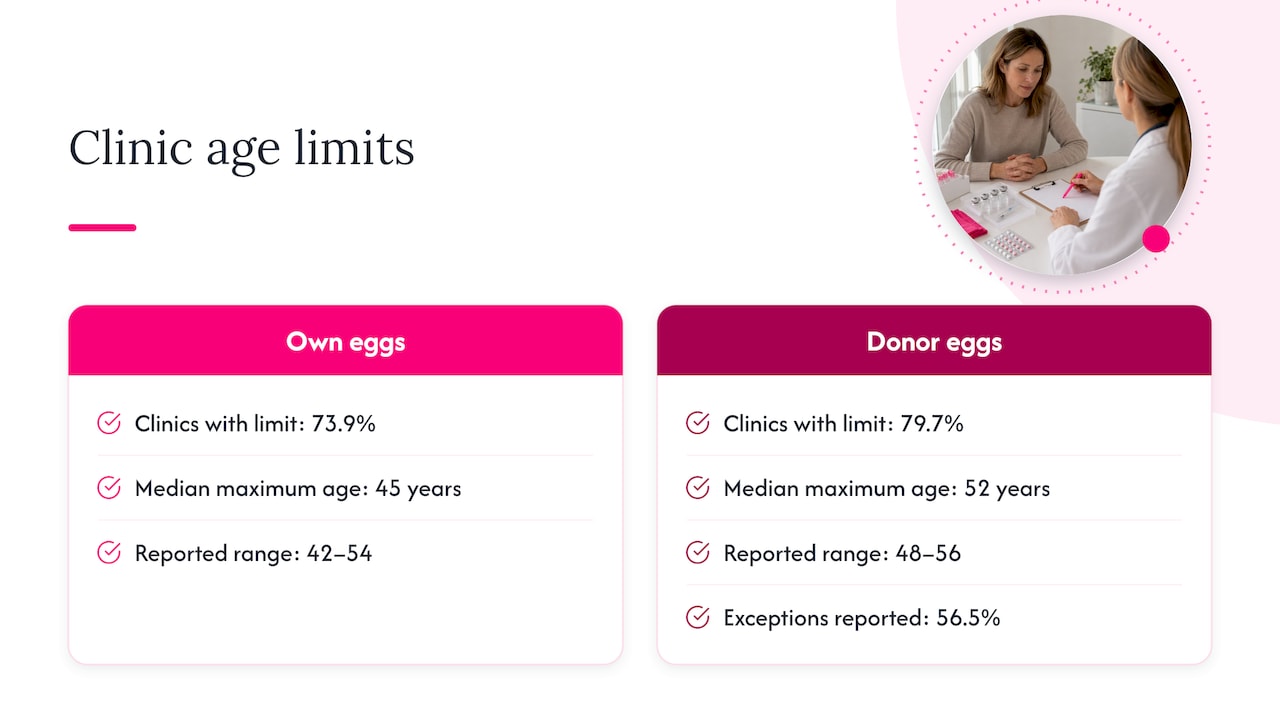
Yes, in many cases, but not at every clinic. A 2023 survey of 69 U.S. fertility clinics on patient age policies found that 73.9% had a maximum age for IVF using a patient’s own eggs. The median maximum was 45 years, and limits ranged from 42 to 54. For donor-egg IVF, 79.7% of clinics had a maximum age, with a median of 52 and a range of 48 to 56. Of those clinics, 56.5% reported making exceptions, most often for patients who already had embryos.
The same survey lists the reasons clinics most often give for age limits: risks to the pregnant patient, lower success rates with ART, risks to the fetus and newborn, and concerns about the ability to parent at an older age. These are medical and counseling judgments, not moral ones, and they differ from clinic to clinic.
What this means in practice: if one clinic turns you away at 45, that is a statement about that clinic’s policy. It is not a verdict on your case. A second opinion is reasonable, particularly if your history is complex. At Life IVF Center, we welcome second-opinion cases and patients who have been told elsewhere that treatment is not an option, and we review each history individually before recommending a path.
What happens to fertility between 35 and 45
Fertility starts to decline by age 30 and falls faster in the mid-30s. ACOG explains that egg numbers decrease and the remaining eggs are more likely to have abnormal chromosomes, and that by 45, natural pregnancy is unlikely.
Two separate things are changing:
- Quantity. The number of eggs available in each cycle shrinks. This is what ovarian reserve testing tries to estimate.
- Quality. The proportion of eggs with the right number of chromosomes drops. This is the main reason embryos from older eggs fail to implant or end in miscarriage.
Quality is the harder problem. ReproductiveFacts.org, the patient resource of ASRM, states that ovarian reserve tests give information about ovarian changes but do not show whether pregnancy is possible, and that age is the best indicator of egg quality. A good test result at 45 is useful information for planning a retrieval, but it does not reverse the age effect on chromosomes.
If you are between 35 and 40, the picture is different from the one at 45. Timelines matter, but outcomes with your own eggs remain meaningfully better. The same principle applies at every age: the sooner a specialist evaluates you, the more options you have.
How many eggs are left at 45?
There is no single number. Egg counts vary widely between individuals, and the number of eggs retrieved in a stimulation cycle at this age is often small. SART notes that egg yield tends to decrease over time and that medication needs tend to rise over cycles, although it is uncertain how much of that reflects age and how much reflects the retrieval process itself. An antral follicle count by ultrasound and blood hormone levels give an estimate for your own body, which is the figure that matters for planning.
IVF success at 45 with your own eggs
This is the part many patients find hardest to read, so we will state it plainly and cite the sources.
- A 2017 study of 1,078 autologous IVF cycles in women aged 45 and older (Gunnala and colleagues) found an overall live birth rate of 3.4% per transfer. There were no live births among patients who had four or fewer oocytes retrieved.
- In the same cohort, women aged 45 had a live birth rate of 2.9% per cycle start, and 82.1% of pregnancies ended in loss.
- The CDC’s 2017 national clinic report showed, for patients aged 43 or older using their own eggs at the reported clinic, a 4.2% live birth rate per intended retrieval and 6.7% per transfer. The CDC cautions that figures like these do not represent an individual patient’s chance.
That last caution is important. These are population averages drawn from older data, and they mix patients with very different ovarian reserve, embryo testing, and clinic practices. They tell you the range to expect. They do not predict your result, and we do not offer a success figure of our own in place of them.
There is also a wide gap between the numbers above and the figures some websites advertise. Higher percentages quoted for women in their mid-40s usually come from donor-egg cycles, from selected patient groups, or from counting transfers of already-tested embryos rather than cycle starts. When you read a rate, ask three things: which age group, which egg source, and whether the denominator is cycle starts, retrievals, or transfers.
Are there success stories at 46 or 47 with your own eggs?
Individual stories exist, and online forums are full of both successes and cycles that produced no usable embryos. Those accounts are real but are not a basis for planning, because people with positive outcomes are more likely to post. The published cohorts above are a better guide, and they show that outcomes at 45 and beyond are uncommon, with the number of eggs retrieved strongly affecting the result.
IVF at 45 with donor eggs or frozen embryos
Donor eggs come from a younger person, so the embryo’s chromosomes reflect the donor’s age rather than yours. That is why the results look so different.
The CDC’s 2017 report combined donor-egg and donated-embryo transfers across recipient ages and reported these live birth rates:
| Cycle type | Live birth rate per transfer |
|---|---|
| Fresh donor eggs | 56.5% |
| Frozen donor eggs | 54.1% |
| Frozen donated embryos | 42.6% |
The report explains that recipient ages were combined because earlier data showed recipient age did not substantially affect success with donor eggs or donated embryos. You can read the underlying figures in the CDC 2017 ART Fertility Clinic Report.
This does not mean donor eggs are simple. The uterus still has to carry a pregnancy at an older age, which brings its own medical considerations (covered below), and many patients need time to think about using donor gametes. Counseling is a normal part of the process. For patients who prefer a genetic connection, another route is to retrieve eggs, create embryos, and test them. That can be worth discussing, but at 45 it often takes more than one retrieval and may still produce no transferable embryo.
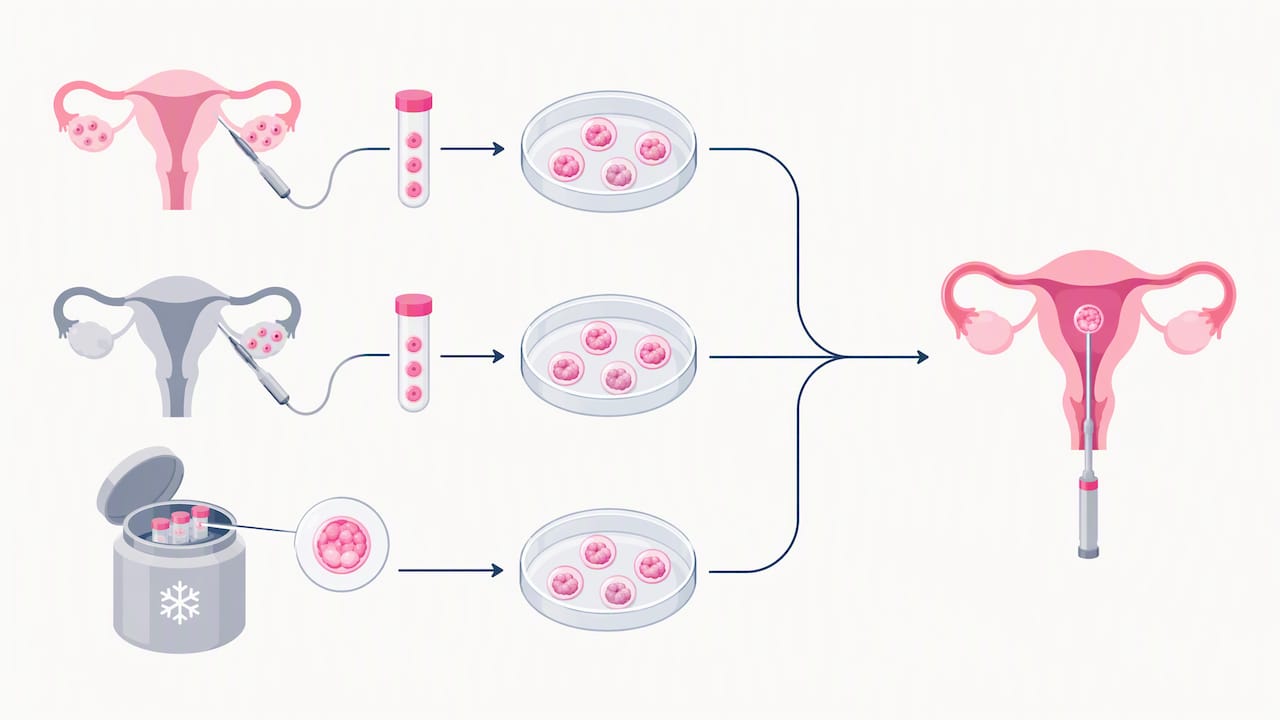
If you froze eggs or embryos when you were younger, the age at freezing, not your current age, largely determines egg quality. Your uterine health and overall medical condition still matter at transfer.
What our team recommends testing first
Before any cycle, a thorough evaluation tells you whether treatment is likely to be worthwhile and which approach to choose. For patients over 40 with no known cause for infertility, ASRM guidance reported in an ACOG committee statement recommends immediate specialist consultation for people with regular, unprotected intercourse and a female partner older than 40. Waiting a year before seeking help is not advised at this age.
A typical pre-IVF workup includes:
- Ovarian reserve assessment: blood hormone levels and an ultrasound count of resting follicles. Remember these estimate quantity, not whether pregnancy is possible.
- Uterine evaluation: a saline infusion sonohysterogram (SIS) to check for polyps, fibroids or scarring that could interfere with implantation.
- Endometrial receptivity: in some cases, an endometrial receptivity assay (ERA) to time an embryo transfer.
- Genetic screening: carrier screening for inherited conditions, and karyotype analysis when the history suggests a chromosomal factor.
- Infectious disease panel and Pap smear: standard before treatment.
- Semen analysis for a male partner, because male factors are often present alongside age-related ones.
On our published pre-IVF price page, these are listed individually: the Infectious Disease (ID) panel is $550 to $750, a sperm count is $185, a Pap smear is $185, karyotype chromosomal analysis is $595, carrier screening for genetic disease is $349, SIS is $450, and ERA is $975. You can review the full list on our pre-IVF testing prices page.
Genetic testing of embryos at 45
Because chromosomal abnormality is the main barrier at this age, patients often ask about preimplantation genetic testing for aneuploidy (PGT-A), which checks embryos for the number of chromosomes before transfer. The idea is straightforward: transfer only embryos that have a chromosomal chance of developing. It can reduce the number of transfers that fail or end in miscarriage. It cannot create a normal embryo from eggs that do not produce one, and at 45 many cycles yield few embryos to test. Whether testing makes sense for you depends on how many embryos you are likely to have, your goals, and your budget, which is a decision to make with your care team. Our genetic testing and IUI services overview explains what we offer.
Our perspective: personalizing treatment at 45
At Life IVF Center, we believe that for patients in their mid-40s, a single standard protocol is the wrong starting point. The patient who comes to us at 45 may have diminished ovarian reserve, endometriosis, an immune factor, a prior failed cycle elsewhere, or all of these. Each changes what we recommend.
Our approach, Precision IVF®, builds the treatment plan around your biology, your medical history, and your goals. In practice, that means we look at your testing results first and decide the stimulation approach, the timing, and the transfer strategy from there. Our in-house laboratories give us direct control over how eggs and embryos are handled, which matters when you may only have a handful of either.
We also think honesty is part of good care. For some patients, the best-supported path is donor eggs, and we say so clearly, along with the reasons. For others, one carefully planned retrieval with their own eggs is a reasonable attempt, provided they understand the published odds and decide with that knowledge. We do not push one answer. We would rather you leave a consultation with an accurate picture, whichever direction you choose.
We treat patients who have been told no elsewhere, and we support patients traveling from out of the area with travel coordination, multi-language support, and financial guidance.
Risks and alternatives to consider
Pregnancy at an older age carries medical risks that deserve a direct discussion with an obstetric specialist, ideally before treatment starts. ACOG notes that multiple pregnancy risk rises with certain fertility treatments and with the tendency of aging ovaries to release more than one egg, which can raise the chance of preterm birth. Transferring a single embryo is one way to limit that risk.
Other considerations include:
- Miscarriage. With own eggs at this age, loss is the common outcome of a positive test, as the cohort data above show.
- Pregnancy complications. Conditions such as high blood pressure and gestational diabetes become more common with age. Your primary physician and a high-risk obstetric team should review your health beforehand.
- Medication and weight. If you use a GLP-1 medication such as semaglutide, plan the timing with your prescriber, because it is typically stopped before conception. A guide to stopping semaglutide before conceiving covers the steps and timeline in more detail.
- Emotional load. Repeated cycles with low odds are hard. Counseling and a clear stopping point, agreed in advance, protect your wellbeing.
Alternatives to own-egg IVF include donor eggs, donated embryos, and gestational surrogacy when carrying a pregnancy is the barrier. Some people also explore adoption or a childfree path, and these are valid choices to weigh with a counselor.
What about IVF after 35 and over 35?
If you are in your late 30s rather than your mid-40s, the guidance changes in degree, not in kind. Egg quality is declining but own-egg treatment is still a realistic path for many patients, and early testing is the most valuable step. If you are considering preserving options, egg or embryo freezing before 40 offers the advantage of locking in the age of the eggs. On our site, Precision Egg Freezing is $7,500 and Precision Embryo Freezing is $8,950, and storage is $750 per year, $2,000 for a three-year prepaid plan, or $70 per month.
What IVF costs at Life IVF Center
Cost is a practical question, and we publish our prices so you can plan. As listed on our treatment packages page, the Advanced IVF Package is $13,500, and an embryo transfer starts from $2,950. The IVF Package and Egg Cryo Package do not have a published price on that page, so confirm those at your consultation. Testing, medications, storage, and any donor or genetic services are additional, and the right package depends on your evaluation.
We also offer financial guidance, so you can understand what insurance may cover and how to budget across more than one cycle if your plan calls for it.
Start with a personalized plan
If you are 45 or older, or between 35 and 45 and unsure how much time you have, the most useful next step is an individual evaluation. We review your history and prior records, order the tests that matter for your case, and give you a plain assessment of your options with your own eggs, with donor eggs, or with eggs and embryos you have already stored.
Learn more about Precision IVF® at Life IVF Center and book a consultation. Bring prior lab results, cycle summaries, and any questions about age limits. We would rather answer them before you decide than after.
FAQ
Can you do IVF at 44?
Yes. Many clinics treat patients at 44 with their own eggs, although the 2023 U.S. clinic survey found a median maximum age of 45 for own-egg IVF. Individual policies vary, so ask each clinic directly. Success rates are lower than at younger ages, and donor eggs are an option if own-egg cycles are unlikely to work.
How many eggs do I have left at age 45?
It depends on the individual. Blood hormone tests and an ultrasound count of follicles estimate your reserve, but ReproductiveFacts.org notes these tests do not show whether pregnancy is possible. Age remains the best indicator of egg quality.
Are there success stories of IVF at 47 with your own eggs?
A few individual cases are reported, but published data show they are uncommon. The study of 1,078 cycles in women 45 and older found a 3.4% live birth rate per transfer. Donor eggs offer much higher chances at this age.
Is it possible to conceive naturally at 48?
It is very unlikely. ACOG states that by 45, natural pregnancy is unlikely. If you do not wish to conceive, you should still use contraception until your doctor confirms menopause. If you do, see a fertility specialist promptly.
Sources
- Survey assessing policies regarding patient age and fertility treatment (PMC, 2023)
- ACOG: Having a Baby After Age 35, How Aging Affects Fertility and Pregnancy
- ReproductiveFacts.org: Reproductive Aging in Women
- SART: Questions and Answers
- One thousand seventy-eight autologous IVF cycles in women 45 and older (PMC)
- CDC 2017 Assisted Reproductive Technology Fertility Clinic Report
- Anticipatory Counseling Regarding Ovarian-Factor Fertility Decline (ACOG committee statement, 2025)
This article is for general educational purposes only and is not a substitute for personalized medical advice, diagnosis, or treatment. Fertility care is highly individual; please consult a qualified healthcare professional about your specific circumstances.
Ready to take the next step?
Life IVF Center specializes in individualized Precision IVF® care for complex cases—including diminished ovarian reserve, prior failed cycles, and advanced maternal age. Our in-house labs and dedicated physicians are ready to help.
Book a Free Consultation →