
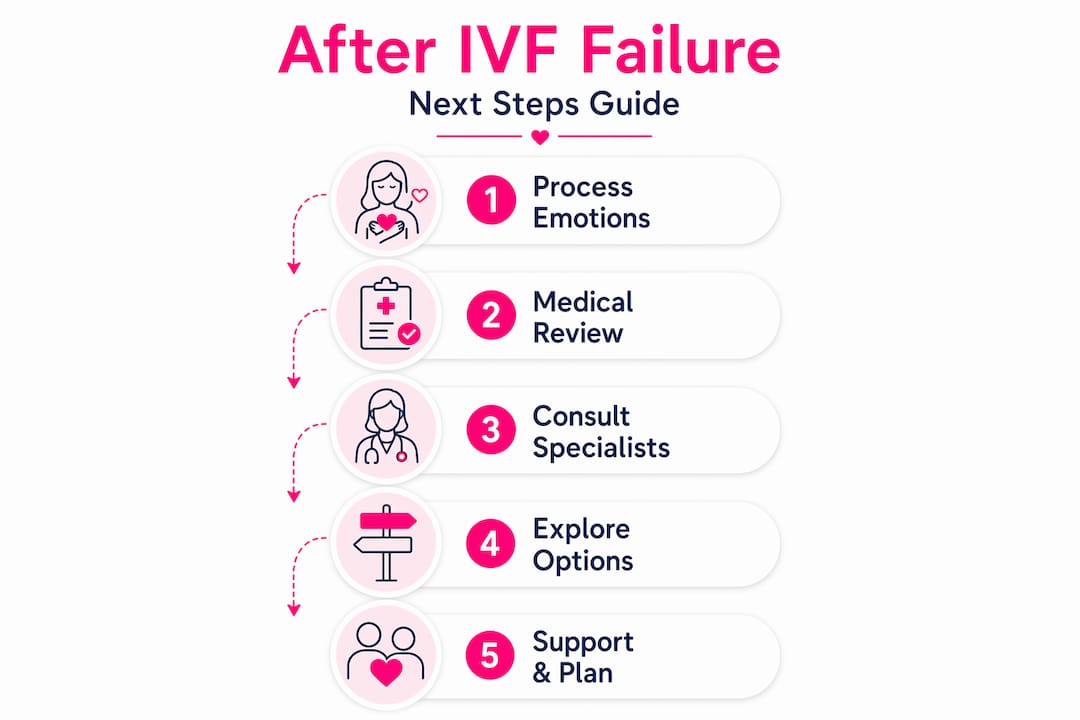
A failed IVF cycle doesn’t just disappoint. It can leave you questioning everything, from your body to your future. If you’re trying to understand how to handle IVF after failed cycles, know that you are not alone and that confusion right now is completely normal. This article covers the full picture: the emotional weight you’re carrying, what a proper medical review should look like, how to take care of yourself in the meantime, and what real options exist going forward. The goal is to give you both clarity and compassion, in equal measure.
Table of Contents
- Key Takeaways
- Emotional responses after failed IVF cycles
- Medical reassessment after IVF failure
- Practical strategies for coping and preparing
- Evaluating your options going forward
- My honest take on navigating IVF failure
- How Life IVF Center supports patients after failed cycles
- FAQ
Key Takeaways
| Point | Details |
|---|---|
| Validate your emotions first | Grief, anger, and guilt are normal responses. Naming them is the first step toward healing. |
| Demand a thorough failure analysis | Repeating an identical protocol without review rarely improves outcomes. Ask your doctor to assess every variable. |
| Take an intentional pause | Physical and emotional recovery time is not surrender. It gives you the clarity to make better decisions. |
| Explore all paths forward | Options include adjusted IVF protocols, donor gametes, surrogacy, and adoption. No path is lesser than another. |
| Seek a second opinion when needed | A fresh expert perspective after failure can clarify unclear outcomes and reveal options you haven’t considered. |
Emotional responses after failed IVF cycles
A failed cycle often hits harder than people outside the experience can fully understand. You may feel grief that rivals any loss, anger that has no clear target, guilt that asks what you did wrong, or a quiet hopelessness that makes planning ahead feel pointless. All of these reactions are legitimate responses to a real loss. Acknowledging these emotions is critical for healing, and suppressing them rarely works for long.
Couples often experience this pain differently from each other. One partner may want to talk constantly while the other retreats inward. Neither response is wrong, but the gap can create friction at an already difficult time. Reading a guide on supporting your partner through IVF can help both of you navigate those differences with more empathy and less conflict.
When grief starts to feel unmanageable, professional support is not a last resort. It’s a smart, practical tool. Therapists who specialize in fertility loss offer more than general emotional support. Specifically, therapies like Acceptance and Commitment Therapy, or ACT, are designed to help you carry pain without letting it dictate decisions by focusing on your values rather than your fears.
- Grief, sadness, and crying without warning are common and do not indicate weakness.
- Anger directed at yourself, your partner, or your doctor often reflects a need for answers, not blame.
- Guilt frequently appears even when nothing you did caused the failure.
- Hopelessness is real but does not reflect the full picture of what is still medically possible.
- Support groups, whether in person or online, connect you with people who understand this experience firsthand.
Pro Tip: If you find that grief is interfering with daily functioning for more than two weeks, consider scheduling a consultation with a fertility-aware therapist before deciding on any next medical steps. Your emotional state directly affects treatment decisions.
Medical reassessment after IVF failure
One of the most important and underutilized steps after a failed cycle is a thorough failure analysis. Many patients assume the answer is simply “try again,” but repeating an identical protocol without analysis is ineffective when the root issue remains unaddressed. Your body gave the clinic significant data during your cycle. That data deserves to be reviewed carefully.
A complete failure review typically examines the following:
- Ovarian response: Did your ovaries produce an adequate number and quality of eggs given your stimulation protocol?
- Fertilization: Did the eggs fertilize normally, and if not, was it a sperm issue, egg quality issue, or lab-related factor?
- Embryo development: Did embryos reach the blastocyst stage, and how were they graded?
- Uterine environment: Was the lining adequate in thickness and receptivity at the time of transfer?
- Immunological factors: Were there signs of an immune-related implantation failure that went untested?
- Laboratory conditions: Were incubator settings, culture media, and timing protocols optimal?
A comprehensive failure review identifies correctable issues and guides treatment adjustments. This is not a judgment on your previous clinic. It is simply good science applied to a specific outcome.
| Area reviewed | What a change might look like |
|---|---|
| Stimulation protocol | Switching medication type or dose based on ovarian reserve |
| Fertilization method | Changing from conventional IVF to ICSI or vice versa |
| Embryo selection | Adding preimplantation genetic testing (PGT) |
| Uterine receptivity | Testing with ERA (Endometrial Receptivity Analysis) before transfer |
| Immunology | Adding treatment for natural killer cell activity or clotting issues |

Second opinions after IVF failure are medically appropriate and more common than most patients realize. If your current clinic’s response to failure is a blanket recommendation to repeat the same cycle, that is a signal worth paying attention to. A second set of expert eyes can reframe your case entirely. You can learn more about when this step makes sense by reviewing information on a failed IVF second opinion before your next consultation.
Pro Tip: Bring a written list of questions to your post-failure consultation. Ask specifically: What did my cycle data show? What would change in the next protocol, and why? What tests have we not done yet? Clinics that can answer these questions clearly are the ones worth staying with.
Practical strategies for coping and preparing
Taking an intentional pause after a failed cycle is not giving up. It is a strategic decision that allows your body time to recover and your mind space to process what happened before committing to the next step. Many patients feel external pressure, whether from age concerns, financial considerations, or social expectations, to start another cycle immediately. That pressure is real, but acting from exhaustion rarely leads to good decisions.
Here is a practical sequence for recovering and preparing well:
- Allow the grief. Give yourself permission to feel the loss fully before shifting into problem-solving mode. A week or two of deliberate rest is not wasted time.
- Return to physical basics. Sleep, nutrition, and light movement like walking or yoga all support hormonal recovery and reduce the physical stress load IVF places on the body.
- Reconnect with your partner. Schedule time together that has nothing to do with treatment, test results, or planning. Fertility struggles can reduce a relationship to a clinical process. Reclaiming connection matters.
- Limit intrusive conversations. You are not obligated to update family or friends on your timeline. It is reasonable to tell people you will share news when there is news worth sharing.
- Practice mindfulness deliberately. Mindfulness and gentle exercise improve well-being and manage stress post-failure. Even ten minutes of guided breathing daily produces measurable changes in cortisol levels over time.
Social triggers deserve particular attention. Baby showers, pregnancy announcements, and casual questions from well-meaning acquaintances can reopen grief without warning. Having a prepared, honest response ready, such as “We’re taking things one step at a time,” protects your energy without requiring explanation.
Pro Tip: Consider working with a fertility counselor specifically during the pause phase, not just after you’ve decided what to do next. Processing in the space between decisions often leads to clearer, calmer choices.
Evaluating your options going forward
Once you’ve allowed yourself time to recover and have completed a thorough medical review, the question becomes: what next? The answer is rarely one-size-fits-all, and knowing what options exist helps you approach that conversation with your care team from a grounded place.
- Adjusted IVF protocol: If your failure analysis identifies specific correctable issues, another IVF cycle with meaningful protocol changes is often a reasonable next step. The key word is “meaningful.” Changes should be based on data, not hope.
- Mini IVF or natural cycle IVF: For patients who responded poorly to stimulation, lower-dose protocols can sometimes produce better-quality eggs with less physical stress.
- Donor eggs or donor sperm: When egg or sperm quality is identified as the central issue, using donor gametes dramatically changes success rates. This path carries emotional complexity, but many couples find it deeply fulfilling.
- Gestational surrogacy: For patients with uterine issues or repeated implantation failure, surrogacy allows genetic parenthood when carrying a pregnancy is not viable.
- Adoption: Choosing adoption after failed IVF cycles reflects self-awareness and love, not defeat. Recognizing when stopping treatment is a valid, strength-based decision is itself a form of wisdom.
The emotional weight attached to each path varies significantly between individuals and couples. Some people feel at peace with donor gametes immediately. Others need months to process the idea. There is no correct timeline.
| Path | Best suited for | Emotional consideration |
|---|---|---|
| Adjusted IVF | Correctable medical factors identified | Manageable with clear expectations |
| Donor eggs/sperm | Poor gamete quality confirmed | May require time to process genetic connection |
| Surrogacy | Uterine or implantation issues | Logistically complex, emotionally significant |
| Adoption | Any stage, personal choice | Rich but lengthy process requiring readiness |
Exploring fertility treatment options across these categories with a knowledgeable team helps you compare them based on your specific medical profile, not general statistics alone.
My honest take on navigating IVF failure
I’ve spoken with hundreds of patients who came through failed cycles, and the common thread I see is this: the ones who do best are not the ones who push hardest the fastest. They are the ones who insist on understanding what actually happened before committing to another round.
What strikes me most is how rarely patients are encouraged to name their grief as a real loss. Clinics can fall into clinical mode quickly. But the emotional processing and the medical reassessment are not separate tracks. They happen together, and skipping the first one compromises the second.
I’d also push back gently on the idea that persisting through more cycles is always the stronger choice. Recognizing your emotional limits and adjusting your path accordingly is not failure. It is good judgment. Define what winning looks like for you, not what it looks like in someone else’s story. That clarity will serve every decision you make from here.
How Life IVF Center supports patients after failed cycles
At Life IVF Center, the team understands that arriving after a failed cycle elsewhere means arriving with a full emotional and medical history, not a blank slate. The clinic’s Precision IVF® approach is built around individualized protocol design, which means every treatment plan is structured around your specific biology, your previous cycle data, and your goals, not a generic protocol applied to all patients.
For patients considering their next steps, Life IVF Center offers thorough failure analysis consultations, second opinion reviews, and tailored treatment packages designed to reduce the number of cycles needed while maintaining realistic expectations. Whether you are weighing another IVF attempt, exploring donor options, or simply seeking clarity before making any decision, the clinic’s Southern California team is equipped to guide you. You can also review information about care after previous failures to understand what the reassessment process looks like in practice.
FAQ
What should you do immediately after a failed IVF cycle?
Allow yourself time to grieve before making any new decisions. Schedule a post-cycle consultation with your doctor to review what the data showed and what, if anything, should change in a future protocol.
How many failed IVF cycles is too many?
There is no universal number. The decision depends on your individual medical findings, emotional reserves, and financial situation. If cycles are being repeated without meaningful protocol changes, that is a signal to seek a second opinion.
When is it appropriate to try IVF again?
Most specialists recommend waiting at least one full menstrual cycle for physical recovery, but the medical review and emotional readiness often take longer. Repeating IVF too quickly without addressing the reasons for failure tends to produce the same results.
Does IVF failure mean something is permanently wrong?
Not necessarily. Many IVF failures are related to factors that can be identified and adjusted, including stimulation protocols, embryo selection methods, and uterine receptivity testing. A thorough failure analysis is the only way to know what actually occurred.
Is it reasonable to seek a second opinion after IVF failure?
Yes, and it is more common than most patients realize. A second expert review often surfaces options or testing that were not previously considered, and it gives you more confidence in whatever path you choose next.
Recommended
- Failed IVF Second Opinion – Life IVF Center
- Failed IVF Elsewhere – Redesign Draft – Life IVF Center
- Previous IVF Failures – Life IVF Center
- IVF Process Explained: Personalize Your Path to Success
Ready to take the next step?
Life IVF Center specializes in individualized Precision IVF® care for complex cases—including diminished ovarian reserve, prior failed cycles, and advanced maternal age. Our in-house labs and dedicated physicians are ready to help.
Book a Free Consultation →