
Some pooled research suggests that high-hyaluronan embryo-transfer media may modestly improve live-birth outcomes, but the size and certainty of the benefit remain limited. A Cochrane review of 26 trials involving 6,704 participants reported a possible absolute increase from a 33% baseline to approximately 37% to 44%. These are study-level findings, not a prediction for an individual patient or a guarantee of benefit.
Safety data are reassuring on the points that matter most. There’s no evidence that hyaluronan-enriched transfer medium (HETM) damages embryos, and pooled analyses show either no change in miscarriage risk or a small decrease, though certainty on that point remains low. The one flag worth knowing: some pooled data show a higher rate of multiple pregnancy, which is why single-embryo transfer policy matters more, not less, when clinics use this medium.
Quick verdict:
- Effect on live birth: Likely positive, modest in size (RR 1.21, absolute gain roughly 4 to 11 percentage points)
- Number needed to treat: About 1 extra live birth per 14 transfers
- Embryo safety: No signal of harm
- Miscarriage: Possibly slightly lower, low certainty
- Multiple pregnancy: Elevated in some analyses; manage with SET
- Regulatory take: The HFEA rates this add-on with a mixed evidence grade, not an unqualified green light
Life IVF Center treats this as one input among many, not a substitute for embryo quality or individualized protocol design.
Key Takeaways
The strongest pooled evidence suggests a possible modest benefit, while uncertainty remains and no individual outcome can be guaranteed.
| Point | Details |
|---|---|
| Pooled effect size | Cochrane data show live birth rising from a 33% baseline to 37% to 44% with high-HA media (RR 1.21). |
| Certainty is limited | Evidence is rated low to moderate certainty, with heterogeneity across trials factored in. |
| Frozen vs fresh differs | Fresh-cycle signals appear more consistent; frozen-cycle data range from strongly positive retrospective cohorts to neutral prospective studies. |
| Multiple pregnancy risk | Some pooled analyses show higher multiple pregnancy rates, reinforcing the case for single-embryo transfer. |
| Life IVF Center’s stance | Precision IVF® treats EmbryoGlue as a possible marginal add-on decided case by case, not a substitute for embryo quality. |
Table of Contents
- What Does the Embryo Glue Evidence Actually Show?
- Which Studies Actually Move the Needle?
- How Is Embryo Glue Supposed to Work?
- Is Embryo Glue Safe to Use?
- Who Is Most Likely to Benefit from Embryo Glue?
- How Do Clinics Typically Offer Embryo Glue, and What Does It Cost?
- What Should You Ask Your Fertility Team About Embryo Glue?
- Life IVF Center’s View on Embryo Glue and Precision IVF®
- A Personal Note on Weighing This Decision
- Talk to Life IVF Center About Whether Embryo Glue Fits Your Plan
- Where to Read the Original Research
- Frequently Asked Questions
- Sources
What Does the Embryo Glue Evidence Actually Show?
The strongest single piece of embryo glue evidence is the 2020 Cochrane systematic review, which pooled data from 26 randomized trials and found that high-concentration hyaluronic acid transfer media probably increase live birth rates compared with low or no HA media. The relative risk was 1.21, with a 95% confidence interval of 1.11 to 1.31, meaning the true effect could be as small as an 11% relative increase or as large as 31%.

Translated into practical terms, the evidence suggests a modest increase in live birth probability compared to lower or no HA media, though the certainty is low to moderate due to variability and inconsistency across studies.
A few things the review makes clear:
- High-HA media likely increase live birth and clinical pregnancy rates versus standard media, though the magnitude is modest and not guaranteed.
- The certainty of evidence is low to moderate, not high, so the true effect size carries real uncertainty.
- Multiple pregnancy rates were elevated in some pooled analyses, highlighting the importance of careful embryo transfer policies.
- No evidence has been found indicating embryo damage caused by HA-enriched media.
A separate focused review on EmbryoGlue and hyaluronan use reached a similar conclusion: moderate-quality evidence supports benefit for some clinical outcomes, but the authors explicitly called for more large randomized trials before treating this as settled science. That’s a meaningfully different message than what marketing materials sometimes imply. The evidence supports a real but bounded effect, not a guaranteed one.
Regulatory bodies read the data the same cautious way. Guidance summaries from organizations like the HFEA and reproductive medicine societies typically grade hyaluronan-enriched transfer media as showing a mixed evidence picture, with more consistent signals in some settings than others. That’s not a rejection of the treatment. It’s an honest acknowledgment that the pooled numbers are real, but not overwhelming.
Which Studies Actually Move the Needle?
Pooled reviews are only as good as the trials feeding them. Here’s how some of the key individual studies behind the embryo glue evidence base compare.
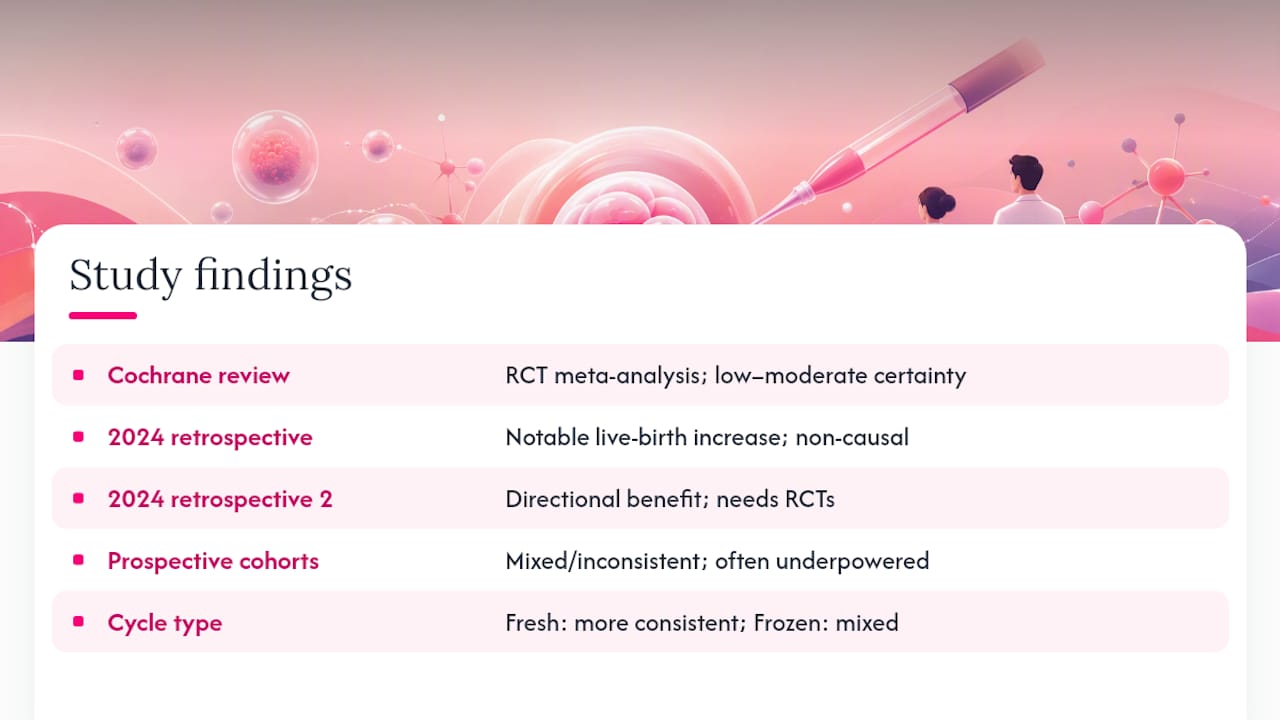
The Cochrane pooled estimate carries the most weight because it combines randomized data across many settings, which reduces the risk that any one clinic’s practice patterns skewed the result. Its main limitation is the low-to-moderate certainty rating driven by inconsistency between trials.
The 2024 multicenter retrospective cohort study specific to frozen embryo transfer found a notable increase in live birth rates favoring EmbryoGlue®, identified as an independent predictor after statistical adjustment. However, as a retrospective study, causality cannot be confirmed and selection bias may influence results.
The second 2024 retrospective analysis observed a similar benefit directionally but emphasized the need for prospective randomized studies to validate findings due to limitations inherent in retrospective data.
Not every study lines up neatly. Some prospective observational cohorts have reported mixed or inconsistent results, with benefits in some populations and negligible effects in others. Many of these smaller prospective studies are underpowered to detect a modest effect, especially once you split by age group or embryo quality.
Fresh and frozen cycles don’t tell identical stories. Clinical commentary and society guidance tend to describe a more consistent benefit signal in fresh embryo transfer cycles, while frozen-cycle data remain more mixed, swinging between strongly positive retrospective cohorts and neutral prospective studies.
How Is Embryo Glue Supposed to Work?
EmbryoGlue® is formulated with components naturally found in the uterus around implantation, which may promote embryo adhesion and communication with the uterine lining.
- Hyaluronan is naturally present in the uterine lining at implantation, and its inclusion in transfer medium aims to simulate this physiological environment.
- Embryos and endometrial tissue carry receptors that interact with hyaluronan, which may support the biochemical signaling involved in attachment.
- The higher viscosity of HA-enriched medium is thought to slow the embryo’s movement during transfer and may improve contact time with the uterine lining.
- EmbryoGlue® also contains a low concentration of recombinant human albumin, included to further approximate natural uterine fluid composition.
Pro Tip: Mechanistic plausibility explains why a small benefit is believable, but it also explains the limit: a hyaluronan-enriched medium can support a genuinely viable embryo’s chance to implant. It can’t rescue an embryo that wasn’t going to implant regardless of the medium used.
Is Embryo Glue Safe to Use?
Safety is where the embryo glue evidence is actually more reassuring than the efficacy debate.
- No evidence suggests embryo damage results from using hyaluronan-enriched transfer media.
- Miscarriage risk shows a mixed picture; some pooled analyses suggest a slight decrease, but the certainty behind that finding is low, so treat it as a hopeful signal rather than a settled fact.
- There’s no clear pattern of increased adverse events tied to the medium itself.
- Elevated multiple pregnancy rates observed in some analyses likely relate more to the number of embryos transferred than to properties of the medium itself.
That last point has a direct clinical consequence. Because higher implantation potential per embryo can raise the odds of twins when more than one embryo is transferred, many clinics lean harder into single-embryo transfer policy specifically when using hyaluronan-enriched media. If your clinic is using this add-on, ask directly whether that shapes how many embryos they recommend transferring in your cycle.
Who Is Most Likely to Benefit from Embryo Glue?
Not every patient stands to gain the same amount from this add-on, and the literature points to a few groups where the marginal benefit may matter more.
- Patients over 35, where implantation rates per embryo tend to be lower to begin with, so even a small absolute gain carries more weight.
- Patients with a history of recurrent implantation failure, where clinicians are often looking for any evidence-supported lever.
- Poor-prognosis patients generally, including those with fewer available embryos, where every transfer counts more.
- Some fresh-cycle scenarios, where the benefit signal has looked more consistent across studies than in frozen cycles.
- Situations involving a limited number of embryos, where the potential incremental benefit may be worth discussing
Pro Tip: A simple gut check: if you’re in a lower-prognosis category, or your clinic has a limited number of embryos to work with, that’s a reasonable moment to ask your care team whether EmbryoGlue fits your specific protocol. If you’re a younger patient with strong-grade embryos and no implantation history, the incremental gain may be smaller relative to what you’re already working with.
Evidence here is heterogeneous, and outcomes at one clinic don’t automatically transfer to another. Ask about your own clinic’s numbers, not just the published averages.
How Do Clinics Typically Offer Embryo Glue, and What Does It Cost?
Practice varies widely across the industry.
- Some clinics bundle hyaluronan-enriched medium into their standard transfer protocol at no separate charge; others bill it as an elective add-on, often in the range of $100 to $300 per transfer.
- Insurance coverage for this specific add-on is inconsistent, and many patients pay for it directly regardless of what their base IVF cycle coverage looks like.
- Consent documentation practices differ too. Some clinics discuss it as a routine part of the transfer, while others require a separate acknowledgment given the mixed evidence grade.
Pro Tip: Ask your clinic for their own live-birth data with and without hyaluronan-enriched medium, and whether they pair its use with a single-embryo transfer policy. A clinic that can answer with real numbers is giving you something far more useful than a general reference to “the studies.”
What Should You Ask Your Fertility Team About Embryo Glue?
A short, targeted list of questions gets you further than a general conversation about add-ons.
- What published evidence and laboratory protocol support its use in my case?
- Is the evidence you’re relying on based on fresh cycles, frozen cycles, or both?
- Does using this medium change your recommendation on how many embryos to transfer?
- Is there an additional cost, and is it itemized separately from the base treatment package?
- Are there any circumstances where you’d advise against using it?
A useful answer should explain the published evidence, its limitations, the laboratory protocol, and why the add-on may or may not fit your case. A promise of improvement without that context is a reason to ask more questions.
Life IVF Center’s View on Embryo Glue and Precision IVF®
Life IVF Center’s Precision IVF® approach begins with embryo quality, treatment history, and individualized protocol design. Hyaluronan-enriched transfer medium may be discussed as an optional adjunct, not as a substitute for the factors that have a larger role in prognosis.
- We consider each patient’s age, embryo grade, and transfer history before recommending any add-on.
No fertility add-on, including hyaluronan-enriched transfer medium, can guarantee an outcome.
Patients can review the Precision IVF® approach and ask the care team how the published evidence applies to their circumstances.
If you’re weighing this option, we’d rather walk through your specific case than quote you a general statistic.
A Personal Note on Weighing This Decision
It’s easy to want to say yes to anything labeled as an add-on when you’ve been trying this long. I understand that pull completely. But the honest read of the evidence is that embryo quality, protocol design, and clinic expertise carry far more weight than any single transfer medium. EmbryoGlue may help some people at the margins. It shouldn’t be the thing you’re pinning your hopes on.
Talk to Life IVF Center About Whether Embryo Glue Fits Your Plan
Reading pooled statistics is one thing. Knowing whether a modest, evidence-backed add-on makes sense for your specific embryo count, age, and transfer history is another conversation entirely, and it’s one worth having with a clinician who can look at your actual case.

Life IVF Center’s Precision IVF® approach considers your biological profile, embryo quality, and cycle history before discussing any add-on. A consultation can help you understand what the research does and does not show for your situation, including whether EmbryoGlue® is worth considering.
Where to Read the Original Research
If you want to go straight to the source material behind this article, these are the core references worth your time.
- The Cochrane systematic review gives the strongest pooled estimate across 26 randomized trials.
- The 2024 multicenter retrospective cohort offers the largest frozen-cycle dataset specific to EmbryoGlue®.
- The focused PubMed review on hyaluronan in transfer media summarizes clinical outcome trends and safety flags.
- The adjusted 2024 retrospective analysis adds statistical modeling with a call for prospective trials.
Frequently Asked Questions
Does embryo glue actually work, or is it mostly marketing?
The Cochrane review suggests a possible modest increase in live-birth outcomes at the study level, but uncertainty remains and the finding does not predict an individual result.
What is the strongest evidence for embryo attachment improvement with EmbryoGlue?
The Cochrane meta-analysis of 26 trials remains the most authoritative single source, showing a relative risk of 1.21 for live birth. Large retrospective cohorts, including the 2024 study of 1,298 FET cycles, add supporting observational data.
What factors affect embryo adhesion beyond the transfer medium?
Embryo grade, endometrial receptivity, age, and underlying conditions like endometriosis all influence implantation far more than the choice of transfer medium alone.
Is embryo glue riskier for fresh versus frozen transfers?
No added risk has been identified for either cycle type. The evidence for benefit is simply more consistent in fresh cycles, while frozen-cycle data remain mixed across studies.
How important is embryo glue compared to embryo quality itself?
Embryo quality and lab-grading standards matter far more than any transfer medium. EmbryoGlue may offer a marginal boost, but it can’t compensate for a nonviable embryo.
Sources
- Does transferring the embryo in media containing high concentrations of hyaluronic acid result in more live births? (Cochrane review)
- Effect of Hyaluronic Acid-Containing Transfer Media (EmbryoGlue®) on the Live Birth Rate in Frozen Thawed Embryo Transfer Cycles (PMC article)
- Embryo Glue: The Use of Hyaluronan in Embryo Transfer Media (PubMed entry)
- Effect of Hyaluronic Acid-Containing Transfer Media (EmbryoGlue®) on the Live Birth Rate in Frozen Thawed Embryo Transfer Cycles (PubMed entry)
Recommended
- Immunotherapies in IVF: What the Evidence Really Shows
- The Role of Technology in IVF: What Really Works
- Do You Need a Hysteroscopy Before IVF?
- Signs of a Healthy Embryo: Your 2026 IVF Guide
Ready to take the next step?
Life IVF Center specializes in individualized Precision IVF® care for complex cases—including diminished ovarian reserve, prior failed cycles, and advanced maternal age. Our in-house labs and dedicated physicians are ready to help.
Book a Free Consultation →