
Sometimes. IVF coverage depends on your specific plan, employer, state law, and medical-necessity requirements. Some fully insured plans are subject to state fertility mandates, while some self-funded employer plans voluntarily include fertility benefits even though state mandates generally do not apply to them. In California, SB 729 expanded fertility coverage requirements for applicable large-group plans beginning in 2026, subject to plan terms and regulatory guidance.
Before you assume anything about your own coverage, take two immediate steps. First, pull your plan’s Summary of Benefits and Coverage (SBC) or Evidence of Coverage and search for “infertility” or “assisted reproductive technology.” Second, call your HR benefits contact and ask directly whether your plan is fully insured or self-funded, since that single detail determines whether your state’s mandate even applies to you.
- Check your SBC or Evidence of Coverage for infertility and ART language.
- Ask HR whether your plan is fully insured or self-funded (self-funded plans usually bypass state mandates).
- Note your state’s mandate type: “cover” versus “offer” versus no mandate at all.
Key Takeaways
IVF may be covered because a state mandate applies to a fully insured plan or because an employer has chosen to include fertility benefits. Confirm your plan type and the written terms of your specific benefit before treatment.
| Point | Details |
|---|---|
| Check plan funding type first | Self-funded ERISA plans are exempt from state IVF mandates regardless of where you live. |
| Know your state’s mandate type | “Mandate to cover” guarantees a benefit; “mandate to offer” only requires insurers to make one available. |
| California’s SB 729 is a major 2026 shift | Fully insured large-group plans must now cover up to three egg retrievals and unlimited transfers. |
| Medications and PGT are frequently excluded | Even covered plans often carve out fertility drugs and genetic testing separately. |
| Use CPT codes when calling insurers | Referencing codes 58970 and 58974 gets more accurate answers than general coverage questions. |
Table of Contents
- Does Insurance Cover IVF in Your State? Mandates Explained
- Why Plan Type Determines Whether State Law Applies to You
- What IVF Insurance Plans Typically Cover and Exclude
- What IVF Actually Costs, With and Without Insurance
- How to Verify Your IVF Coverage Before You Start Treatment
- If Your Plan Doesn’t Cover IVF: Financing, Grants, and Employer Options
- How Life IVF Center Helps Patients Navigate Insurance
- What the 2026 Coverage Changes Actually Mean for You
- Frequently Asked Questions
- Sources
Does Insurance Cover IVF in Your State? Mandates Explained
The words “mandate to cover” and “mandate to offer” sound similar, but they produce completely different outcomes for your wallet. A mandate to cover means the state legally requires insurers to include IVF as a covered benefit in applicable plans. A mandate to offer only requires insurers to make an IVF benefit available for employers to purchase. Employers can, and often do, decline it to keep premiums lower. If you work for a company in an “offer” state and your employer didn’t select the fertility rider, you may have zero IVF coverage even though your state technically has a fertility law on the books.
RESOLVE’s state-by-state tracker counts about 15 states plus D.C. with true coverage mandates, including states like Illinois, New York, New Jersey, Massachusetts, Connecticut, Maryland, Rhode Island, and California. Several other states, including Texas and Louisiana, only require insurers to offer coverage as an option. A dozen-plus states have no fertility insurance law at all, meaning coverage depends entirely on what your specific employer chose to purchase.
California’s SB 729 took effect for applicable plans in 2026. It requires covered large-group plans to include diagnosis and treatment of infertility and fertility services, with defined retrieval and transfer benefits subject to medical necessity, plan applicability, and current regulatory guidance. Because implementation can vary by renewal date and plan type, confirm the effective terms with your insurer or employer in writing.

New York has required large-group IVF coverage since 2020, and D.C.’s mandate applies broadly to insurers operating in the district. Illinois has one of the longest-standing mandates in the country, dating back decades, and it’s frequently cited as a model because it covers a relatively high number of cycles compared to peer states.
A few structural details cut across nearly every state mandate, regardless of how generous the underlying law sounds:
- Small-employer carve-outs. Most state mandates only apply to employers above a certain size, commonly 50 or more employees. Small businesses are frequently exempt entirely.
- Religious exemptions. Many states allow religious employers to opt out of fertility mandates on faith-based grounds.
- Marriage or diagnosis requirements. Some older state statutes still tie eligibility to specific infertility diagnosis criteria or require a defined period of unsuccessful conception attempts, though newer laws like California’s are loosening these definitions.
- Individual market exclusions. Mandates typically apply to group plans purchased through employers, not to plans people buy on their own through the individual marketplace.
The practical lesson is that a state mandate raises your odds of coverage. It doesn’t guarantee it. You still have to check your specific plan.
Why Plan Type Determines Whether State Law Applies to You
State IVF mandates only reach plans that states actually regulate, and a huge share of American workers are covered by plans states can’t touch. Here’s how to figure out where you land.
- Understand the ERISA exemption. Federal law under the Employee Retirement Income Security Act (ERISA) allows large employers to “self-fund” their health plans, meaning the employer, not an insurance company, actually pays claims out of its own funds even though a carrier like Aetna or Cigna administers the plan. Self-funded plans are exempt from state insurance mandates entirely, including IVF requirements. A peer-reviewed review in PMC documents that a large share of employer-sponsored plans in the U.S. fall into this self-funded, ERISA-exempt category, which is a major reason state mandates leave so many workers uncovered.
- Rule out federal programs that generally exclude IVF. Medicare doesn’t cover IVF. Traditional TRICARE coverage for IVF is narrow and typically limited to specific service-connected circumstances. Medicaid rarely covers IVF itself, though a small number of state Medicaid programs have approved limited fertility preservation coverage tied to cancer treatment, which is a different benefit than IVF for infertility.
- Check whether your employer falls under a size exemption. Even in mandate states, businesses below the mandate’s employee threshold (commonly 50 employees) are usually exempt, and religious organizations frequently qualify for a separate carve-out.
- Find out who actually issued your SBC. Look at the letterhead or issuer name on your Summary of Benefits and Coverage. If it names a commercial insurer as the risk-bearing entity, you’re likely fully insured and state mandates may apply. If the document describes the employer as the plan sponsor bearing the financial risk, you’re almost certainly self-funded.
- Ask HR the direct question. Don’t guess. HR benefits staff know, or can find out in one phone call to the plan administrator, whether your plan is fully insured or self-funded, and that answer settles the mandate question faster than any amount of internet research.
One nuance worth flagging: even self-funded employers frequently choose to offer fertility benefits voluntarily, without being required to. Large employers competing for talent have added IVF benefits well beyond what any state law demands, which means your employer’s voluntary generosity can matter more than your zip code.
What IVF Insurance Plans Typically Cover and Exclude
When a plan does include IVF coverage, that coverage rarely means “everything is paid for.” Insurers build in caps, carve-outs, and specific exclusions that catch patients off guard if they don’t read the fine print early.
Plans that cover IVF commonly include:
- Initial infertility diagnosis and diagnostic testing
- Ongoing cycle monitoring, including bloodwork and ultrasounds
- Egg retrieval procedures
- Embryo transfer procedures
- Anesthesia associated with covered procedures
Plans just as commonly limit or exclude:
- Fertility medications, which are sometimes carved out to a separate pharmacy benefit with its own deductible and copay structure, or excluded outright
- Preimplantation genetic testing (PGT) on embryos, frequently billed separately and often not covered even when the retrieval and transfer are
- Cryopreservation and ongoing storage fees for embryos or eggs
- Donor egg, donor sperm, or surrogacy-related costs, which fall outside standard IVF mandates in nearly every state
Cycle caps and lifetime dollar limits are where the real financial exposure lives. Some plans cap coverage at a set number of embryo transfers, others cap it at a lifetime dollar figure (commonly somewhere in the $20,000 to $50,000 range depending on the plan), and once you hit that cap, every dollar afterward comes out of pocket regardless of how generous the underlying mandate sounded on paper. California’s SB 729 is notable specifically because it avoids a lifetime dollar cap in favor of a cycle-based structure: up to three egg retrievals with unlimited transfers, which tends to be more useful for patients who need multiple attempts.
Prior authorization adds another layer. Insurers typically require documented proof that you meet their clinical definition of infertility before approving any procedure, and some plans still require “step therapy,” meaning you must first attempt and fail less intensive treatments like IUI before the plan will approve IVF. That clinical definition question matters more than most patients realize, since it directly determines who even qualifies to file a claim in the first place.
What IVF Actually Costs, With and Without Insurance
A single IVF cycle commonly runs between $15,000 and $30,000 once medications, monitoring, and lab fees are included, and many patients need more than one cycle to achieve a pregnancy. Genetic testing and embryo storage push the total higher still. That range explains why insurance status changes the financial picture so dramatically for most families.
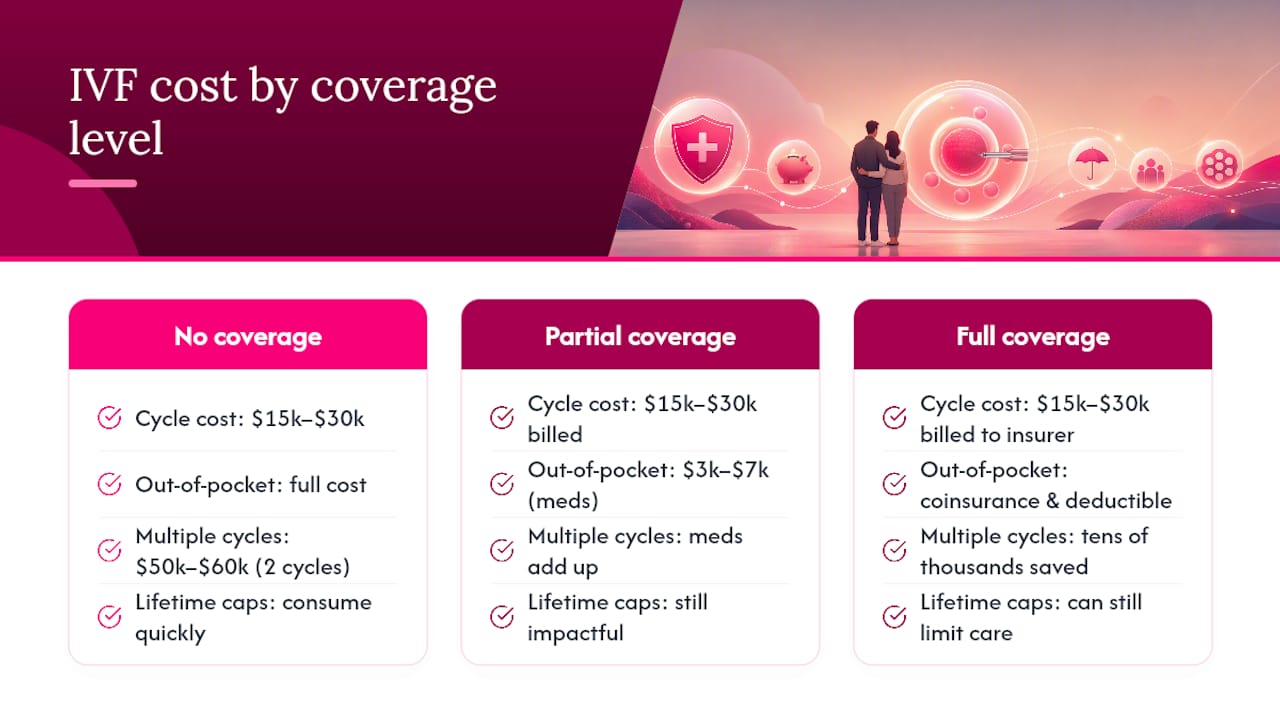
Scenario one: no coverage at all. A patient in a state with no mandate, on a self-funded plan, pays the full cost of each cycle out of pocket. Two cycles at the middle of that cost range can easily approach $50,000 to $60,000 before medications are fully tallied.
Scenario two: partial coverage. Some plans cover monitoring and the procedures themselves but carve out medications to a separate benefit or exclude them entirely. A patient in this scenario might pay $3,000 to $7,000 per cycle in medication costs alone, even though the retrieval and transfer are billed to insurance.
Scenario three: full coverage under a cycle-based mandate. A patient in California under SB 729, or in a state like Illinois with a long-standing comprehensive mandate, pays coinsurance and deductible amounts but avoids the bulk of the procedure and medication costs, often reducing total out-of-pocket spending by tens of thousands of dollars across multiple cycles.
Lifetime dollar caps change this math further. A plan with a $25,000 lifetime IVF benefit sounds generous until you realize a single cycle with medications can consume most of it, leaving little for a second attempt if the first cycle doesn’t result in pregnancy.
Two tax-advantaged tools can soften the blow regardless of your coverage situation. Health Savings Accounts (HSAs) and Flexible Spending Accounts (FSAs) let you pay for qualified IVF expenses with pretax dollars, and the IRS treats many fertility treatment costs as deductible medical expenses once your total qualifying medical spending exceeds 7.5% of adjusted gross income for the tax year. That IRS threshold is worth discussing with a tax professional, since it can meaningfully offset the cost of a self-pay cycle even without employer insurance.
Practical tip: Review HSA or FSA eligibility and contribution limits before open enrollment, and consult a qualified tax professional about how the rules apply to your circumstances.
How to Verify Your IVF Coverage Before You Start Treatment
Confirming coverage before your first appointment prevents the most common source of billing shock: assuming a benefit exists that was never actually approved.
- Pull your SBC or Evidence of Coverage document and search specifically for the terms “infertility services” or “assisted reproductive technology.” Generic health plan summaries often bury this language in an exclusions section rather than a benefits section.
- Confirm your plan’s funding type with HR before you do anything else. This single fact determines whether your state’s mandate is even relevant to your case.
- Call your insurer’s member services line directly and reference specific CPT codes rather than asking a vague question. Ask about CPT 58970 (egg retrieval) and CPT 58974 (embryo transfer) specifically, since generic questions about “IVF coverage” often get incomplete or inaccurate answers from call center staff unfamiliar with fertility billing codes.
- Ask about cycle limits, lifetime dollar caps, medication carve-outs, and prior authorization requirements in the same call, and get the representative’s name and a reference number.
- Loop in your clinic’s financial counselor early. Fertility clinics deal with insurance verification daily and can often spot gaps or catch missing prior authorization steps before they become denials.
- Document every conversation. Keep a written log with dates, representative names, and reference numbers, and request preauthorization decisions in writing whenever possible.
- If you’re denied, request the denial letter in writing and ask your clinic’s billing team whether the denial is appealable, since many initial IVF denials are overturned on appeal once additional clinical documentation is submitted.
Practical tip: Ask for written benefit verification and any required prior authorization before treatment. Your plan documents and written determinations control coverage, and estimates are not a guarantee of payment.
If Your Plan Doesn’t Cover IVF: Financing, Grants, and Employer Options
A lack of coverage doesn’t mean you’re out of options. It means the path runs through a different set of levers.
Start with your employer. Even companies without a state mandate obligation increasingly add voluntary fertility benefits to compete for talent, and open enrollment or plan renewal periods are the right moment to make that request formally, ideally with data showing what peer companies in your industry offer.
If employer advocacy doesn’t move fast enough for your timeline, look at financing directly. Many fertility clinics offer in-house payment plans and treatment packages that spread costs across a cycle rather than requiring a lump sum upfront, and dedicated medical financing programs exist specifically for fertility treatment, often with lower rates than general-purpose credit for medical borrowers with strong credit histories. Ivf financing companies typically structure loans around the treatment timeline itself, releasing funds in stages tied to retrieval and transfer dates rather than as a single disbursement.
Nonprofit grants are worth pursuing in parallel, not instead of financing, since award timelines are often unpredictable and competitive. Several national fertility nonprofits offer grant cycles specifically for IVF, and some clinics maintain their own scholarship or discount programs for qualifying patients.
Timing matters more than most patients realize. If you’ve already met your annual deductible from earlier diagnostic testing, scheduling a retrieval before the calendar year resets can meaningfully lower your out-of-pocket cost compared to starting the same cycle in January under a fresh deductible.
How Life IVF Center Helps Patients Navigate Insurance
Confirming coverage shouldn’t feel like a second full-time job stacked on top of treatment itself. Life IVF Center built dedicated resources specifically to reduce that burden for prospective patients trying to figure out what their plan actually pays for.
Patients frequently arrive uncertain whether their plan is fully insured or self-funded, whether their state’s mandate even applies to their employer, and what CPT codes their insurer needs to process a claim correctly. Clarifying those three questions upfront is often what separates a smooth authorization from a denied claim.
The clinic’s Prospective Insurance Patients resource walks new patients through benefits verification step by step, and financial counselors help interpret SBC language that often confuses patients unfamiliar with insurance terminology. For California residents specifically, the clinic’s Insurance and SB 729 guidance page breaks down exactly how the new law changes what large-group fully insured plans must cover starting in 2026.
Life IVF Center’s financial team can help patients gather plan information and understand common authorization steps. Precision IVF® focuses on individualized treatment planning based on clinical findings. Coverage, authorization, and out-of-pocket costs remain dependent on the patient’s plan and are not guaranteed.
- Benefits verification support before treatment begins
- Financial counseling to interpret SBC and Evidence of Coverage language
- SB 729-specific guidance for California patients
- Precision IVF® treatment planning tailored to individual clinical findings
If you’re unsure where your coverage stands, reviewing available treatment packages alongside a benefits verification conversation gives you a realistic budget before your first appointment, rather than after a surprise bill.
What the 2026 Coverage Changes Actually Mean for You
The conventional advice on this topic, “check if your state has a mandate,” undersells how much plan type matters. State mandate status gets all the attention because it’s easy to search and easy to write about. Plan funding type is the variable that actually decides most cases, and it’s the one patients skip because it requires an awkward phone call to HR instead of a quick internet search.
California’s SB 729 is genuinely significant, not just as a headline but as a structural change: a cycle-based benefit with no lifetime dollar cap is a meaningfully different financial reality than the dollar-cap model most other mandate states still use. Patients outside California shouldn’t assume their state will follow suit quickly. Legislative change in this space has historically moved state by state, over years, not in a coordinated wave.
If you take one action from this article, make it the HR phone call about plan funding type before you spend time researching your state’s statute. That single answer tells you whether the rest of the research even applies to you.
Frequently Asked Questions
Does insurance cover IVF in every state?
No. Only about 15 states plus D.C. currently mandate IVF coverage specifically, and even in those states, self-funded employer plans are typically exempt under federal ERISA law.
Which states cover IVF under insurance mandates?
States including California, New York, Illinois, New Jersey, Massachusetts, Connecticut, Maryland, and Rhode Island require IVF coverage in at least some fully insured plans, while other states only require insurers to offer it as an option.
Are fertility treatments tax deductible?
Many IVF-related medical expenses qualify as deductible under IRS rules once total qualifying medical costs exceed 7.5% of adjusted gross income for the year, and HSA or FSA funds can also be used for qualified expenses.
Does insurance cover egg freezing the same way it covers IVF?
Not usually. Egg freezing for elective, non-medical reasons is covered far less often than IVF for diagnosed infertility, though some newer mandates, including California’s SB 729, extend broader definitions that can include preservation in certain cases.
What if my employer’s plan doesn’t cover IVF at all?
Look into clinic financing, third-party medical financing companies, nonprofit fertility grants, and HSA or FSA funds, and consider asking HR to add fertility benefits at the next plan renewal.
How is IUI coverage different from IVF coverage?
IUI is generally less expensive and more frequently covered, even in states without a full IVF mandate, and some plans require patients to attempt IUI before approving IVF under step-therapy rules.
This article is for general educational purposes only and is not medical, insurance, legal, or tax advice. Coverage rules and plan terms change. Confirm benefits directly with your insurer or employer and consult qualified medical, legal, or tax professionals as appropriate. Life IVF Center can help you prepare questions for a benefits-verification conversation.
Sources
For state-by-state detail beyond this overview, consult RESOLVE’s insurance coverage map, the PMC review of U.S. fertility insurance coverage, CDC assisted reproductive technology data, and Life IVF Center’s SB 729 guidance page for California-specific updates.
- Insurance Coverage by State: RESOLVE
- What is the status of insurance coverage for fertility services in the United States by large insurers? PMC (NIH)
- IVF Insurance Coverage 2026: Fertility Cost Guide
Recommended
- IVF and Surrogacy: What Patients Need to Know
- D. Pricing & Finances Archives – Life IVF Center
- FAQs Archive – Life IVF Center
- Prospective Insurance Patients – Life IVF Center
Ready to take the next step?
Life IVF Center specializes in individualized Precision IVF® care for complex cases—including diminished ovarian reserve, prior failed cycles, and advanced maternal age. Our in-house labs and dedicated physicians are ready to help.
Book a Free Consultation →