
Higher body mass index is associated with a measurable, dose-dependent decline in IVF live birth rates and a rise in pregnancy complications, but BMI alone rarely determines whether treatment can move forward. The practical takeaway: BMI is one input among many, and the right next step is an individualized evaluation, not a number on a chart.
TL;DR:
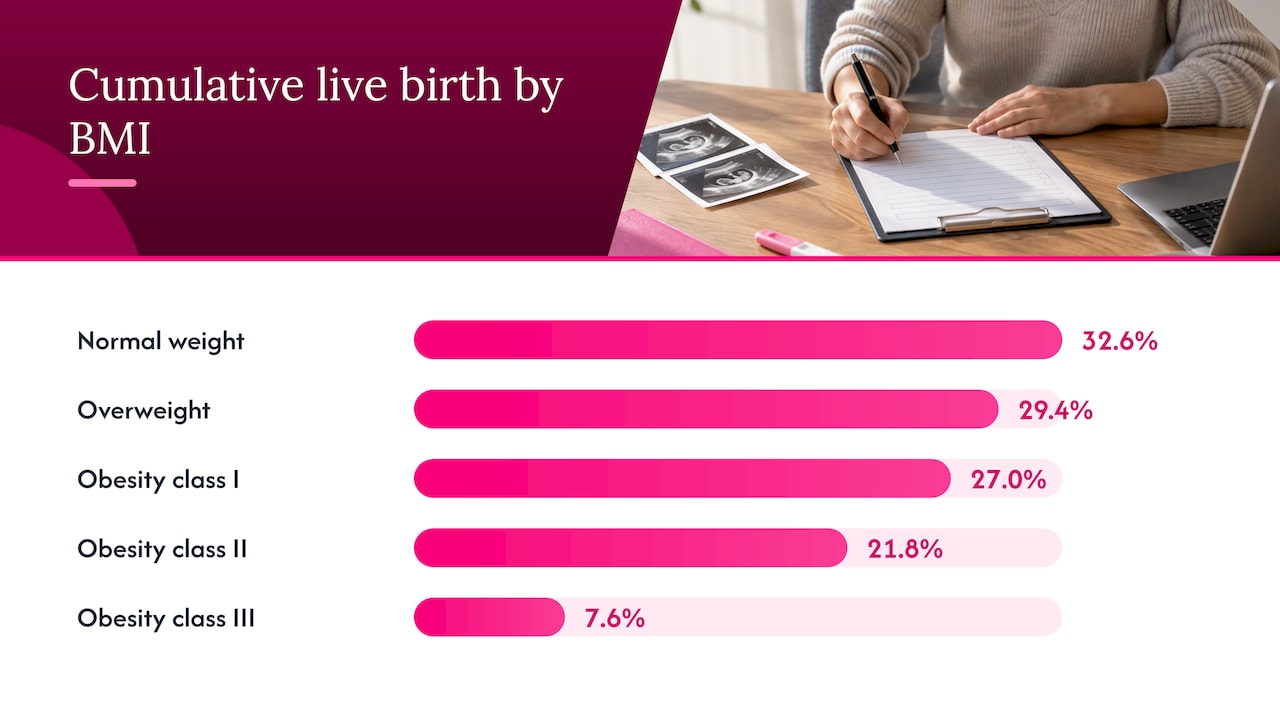
- Cumulative live birth rates were 32.6% at normal weight, 29.4% when overweight, 27.0% in class I obesity, and 7.6% in class III.
- Weight loss before IVF lowers body weight, but trials have not established improved IVF live birth rates; discuss delays when age creates time pressure.
- For BMI of 45 kg/m² or higher, retrieval studies found few anesthesia complications, though procedures may take longer and require more medication or transabdominal access.
- Clinic BMI cutoffs vary; ask whether anesthesia and maternal and fetal medicine specialists review cases individually, what criteria apply, and whether exceptions are considered.
- Higher BMI can require larger gonadotropin doses and longer stimulation, so clinicians tailor protocols to prior response, hormone levels, and individual health.
Table of Contents
- What the clinical evidence shows about BMI categories and IVF outcomes
- How BMI changes IVF treatment mechanics: stimulation, eggs, and embryos
- Procedure and pregnancy safety: what anesthesia and obstetric data show
- Does losing weight before IVF improve live-birth chances?
- How clinics use BMI policies: thresholds, variation, and the ethical debate
- Practical steps to prepare for IVF when BMI is a concern
- Role of paternal BMI on IVF outcomes and possible influences on embryo quality
- Impact of BMI on sperm parameters and male fertility contributing to IVF success
- Psychological and emotional considerations related to BMI and IVF treatment
- Guidance on nutritional and lifestyle modifications tailored for IVF patients across BMI ranges
- Impact of BMI on embryo implantation at molecular or endometrial receptivity level beyond clinical pregnancy rates
- Life IVF Center’s clinic perspective on individualized care for patients with BMI concerns
- How Life IVF Center can help: consultations, individualized protocols, and next steps
- FAQ
- Sources
What the clinical evidence shows about BMI categories and IVF outcomes
The clearest data come from a national cohort study tracking outcomes from 2002 to 2020, which found cumulative live birth rates fell from 32.6% in women of normal weight to 29.4% among those classified as overweight, then to 27.0% in obesity class I, 21.8% in class II, and 7.6% in class III, with hypertensive disorders and preterm birth climbing in step with each BMI category. That pattern, a steady decline rather than a sharp cutoff, is why clinicians describe the relationship as dose-dependent: each incremental rise in weight class nudges outcomes in the same direction.
Other systematic reviews put a number on the slope. Some analyses estimate a 5 to 7% decline in clinical pregnancy and live birth for every five-unit increase in BMI, alongside higher miscarriage rates in women with obesity.
A few caveats matter when reading these numbers:
- Age may also influence IVF outcomes, so BMI is only one factor to consider.
- Study designs vary in how they define obesity classes, which limits exact comparisons across papers.
- Retrospective cohorts cannot fully separate BMI’s effect from related conditions.
The decline from class I to class III obesity is not linear; it steepens. The drop from 27.0% to 7.6% cumulative live birth between obesity class I and class III is far larger than the earlier step from normal weight to overweight, which is why individualized counseling becomes more important at higher BMI levels rather than less.
How BMI changes IVF treatment mechanics: stimulation, eggs, and embryos
Obesity alters the follicular environment in ways that show up during ovarian stimulation itself. Many patients with higher BMI need larger gonadotropin doses and longer stimulation windows to reach the same follicular development that a lower-BMI patient achieves faster, a pattern consistent with decreased ovarian responsiveness at higher weight classes, according to ASRM’s committee opinion on obesity and reproduction.
The effects on egg and embryo quality are less uniform:
- Some cohorts report fewer oocytes retrieved at higher BMI, though this is not consistent across every study.
- Findings on fertilization and embryo quality vary across studies.
- Endometrial and oocyte function may both be affected, though the mechanisms are not fully separated in current research.
The clinical response to this variability is individualized dosing. A stimulation protocol built around a patient’s prior response, hormone levels, and BMI, rather than a standard dose applied to everyone, can help the clinical team tailor treatment.
Procedure and pregnancy safety: what anesthesia and obstetric data show
A frequent concern among patients with higher BMI is whether the retrieval procedure itself carries added risk. The data are reassuring on that specific point. A Fertility and Sterility series comparing patients with BMI 40 to 44.9 kg/m2 against those with BMI of 45 kg/m2 or higher found similar ART outcomes between the two groups and few anesthesia complications overall, even though operative time and some anesthesia and medication needs were higher in the highest BMI group. A related procedure-focused series found that as BMI rises, operating room time and anesthetic dosing increase and transabdominal retrieval approaches become more common, yet serious complications remained uncommon in centers equipped to manage them, as reported in a study on class III and class IV obesity and oocyte retrieval.
The pregnancy risks that do rise with BMI are better documented in the obstetric outcomes themselves: hypertensive disorders, gestational diabetes, and preterm birth each increase progressively across BMI classes.
Practical safety steps that reduce risk at higher BMI include:
- Discuss anesthesia planning with the care team.
- Ask whether consultation with a maternal-fetal medicine specialist is appropriate for your circumstances.
- Confirming the treatment center has equipment and staffing suited to transabdominal retrieval when needed.
Pro Tip: Ask your clinic about its experience with retrievals for patients with a higher BMI and how it plans anesthesia for your circumstances.
Does losing weight before IVF improve live-birth chances?
The honest answer is: it is not clear that it does, at least not for live birth specifically. A systematic review and meta-analysis of randomized controlled trials through December 2022 found that weight loss before IVF reduced body weight but did not significantly improve live birth rates in women with overweight or obesity, drawing on just six eligible trials. A separate review of trials through May 2025 reached a similar conclusion, finding that pre-IVF weight loss interventions increased total pregnancy rates and unassisted conceptions, but the effect on live birth after IVF specifically remained uncertain.
A few reasons explain why the evidence stays murky:
- Trials were limited in number, and their findings may not establish whether weight loss changes live birth outcomes.
- Study designs and weight-loss methods varied, making pooled results harder to interpret.
- Differences in study methods limit how confidently the results can be interpreted.
Weight loss before IVF can still improve general metabolic health and may raise the odds of an unassisted pregnancy for some patients, but it is not a proven route to a higher IVF live birth rate. For patients with age-related time pressure, a prolonged weight-loss attempt before starting IVF deserves a frank conversation about trade-offs rather than a default delay.
How clinics use BMI policies: thresholds, variation, and the ethical debate
Clinic policies on BMI vary. Some programs set internal thresholds, but there is no single national standard that every clinic follows. ASRM’s own committee opinion on obesity and reproduction advises against denying treatment solely on the basis of BMI and instead recommends individualized, multidisciplinary assessment when obesity raises medical risk.
That guidance creates a gap between policy and practice that patients often have to navigate themselves. If a clinic you are considering applies a BMI cutoff, it is reasonable to ask:
- What specific criteria led to that threshold, and whether it is applied uniformly or case by case.
- Whether a multidisciplinary team, including anesthesia and maternal-fetal medicine, reviews higher-risk cases individually.
- Whether exceptions exist when a patient’s broader health profile supports moving forward despite BMI.
A cutoff is a starting point for a conversation, not necessarily the final word on your eligibility.
Practical steps to prepare for IVF when BMI is a concern
Whatever your BMI, a short pre-treatment optimization phase can reduce risk without necessarily requiring significant weight change first.
- Ask your care team whether metabolic labs and glucose screening are appropriate before stimulation begins.
- Discuss blood pressure monitoring and management with your care team.
- Request a nutritional referral if lifestyle changes are part of your plan, rather than attempting them alone.
- Review any existing comorbidities, such as thyroid conditions or PCOS, that may compound BMI-related risk.
- Ask the clinic about its anesthesia experience with higher-BMI patients and its access to maternal-fetal medicine specialists.
Pro Tip: If you are weighing weight loss against your fertility plans, ask your clinic to discuss the timing and possible treatment options with you.
Role of paternal BMI on IVF outcomes and possible influences on embryo quality
IVF outcome conversations often focus on the person carrying the pregnancy, but a fertility evaluation can consider both partners. For couples, a semen analysis alongside other fertility testing gives the clinical team information to consider when building a treatment plan. IVF outcomes can reflect many factors, including maternal health, age, ovarian reserve, and underlying conditions.
Impact of BMI on sperm parameters and male fertility contributing to IVF success
A semen analysis can assess sperm parameters that may be relevant to fertilization during IVF or ICSI. The factors that influence sperm quality vary, so testing and treatment planning should be discussed with the clinical team.
For couples pursuing IVF, this means a semen analysis is not just a baseline test; it is a data point that can shape whether conventional insemination or ICSI is the better fit for a given cycle. A sperm count evaluation early in the process gives the clinical team the information needed to choose the right fertilization approach rather than defaulting to one method. Addressing modifiable factors, when they exist, is a reasonable part of pre-treatment planning, though it should be framed as one input among several rather than a guaranteed fix.
Psychological and emotional considerations related to BMI and IVF treatment
Weight is a sensitive subject under ordinary circumstances, and layering it onto an already emotionally demanding IVF process can intensify feelings of frustration, self-blame, or anxiety. Patients who have been told by a previous provider that their BMI is a barrier often arrive at a new consultation carrying that weight, figuratively and otherwise, before treatment has even started.
A few things are worth naming directly:
- Feeling judged about body weight during a fertility evaluation can be distressing.
- Concern about whether weight will affect treatment eligibility may make it harder to seek care.
- Clear, nonjudgmental communication about what the evidence actually shows, rather than vague warnings, helps patients make informed decisions instead of operating from fear.
A supportive care team addresses BMI as a clinical variable to plan around, not as a personal failing to be corrected before treatment can “count.” Counseling resources or support groups can also help patients process the emotional load of fertility treatment generally, and that support is especially relevant when BMI has already been a source of stress in prior medical encounters. Being asked about weight should come paired with an explanation of why it matters clinically and what options exist, not as a standalone judgment.
Guidance on nutritional and lifestyle modifications tailored for IVF patients across BMI ranges
Nutrition and lifestyle guidance during IVF preparation should look different depending on where a patient’s BMI falls, rather than following a single generic recommendation for everyone.
For patients in the normal weight range, the focus tends to be on nutrient adequacy, particularly folate, vitamin D, and iron, rather than weight change itself. For patients with overweight or obesity, lifestyle modification can support better metabolic health going into stimulation, even when its effect on live birth rates remains uncertain in the trial data:
- A referral to a registered dietitian familiar with fertility treatment can help build a sustainable eating pattern rather than a short-term restrictive diet.
- Discuss physical activity with your care team as part of a personalized health plan.
- Sleep and stress management may also be worth discussing during treatment planning.
For patients who are underweight, discuss nutritional needs and any fertility or pregnancy concerns with the care team. Across every BMI category, the goal of nutritional counseling during IVF preparation is steady, individualized support rather than a rushed transformation before a cycle begins. Given the mixed trial evidence on weight loss and live birth, framing these changes around overall health and pregnancy safety, rather than a promised IVF outcome, keeps expectations realistic.
Impact of BMI on embryo implantation at molecular or endometrial receptivity level beyond clinical pregnancy rates
Clinical pregnancy and live birth rates tell part of the story, but researchers have also looked at what happens at the tissue level inside the uterus. Endometrial receptivity, the window during which the uterine lining is best prepared to accept an embryo, appears to be influenced by BMI in ways that go beyond simple pregnancy statistics.
Some of the molecular changes studied in connection with higher BMI include:
Some studies explore whether BMI may relate to endometrial receptivity, inflammation, or uterine tissue characteristics, but the specific findings are not established by the sources cited here.
This research helps explain why BMI’s effect on IVF outcomes is not purely a matter of egg quality or stimulation response. Even when a good-quality embryo is transferred, the receiving environment may behave differently depending on maternal BMI, which is one reason endometrial assessment tools exist as part of a fuller workup. An Endometrial Receptivity Assay (ERA) can help identify whether timing, rather than weight alone, is playing a role in implantation difficulty for a given patient, giving the clinical team another lever to adjust beyond stimulation protocol changes.
Life IVF Center’s clinic perspective on individualized care for patients with BMI concerns
Our approach treats BMI as one data point among many, not a gatekeeping number. We build stimulation protocols under Precision IVF® around each patient’s biology and coordinate anesthesia or maternal-fetal medicine input when clinically indicated. Bringing prior records and metabolic labs to your first consult lets our team build a plan around you, with transparent counseling at every step.
How Life IVF Center can help: consultations, individualized protocols, and next steps
If BMI has made you uncertain about where you stand, a direct conversation with our team beats guessing from a chart. We review your full history, not just a number, and build stimulation and lab plans through Precision IVF® around what your biology actually needs.

A first visit typically goes smoother when you bring:
- Any prior fertility testing, stimulation records, or retrieval outcomes from previous cycles.
- Recent metabolic labs, including glucose and thyroid panels if you have them.
- A list of questions about anesthesia planning, lab coordination, or timing trade-offs specific to your situation.
Explore our treatment packages and pricing or reach out to book a consultation built around your own profile rather than a generic cutoff.
This article is general information, not a substitute for advice from a qualified doctor. Consult a qualified healthcare professional about your own circumstances before acting on anything here.
FAQ
What BMI do you need to qualify for IVF?
There is no single BMI requirement across clinics; thresholds vary, and ASRM guidance recommends against denying treatment based on BMI alone. Individual clinics may set their own internal guidelines, so it is worth asking directly how a specific center evaluates higher-BMI cases.
Does higher BMI lower IVF success rates?
Large cohort data show cumulative live birth rates decline progressively across BMI categories, from 32.6% in normal-weight women down to 7.6% in women with class III obesity, with maternal and perinatal risks also rising. The relationship is dose-dependent rather than an abrupt cutoff at any single weight.
Can losing weight before IVF improve live birth chances?
Weight loss interventions before IVF reliably reduce body weight, but trials have not shown a clear improvement in live birth rates after IVF specifically. Some reviews found increases in total pregnancy and unassisted conception rates, but the IVF live birth effect remains uncertain.
At what age is IVF generally most successful?
Age is one factor to discuss when considering IVF, alongside BMI and other aspects of an individual’s health and fertility. An individualized evaluation can help address how these factors relate to treatment planning.
Is it safe to undergo egg retrieval at a very high BMI?
Procedure-focused research on patients with BMI of 45 kg/m2 or higher found similar ART outcomes and few anesthesia complications compared with slightly lower BMI groups, when managed with appropriate preoperative evaluation. Operative time and some anesthesia needs do increase at higher BMI, which is why centers with specific experience in this area matter.
Sources
- Pubmed
- The association between body mass index and live birth and maternal and perinatal outcomes after in-vitro fertilization: a national cohort study
- Pubmed
- Patients with a body mass index of ≥45 kg/m2 can safely undergo oocyte retrievals and anticipate similar assisted reproductive technology outcomes – Fertility and Sterility
This article is for general educational purposes only and is not a substitute for personalized medical advice, diagnosis, or treatment. Fertility care is highly individual; please consult a qualified healthcare professional about your specific circumstances.
Ready to take the next step?
Life IVF Center specializes in individualized Precision IVF® care for complex cases—including diminished ovarian reserve, prior failed cycles, and advanced maternal age. Our in-house labs and dedicated physicians are ready to help.
Book a Free Consultation →