

Intrauterine insemination (IUI) is a fertility procedure that places specially prepared sperm directly into the uterus to increase the chances of conception. Unlike natural intercourse, where sperm must travel through the vagina and cervix before reaching the uterus, IUI bypasses those barriers by depositing sperm near the fallopian tube openings, reducing the distance sperm must travel and improving fertilization odds. The procedure is performed in a clinic setting without anesthesia, making it one of the most accessible first-line fertility treatments available. For individuals and couples exploring conception options, understanding what IUI involves, who it helps, and what it realistically costs is the foundation for making an informed decision.
How does the IUI procedure work step by step?
The IUI process follows a clear sequence, and knowing each step in advance reduces anxiety considerably.
-
Ovulation monitoring. Your fertility specialist tracks your cycle using ultrasound or urine-based ovulation predictor kits to identify the precise window when your body releases an egg. Timing insemination within 24 to 36 hours of ovulation is critical to success.
-
Sperm collection and washing. A semen sample is collected and processed in a laboratory. Sperm washing removes prostaglandins and cellular debris that would cause severe uterine cramping if introduced directly into the uterus. The result is a concentrated sample of the healthiest, most motile sperm.
-
Catheter insertion. A thin, flexible catheter is passed through the cervix and into the uterine cavity. The washed sperm sample is then gently deposited. The procedure takes 5 to 10 minutes and requires no sedation.
-
Post-procedure rest. Most clinics ask you to lie still for 10 to 15 minutes after insemination. After that, you are free to leave.
-
Pregnancy testing. A blood or urine pregnancy test is scheduled 10 to 14 days after the procedure to confirm whether implantation occurred.
Pro Tip: Ask your clinic whether they use a soft or firm catheter. Patients with a tilted uterus or narrow cervical canal may find a soft catheter more comfortable, and some clinics adjust technique based on anatomy to keep the procedure brief and tolerable.
Most patients describe the sensation as mild pressure or light cramping, similar to a Pap smear. Some spotting afterward is normal. Patient anatomy can influence how straightforward catheter placement is, but the procedure remains non-surgical in all cases.
Who is IUI best suited for?
IUI is not a universal solution for infertility. It works best for a defined set of clinical situations, and your fertility specialist will evaluate your full medical profile before recommending it.
IUI is recommended primarily for the following conditions:
- Mild male factor infertility. Low sperm count or reduced motility that is not severe enough to require IVF or intracytoplasmic sperm injection (ICSI).
- Cervical factor infertility. Thickened cervical mucus or cervical scarring that prevents sperm from reaching the uterus naturally.
- Donor sperm use. Single individuals and same-sex couples using donor sperm routinely undergo IUI as the standard insemination method.
- Polycystic ovary syndrome (PCOS). When combined with ovulation-stimulating medications, IUI can improve conception rates for women with irregular cycles.
- Unexplained infertility. Couples who have not conceived after 12 months of unprotected intercourse with no identifiable cause often try IUI before advancing to IVF.
IUI is generally not recommended when both fallopian tubes are blocked, when sperm parameters are severely compromised, or when a woman has significantly diminished ovarian reserve. In those cases, fertility treatment options like IVF offer meaningfully higher success rates and are the more appropriate starting point.
The distinction between IUI and IVF matters here. IUI is less invasive and less expensive, but it also has lower per-cycle success rates. IVF involves retrieving eggs, fertilizing them in a laboratory, and transferring embryos directly into the uterus. IUI is the right first step for many patients, but it is a stepping stone, not a replacement for more advanced care when the clinical picture calls for it.
What are typical IUI success rates?
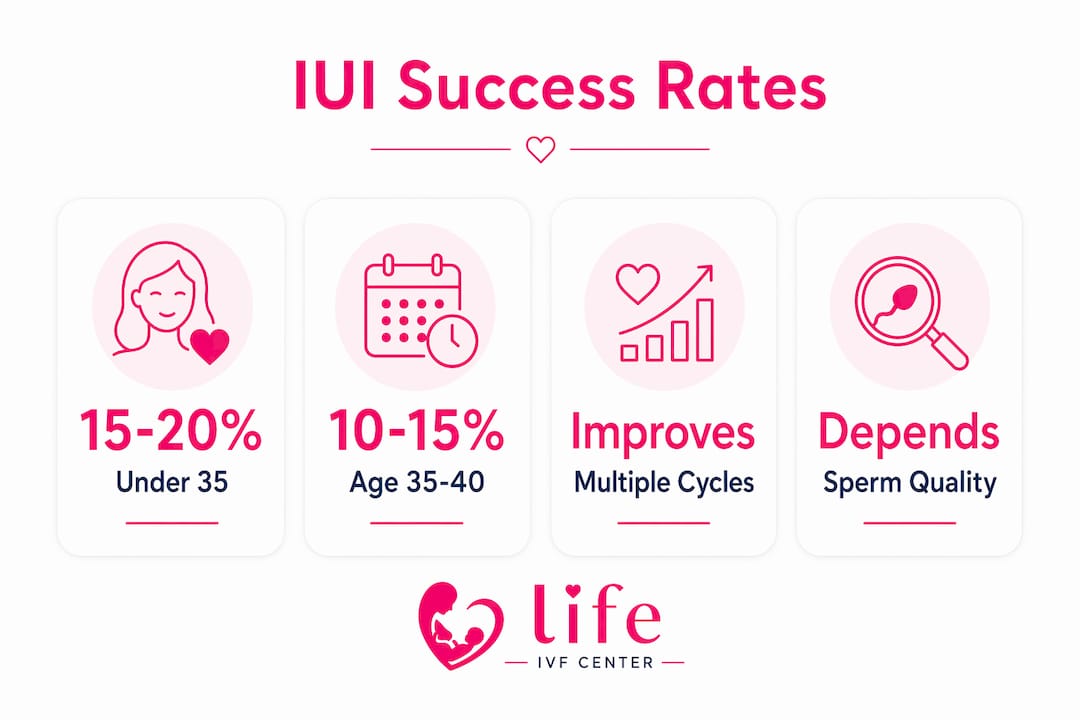
IUI success rates vary considerably depending on age, diagnosis, and sperm quality. Per-cycle success rates generally range from 10% to 20% for women under 35 with favorable fertility profiles. That number drops as age increases, particularly after 40, where per-cycle rates can fall below 5%.
| Factor | Impact on IUI success |
|---|---|
| Age under 35 | Higher per-cycle rates, typically 15–20% |
| Age 35–40 | Moderate rates, typically 10–15% per cycle |
| Age over 40 | Lower rates, often below 5% per cycle |
| Sperm motility | Higher motility correlates with better outcomes |
| Ovarian stimulation | Medicated cycles generally outperform natural cycles |
Cumulative success rates improve with multiple attempts. Many specialists recommend planning for 3 to 6 cycles before reassessing whether to advance to IVF. This is not a sign of failure. It reflects the statistical reality that even fertile couples without any treatment have only a 20% to 25% chance of conceiving in any given month.
Pro Tip: Before starting IUI, ask your doctor to define the threshold at which they would recommend moving to IVF. Having that conversation early prevents emotional and financial uncertainty later.
Uterine anatomy also plays a role. Fibroids, polyps, or a septum inside the uterine cavity can reduce implantation rates regardless of sperm quality. A fertility evaluation checklist that includes a uterine assessment before starting IUI cycles is standard practice at reputable clinics.
How much does IUI cost?
IUI is significantly less expensive than IVF, but the total cost is often higher than the base procedure fee suggests. IUI costs range from $1,000 to $4,000 per cycle in the United States, and the final bill can be 50% to 200% higher once monitoring, medications, and sperm processing fees are added.
Here is a breakdown of typical cost components:
| Cost component | Typical range (US) |
|---|---|
| Base IUI procedure | $300–$1,000 |
| Sperm washing and preparation | $200–$600 |
| Ovulation monitoring (ultrasounds) | $200–$800 |
| Fertility medications (if used) | $100–$2,000+ |
| Total per cycle estimate | $1,000–$4,000+ |
Insurance coverage for IUI varies by state and plan. Some states mandate coverage for fertility treatments, while others leave it entirely to individual policy terms. Patients should contact their insurer directly and ask specifically whether IUI, monitoring, and medications are covered as separate line items.
A few practical steps to manage costs effectively:
- Request an itemized fee schedule from your clinic before your first cycle begins.
- Ask whether the clinic offers multi-cycle packages, which often reduce per-cycle costs.
- Confirm whether your monitoring appointments are billed separately from the insemination fee.
- Check whether insurance coverage applies to diagnostic tests ordered alongside IUI.
Clinic billing structures vary widely, and surprise charges are common when patients do not ask for a detailed breakdown upfront. Transparency here protects your budget and your peace of mind.
What to expect before, during, and after an IUI cycle
Preparation for IUI begins well before the day of insemination. Your clinic will coordinate ovulation tracking, which may involve daily ultrasounds in the days leading up to the procedure. Some patients also use at-home ovulation predictor kits to supplement monitoring.
On the day of the procedure, wear comfortable clothing and plan for a brief appointment. The insemination itself is quick, and you can resume normal activities immediately afterward, including light exercise. There is no medical basis for extended bed rest following IUI, though some patients prefer to rest for personal comfort.
Common experiences in the days after IUI include:
- Mild pelvic cramping for 24 to 48 hours
- Light spotting from catheter insertion
- Breast tenderness if fertility medications were used
- Emotional sensitivity during the two-week wait before testing
The two-week wait is often the hardest part of the process. Resist the urge to test early with a home pregnancy kit, as results before the 10-day mark are frequently inaccurate. If you experience heavy bleeding, fever, or severe abdominal pain, contact your clinic promptly.
Partner involvement on insemination day, whether for emotional support or sperm collection, is encouraged at most clinics. For patients using donor sperm, the clinic coordinates sample preparation in advance. Reviewing questions to ask your fertility doctor before each cycle helps you stay informed and confident throughout the process.
Key takeaways
IUI is a well-established, minimally invasive fertility procedure best suited for specific diagnoses, with realistic per-cycle success rates of 10% to 20% and total costs that typically range from $1,000 to $4,000 per cycle in the United States.
| Point | Details |
|---|---|
| IUI definition | Washed sperm is placed directly into the uterus to improve fertilization odds. |
| Best candidates | Mild male infertility, cervical factor, donor sperm use, PCOS, and unexplained infertility. |
| Success rates | Per-cycle rates range from 10–20% for women under 35; plan for 3–6 cycles. |
| Total cost | Base fee plus monitoring and medications typically totals $1,000–$4,000 per cycle. |
| Post-procedure care | Normal activities resume immediately; pregnancy testing occurs 10–14 days after insemination. |
My honest assessment of IUI as a fertility option
IUI is often the right first step, but patients frequently arrive with expectations shaped by hope rather than statistics. The procedure itself is genuinely simple. What is not simple is the emotional weight of waiting, cycling, and deciding when to move on.
The most common misconception I encounter is that IUI is just a less expensive version of IVF with similar odds. It is not. IVF success rates per cycle are substantially higher, particularly for women over 35 or those with identifiable structural issues. IUI earns its place in treatment planning because it is low-risk, relatively affordable, and appropriate for a real subset of patients. But it is not a delay tactic, and it should not be used as one.
What I find most valuable is the clarity that a few IUI cycles can provide. If three well-timed, medicated cycles do not result in pregnancy, that information is diagnostically useful. It tells your care team something meaningful about your fertility profile and often accelerates the decision to pursue IVF with more confidence.
Financial and emotional planning before starting IUI matters more than most patients realize. Know your budget for multiple cycles. Know the threshold at which you and your partner will consider advancing care. And give yourself permission to feel the full range of emotions this process brings without letting them drive clinical decisions.
IUI works. For the right patients, at the right time, it works well. The goal is to know whether you are that patient before you begin.
Start your IUI consultation at Life IVF Center
Life IVF Center offers fertility treatment packages designed to make IUI accessible without sacrificing the quality of care. The clinic’s experienced team provides transparent pricing, personalized monitoring protocols, and clear guidance on when IUI is the right fit and when advancing to IVF makes more clinical sense.

Appointments are available across multiple Southern California locations, and the team walks every patient through their options before a single cycle begins. If you are ready to understand your fertility profile and explore whether IUI treatment fits your situation, scheduling a consultation with Life IVF Center is the most direct next step you can take.
FAQ
What is IUI in simple terms?
IUI, or intrauterine insemination, is a fertility procedure where washed sperm is placed directly inside the uterus using a thin catheter. The goal is to shorten the distance sperm must travel to reach an egg, improving the odds of fertilization.
How long does the IUI procedure take?
The insemination itself takes 5 to 10 minutes and is performed in a clinic without anesthesia or sedation. Most patients are in and out of the office within 30 minutes when monitoring and preparation time are included.
Is IUI painful?
Most patients experience mild cramping or pressure during catheter insertion, comparable to a Pap smear. Some light spotting may occur afterward, but significant pain is uncommon and should be reported to your doctor.
How many IUI cycles should I try before moving to IVF?
Most fertility specialists recommend attempting 3 to 6 IUI cycles before reassessing and considering IVF, depending on age, diagnosis, and response to treatment. Discussing this threshold with your doctor before starting is strongly advised.
Does insurance cover IUI?
Coverage depends on your state and insurance plan. Some states mandate fertility treatment coverage, while others do not. Patients should verify whether the procedure, monitoring, and medications are each covered as separate benefits under their specific policy.
Recommended
- ICSI in IVF: Benefits, risks, and when it’s needed
- IVF Process Explained: Personalize Your Path to Success
- Uterine Health and IVF Success: What You Need to Know
- Intrauterine Insemination (IUI) – Life IVF Center
Ready to take the next step?
Life IVF Center specializes in individualized Precision IVF® care for complex cases—including diminished ovarian reserve, prior failed cycles, and advanced maternal age. Our in-house labs and dedicated physicians are ready to help.
Book a Free Consultation →