
Stem cells are defined as undifferentiated cells with the ability to self-renew and develop into specialized tissue types, including reproductive cells. The role of stem cells in fertility centers on their capacity to regenerate damaged ovarian tissue, restore uterine lining integrity, and improve the conditions needed for successful embryo implantation. Clinical trials now show clinical pregnancy rates around 38.5% in patients treated for uterine adhesions with stem cell therapy. The American Society for Reproductive Medicine (ASRM) and leading research institutions continue to shape the standards governing how these therapies are tested and applied. For patients exploring advanced fertility options, understanding what the science actually supports is the most important first step.
How do stem cells improve ovarian function and follicle quality?
Mesenchymal stem cells (MSCs) improve ovarian function primarily through paracrine signaling, not by replacing damaged cells directly. They secrete growth factors, most notably insulin-like growth factor 1 (IGF-1), which promotes cell proliferation and survival in aging ovarian tissue. This distinction matters because it reframes how patients should think about the therapy. Stem cells act more like a biological signal than a transplant.
Clinical evidence supports this mechanism. Intraovarian injection of peripheral blood-derived stem cells significantly improves ovarian reserve, nearly doubling AMH levels in women with diminished ovarian reserve across a 60-participant study. AMH (anti-Müllerian hormone) is the primary blood marker used to estimate how many eggs remain in the ovaries. Doubling that number represents a meaningful shift in a patient’s fertility prognosis.

Stem cells used in ovarian therapies come from several sources, each with different collection methods and biological profiles:
| Stem cell source | Collection method | Primary benefit in ovarian therapy |
|---|---|---|
| Bone marrow (CD133+) | Bone marrow aspiration | Strong evidence for tissue repair and angiogenesis |
| Peripheral blood-derived | Blood draw after mobilization | Minimally invasive; shown to improve AMH levels |
| Umbilical cord MSCs | Cord tissue at birth | High proliferative capacity; low immune rejection risk |
| Adipose-derived MSCs | Minor liposuction procedure | Abundant supply; paracrine signaling potential |
Patients with diminished ovarian reserve are the most studied population for ovarian stem cell therapies. Results are promising, but translation into standardized clinical protocols is still in progress.
Pro Tip: Ask your fertility specialist specifically about your AMH and antral follicle count before any ovarian rejuvenation discussion. These two markers together give the clearest picture of whether ovarian stem cell therapy is a realistic option for you.
What are the current clinical applications for uterine and endometrial repair?
MSCs restore endometrial function through three distinct biological mechanisms: angiogenesis (new blood vessel formation), immunomodulation (calming inflammatory responses), and extracellular matrix remodeling. Together, these processes improve implantation success by rebuilding the uterine environment that a fertilized embryo needs to attach and grow.
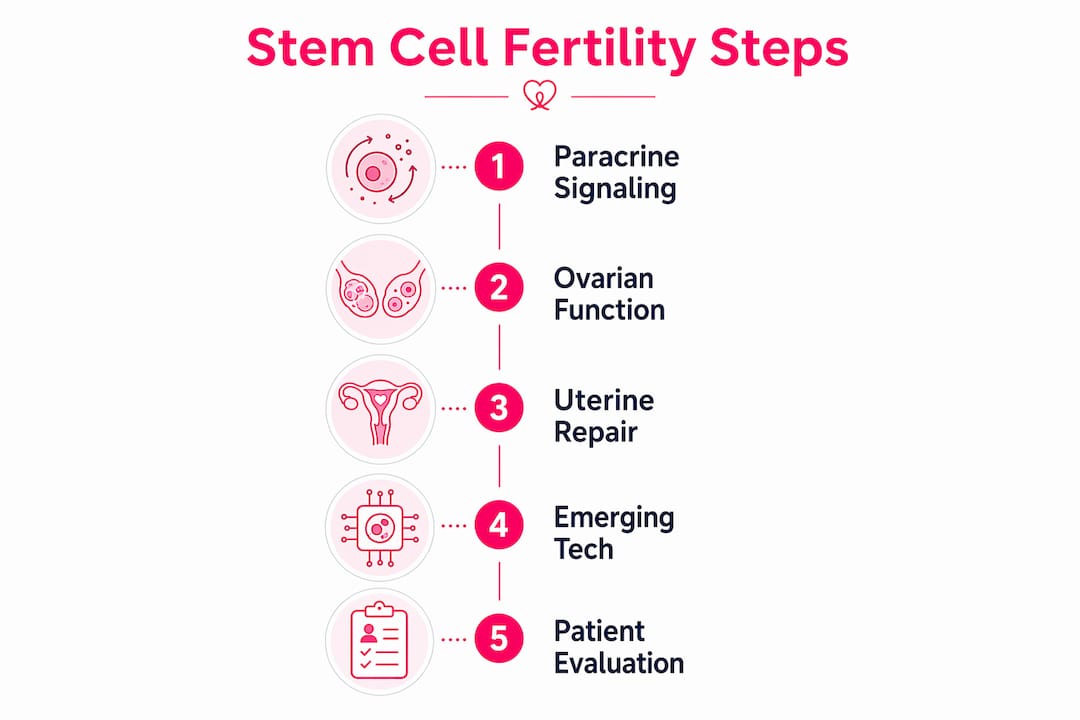
The clinical results in Asherman Syndrome, a condition where scar tissue forms inside the uterus, are among the most documented. A phase 1/2 trial using CD133+ bone marrow-derived stem cells showed endometrial thickness increased from 4.2 mm to 6.8 mm after treatment, with a 31.7% implantation rate per embryo. For context, a uterine lining below 7 mm is generally considered too thin to support implantation. Moving from 4.2 mm to 6.8 mm is clinically significant.
A typical stem cell therapy procedure for endometrial repair follows these steps:
- Baseline assessment: Ultrasound and hysteroscopy confirm the degree of scarring or thinning.
- Stem cell preparation: Cells are harvested from the patient’s bone marrow or peripheral blood, then processed in a laboratory.
- Intrauterine delivery: Stem cells are infused directly into the uterine cavity, often guided by imaging.
- Hormonal support: Estrogen and progesterone protocols support lining development post-infusion.
- Follow-up monitoring: Repeat ultrasounds track endometrial thickness over several weeks before any embryo transfer is attempted.
Patients with thin endometrium who have experienced previous IVF failures are among those most likely to benefit from this approach. The therapy does not guarantee pregnancy, but it addresses a structural barrier that standard hormonal protocols often cannot resolve.
Pro Tip: Endometrial stem cell therapy requires patience. Most protocols involve at least one full menstrual cycle of recovery before a transfer is scheduled. Rushing this timeline reduces the chance of success.
What emerging stem cell technologies are advancing fertility treatments?
Two distinct research tracks are reshaping the future of stem cell therapy for infertility: MSC-derived extracellular vesicles (EVs) and in vitro gametogenesis (IVG). They differ significantly in readiness, risk, and regulatory status.
MSC-derived extracellular vesicles are nanoscale particles released by stem cells that carry regenerative signals, including proteins and RNA, without containing living cells. Systematic reviews highlight that EVs protect against gonadotoxic damage in animal models, particularly in patients who have undergone chemotherapy or radiation. Because EVs carry no living cells, they bypass many of the immune rejection and regulatory obstacles associated with direct stem cell transplantation. This makes them a practical candidate for fertility preservation before cancer treatment.
In vitro gametogenesis takes a fundamentally different approach. IVG aims to create functional eggs or sperm from a patient’s own stem cells entirely in a laboratory setting. The ASRM’s ethics committee stated in 2026 that IVG is experimental, inefficient, and carries unknown risks, and is not yet a standard treatment. That assessment reflects where the science actually stands, not where it is headed.
| Approach | Current readiness | Primary benefit | Key limitation |
|---|---|---|---|
| MSC-derived extracellular vesicles | Early clinical and animal studies | Cell-free; lower immune risk | Not yet standardized for fertility use |
| In vitro gametogenesis (IVG) | Experimental only | Could create gametes from any cell | Inefficient; ethical and safety concerns unresolved |
For patients exploring fertility preservation options, EV therapy represents the more near-term possibility. IVG remains a research priority but is years away from clinical availability.
How should patients evaluate stem cell therapies for infertility?
Stem cell therapy for infertility is not a single treatment. It is a category of therapies with different cell sources, delivery methods, and evidence bases. Patients who approach it as one unified option often end up confused or misled by clinics that overstate results.
The most reliable framework for evaluation starts with the clinical trial phase. Phase 1/2 trials, like the Asherman Syndrome study, establish safety and early efficacy signals. They are not the same as large randomized controlled trials. Patients should ask any clinic offering stem cell fertility treatments which phase their protocol has reached and whether it is registered with a national clinical trial database.
Multi-month follow-up is required after stem cell therapies for infertility. The Asherman Syndrome trial included a 15-month post-treatment observation period. That timeline exists because reproductive outcomes, including live birth rates, take time to assess and because late-emerging safety signals need monitoring.
Common misconceptions patients should be aware of before consulting a specialist:
- “Stem cell therapy will restore my fertility completely.” Current evidence shows improvement in specific markers like AMH and endometrial thickness, not guaranteed pregnancy.
- “All stem cell treatments are the same.” Bone marrow-derived, adipose-derived, and peripheral blood-derived cells have different evidence profiles and applications.
- “If it worked in animals, it works in humans.” Translation from animal models to human clinical outcomes is not automatic. Many promising animal results have not replicated in human trials.
- “Stem cells replace damaged tissue.” The primary mechanism is paracrine signaling, meaning stem cells stimulate the body’s own repair processes rather than directly replacing cells.
- “Experimental means unsafe.” Experimental means the evidence base is still being built. Safety profiles in phase 1/2 trials are generally acceptable, but long-term data is limited.
Patients with immune-related fertility challenges may find additional context in immune disorder fertility solutions, where MSC immunomodulation plays a direct role in treatment planning.
Key takeaways
Stem cells improve fertility outcomes primarily through paracrine signaling, not direct tissue replacement, making the source and delivery method of treatment as important as the diagnosis itself.
| Point | Details |
|---|---|
| Paracrine signaling drives results | MSCs secrete IGF-1 and other factors that stimulate the body’s own tissue repair, not direct cell replacement. |
| Ovarian reserve can improve | Intraovarian stem cell injections have nearly doubled AMH levels in women with diminished ovarian reserve in clinical studies. |
| Endometrial repair is documented | CD133+ stem cells increased uterine lining thickness from 4.2 mm to 6.8 mm in a phase 1/2 trial, enabling embryo implantation. |
| Extracellular vesicles are the near-term frontier | MSC-derived EVs offer regenerative benefits without living cells, reducing immune risk and regulatory barriers. |
| Long-term follow-up is non-negotiable | Safety and efficacy assessments require up to 15 months of monitoring after treatment, per clinical trial protocols. |
What I’ve learned watching stem cell fertility research evolve
The most important shift I’ve seen in stem cell fertility research is the move away from the idea that these therapies work by replacing damaged tissue. For years, the narrative was that stem cells would grow into new eggs or rebuild a scarred uterus from scratch. The science has corrected that story. The real mechanism is the secretome, the collection of proteins, growth factors, and signaling molecules that stem cells release into the surrounding tissue. That distinction changes everything about how patients should evaluate these treatments and what outcomes they should realistically expect.
What concerns me most is the gap between clinical trial results and what some clinics communicate to patients. A 38.5% clinical pregnancy rate in Asherman Syndrome patients is genuinely meaningful. It is not a cure, and it does not apply to every diagnosis. Patients who walk into a consultation having read only the headline number are set up for disappointment. The honest conversation includes the diagnosis specificity, the trial phase, and the follow-up requirements.
The therapies I find most credible right now are the ones with the clearest mechanistic explanation and the most rigorous follow-up protocols. MSC-based endometrial repair and ovarian reserve improvement via intraovarian injection both meet that standard, at least at the early trial level. Extracellular vesicle therapy is the area I am watching most closely because it sidesteps the immune and regulatory complexity of live cell transplantation. IVG, by contrast, is a long way from clinical reality despite the excitement it generates.
My advice to anyone considering these options is straightforward. Ask for the trial phase, ask for the follow-up protocol, and ask what the treatment will specifically address in your case. Stem cell therapy is not a general fertility booster. It is a targeted intervention for specific conditions, and the best outcomes come from matching the right therapy to the right diagnosis.
Life IVF Center’s approach to advanced fertility care
Patients researching stem cell fertility options deserve a clinic that integrates emerging science with proven protocols, not one that treats every patient the same way. Life IVF Center’s Precision IVF® approach is built around exactly that principle, customizing treatment plans based on each patient’s biological profile, diagnosis history, and reproductive goals.
For patients with diminished ovarian reserve, thin endometrium, or a history of implantation failure, Life IVF Center offers consultations that address whether regenerative therapies fit within a broader fertility plan. The clinic’s fertility treatment packages are designed to make advanced care accessible without sacrificing the personalization that complex cases require. Scheduling a consultation is the clearest next step for anyone who wants an honest, evidence-based assessment of their options.
FAQ
What is the role of stem cells in fertility treatment?
Stem cells improve fertility by secreting growth factors that stimulate tissue repair in the ovaries and uterus, rather than replacing damaged cells directly. Clinical applications include ovarian reserve restoration and endometrial repair for conditions like Asherman Syndrome.
How do stem cells affect AMH levels and ovarian reserve?
Intraovarian injection of peripheral blood-derived stem cells has been shown to nearly double AMH levels in women with diminished ovarian reserve, based on a 60-participant clinical study with statistically significant results.
Are stem cell therapies for infertility safe?
Phase 1/2 clinical trials show acceptable safety profiles, but long-term data is still being collected. The Asherman Syndrome trial required a 15-month follow-up period to fully assess safety and reproductive outcomes.
What is in vitro gametogenesis and is it available?
In vitro gametogenesis (IVG) is an experimental technique that aims to create eggs or sperm from a patient’s own stem cells in a laboratory. The ASRM stated in 2026 that IVG is not yet a standard treatment due to inefficiency and unresolved safety concerns.
How do I know if stem cell therapy is right for my fertility diagnosis?
Stem cell therapy is most supported by evidence for specific conditions including Asherman Syndrome, thin endometrium, and diminished ovarian reserve. A consultation with a fertility specialist who reviews your AMH, antral follicle count, and uterine history is the necessary starting point.
Recommended
- Blog – Life IVF Center
- Fertility treatment options: Effectiveness and best uses
- Evidence-Based Endometriosis Fertility Tips for Better Conception
- Immune Disorder Fertility Solutions: Your Treatment Guide
Ready to take the next step?
Life IVF Center specializes in individualized Precision IVF® care for complex cases—including diminished ovarian reserve, prior failed cycles, and advanced maternal age. Our in-house labs and dedicated physicians are ready to help.
Book a Free Consultation →