

Step-by-step egg freezing is the process of medically stimulating the ovaries, retrieving mature eggs, and preserving them through vitrification for future use. Clinically called oocyte cryopreservation, this procedure gives women the ability to pause their biological clock without committing to immediate pregnancy. The complete egg freezing cycle typically spans 4 to 6 weeks from initial consultation through storage, with the active medical phase lasting 10 to 15 days. Whether you are focused on career timing, a medical diagnosis, or simply not ready yet, understanding each phase of the egg freezing process removes the uncertainty and helps you plan with confidence.
What is the step-by-step egg freezing process?
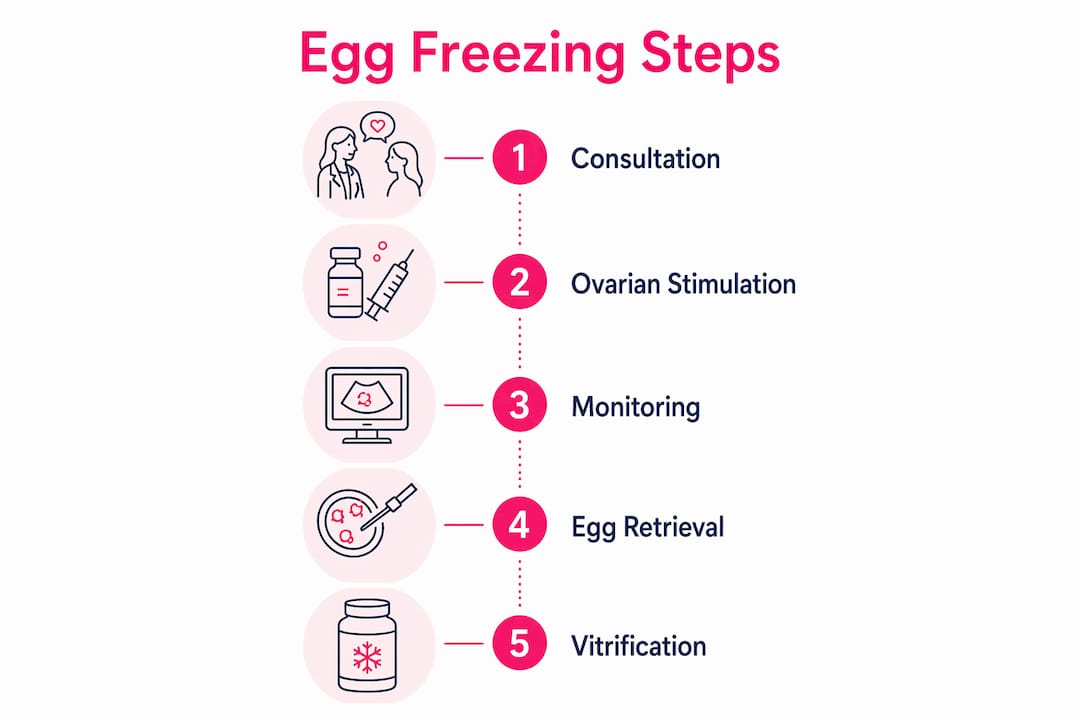
Egg freezing follows a defined sequence: consultation and testing, ovarian stimulation, monitoring, egg retrieval, and vitrification. Each phase builds on the last, and skipping or rushing any step reduces the chance of a successful outcome. The total timeline of 4 to 6 weeks feels manageable once you understand what each week involves. Knowing the full arc upfront also helps you coordinate work schedules, travel, and personal support.
The benefits of egg freezing extend beyond convenience. Women facing chemotherapy, early menopause, or endometriosis use this process to protect their future fertility before treatment begins. For women in their late 20s and early 30s who are not yet ready to conceive, freezing eggs at peak reproductive age preserves the quality that matters most when they are ready.

How to prepare before starting an egg freezing cycle
Preparation determines how smoothly the cycle runs. The process starts with a fertility consultation that includes a full medical history review, a pelvic ultrasound, and blood tests. The most important blood test is Anti-Müllerian Hormone (AMH), which estimates your ovarian reserve. AMH results do not predict fertility with certainty, but they guide your doctor in designing the right stimulation protocol for your body.
During the consultation, your care team will also review any chronic conditions, current medications, and prior reproductive history. Women with conditions like PCOS, endometriosis, or thyroid disorders may need additional evaluation before starting. This is also the time to ask about realistic outcomes, potential side effects, and what happens if the first cycle does not yield enough eggs.
Practical steps to complete before cycle day one:
- Confirm your schedule for the 10 to 15 day active phase, including daily clinic visits
- Arrange transportation for retrieval day, since you cannot drive after sedation
- Learn self-injection technique from your nurse or through a clinic demonstration
- Fill all prescriptions before stimulation begins to avoid delays
- Identify a support person who can accompany you to retrieval and be available afterward
Pro Tip: Ask your clinic for a written medication calendar before your cycle starts. Knowing exactly which injection to give on which day reduces errors and lowers anxiety during the stimulation phase.
Lifestyle adjustments also matter in the weeks before starting. Reducing alcohol, avoiding strenuous exercise, and maintaining consistent sleep support ovarian response. Your care team will give specific guidance based on your health profile.
How does ovarian stimulation work during egg freezing?
Ovarian stimulation is the most medically active phase of the egg freezing process. It involves daily injectable hormones designed to encourage multiple follicles to develop at once, rather than the single egg the body naturally releases each month. The goal is to retrieve as many mature eggs as possible in one cycle.
The stimulation phase follows a structured sequence:
- Day 1 to 2: Your menstrual cycle begins, and your clinic confirms the start date with a baseline ultrasound and blood draw to check estrogen and FSH levels.
- Day 2 to 3: Daily injections of FSH (follicle-stimulating hormone) and sometimes HMG (human menopausal gonadotropin) begin. These hormones signal the ovaries to develop multiple follicles simultaneously.
- Day 5 to 6: An antagonist medication is added to prevent premature ovulation. Without it, the body could release eggs before retrieval, ending the cycle prematurely.
- Days 6 to 10: Monitoring visits every 1 to 2 days track follicle size via ultrasound and hormone levels via blood tests. Medication doses are adjusted based on how your ovaries respond.
- Day 10 to 12: When follicles reach the target size (typically 18–20 mm), the trigger shot is administered. This final injection matures the eggs and times retrieval precisely.
- 36 hours after trigger: Egg retrieval is scheduled. Timing is exact. Missing the retrieval window means the eggs may ovulate naturally and be lost.
Ovarian stimulation with FSH and HMG typically runs 8 to 12 days. The exact duration depends on how your ovaries respond, which is why frequent monitoring is non-negotiable.
Common side effects during stimulation include mild bloating, pelvic pressure, mood changes, and breast tenderness. Most symptoms are manageable and resolve after retrieval. Severe abdominal pain, rapid weight gain, or difficulty breathing require immediate medical attention, as these can signal ovarian hyperstimulation syndrome (OHSS).
Pro Tip: Take photos of your injection sites and keep a daily log of how you feel. This record helps your care team spot early signs of over-response and adjust your protocol before problems develop.
What happens during egg retrieval and recovery?
Egg retrieval is a short outpatient procedure. You arrive at the clinic fasting, typically for 8 hours before the scheduled time. The care team places an IV line, and you receive sedation or light anesthesia so you feel no pain during the procedure.
The retrieval procedure lasts 10 to 20 minutes. Your doctor uses a transvaginal ultrasound probe fitted with a fine needle to locate each follicle and aspirate the fluid inside. An embryologist in the adjacent lab immediately examines the fluid under a microscope to identify and isolate the eggs. You do not feel the needle because of the sedation.
What to expect on retrieval day:
- Arrive with a support person who will drive you home
- Wear comfortable, loose clothing
- Expect to spend 1 to 2 hours in recovery before discharge
- Mild cramping and light spotting are normal for 2 to 3 days after the procedure
- Avoid strenuous activity, alcohol, and sexual intercourse for at least 48 hours
“Most patients are surprised by how quickly the procedure is over. The preparation and monitoring feel like the harder part. Retrieval itself is fast, and most women feel well enough to rest at home the same afternoon.”
Contact your clinic immediately if you experience severe pain, heavy bleeding, fever, or significant abdominal swelling after retrieval. These symptoms are uncommon but require prompt evaluation.
How are eggs frozen and stored through vitrification?
Vitrification is the gold standard for egg cryopreservation. It is a rapid freezing technique that drops the egg’s temperature so fast that water molecules do not have time to form ice crystals. Ice crystal formation was the primary reason older slow-freezing methods damaged eggs. Vitrification prevents this damage, preserving the egg’s cellular structure far more reliably.
After retrieval, the embryology team identifies which eggs are mature (called MII oocytes). Only mature eggs are suitable for freezing. The eggs are then treated with cryoprotectants, which are solutions that replace water inside the cell and protect it during freezing. The eggs are loaded onto a thin carrier and plunged into liquid nitrogen at minus 196°C within seconds.
| Step | What happens | Purpose |
|---|---|---|
| Egg identification | Embryologist examines follicular fluid | Selects only mature eggs for freezing |
| Cryoprotectant treatment | Eggs are exposed to protective solutions | Replaces intracellular water to prevent ice damage |
| Vitrification | Eggs are rapidly cooled to minus 196°C | Locks eggs in a stable, glass-like state |
| Cryogenic storage | Eggs are stored in liquid nitrogen tanks | Maintains viability indefinitely without aging |
| Future use | Eggs are warmed and fertilized when needed | Enables pregnancy at a later date |
Eggs stored through vitrification do not age in storage. A 32-year-old woman who freezes eggs today and uses them at 40 uses eggs with the biology of a 32-year-old. This is the core reproductive benefit of the process.
Common mistakes that reduce egg freezing success
Poor medication adherence is the most preventable cause of a failed cycle. Missing an injection or taking it at the wrong time disrupts the hormone rhythm the stimulation protocol depends on. Set phone alarms and keep medications refrigerated as directed.
Delaying monitoring visits is equally damaging. Follicles grow quickly, and a missed ultrasound can mean your doctor misses the optimal retrieval window. Treat every monitoring appointment as non-negotiable.
Other mistakes to avoid:
- Skipping the trigger shot or taking it at the wrong time. The trigger shot must be given exactly 36 hours before retrieval. Even a one-hour error can compromise the cycle.
- Underestimating the number of eggs needed. Age at vitrification is a key predictor of future success. More eggs generally improve the odds of a future pregnancy, and many women choose to complete two or more cycles to build a larger reserve.
- Ignoring emotional health. Hormone injections affect mood. Connecting with a counselor, a support group, or a trusted friend during the cycle reduces stress and improves the overall experience.
- Resuming intense exercise too soon after retrieval. The ovaries remain enlarged for several days. High-impact activity during this period increases the risk of ovarian torsion.
Pro Tip: If your first cycle yields fewer eggs than expected, ask your doctor about a second cycle before making any decisions. Many women bank eggs across two or three cycles to reach a target number that gives them a realistic chance of future pregnancy.
Key takeaways
Step-by-step egg freezing is a well-defined medical process that, when followed precisely, gives women a reliable path to preserving their fertility at any age or life stage.
| Point | Details |
|---|---|
| Total timeline | The complete cycle takes 4 to 6 weeks, with active stimulation lasting 8 to 12 days. |
| Pre-cycle testing | AMH blood tests and ultrasound guide the stimulation protocol before injections begin. |
| Trigger shot timing | The trigger shot must be given exactly 36 hours before retrieval for the cycle to succeed. |
| Vitrification advantage | Rapid freezing at minus 196°C prevents ice crystal damage and preserves egg quality for years. |
| Multiple cycles | Freezing eggs across more than one cycle increases the total egg count and future pregnancy odds. |
What I’ve learned from watching women go through this process
The women who do best in an egg freezing cycle are not necessarily the ones with the highest AMH or the most follicles. They are the ones who ask questions, show up to every monitoring visit, and give themselves permission to feel whatever they feel during the hormone phase. The clinical side of this process is well-mapped. The emotional side is where most people are underprepared.
One thing I consistently observe is that women underestimate how much the trigger shot timing matters. It is not approximate. It is exact. A patient who takes it two hours late because she forgot or was traveling has compromised her entire cycle. That single detail deserves as much attention as the two weeks of injections that came before it.
Vitrification technology has genuinely changed what is possible here. The survival rates for vitrified eggs are dramatically better than what slow-freezing produced a decade ago. Women freezing eggs in 2026 are working with a process that is more reliable than what their older sisters or colleagues experienced even five years ago. That matters when you are making a decision this significant.
My honest advice: do not freeze eggs as a vague insurance policy without understanding the numbers. Talk to your doctor about how many eggs you realistically need based on your age, and plan your cycles accordingly. Informed patients get better outcomes, not because the biology changes, but because they follow the protocol correctly and make smarter decisions when results are not what they hoped.
Life IVF Center’s egg freezing support for your next step
Life IVF Center specializes in fertility preservation for women who want expert guidance through every phase of the egg cryopreservation process. The clinic’s team in Southern California provides personalized stimulation protocols, close monitoring, and clear communication from the first consultation through long-term storage.
Life IVF Center offers structured egg freezing packages designed to make the process more affordable and predictable, with transparent pricing and support at every step. For women navigating insurance questions, the clinic’s insurance patient resources outline coverage options and financial planning tools. Schedule a consultation to receive a personalized assessment and a clear plan built around your timeline and reproductive goals.
FAQ
What is egg freezing, and who is it for?
Egg freezing, or oocyte cryopreservation, is a medical process that retrieves and preserves mature eggs for future use. It is recommended for women who want to delay pregnancy, face a medical diagnosis that threatens fertility, or want to preserve eggs at peak reproductive age.
How long does the egg freezing process take?
The complete cycle takes 4 to 6 weeks, including consultation, testing, stimulation, and retrieval. The active medical phase from first injection to retrieval runs 10 to 15 days.
Does egg freezing work for women with PCOS?
Yes. Women with PCOS can freeze their eggs, though the condition requires careful monitoring during stimulation due to a higher risk of OHSS. Egg freezing does not treat PCOS but preserves fertility options for future conception.
How many eggs do I need to freeze?
The number depends on your age at freezing. Age at vitrification is the strongest predictor of success, and more eggs generally improve the odds of a future pregnancy. Your doctor will recommend a target number based on your AMH results and age.
Are frozen eggs as effective as fresh eggs?
Eggs frozen through vitrification maintain viability for years without aging. Survival rates with vitrification are significantly higher than with older slow-freezing methods, making modern frozen eggs a reliable option for future fertility treatment.
Recommended
- Egg & Embryo Freezing – Life IVF Center
- Egg & Embryo Freezing – Revision – Life IVF Center
- Egg freezing in Orange County: safe fertility preservation
- Grad, Cryo, Freezing – Life IVF Center
Ready to take the next step?
Life IVF Center specializes in individualized Precision IVF® care for complex cases—including diminished ovarian reserve, prior failed cycles, and advanced maternal age. Our in-house labs and dedicated physicians are ready to help.
Book a Free Consultation →