

Pursuing IVF while managing financial pressure is one of the most stressful experiences a family can face. In Southern California, where living costs are already high, the prospect of spending $15,000 or more per cycle stops many hopeful parents before they even schedule a consultation. The good news is that affordable pathways do exist, but they require careful navigation, honest comparison, and access to the right resources. This guide is designed to cut through the confusion, explain how IVF pricing actually works, identify credible financial assistance programs, and help you make decisions grounded in realistic outcomes rather than marketing promises.
Table of Contents
- Understanding IVF pricing and benchmarks
- Sources of financial assistance and discount programs
- Choosing clinics and packages for maximum value
- Setting realistic expectations: Success rates, efficiency, and outcome tracking
- Our take: Navigating promotional claims and real-world outcomes
- Next steps: Connect with Southern California’s IVF specialists
- Frequently asked questions
Key Takeaways
| Point | Details |
|---|---|
| Know your true IVF costs | Review every expense, including add-ons, before committing to any package or clinic. |
| Seek credible financial aid | Use nonprofit and clinic-based programs vetted through trusted directories like RESOLVE. |
| Use benchmarks and calculators | Leverage SART and CDC outcome tools tailored to your age and diagnosis for realistic planning. |
| Compare packages against your needs | Multi-cycle and batching packages often bring greater value for those with challenging fertility profiles. |
| Track progress and ask tough questions | Stay engaged with outcome reporting and insist on transparency for true affordability. |
Understanding IVF pricing and benchmarks
With the challenge introduced, it helps to first clarify exactly how IVF pricing works and what benchmarks reveal about true affordability.
IVF costs are rarely a single flat fee. Most clinics break down pricing into several components, and understanding each one prevents unwelcome surprises later in the process.
Key IVF cost components include:
- Procedure fees: The core clinical services, including egg retrieval, fertilization, and embryo transfer.
- Medication costs: Fertility drugs used during stimulation can range from $3,000 to $7,000 per cycle and are frequently not included in base pricing.
- Laboratory fees: Embryo culture, genetic screening (PGT-A or PGT-M), and cryopreservation add several thousand dollars to the total.
- Diagnostic add-ons: Tests like endometrial receptivity analysis (ERA), immune panels, or sperm DNA fragmentation testing are often priced separately.
- Monitoring visits: Bloodwork and ultrasounds during stimulation may or may not be bundled into the quoted price.
Because each of these categories carries its own cost, two clinics quoting similar base prices can result in dramatically different final bills depending on what is included and what is not.
Age and medical history significantly affect your true cost. A 32-year-old with no underlying diagnosis typically requires fewer monitoring visits, fewer medication adjustments, and fewer total cycles than a 40-year-old with diminished ovarian reserve or endometriosis. This is why transparent IVF costs that account for your specific profile are more useful than any average figure you will find online.
When comparing clinics, success rates are often cited as proof of value. But using them incorrectly leads to poor decisions. SART cautions that patient characteristics vary significantly between clinics, and their online tools are designed to help you compare rates based on age and diagnosis, not just overall clinic averages. A clinic reporting a 60% success rate may serve a much younger, lower-risk patient population than one reporting 45%, making the comparison meaningless without adjusting for case mix.
Additionally, recent research published in peer-reviewed literature suggests that IVF practice efficiency may decline over time even as the total number of cycles and live births increases. This means that affordability plans need to be built around realistic cumulative outcome expectations, including the possibility of attrition between retrieval, fertilization, and successful transfer. You may retrieve 10 eggs, fertilize 6, reach blastocyst stage with 3, and transfer 1. Planning financially for that funnel is essential.
| Cost component | Typical range | Often bundled? |
|---|---|---|
| Procedure fee | $8,000 to $12,000 | Yes |
| Medications | $3,000 to $7,000 | Rarely |
| Lab and PGT | $2,000 to $5,000 | Sometimes |
| Monitoring | $1,000 to $2,500 | Varies |
| Cryopreservation | $500 to $1,500 per year | No |
Reviewing affordable fertility packages from clinics that itemize costs clearly is the most practical first step toward understanding what you will actually spend.

Sources of financial assistance and discount programs
Once you understand the cost structure, finding support can make IVF genuinely attainable. Here is where to look for credible help.
The nonprofit organization RESOLVE is one of the most trusted resources for fertility financial assistance in the United States. RESOLVE’s financing directory lists multiple programs that help patients pay for IVF cycles and medications. Importantly, RESOLVE explicitly states it does not endorse any individual program, which helps you approach these resources with appropriate scrutiny rather than assuming all listed options are equivalent in quality or terms.
Categories of financial assistance commonly available in Southern California:
- Clinic-based income or eligibility discounts: Some clinics offer reduced fees for patients who meet income thresholds, military service criteria, or professional category eligibility such as first responders or teachers.
- Medication savings programs: Pharmaceutical manufacturers occasionally offer compassionate use or patient assistance programs for fertility medications. Bundled medication packages negotiated through specialty pharmacies can reduce costs significantly.
- Multi-cycle or PGT batching packages: Clinics may offer a lower per-cycle cost when you commit to two or three cycles upfront, and batching multiple embryo biopsies for genetic testing into one laboratory run reduces per-test fees.
- Third-party financing: Medical loan companies offer installment plans specifically designed for fertility treatment. Interest rates vary widely, so reading the full loan terms before committing is critical.
- Refund or shared-risk programs: Some clinics refund a portion of fees if a defined number of cycles does not produce a live birth. These programs require careful reading of eligibility criteria and exclusions.
| Assistance type | Source | Best for |
|---|---|---|
| Nonprofit financing directory | RESOLVE | Finding vetted loan programs |
| Medication assistance | Pharma programs | Reducing stimulation drug costs |
| Income-based clinic discounts | Individual clinics | Lower-income applicants |
| Multi-cycle packages | Clinic pricing tiers | Patients expecting multiple cycles |
| Refund programs | Clinic-specific | Higher-risk patients seeking safety net |
Pro Tip: When evaluating any financing program, ask specifically whether interest accrues during treatment or only after the repayment period begins. Some programs that advertise low monthly payments carry high total interest burdens that add thousands to your overall IVF investment.
To understand what is available through your specific clinic, reviewing detailed fertility financing options and consulting your clinic’s financial counselor are both recommended before signing any financial agreements. If you still have questions after reviewing the options, a clinic’s finances FAQ page can address common concerns about payment structures and coverage.
Choosing clinics and packages for maximum value
With financial help identified, choosing the right clinic and package is the next crucial step in building an affordable and realistic IVF plan.
Not all clinics are equally transparent about what their quoted fees actually include. Knowing exactly what questions to ask protects you from discovering significant gaps in coverage after you have already committed financially.
Ask every clinic you evaluate these specific questions:
- What is your self-pay global fee, and what services are included in that fee?
- Do you offer eligibility-based discounts for income level, military service, or other qualifying categories?
- Is PGT-A (genetic screening of embryos) included or billed separately, and do you offer batch testing to reduce costs?
- What multi-cycle packages do you offer, and how is the per-cycle cost reduced in those packages compared to single-cycle pricing?
- Do you offer a refund or shared-risk program, and what are the precise eligibility requirements and exclusion criteria?
- How are monitoring appointments and bloodwork billed, and are they included in the base fee?
RESOLVE’s guidance on practical affordability mechanics specifically recommends asking about all four of these categories: eligibility-based discounts, self-pay global fees and included add-ons, multi-cycle and PGT batching packages, and financing or refund programs. Skipping any of these questions leaves gaps in your financial picture.
Comparing single-cycle vs. multi-cycle packages:
Single-cycle pricing gives maximum flexibility. If your first cycle succeeds, you have not overpaid for cycles you did not need. Multi-cycle packages lower the cost per cycle but require a larger upfront investment, which many families finance through loans. The right choice depends on your age, ovarian reserve, and prior IVF history.
| Package type | Advantages | Considerations |
|---|---|---|
| Single cycle | Lower upfront cost, maximum flexibility | Higher per-cycle price |
| Multi-cycle (2 to 3 cycles) | Lower per-cycle cost, built-in planning | Larger initial financial commitment |
| Refund program | Financial safety net | Strict eligibility, exclusions apply |
| Egg freezing bundle | Batched PGT cost savings | Best for future cycle planning |
For patients with insurance for IVF coverage, the calculation changes further. Insurance-covered cycles may make single-cycle approaches more practical. For patients considering fertility preservation before IVF, reviewing egg freezing packages can identify cost-sharing opportunities between retrieval and future transfer cycles.
The SART calculator is specifically designed to estimate cumulative live birth rates across up to three cycles based on your age and diagnosis profile. Using this tool before committing to a package helps you determine whether the statistical benefit of a multi-cycle commitment actually aligns with your personal likelihood of success, rather than assuming the package is always the better financial decision.
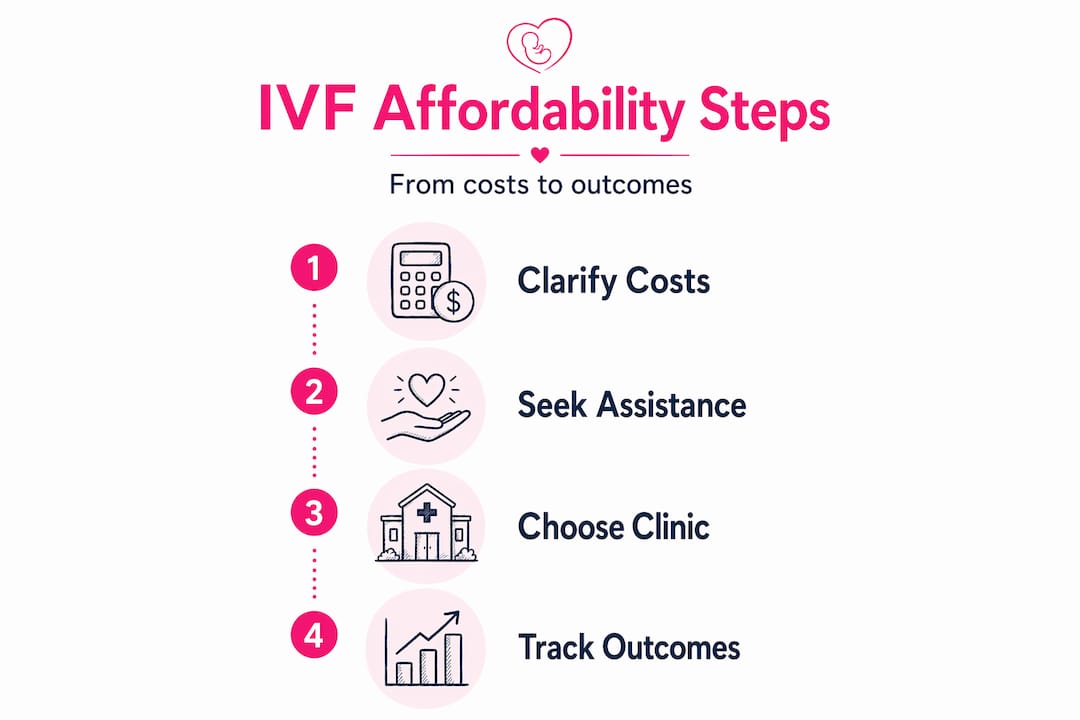
Pro Tip: Bring your most recent fertility evaluation results including AMH level, antral follicle count, and any prior diagnosis to your clinic consultation. Clinics can provide more accurate package recommendations when they know your specific ovarian reserve and clinical history from the start.
Setting realistic expectations: Success rates, efficiency, and outcome tracking
Once you have chosen a clinic and package, understanding how to track and interpret your progress can help control costs and maintain realistic hope through each stage of treatment.
The CDC’s ART Surveillance System collects cycle-specific and clinic-specific data including patient diagnosis, type of ART performed, and pregnancy outcomes. This database underlies the clinic outcome reports that SART publishes annually. Reviewing these reports for any clinic you are considering gives you an evidence-based foundation rather than relying solely on a clinic’s own marketing materials.
Key factors that influence your individual success rate:
- Age at retrieval: Success rates decline meaningfully after 35 and more steeply after 40.
- Ovarian reserve markers: AMH and antral follicle count predict how many eggs are likely to be retrieved in a stimulation cycle.
- Underlying diagnosis: Conditions like endometriosis, PCOS, uterine abnormalities, or male factor infertility each carry different outcome implications.
- Clinic-specific protocols: How a clinic approaches stimulation, laboratory culture conditions, and embryo transfer timing all influence outcomes.
- Prior IVF history: Patients with prior failed cycles may benefit from protocol modifications that change cost structures.
“Understanding that IVF outcomes are probabilistic, not guaranteed, is one of the most important steps toward building a financially and emotionally sustainable plan. Planning for multiple cycles while hoping for one is the mindset that protects both your budget and your wellbeing.”
For a thorough grounding in how different treatments compare, reviewing a treatment effectiveness guide helps contextualize IVF within the broader landscape of fertility interventions. Before your first cycle, working through a detailed fertility evaluation checklist ensures that your clinical picture is complete, which directly influences the accuracy of cost and success projections.
Our take: Navigating promotional claims and real-world outcomes
Having covered the practical steps in detail, here is a candid perspective on what actually delivers affordable IVF results versus what simply sounds affordable.
The phrase “low cost IVF” circulates widely in fertility marketing, and it deserves careful scrutiny. A clinic advertising a $5,000 base fee may exclude medications, genetic testing, and monitoring, which together frequently total more than the procedure itself. The true question is not what a cycle costs to start, but what it costs to achieve a live birth when all associated expenses across the likely number of cycles for your specific profile are counted.
CDC and SART benchmarks consistently emphasize that age and patient characteristics are the primary drivers of outcome, not clinic size or promotional budget. A clinic that has lower promotional visibility but a rigorous approach to protocol customization may deliver a better cost-per-live-birth outcome than one with heavy advertising and broad success rate claims that do not account for patient mix.
What genuinely makes IVF affordable is a combination of factors: clinics that provide honest itemized pricing, protocols tailored to your biology rather than applied generically, financial assistance programs with clear and fair terms, and realistic outcome expectations that help you plan financially for the full likely treatment course. Understanding the realities of IVF cost means looking past promotional pricing and asking the right questions every step of the way.
Patients who come prepared with their own benchmark knowledge, using SART calculators, reviewing CDC outcome data, and asking detailed questions about package inclusions, are consistently better positioned to evaluate affordability honestly. The most dangerous financial decision in IVF is choosing a clinic based on advertised price alone without understanding what that price actually delivers.
Next steps: Connect with Southern California’s IVF specialists
Ready to take action? You now have the framework to evaluate IVF costs, identify financial assistance, choose the right package, and interpret success data with confidence.
Life IVF Center’s Precision IVF® approach is built around exactly the kind of individualized, transparent care this guide describes. Rather than applying generic protocols, the team customizes stimulation and transfer planning based on your biological profile, medical history, and financial goals. If you have insurance, the clinic’s insurance options for IVF team can help clarify what your plan covers before you commit to any out-of-pocket spending. And if you are just beginning to explore whether IVF is the right path, the IVF basics resource section answers foundational questions clearly and compassionately. Schedule a consultation with Life IVF Center to get a cost picture built specifically for your situation, not a generic estimate.
Frequently asked questions
What types of IVF financing are most common in Southern California?
Most clinics offer financing through nonprofit directories, private loan programs, and refund-based packages; the RESOLVE financing directory is a widely trusted starting point for comparing available options without a clinic affiliation bias.
Do all IVF clinics advertise the true cost upfront?
Transparency varies considerably; some clinics provide fully itemized breakdowns while others use promotional base pricing that omits medications, genetic testing, or monitoring fees, so clinic averages and promotional prices should always be verified against a detailed written quote.
How can I estimate my true success rate and expected IVF costs?
Use the SART cumulative calculator to estimate live birth probability across up to three cycles based on your age and diagnosis, then map that probability against the full itemized cost of each cycle to build a realistic financial projection.
Are efficiency trends affecting IVF affordability in 2026?
Recent peer-reviewed analysis shows that IVF efficiency is declining even as cycle numbers and live births increase nationally, which means affordability planning should include realistic expectations for multiple cycles rather than assuming a single cycle will be sufficient.
Recommended
- Mini IVF: A personalized path to fertility success
- Making IVF Affordable: How Life IVF Keeps Costs Transparent and Manageable – Life IVF Center
- Precision IVF® benefits for couples over 35 in SoCal
Ready to take the next step?
Life IVF Center specializes in individualized Precision IVF® care for complex cases—including diminished ovarian reserve, prior failed cycles, and advanced maternal age. Our in-house labs and dedicated physicians are ready to help.
Book a Free Consultation →