
IVF carries the hope of building a family, but it also carries a complexity that is often underestimated. Many people enter their first cycle expecting a straightforward path from treatment to pregnancy, only to find that outcomes are far less predictable than popular stories suggest. Only 18.2% of initiated IVF cycles resulted in a live birth in a recent cohort study, a figure that underscores why knowledge, realistic expectations, and personalized care are not just helpful but essential for anyone navigating this journey.
Table of Contents
- Understanding the basics: What is IVF and why is it used?
- IVF step-by-step: What happens in a typical cycle
- Personalized care and prediction: Why your clinic matters
- Special circumstances: Individualized strategies for complex cases
- Our perspective: What most people misunderstand about IVF
- Connect with personalized IVF solutions at Life IVF Center
- Frequently asked questions
Key Takeaways
| Point | Details |
|---|---|
| IVF outcomes vary | Success depends on age, diagnosis, embryos, and clinic expertise. |
| Personalized care matters | Clinic-level data and individualized strategies improve results and counseling. |
| Expect realistic success rates | Most IVF cycles do not result in live birth, so setting expectations is key. |
| Complex cases need custom plans | Thin endometrium and other conditions require specialized strategies. |
| Choose your clinic wisely | Selecting a clinic with advanced prediction tools and local expertise can maximize your chances. |
Understanding the basics: What is IVF and why is it used?
In vitro fertilization, commonly known as IVF, is an assisted reproductive technology in which eggs are retrieved from the ovaries, fertilized with sperm in a laboratory setting, and then transferred back into the uterus as embryos. The word “in vitro” literally means “in glass,” referring to the controlled lab environment where fertilization takes place outside the body.
IVF is not a one-size-fits-all treatment. It is recommended for a wide range of medical situations, including:
- Blocked or damaged fallopian tubes, which prevent natural fertilization
- Male factor infertility, including low sperm count or poor motility
- Ovulation disorders such as polycystic ovary syndrome (PCOS)
- Endometriosis, which can impair egg and embryo quality
- Unexplained infertility after other treatments have failed
- Genetic conditions where preimplantation genetic testing (PGT) is desired
- Same-sex couples and single parents using donor eggs or sperm
Despite its widespread use, IVF is frequently misunderstood as a guaranteed solution. In reality, outcomes are shaped by numerous biological and clinical factors. Age is one of the strongest predictors: women under 35 generally see higher success rates, while those over 40 may face significantly lower odds. Embryo quality, the health of the uterine lining, hormone levels, and even the number of eggs retrieved all play meaningful roles.
“Success rates should be interpreted cautiously because patient outcomes vary widely by age, diagnosis, embryo factors, and uterine environment,” as noted in a recent IVF outcomes review.
This variability is precisely why approaches like Precision IVF are gaining traction. Rather than applying a uniform protocol, a precision-based approach tailors every aspect of treatment to the individual patient. If you are just getting started and have broader questions, reviewing an IVF introduction resource can help you orient yourself before your first consultation.
IVF step-by-step: What happens in a typical cycle
With a grasp on the basics, let’s walk through each phase of the IVF process so you know exactly what to expect and where you can influence your journey. Understanding each step helps you prepare, ask better questions, and feel more in control of an emotionally demanding process.
-
Ovarian stimulation. The cycle begins with injectable hormone medications that stimulate your ovaries to produce multiple follicles rather than the single egg released in a natural cycle. This phase typically lasts 8 to 14 days and involves regular monitoring appointments, including blood tests and ultrasounds, to track follicle development.
-
Trigger shot. Once follicles reach the appropriate size, a trigger injection (usually hCG or a GnRH agonist) is administered to finalize egg maturation. Timing here is precise: the retrieval must happen at exactly the right window.
-
Egg retrieval. This is a minor surgical procedure performed under light sedation. Using ultrasound guidance, the physician uses a thin needle to aspirate fluid and eggs from each mature follicle. Reviewing expert tips on egg retrieval can help you prepare physically and mentally for this step.
-
Fertilization. Retrieved eggs are examined by embryologists and combined with sperm in the laboratory. Depending on sperm quality, fertilization may occur through conventional insemination or intracytoplasmic sperm injection (ICSI), where a single sperm is injected directly into the egg.
-
Embryo culture. Fertilized eggs become embryos that are cultured in the lab for 3 to 6 days. Embryologists monitor development closely, looking for normal cell division and healthy progression to the blastocyst stage. Not all fertilized eggs will develop to a transferable embryo, which is a normal part of the attrition process.
-
Embryo transfer. A selected embryo is placed directly into the uterus through a thin catheter in a procedure that is generally painless and does not require sedation. Understanding the nuances of embryo transfer timing and technique can clarify what to expect on transfer day and in the two-week wait that follows.
-
Pregnancy test. Approximately 10 to 14 days after the transfer, a blood test measures hCG levels to determine whether implantation has occurred.
It is also worth noting that mini IVF is an alternative protocol that uses lower doses of stimulation medications. This approach may be suitable for patients who are poor responders, older, or those who prefer to minimize medication exposure.
Real-world success probabilities remain modest across the board. Only a minority of initiated IVF cycles result in a live birth outcome, which is why multiple cycles are often part of a patient’s overall treatment plan.
Pro Tip: Physical preparation before stimulation matters more than many patients realize. Prioritizing sleep, managing stress, reducing alcohol consumption, and reaching a healthy weight in the 90 days before a cycle can positively influence egg quality and hormone response.

Personalized care and prediction: Why your clinic matters
Once you’re familiar with the standard steps, it’s crucial to understand how clinic choices and data-driven care can shape your personal IVF outcome. Not all clinics operate with the same level of sophistication when it comes to predicting outcomes and tailoring protocols.
Historically, most IVF success rate data came from national averages published by organizations like the CDC or SART. While useful as a general reference, these aggregate numbers do not reflect your individual biology or the specific practices of your clinic. A patient who is 38 years old with diminished ovarian reserve and a history of prior failed cycles has a very different probability profile than what national statistics suggest.
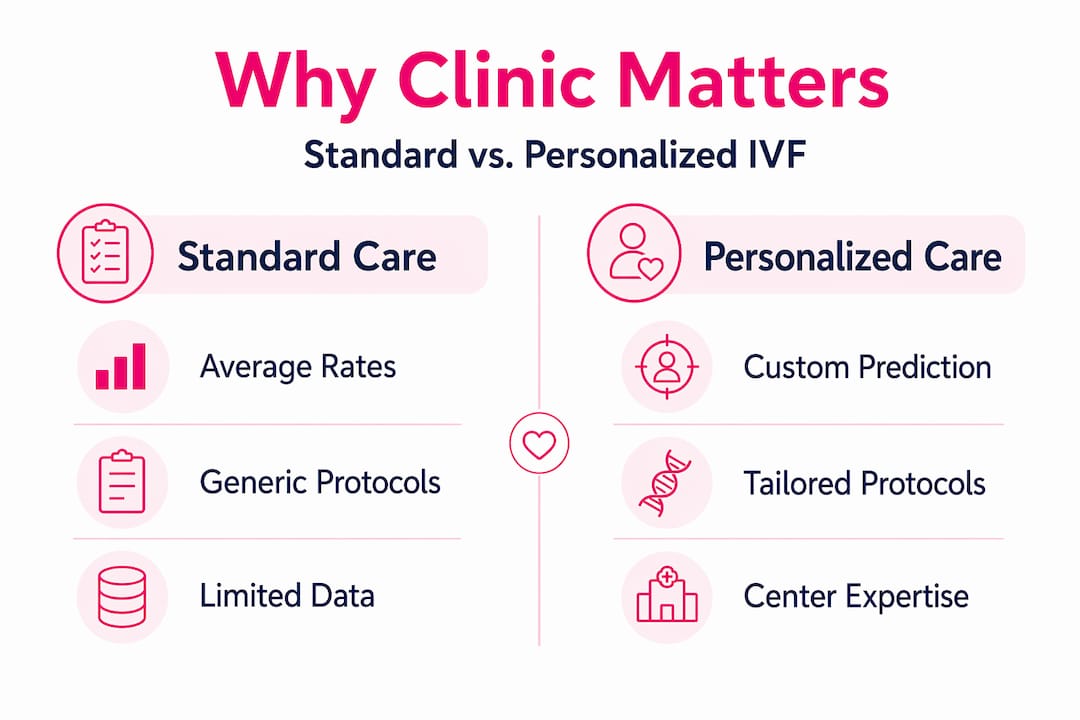
Modern clinics are increasingly turning to center-specific prediction models. These tools analyze patient-level data from within a single clinic’s own patient population, accounting for variables like lab protocols, culture media, and clinical staff practices. Center-specific models outperform national models for live birth prediction, which means the clinic you choose directly affects how accurately your chances can be assessed and communicated.
The difference in counseling quality between a data-driven clinic and one that relies on broad averages is significant. Consider the following comparison:
| Counseling approach | Data source | Prediction accuracy | Personalization level |
|---|---|---|---|
| National average model | CDC/SART aggregate data | Lower | Minimal |
| Center-specific model | Clinic’s own patient data | Higher | High |
| Precision IVF protocol | Individual biological profile | Highest | Fully individualized |
A statistic worth noting: Research using a 50% prediction threshold found that center-specific models showed meaningfully improved accuracy compared to national benchmarks. This improvement translates directly into better-informed conversations between doctors and patients, allowing couples to make decisions with realistic, relevant data rather than generic probabilities.
The advantages of a clinic with local expertise and advanced modeling go beyond counseling accuracy. When treatment protocols are adjusted in real time based on a patient’s response, the likelihood of retrieving a viable embryo increases. This is the philosophy behind the Precision IVF benefits framework, which goes further than standard care by integrating biological profiling into every treatment decision. For couples over 35 in Southern California specifically, precision-based IVF advantages address age-related challenges with targeted clinical strategies.
Special circumstances: Individualized strategies for complex cases
While most cycles follow standard protocols, some situations call for extra customization and careful counseling. Here’s how special circumstances are handled when a patient’s medical history falls outside typical parameters.
One of the most challenging scenarios in reproductive medicine is managing IVF for patients with a severely thin endometrium, particularly those who have experienced Asherman syndrome. Asherman syndrome is a condition in which adhesions or scar tissue form inside the uterus, often as a result of prior uterine surgery, dilation and curettage (D&C), or infection. This scarring can damage the endometrial lining, reducing its thickness and receptivity.
For patients with a persistent endometrial thickness of 3mm or less, the risks are considerable. A thin lining compromises the embryo’s ability to implant and significantly raises obstetric risk if a pregnancy does occur. Success rates in these cases are markedly lower than standard IVF cycles, typically falling in the range of 5% to 15% per transfer, and counseling must be individualized to reflect these realities rather than generic statistics.
Key considerations for complex and individualized cases include:
- Endometrial thickness monitoring at multiple points during the stimulation phase
- Adjunct therapies such as platelet-rich plasma (PRP) infusion, low-dose aspirin, or sildenafil to improve uterine blood flow
- Freeze-all cycles, in which all embryos are frozen and transfer is delayed until the endometrium reaches a more favorable state
- Donor egg consideration when a patient’s own egg quality is severely compromised
- Genetic screening via PGT-A, which identifies chromosomally normal embryos to maximize the value of each transfer attempt in low-odds scenarios
The counseling process for complex cases must address both clinical strategy and emotional preparedness. Couples facing low implantation odds benefit enormously from transparent conversations that present realistic probabilities, available options, and the rationale behind each recommendation. A thorough fertility evaluation checklist can help patients identify which assessments are most relevant to their specific situation before beginning treatment.
Pro Tip: If you have a history of uterine procedures or have been told your lining is thin, ask your physician directly about an individualized transfer plan. Questions such as “What thickness threshold would you require before transfer?” and “What options do we have if lining preparation fails?” will lead to more useful answers than general inquiries about success rates.
Our perspective: What most people misunderstand about IVF
Having seen how individuality shapes every IVF process, let’s step back and consider why popular wisdom, often built on selective stories, can distort real outcomes, and what to do instead.
The loudest voices in the IVF conversation tend to be the success stories. Social media, patient forums, and popular media are filled with accounts of people who conceived after one cycle, often at an age or under circumstances that standard statistics would classify as lower probability. These stories are genuine and meaningful, but they create a skewed picture. People who experience failed cycles or decide to stop treatment often share their stories less publicly. This natural imbalance means that anecdotal accounts lead people to over- or mis-calibrate expectations in ways that can cause real emotional harm.
The result is that many patients enter their first or second cycle with higher expectations than their individual clinical profile warrants. When outcomes don’t match those expectations, the emotional fallout can be severe, sometimes leading to rushed decisions about additional cycles, premature treatment escalation, or abandoning a valid plan too early.
Our perspective at Life IVF Center is straightforward: personalized, data-driven counseling is an act of compassion, not pessimism. Giving a patient an honest probability range based on their own biological data, their own history, and our own clinical outcomes is not discouraging. It is equipping them to make sound decisions.
Managing expectations does not mean managing hope away. It means building hope on a realistic foundation. Couples who understand their true probability profile can make better choices about how many cycles to attempt, whether to consider alternatives like donor eggs, and how to plan financially and emotionally. Navigating this as a couple is especially important. Resources on supporting your partner through IVF highlight how shared understanding of realistic outcomes strengthens the relationship and the treatment process simultaneously.
The shift from hearsay to data is not a cold or clinical move. It is the most caring thing a fertility clinic can offer.
Connect with personalized IVF solutions at Life IVF Center
If you’re ready to take the next step or want more options tailored to your circumstances, here’s how Life IVF Center can help.
At Life IVF Center, the Precision IVF® approach means your treatment protocol is never pulled from a generic template. Every recommendation is grounded in your biological profile, your history, and real clinical data from our Southern California patient population. Whether you are beginning your first cycle or reassessing after a prior attempt, our team is prepared to offer the kind of honest, individualized guidance this journey demands.
Explore our Precision IVF services to understand how a customized protocol is built around your specific needs, from stimulation strategy to transfer timing. If you’re also thinking about fertility preservation, our egg freezing packages offer structured, affordable options across multiple Southern California locations. Schedule a consultation and take the first step with a team that treats your case as exactly that, yours.
Frequently asked questions
How long does the IVF process take from start to finish?
The standard IVF cycle usually takes about 4 to 6 weeks, but the timeline can vary depending on individual protocols, monitoring responses, and whether a freeze-all approach is used.
What factors influence IVF success rates most?
Success rates are largely determined by age, diagnosis, embryo quality, and the uterine environment, and outcomes vary widely from patient to patient based on these individual biological factors.
How can clinics improve IVF outcome predictions?
Clinics that use center-specific prediction models and data-driven counseling provide more accurate forecasts, since center-specific models outperformed national benchmarks for live birth prediction in recent research.
Is IVF a viable option for women with thin endometrium after Asherman syndrome?
IVF is possible but success rates are generally 5% to 15% per transfer with increased obstetric risks, making individualized counseling and a carefully tailored transfer strategy essential.
Can IVF be personalized for couples in Southern California?
Yes. Life IVF Center offers advanced, individualized Precision IVF® protocols tailored to each patient’s unique medical history and biological profile, with multiple locations across Southern California to serve diverse patient needs.
Recommended
- Precision IVF: Transforming Fertility Treatment – Life IVF Center
- Mini IVF: A personalized path to fertility success
- Understanding embryo transfer: The key step in IVF
- How to Support Your Partner Through IVF: A Complete Guide
Ready to take the next step?
Life IVF Center specializes in individualized Precision IVF® care for complex cases—including diminished ovarian reserve, prior failed cycles, and advanced maternal age. Our in-house labs and dedicated physicians are ready to help.
Book a Free Consultation →