
Preimplantation genetic testing (PGT) is a test of embryo cells taken before transfer, and it is billed in pieces: the IVF cycle, the embryo biopsy and the laboratory analysis often arrive as separate charges. The most reliable way to finance it is to price each piece first, then match each one to the funding that fits: insurance where your plan allows it, grants for the testing itself, pre-tax health accounts, and installment financing only after you have compared the terms. At Life IVF Center, our published price lists let you start that budget with real numbers for the parts of the process we provide.
TL;DR
- PGT is usually not one bill. A clinic bills the biopsy, and a genetic laboratory bills the testing, on top of the IVF cycle itself.
- Insurance coverage depends on your plan and your reason for testing. Many plans cover PGT only for specific medical situations, and most plans do not fully cover IVF.
- Grants exist that name PGT as an eligible expense, and they are usually paid straight to the clinic.
- If you finance, compare the APR, the repayment term and whether a “0%” offer is deferred interest before you sign.
- Ask for an itemized estimate so every line can be matched to a funding source.
Table of Contents
- What PGT is and why the bill has several parts
- What PGT typically costs in the United States
- What Life IVF Center publishes
- Does insurance cover PGT?
- Grants that can help with PGT
- Using HSA and FSA funds
- Financing the balance: loans, cards and payment plans
- Building a budget in four steps
- Perspective: why an itemized plan beats a headline price
- Starting with Life IVF Center
- FAQ
- Sources
What PGT is and why the bill has several parts
PGT examines a few cells from an embryo grown in the lab during IVF. There are three common types: PGT-A looks for an abnormal number of chromosomes, PGT-SR looks for structural chromosome rearrangements, and PGT-M looks for a specific single-gene condition that runs in a family. Which one applies to you depends on your age, history and genetics, which is why it is decided in a consultation and not in a price list.
For billing, the important point is that PGT has more than one payer event. A Harvard University overview of its Maven fertility benefit (May 2025) describes two separate billing events: the biopsy, billed by the fertility clinic, and the testing, billed by a PGT laboratory. Using a lab outside the plan’s preferred network in that program meant paying out of pocket and then submitting for reimbursement.
That structure is typical of how you should read any estimate. Look for these lines:
- The IVF cycle (stimulation, retrieval, fertilization, lab culture).
- Fertility medications, which are often priced separately.
- The embryo biopsy.
- The laboratory fee for the genetic analysis, often charged per embryo.
- Embryo freezing and storage.
- The embryo transfer.
What PGT typically costs in the United States
Costs vary by clinic, lab and the number of embryos tested, so published ranges are best used to size your plan, not to predict your bill. Kaiser Permanente Northern California’s patient information on preimplantation genetic testing (last reviewed July 2020) lists an IVF cycle at $10,000 to $15,000 or more, IVF medications at $5,000 to $8,000, an embryo biopsy at $3,000 or more, and an additional outside-laboratory fee for each embryo tested. Those are 2020 figures and prices have moved since, so treat them as a structure, not a quote.
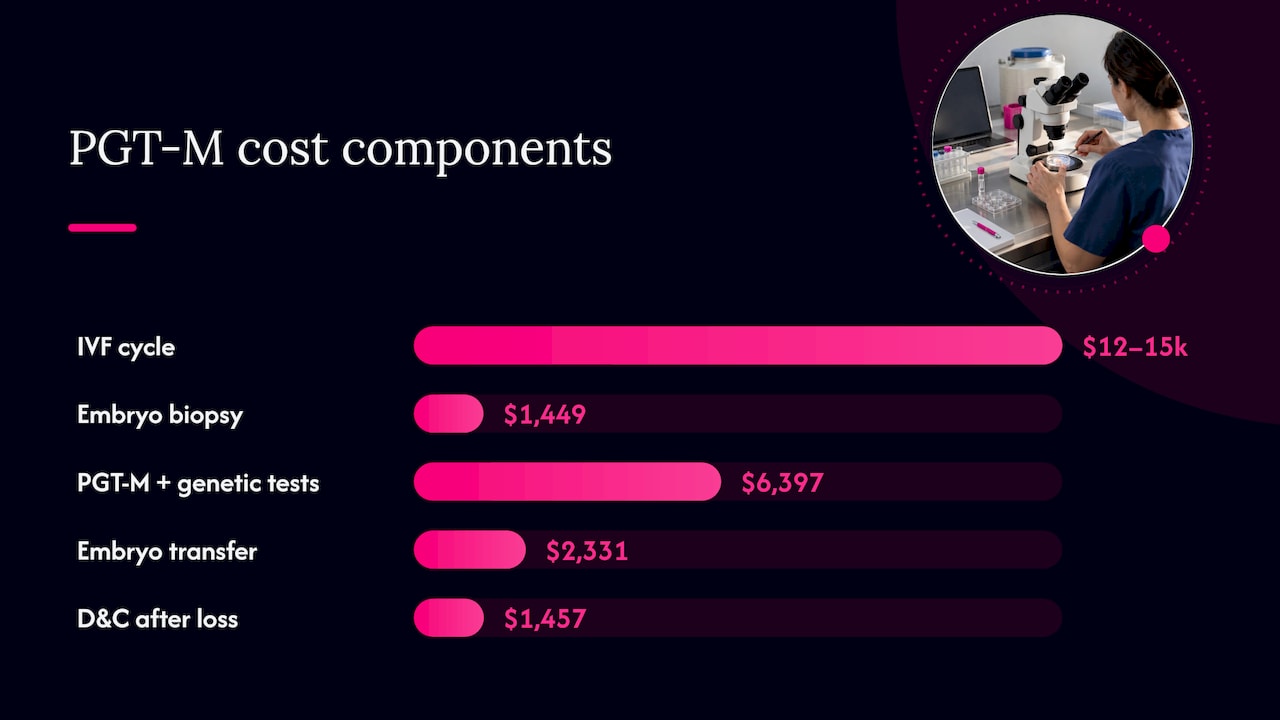
Peer-reviewed work shows how the pieces add up. A 2023 review of PGT-M for adult-onset neurodegenerative disease estimated IVF with PGT-M at roughly $30,000 per unaffected live birth in the US. Its breakdown was $12,000 to $15,000 for IVF, $1,449 for embryo biopsy, $6,397 for PGT-M and other genetic testing, $2,331 for embryo transfer and $1,457 for a D&C if a pregnancy loss occurred. A cost-effectiveness study of IVF with PGT-M/A for spinal muscular atrophy carrier couples reported an average cost of $41,002 and concluded that the approach was cost-effective at standard willingness-to-pay thresholds, which supports the case for insurance coverage in that situation.
Two things move your own total more than anything else: how many embryos reach the biopsy stage, and whether you need more than one retrieval. Your physician can discuss both with you after reviewing your history and ovarian reserve.
What Life IVF Center publishes
A financing plan is easier when part of the budget is fixed. Our price pages list several of the pieces you will need. These are published prices, and your treatment plan determines which apply to you.
| Item | Published price |
|---|---|
| Advanced IVF Package | $13,500 |
| Embryo Transfer | from $2,950 |
| Precision Embryo Freezing | $8,950 |
| Precision Egg Freezing | $7,500 |
| Annual Storage | $750 per year |
| 3 Year Prepaid Storage | $2,000 |
| Monthly Storage | $70 per month |
| Carrier Screening for Genetic Disease | $349 |
| Karyotype Chromosomal Analysis | $595 |
| Endometrial Receptivity Assay (ERA) | $975 |
You can see the full lists on our treatment packages page, our freezing pricing page and our pre-IVF testing page. Our genetic testing service does not have a published price, so the cost of PGT for your plan is discussed during your consultation.
Storage is worth planning for early. If embryos are frozen after testing, our storage pricing shows three ways to pay: $750 per year, $70 per month, or $2,000 for three years prepaid. Choosing the structure that fits your timeline is a small decision that avoids surprises later.
Does insurance cover PGT?
Sometimes, and almost always conditionally. The answer depends on three layers: whether your plan includes fertility benefits at all, whether it covers IVF, and whether it covers PGT for your specific indication.
Coverage depends on the medical reason
Kaiser Permanente’s medical policy on preimplantation genetic testing (May 2026) is a useful example of how insurers think. It treats PGT as medically necessary when it is needed to detect a single-gene disorder (PGT-M) or a structural chromosome abnormality (PGT-SR) with significant medical impact. Qualifying situations include a parent with a balanced reciprocal or Robertsonian translocation, both parents carrying the same autosomal recessive disorder, or a female parent carrying an X-linked disorder. In that policy the biopsy and testing are covered when those criteria are met, while IVF and embryo transfer are covered only for members who have assisted reproductive technology benefits. The policy also notes that PGT may be excluded under plan terms.
Plans differ, so use this as a model for the questions to ask, not as a promise about your plan.
State mandates change the picture
Government programs such as Medicare, Medicaid and the Veterans Health Administration do not generally cover advanced fertility treatment such as IVF and PGD, according to a comparative policy analysis published in 2017. More recently, a 2024 review on informed consent in assisted reproduction reports that assisted reproduction in the US is primarily paid out of pocket, that 20 states have laws requiring payers to cover infertility diagnosis and treatment, and that fewer than a third of US IVF cycles take place in mandate states. A state mandate may also apply only to certain employer plans, and self-funded employer plans are often outside state rules, so confirm which type you have.
Questions to ask your insurer or HR benefits team
- Does my plan include infertility or ART benefits, and is there a lifetime maximum?
- Is PGT-A, PGT-SR or PGT-M covered, and under what medical criteria?
- Are the biopsy and the lab analysis covered separately?
- Is prior authorization needed, and does a genetic counseling visit have to come first?
- Does the lab have to be in-network, and what is the reimbursement process if it is not?
- Do medications fall under the pharmacy benefit?
Get answers in writing, with the date and the name of the representative. Our financial guidance team can help you read what you receive and line it up against an estimate.
Grants that can help with PGT
Nonprofit grants are the most direct source of funds aimed at testing. Most are paid to the clinic, not to you, and each has its own eligibility rules and application windows, so read the current terms on the grantor’s page before planning around one.
- Conceive Fertility Foundation. Its grant FAQ describes a $15,000 IVF grant, with leftover funds usable for medications, embryo testing and storage, together with a separate $1,000 PGT grant restricted to PGT services. Its criteria include an age range of 25 to 42, a formal infertility diagnosis, financial need within stated income limits, and use at a US clinic.
- Hopeful Mama Foundation. The Hopeful Mama grant page lists carrier screening and PGT among eligible expenses. It requires a documented female-factor infertility diagnosis, US citizenship or permanent residency, treatment at an accredited US clinic and basic medical insurance. Grants begin at $500, and the application opens once a year.
- Coalition for Family Building. Its family building grant page says grants can cover PGT-A, PGT-SR or PGT-M, including up to $5,000 specifically for PGT-M for BRCA1 and BRCA2 carriers. Grants are paid directly to providers, must be started within 6 months and expire 12 months after issuance, and the main application cycles fall in spring and late in the year.
- Industry-backed programs. A CooperSurgical announcement of its 2025 IVF grant program describes grants covering roughly one IVF cycle, excluding medication, with an additional $1,000 toward PGT with ICSI.
Because grants are paid to the clinic and have use-by dates, tell your care team early if you are applying. Timing your cycle to the grant’s window is easier when it is planned from the first consultation.
Using HSA and FSA funds
Health savings accounts (HSAs) and flexible spending accounts (FSAs) let you pay medical costs with pre-tax money, which can lower the real cost of testing. What counts is set by the IRS and your plan administrator, so confirm that your specific PGT charges qualify before you pay with the account.
Documentation is where claims are often delayed. The federal FSAFEDS guide to eligible Health Care FSA expenses states that the IRS determines which expenses are reimbursable and that you must keep itemized receipts, because credit card receipts, canceled checks and balance-forward statements do not meet IRS documentation requirements. Some expenses also need a letter of medical necessity signed by a doctor, plus a detailed receipt.
A practical routine:
- Ask your administrator in writing whether PGT, the biopsy and genetic counseling are eligible.
- Request an itemized invoice that separates the biopsy, the lab analysis and the IVF cycle.
- Request a letter of medical necessity if your administrator asks for one.
- Check the FSA plan-year deadline, since unused funds may be forfeited under the plan’s rules.
Other genetic tests you may come across during a pregnancy, such as noninvasive prenatal paternity testing, are billed separately from PGT and should not be assumed to fall under the same estimate or reimbursement.
Financing the balance: loans, cards and payment plans
After insurance, grants and pre-tax funds, many patients still have a balance. Financing can make it manageable, but the terms deserve as much attention as the treatment price. The Consumer Financial Protection Bureau’s May 2023 report, Medical Credit Cards and Financing Plans, gives the most useful framework.
The report found a typical medical credit card APR of 26.99%, compared with roughly 16% for general-purpose cards. It describes deferred-interest promotions, where interest is charged on the full original purchase if the balance is not paid off by the end of the promotional period. It also notes medical installment loan terms ranging from 3 to 60 months, with APRs that vary widely by product and the borrower’s credit risk. These were the figures for that report’s period, so rates today depend on the lender and move with the market.
What to compare before you sign
| Question | Why it matters |
|---|---|
| What is the APR after any promotion ends? | A short promotion can be followed by a high rate. |
| Is the “0%” offer deferred interest? | Missing the deadline can add interest on the whole original amount. |
| What is the term, and the monthly payment? | A longer term lowers the payment but raises total interest. |
| Are there origination or late fees? | Fees add to the real cost. |
| What does the loan cover? | Some plans cover only certain services, so check that testing and storage are included. |
| Is there a penalty for early payoff? | Flexibility matters if a grant or reimbursement arrives later. |
A simple example shows why the structure matters. If a $10,000 balance is on a deferred-interest promotion and $200 remains unpaid at the deadline, interest can apply to the original $10,000 from the purchase date, not to the $200. Dividing the balance by the number of promotional months and setting up automatic payments is the safest way to use that kind of offer.
Building a budget in four steps
- Get an indication-based plan. Your age, ovarian reserve, history of losses and any known genetic condition determine whether PGT is recommended and which type. Our team starts there, with a reproductive health evaluation, before pricing anything.
- Price every line. Use the list above and ask for the biopsy, laboratory and transfer costs separately. Our pre-IVF testing prices, such as carrier screening at $349 and karyotype analysis at $595, help you see the diagnostic stage early.
- Apply funding in order. Insurance and grants first, since both are often paid to the provider. Then HSA or FSA funds, then financing for the remainder.
- Plan for the stages after the cycle. Transfer, storage and any follow-up monitoring are part of the real cost of building a family through IVF with testing.
Perspective: why an itemized plan beats a headline price
We see PGT as one tool inside a larger treatment plan, and that is how we think it should be paid for. Our Precision IVF® approach builds the protocol around each patient’s biology, medical history and goals, and we design it to reduce the number of trial cycles. A plan built that way gives you something concrete to budget against.
We believe patients are better served when pricing is transparent. That is why we publish prices for our packages, freezing, storage and pre-IVF testing, and why we welcome second-opinion cases and patients who have been told elsewhere that their situation is too complex. Knowing the cost of each stage lets you apply insurance, grants and pre-tax funds to the right line.
Our in-house labs and our travel and financial guidance exist for the same reason: fewer unknowns for you. Genetic testing questions are best answered in a consultation, where your history decides which test makes sense and what it should cost.
Starting with Life IVF Center
If you are weighing PGT, the first practical step is a consultation that settles which testing, if any, fits your situation, followed by an itemized estimate you can take to your insurer, grant applications and benefits administrator. Our Precision IVF® program is built around your individual profile, and our team also supports patients with multi-language assistance, travel coordination and financial guidance.
You can review our published prices on the treatment packages page or learn more about our genetic testing and IUI services, then book a consultation through Life IVF Center.
FAQ
Is PGT included in the price of an IVF package?
Not necessarily. PGT usually involves a biopsy charge and a separate laboratory fee per embryo, in addition to the IVF cycle. Ask for an itemized estimate so you can see which lines your package covers and which are added.
Will my insurance pay for PGT if it does not cover IVF?
It can, but it depends on the plan. Some policies cover the biopsy and testing when there is a specific medical indication, such as a single-gene disorder or a chromosome rearrangement, while covering IVF itself only for members with fertility benefits. Call your insurer with the exact test type and ask for the answer in writing.
Can I pay for PGT with an HSA or FSA?
Often yes, but your plan administrator decides eligibility under IRS rules. Keep itemized receipts, because credit card slips and bank statements alone do not meet the documentation requirement, and ask whether a letter of medical necessity is needed.
Are fertility grants available for genetic testing?
Yes. Several nonprofits list PGT as an eligible expense or offer a PGT-specific amount, and most pay the clinic directly. Each has age, diagnosis, residency and income rules and application windows that recur, so check the grantor’s page for the current cycle.
What is the biggest risk with medical financing?
Deferred-interest promotions. The CFPB reports that interest can be charged on the full original amount if the balance is not cleared by the end of the promotional period, so confirm the terms and set a payoff plan before you accept.
Sources
- Harvard University Maven Clinic Program Overview (May 2025)
- Kaiser Permanente Northern California: Preimplantation Genetic Testing patient information
- PMC review: Preimplantation Genetic Testing for Adult-Onset Neurodegenerative Disease
- PMC study: Cost-effectiveness of IVF with PGT-M/A for Spinal Muscular Atrophy Carrier Couples
- Kaiser Permanente Medical Policy: Preimplantation Genetic Testing (May 2026)
- PMC: Comparative Preimplantation Genetic Diagnosis Policy (2017)
- PMC: Informed Consent in Assisted Reproductive Technology (2024)
- Conceive Fertility Foundation: Frequently Asked Questions
- Hopeful Mama Foundation: Grant Information
- Coalition for Family Building: Family Building Grant
- CooperSurgical Press Release: 2025 IVF Grant Program Launch
- FSAFEDS: Eligible Health Care FSA Expenses
- CFPB Report: Medical Credit Cards and Financing Plans (May 2023)
- Noninvasive Prenatal Paternity Testing from 8 to 9 Weeks
This article is for general educational purposes only and is not a substitute for personalized medical advice, diagnosis, or treatment. Fertility care is highly individual; please consult a qualified healthcare professional about your specific circumstances.
Ready to take the next step?
Life IVF Center specializes in individualized Precision IVF® care for complex cases—including diminished ovarian reserve, prior failed cycles, and advanced maternal age. Our in-house labs and dedicated physicians are ready to help.
Book a Free Consultation →