

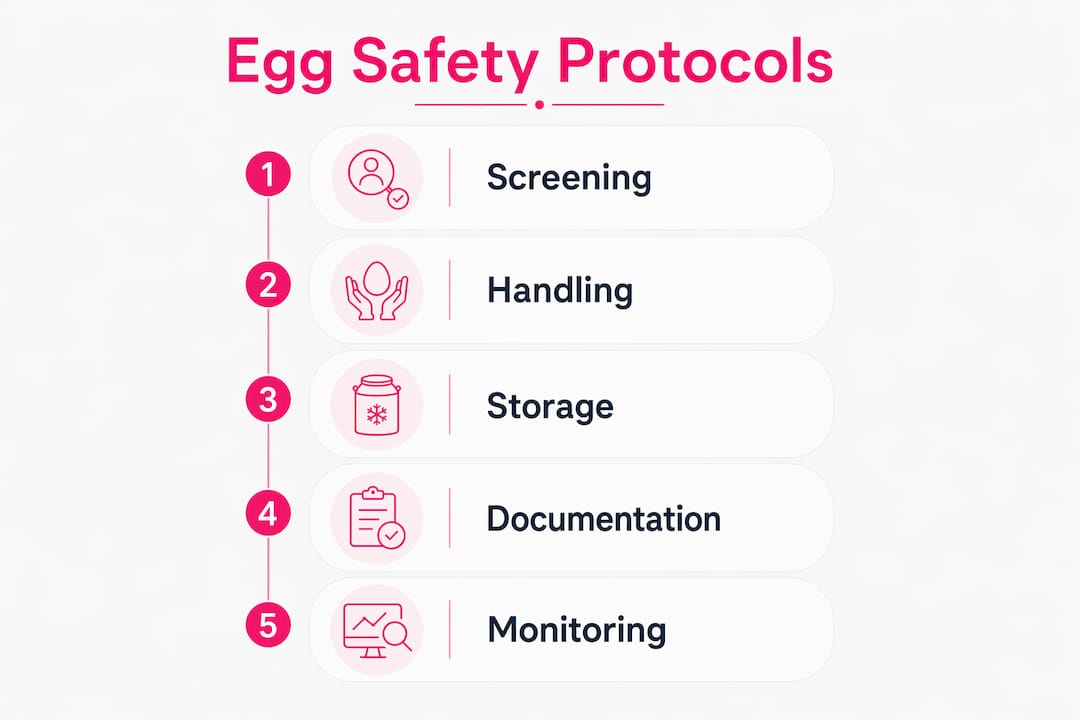
Clinical egg safety protocols are the layered set of measures: infectious-disease screening, aseptic laboratory handling, dual-witness labeling, traceable chain-of-custody, and continuously monitored cryostorage, that accredited fertility clinics use to protect oocytes throughout IVF and egg freezing. The FDA confirms that even visually clean eggs can harbor Salmonella Enteritidis, which is why both food-safety and clinical reproductive contexts depend on strict handling controls from the moment of retrieval onward.
What patients should expect at a minimum:
- Infectious-disease screening (HIV, hepatitis B and C) before retrieval or donation
- A two-person witness system confirming every label at each transfer step
- Validated vitrification with documented oocyte survival rates
- Continuous temperature monitoring with alarms and backup systems in cryostorage
Organizations including the American Society for Reproductive Medicine (ASRM), the Society for Assisted Reproductive Technology (SART), and the U.S. Food and Drug Administration (FDA) each set standards that govern these steps. Life IVF Center aligns its clinical workflows with all three.
Table of Contents
- What does a complete egg safety protocol actually cover?
- What should you do before, during, and after egg retrieval?
- How do embryology labs protect eggs during handling?
- How is cryostorage kept safe for frozen eggs?
- Which U.S. standards govern egg safety in fertility care?
- What are the main risks, and how do clinics reduce them?
- What questions should you ask your clinic about egg safety?
- How Life IVF Center implements egg safety protocols
- Key Takeaways
- Why strict protocols matter more than patients realize
- Ready to review your egg safety checklist with Life IVF Center?
- Authoritative sources for deeper verification
What does a complete egg safety protocol actually cover?
A thorough protocol spans nine core areas. Use this checklist when evaluating any clinic:
- Infectious-disease screening: HIV, hepatitis B/C, syphilis, and other required tests for patients and donors
- Informed consent: Written documentation of risks including mislabeling, thaw failure, and ovarian hyperstimulation syndrome (OHSS)
- Aseptic handling: Laminar flow hoods, clean-room environments, and staff hygiene controls
- Single-egg examination: Each oocyte assessed individually, pooling raw eggs is high-risk in any biological context because one contaminated specimen can compromise an entire batch
- Labeling and witness systems: Dual-verification at every transfer point
- Temperature-controlled transport: Validated cold-chain carriers with data loggers
- Validated vitrification: Clinically proven rapid-freeze protocols
- Monitored cryostorage: Continuous logs, remote alarms, redundant liquid nitrogen, and emergency power
- Documentation and audits: Standard operating procedures (SOPs), external reviews, and equipment calibration records
The three easiest items to verify before treatment: ask for the clinic’s CLIA and CAP accreditation certificates, request a written description of the witness procedure, and ask for documented oocyte survival rates.
Pro Tip: Ask specifically whether the clinic uses an electronic witnessing system or a paper-based log. Electronic systems create a timestamped audit trail that is harder to alter and easier to review if a question arises later.
What should you do before, during, and after egg retrieval?
Before retrieval
- Confirm that your clinic has ordered required infectious-disease panels (HIV, hepatitis B/C, syphilis) and that results are documented in your chart.
- Review your consent form carefully. It should name specific risks: mislabeling, failure to survive thaw, OHSS, and storage loss.
- Ask for proof of CLIA certification and CAP accreditation, and verify SART membership at the SART public registry.
- Request the clinic’s documented oocyte survival rate and ask how many cycles they perform annually.
- Clarify storage options: on-site versus off-site, what monitoring is in place, and whether storage is insured against loss.
Day of retrieval
- Follow all pre-procedure hygiene instructions your clinic provides.
- Confirm that staff will verify your identity and your partner’s (or donor’s) identity before any specimen is labeled.
- Ask how eggs are assessed immediately after retrieval and how that assessment is documented.
After retrieval
- Ask where your eggs are stored and how often temperature logs are reviewed.
- Request a copy of your storage consent and understand the terms for long-term storage, transport, or disposition.
Pro Tip: Request a sample temperature log snapshot during your pre-treatment consultation. A well-run lab will show you a recent 24-hour graph. Flat lines within the target range signal reliable monitoring; unexplained spikes are a red flag worth discussing.
The egg retrieval process page at Life IVF Center walks through what patients can expect at each stage, including post-retrieval documentation.
How do embryology labs protect eggs during handling?
Environmental controls
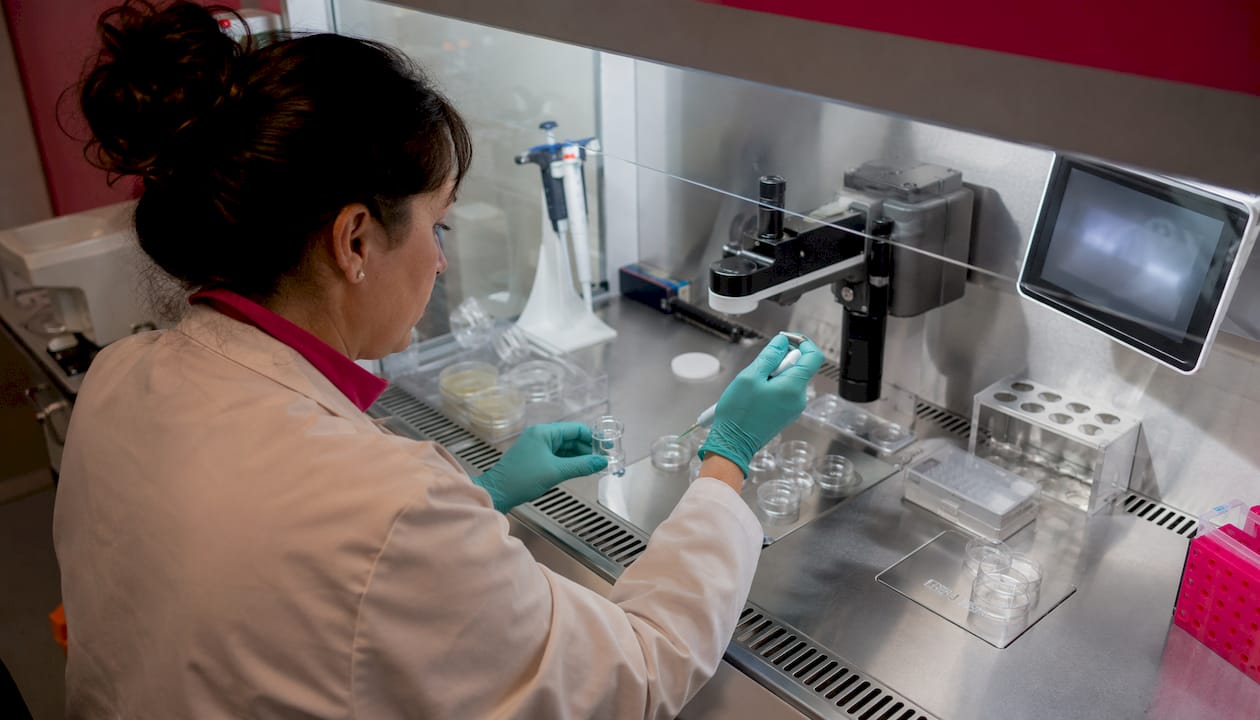
Accredited labs handle oocytes inside laminar flow hoods that maintain a sterile, particle-controlled environment. Clean-room conditions limit airborne contaminants that could compromise oocyte integrity. Staff follow strict hand-hygiene protocols: washing with hot, odorless soap and using single-use gloves changed frequently throughout the session. These controls mirror the hygiene standards required in commercial egg-breaking operations under federal regulation.
Witness systems and chain-of-custody
Every time an oocyte moves, from retrieval dish to culture medium, from culture to vitrification straw, from straw to storage tank, two qualified staff members independently verify the label. This dual-verification step is the primary defense against mislabeling. Electronic witnessing platforms create a timestamped record at each checkpoint, and paper-based systems require two signatures. Chain-of-custody forms document who handled the specimen, when, and under what conditions.
Staff qualifications and external signals
Look for embryologists credentialed through the American Board of Bioanalysis (ABB) or holding equivalent professional certification. External quality signals include:
- CLIA certification: Required by federal law for any lab performing clinical testing on human specimens
- CAP accreditation: Voluntary but rigorous; CAP inspectors conduct unannounced on-site audits
- SART membership: Requires adherence to ASRM practice guidelines and annual outcome reporting
Equipment calibration is equally important. Temperature measuring devices used in clinical labs should be calibrated to tight tolerances, and calibration records should be available on request.
How is cryostorage kept safe for frozen eggs?
Vitrification is the current clinical standard for oocyte cryopreservation. Unlike older slow-freeze methods, vitrification uses ultra-rapid cooling to prevent ice crystal formation inside the cell, which is the primary cause of membrane damage during freezing. Accredited programs track and publish their oocyte survival rates so patients can compare outcomes.
| Storage feature | What to verify |
|---|---|
| Temperature monitoring | Continuous electronic logging, not manual spot-checks |
| Alarm systems | Remote alerts sent to on-call staff 24/7 |
| Redundant liquid nitrogen | Secondary supply or auto-fill system |
| Emergency power | Backup generator covering cryostorage tanks |
| Transport validation | Data loggers inside carriers; chain-of-custody on transfer |
| Insurance/indemnity | Written policy covering loss or damage during storage |
The USDA notes that temperature fluctuation allows bacteria to move through porous egg shells, a principle that applies equally to biological specimens: any break in cold-chain integrity creates risk. For transported oocytes, validated temperature-sensitive shipment handling protocols and data loggers are the standard way to document that the cold chain held throughout transit.
Life IVF Center’s cryopreservation services include on-site monitored storage with alarm and backup systems.
Which U.S. standards govern egg safety in fertility care?
| Body | What it governs | Patient action |
|---|---|---|
| ASRM | Clinical practice guidelines for IVF, egg freezing, and donor cycles | Ask if clinic follows current ASRM guidelines |
| SART | Program membership, annual outcome reporting, and registry | Verify membership at sart.org |
| FDA | Donor tissue screening rules; egg product pasteurization oversight | Confirm donor screening meets FDA 21 CFR Part 1271 |
| CDC | Infectious-disease testing recommendations | Confirm required panels are ordered |
| CLIA | Federal lab certification for clinical testing | Request CLIA certificate number |
| CAP | Voluntary accreditation with unannounced audits | Request CAP accreditation status |
For donor-recipient cycles, FDA regulations under 21 CFR Part 1271 require documented infectious-disease testing within a defined window before donation. Clinics must maintain records of these results and make them available during regulatory inspections.
“Consumers play an important role in preventing foodborne illness from bacteria like Salmonella by handling, cooking, and storing eggs safely.” (FDA Egg Safety Guidance.) In the clinical fertility context, that same principle extends to patients: knowing what to ask and what documentation to request puts you in a position to actively participate in your own safety.
What are the main risks, and how do clinics reduce them?
| Risk | Typical clinic controls | Documentation to request |
|---|---|---|
| Contamination/infection | Aseptic technique, laminar flow, infectious-disease screening | Screening results, lab accreditation |
| Mislabeling/mix-up | Dual-witness system, electronic audit trail | Witness procedure description, sample log |
| Thaw/survival failure | Validated vitrification, documented survival rates | Published or clinic-specific survival statistics |
| OHSS | Individualized stimulation protocols, monitoring | Stimulation protocol and monitoring schedule |
| Cold-chain failure | Continuous temperature logs, alarms, redundant nitrogen | Temperature log sample, alarm response policy |
OHSS risk is managed through individualized hormone stimulation protocols. Clinics using a Precision IVF® approach, as Life IVF Center does, tailor stimulation to each patient’s biological profile, which can reduce the likelihood of over-response.
What questions should you ask your clinic about egg safety?
Pre-treatment screening
- Are you CLIA-certified and CAP-accredited? Can I see the certificates?
- Are you a SART member, and can I find your outcomes on the SART registry?
- What infectious-disease panels do you require, and when are they drawn?
Day of retrieval
- Do you use a two-person witness system at every transfer step?
- Is witnessing electronic or paper-based, and how is the record stored?
Storage and transport
- What is your documented oocyte survival rate after vitrification and thaw?
- How is cryostorage monitored, and who receives alarms after hours?
- If I need eggs transported to another clinic, what cold-chain validation do you use?
Data access and consent
- Can I request a copy of my temperature logs and chain-of-custody records?
- What are my options for long-term storage, and is storage insured against loss?
The single best question that surfaces the most safety gaps: “Can you walk me through what happens to my eggs between the moment they leave my body and the moment they enter cryostorage?” A clinic with strong protocols will answer this in specific, sequential detail without hesitation.
How Life IVF Center implements egg safety protocols
Life IVF Center’s approach to egg safety is built on the same layered framework described throughout this article:
- Screening: Required infectious-disease panels for all patients and donors, documented before any cycle begins
- Accredited laboratory practices: CLIA-certified lab environment with aseptic handling and laminar flow controls
- Witness and chain-of-custody: Dual-verification at every specimen transfer, with records maintained in the patient file
- Vitrification and cryostorage: Validated rapid-freeze protocols with continuous temperature monitoring, remote alarms, and backup systems
- Staff qualifications: Credentialed embryologists and clinical staff operating under documented SOPs
- Precision IVF® individualization: Stimulation protocols tailored to each patient’s profile to support both safety and outcomes
Patients can review the egg freezing process and donor egg workflows on the Life IVF Center website for clinic-specific detail.
Key Takeaways
Egg safety in fertility care depends on six verifiable layers: infectious-disease screening, aseptic lab handling, dual-witness labeling, validated vitrification, continuously monitored cryostorage, and documented chain-of-custody at every transfer point.
| Point | Details |
|---|---|
| Verify accreditation first | Ask for CLIA certification and CAP accreditation before committing to a clinic. |
| Witness systems prevent mix-ups | Dual-verification at every specimen transfer is the primary defense against mislabeling. |
| Vitrification is the current standard | Rapid-freeze vitrification reduces ice crystal damage; ask for the clinic’s documented survival rate. |
| Cold-chain integrity matters | Continuous temperature logs, remote alarms, and redundant nitrogen supply are non-optional for safe storage. |
| Life IVF Center’s approach | Life IVF Center applies Precision IVF® individualization alongside CLIA-certified lab protocols and monitored cryostorage. |
Why strict protocols matter more than patients realize
Most patients focus on success rates when choosing a fertility clinic, which is understandable. But the protocols that produce those rates, the witness systems, the temperature logs, the calibrated equipment, are what make a published survival rate trustworthy in the first place. A clinic that cannot show you its accreditation certificates or explain its witness procedure in plain language is not hiding modesty; it is signaling a gap in its quality infrastructure. Patients who ask specific, documentation-oriented questions before treatment are not being difficult. They are doing exactly what the regulatory framework expects them to do. ASRM, SART, CLIA, and CAP exist precisely because these safeguards require external verification, not just self-reporting. You have every right to see the evidence, and a well-run clinic will welcome the question.
Ready to review your egg safety checklist with Life IVF Center?
Life IVF Center offers consultations specifically designed to help patients evaluate their options before committing to a treatment cycle. Whether you want to review a clinic’s safety documentation, understand what your consent forms actually cover, or get a second opinion on a proposed protocol, the team at Life IVF Center can walk you through each checkpoint in plain language.
The clinic’s egg freezing packages and treatment packages include transparent pricing alongside clinical detail, so you can compare care on both safety and cost. To schedule a consultation or request proof of accreditation before your first appointment, contact Life IVF Center directly through the clinic website.
Authoritative sources for deeper verification
- FDA Egg Safety: Refrigeration, safe handling, and Salmonella risk for consumers and clinical contexts
- FSIS Shell Eggs from Farm to Table: Temperature danger zone, cold-chain requirements, and egg product inspection rules
- ASRM (asrm.org): Clinical practice guidelines for IVF, egg freezing, and donor cycles
- SART (sart.org): Program membership verification and annual outcome data by clinic
- CAP (cap.org): Laboratory accreditation lookup and proficiency testing standards
- CLIA (cms.gov/CLIA): Federal lab certification database and compliance requirements
- CDC Infectious Disease Testing: Recommended panels for donors and recipients in assisted reproduction
Recommended
- The Egg Retrieval – Life IVF Center
- Blog – Life IVF Center
- Egg & Embryo Freezing – Life IVF Center
- Preparing for Egg Retrieval: Your Step-by-Step Guide
Ready to take the next step?
Life IVF Center specializes in individualized Precision IVF® care for complex cases—including diminished ovarian reserve, prior failed cycles, and advanced maternal age. Our in-house labs and dedicated physicians are ready to help.
Book a Free Consultation →