
Not all IVF is created equal, and for many individuals and couples navigating fertility challenges in Southern California, that distinction matters enormously. Mini IVF, formally known as minimal stimulation in vitro fertilization, offers a gentler, more targeted alternative to conventional protocols, particularly for those over 35 or with a complex reproductive history. This guide covers what mini IVF is, who it benefits most, what the process looks like step by step, how it compares to traditional IVF, and what outcomes you can realistically expect when you choose a personalized approach to care.
Table of Contents
- What is mini IVF and how does it work?
- Who is an ideal candidate for mini IVF?
- Step-by-step: What happens during a mini IVF cycle?
- Mini IVF vs. traditional IVF: Which is right for you?
- Real-world outcomes: What can you expect from mini IVF?
- Why mini IVF is redefining fertility care in Southern California
- Take the next step: Discover your personalized mini IVF options
- Frequently asked questions
Key Takeaways
| Point | Details |
|---|---|
| Mini IVF defined | Mini IVF is a gentler, lower-medication alternative to traditional IVF focusing on quality over quantity. |
| Best for complex cases | It’s especially effective for patients over 35 or those with diminished ovarian reserve. |
| Streamlined, individualized care | The process emphasizes personalized protocols and less physical stress. |
| Compare options carefully | Weigh mini IVF versus traditional IVF based on your medical history, goals, and doctor’s advice. |
| Hope for difficult journeys | Mini IVF offers a viable path for those who haven’t succeeded with standard fertility treatments. |
What is mini IVF and how does it work?
Mini IVF is not simply a scaled-down version of conventional IVF. It is a deliberately designed protocol that prioritizes egg quality over egg quantity, using lower doses of stimulation medication to encourage the development of a smaller number of carefully selected eggs. As noted in the intro to IVF resources at Life IVF Center, mini IVF uses lower doses of stimulation medication and aims to retrieve fewer, higher-quality eggs.
In a conventional IVF cycle, patients typically receive high doses of injectable gonadotropins (hormones that stimulate the ovaries) to produce as many eggs as possible, sometimes 10 to 20 or more. Mini IVF, by contrast, uses oral medications like clomiphene citrate or low-dose injectable medications to encourage the development of two to five eggs per cycle. The logic is straightforward: a smaller number of high-quality eggs can yield healthier embryos, which is especially relevant for patients whose ovarian reserve is already limited.
The following table highlights the core differences between mini IVF and conventional IVF at a glance:
| Feature | Mini IVF | Conventional IVF |
|---|---|---|
| Medication type | Oral or low-dose injectable | High-dose injectable gonadotropins |
| Eggs retrieved (average) | 2 to 5 | 10 to 20+ |
| Ovarian hyperstimulation risk | Low | Moderate to high |
| Cycle length | 2 to 3 weeks | 3 to 4 weeks |
| Cost (general range) | Lower | Higher |
| Focus | Egg quality | Egg quantity |
“The goal of mini IVF is not to collect the most eggs possible. It is to collect the right eggs for each individual patient, reducing physical burden while maintaining meaningful outcomes.”
This philosophy reflects a broader shift in reproductive medicine toward individualized care, where treatment is built around your biology rather than a standard protocol applied to everyone.

Who is an ideal candidate for mini IVF?
With a clear picture of what mini IVF offers, the next question is whether it aligns with your specific situation. Not every patient is the right fit for mini IVF, but for a well-defined group of individuals, it can be the most appropriate and effective path forward.
Mini IVF is often recommended for women with diminished ovarian reserve or those over 35, where aggressive stimulation may not produce significantly better results and may actually compromise egg quality. Diminished ovarian reserve (DOR) refers to a reduced number of viable eggs remaining in the ovaries, often measured through anti-Mullerian hormone (AMH) levels or antral follicle count (AFC). For patients with low AMH treatment needs, mini IVF can be a more realistic and physiologically appropriate option.
The following patient profiles tend to benefit most from mini IVF:
- Women over 35 whose egg quantity has naturally declined but whose egg quality can still be optimized with targeted stimulation
- Patients with diminished ovarian reserve who may not respond strongly to high-dose medications anyway
- Individuals who experienced poor response to conventional IVF stimulation in previous cycles
- Those with a history of ovarian hyperstimulation syndrome (OHSS), a potentially serious complication of high-dose stimulation
- Patients with specific health conditions such as polycystic ovary syndrome (PCOS) who are at elevated risk for OHSS
- Individuals seeking lower emotional and financial stress without compromising their chances of a successful outcome
- Those with strong personal or medical reasons to minimize hormone exposure
Beyond the physical profile, mini IVF is also a meaningful option for those who have felt overwhelmed or discouraged by previous fertility treatment experiences. The reduced medication burden can make the process feel more manageable and less disruptive to daily life.
Pro Tip: Before your consultation, ask your fertility specialist to review your AMH level, antral follicle count, and previous cycle response data. This information will help your care team determine whether mini IVF can be customized to your ovarian reserve and reproductive history.
Step-by-step: What happens during a mini IVF cycle?
Once you and your care team determine that mini IVF is the right fit, the process follows a structured but individualized sequence. Understanding each step in advance can reduce anxiety and help you prepare practically and emotionally.
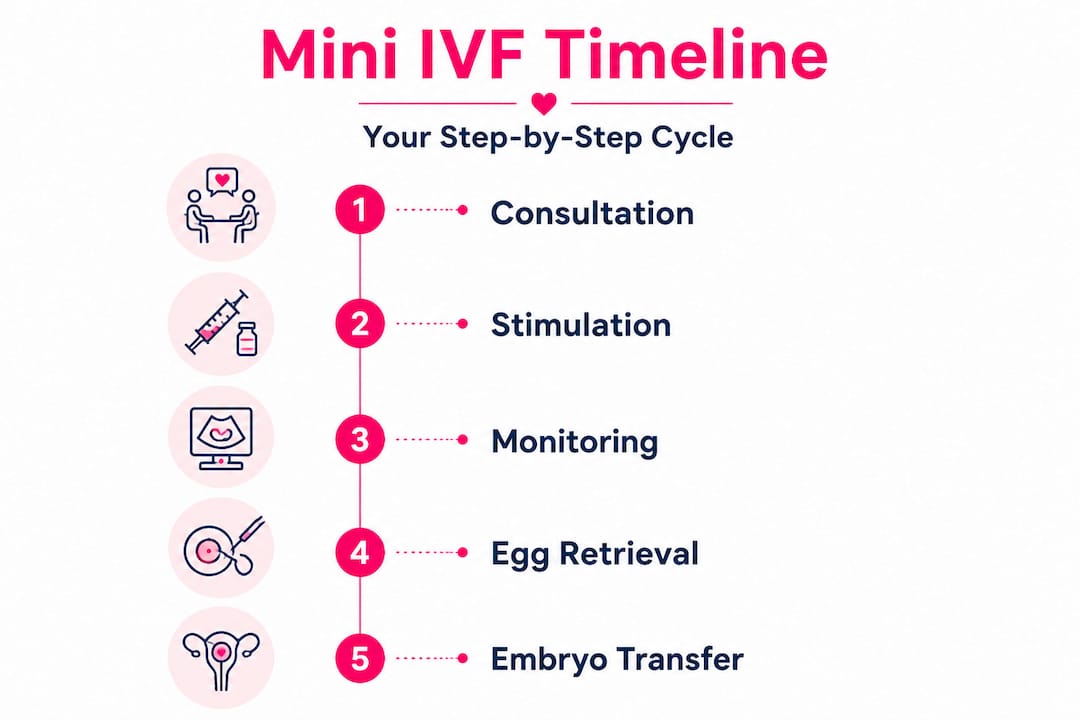
-
Initial consultation and baseline testing. Your cycle begins with a thorough consultation, including bloodwork to assess hormone levels and an ultrasound to evaluate your ovaries. This baseline data shapes your entire protocol.
-
Personalized medication plan. Based on your test results, your physician designs a low-dose stimulation plan. This typically involves oral medications or minimal injectable hormones, administered over approximately 10 days.
-
Monitoring appointments. As noted in the precision IVF approach at Life IVF Center, mini IVF cycles involve fewer medications, regular ultrasounds, and monitoring to optimize each egg’s quality. You will attend several monitoring visits during stimulation to track follicle growth and adjust medication if needed.
-
Trigger shot. When follicles reach the appropriate size, a trigger injection is given to finalize egg maturation before retrieval.
-
Egg retrieval. A minor outpatient procedure performed under sedation, typically lasting 20 to 30 minutes. The physician uses ultrasound guidance to retrieve the mature eggs. Reviewing egg retrieval tips ahead of time can help you know what to expect on retrieval day.
-
Fertilization in the laboratory. Retrieved eggs are fertilized using conventional insemination or intracytoplasmic sperm injection (ICSI), where a single sperm is injected directly into each egg. Embryos are then monitored for development over three to five days.
-
Embryo transfer. The most viable embryo is selected and transferred to the uterus in a simple, typically painless procedure. Understanding the embryo transfer process in advance helps patients feel more confident and prepared going into this final stage.
The following table compares the general timelines of a mini IVF cycle versus a conventional IVF cycle:
| Phase | Mini IVF timeline | Conventional IVF timeline |
|---|---|---|
| Stimulation | 8 to 10 days | 10 to 14 days |
| Monitoring visits | 2 to 4 | 4 to 6 |
| Retrieval to transfer | 5 to 6 days | 5 to 6 days |
| Total cycle length | 2 to 3 weeks | 3 to 4 weeks |
Pro Tip: Keep a fertility journal throughout your cycle. Record your medication schedule, monitoring appointment notes, and any questions that come up between visits. This habit helps you stay organized and makes your conversations with your care team more productive.
Mini IVF vs. traditional IVF: Which is right for you?
After walking through the process, it is natural to weigh your options directly. Mini IVF and traditional IVF are both effective, but they serve different patient needs. The right choice depends on your ovarian reserve, medical history, financial situation, and personal preferences.
Mini IVF can offer a lower-cost, lower-stress alternative to traditional IVF while still providing competitive success rates in select patient groups. For those who respond poorly to high-dose stimulation, the conventional approach may actually yield fewer usable embryos than mini IVF, making the additional medication cost and physical burden counterproductive.
| Comparison factor | Mini IVF | Traditional IVF |
|---|---|---|
| Medication cost | Lower | Higher |
| Eggs retrieved | Fewer (2 to 5) | More (10 to 20+) |
| OHSS risk | Low | Moderate to high |
| Side effects | Milder | More pronounced |
| Suitable for low reserve | Yes, often preferred | Less effective |
| Suitable for high reserve | Less common | Often preferred |
| Cumulative success (multiple cycles) | Competitive for select groups | Higher for good responders |
Key considerations when comparing the two options:
- Egg quantity matters less when quality is the priority. For patients over 35 or with DOR, fewer but healthier eggs often lead to better embryo development.
- Cost savings can enable multiple attempts. Because mini IVF is generally less expensive, some patients are able to undergo two or three cycles for the cost of one conventional cycle, improving cumulative success rates.
- Traditional IVF remains the standard for patients with normal or high ovarian reserve, where producing more eggs creates more opportunities for viable embryos and future frozen transfers.
- Your physician’s recommendation should be data-driven, based on your AMH levels, previous cycle history, and overall reproductive profile.
Reviewing pre-IVF pricing information early in the process can help you plan financially and understand what each approach may realistically cost for your situation.
Real-world outcomes: What can you expect from mini IVF?
Setting realistic expectations is one of the most important parts of any fertility treatment decision. Mini IVF is not a guaranteed path to pregnancy, but for the right patients, it offers meaningful hope and a gentler experience along the way.
Life IVF Center has helped patients achieve success with mini IVF, including those with challenging reproductive histories. Reading through mini IVF success stories from real patients can provide both encouragement and a grounded sense of what is possible.
“After two failed conventional IVF cycles, I was told my ovarian reserve was too low to try again. Mini IVF gave me a different answer. We retrieved two eggs, one became a healthy embryo, and today I have a daughter. The process felt manageable for the first time.”
Realistic outcomes to keep in mind:
Potential advantages:
- Lower physical side effects and faster recovery between cycles
- Reduced emotional and financial burden per cycle
- Comparable success rates for patients with diminished ovarian reserve
- Lower risk of OHSS and related complications
- More sustainable for multiple attempts if needed
Honest challenges:
- Fewer eggs per cycle means fewer embryos and less flexibility for selection
- Not every cycle will produce a transferable embryo
- Multiple cycles may be needed to achieve pregnancy
- Success rates vary significantly based on age, reserve, and individual biology
- Mini IVF is not the optimal choice for every patient, and some individuals will still need conventional IVF
The emotional experience of mini IVF is often described as more manageable. Fewer injections, less hormonal fluctuation, and shorter cycles can reduce the psychological toll of treatment, which matters deeply for patients who have already endured difficult fertility journeys.
Why mini IVF is redefining fertility care in Southern California
There is a persistent assumption in reproductive medicine that more stimulation equals better outcomes. More eggs, more embryos, more chances. For many patients, that logic holds. But for a significant and often underserved group, including women over 35, those with diminished ovarian reserve, and those who have experienced repeated treatment failures, aggressive stimulation can be counterproductive and emotionally exhausting.
Mini IVF challenges that assumption in a direct and evidence-based way. The focus on quality over quantity reflects a deeper understanding of how age and ovarian reserve actually affect fertility outcomes. Producing 15 eggs in a patient with DOR is not the same as producing 15 eggs in a 28-year-old with normal reserve. The biology is different, and the treatment should be too.
One common misconception is that mini IVF is a last resort or a lesser option. In reality, for the patients it is designed to serve, it is often the most clinically appropriate first choice. Another misconception is that older women cannot benefit from mini IVF. The evidence suggests otherwise. Targeted stimulation that respects the body’s actual capacity can yield better embryo quality than pushing the ovaries beyond their functional limits.
Southern California fertility clinics, including Life IVF Center, are increasingly at the forefront of this patient-centered model. Understanding what to expect at Life IVF reflects the clinic’s commitment to individualized care that accounts for the full picture of each patient’s health, history, and goals. The region’s diverse patient population and high concentration of reproductive specialists have created an environment where personalized protocols are not just available but expected.
The broader lesson is this: the best fertility treatment is not the most aggressive one. It is the one that fits your biology, your circumstances, and your goals with precision and care.
Take the next step: Discover your personalized mini IVF options
If you have been navigating fertility challenges and wondering whether there is a more tailored path forward, Life IVF Center’s expertise in mini IVF and personalized reproductive care may be exactly what you have been looking for. The team’s Precision IVF® approach means your protocol is built around your unique biology, not a generic template.
To understand how this approach works and whether it aligns with your situation, learn about Precision IVF® and the science behind individualized stimulation protocols. If you are ready to take the first step toward a consultation, the get started with IVF resources at Life IVF Center provide a clear overview of what to expect from your first appointment through every stage of your treatment. You deserve a plan that reflects who you are, not just a standard approach applied to everyone.
Frequently asked questions
Is mini IVF more affordable than traditional IVF?
Mini IVF can offer a lower-cost alternative to traditional IVF primarily because it uses less medication, though total cost varies by clinic, location, and individual treatment needs.
Will mini IVF reduce my chances of success?
For many women with low ovarian reserve or over 35, mini IVF is effective for select patient groups and can offer comparable success rates to conventional IVF with significantly less medication burden.
How long does a mini IVF cycle take from start to finish?
A typical mini IVF cycle runs two to three weeks from initial stimulation to embryo transfer, as mini IVF cycles involve regular ultrasounds and monitoring within a carefully controlled timeline.
Can mini IVF help if I’ve had poor results with standard IVF?
Yes, mini IVF is specifically designed to improve outcomes for patients who did not respond well to traditional protocols, and mini IVF is recommended for failed IVF cycles or sensitivity to stimulation medications.
Are there age restrictions for mini IVF candidates?
There are no strict age cutoffs, but mini IVF is often recommended for women over 35 and those with diminished ovarian reserve, where the quality-focused approach tends to produce the most meaningful results.
Recommended
- Precision IVF®: Transforming Fertility Treatment – Life IVF Center
- Fertility treatment options: Effectiveness and best uses
Ready to take the next step?
Life IVF Center specializes in individualized Precision IVF® care for complex cases—including diminished ovarian reserve, prior failed cycles, and advanced maternal age. Our in-house labs and dedicated physicians are ready to help.
Book a Free Consultation →