
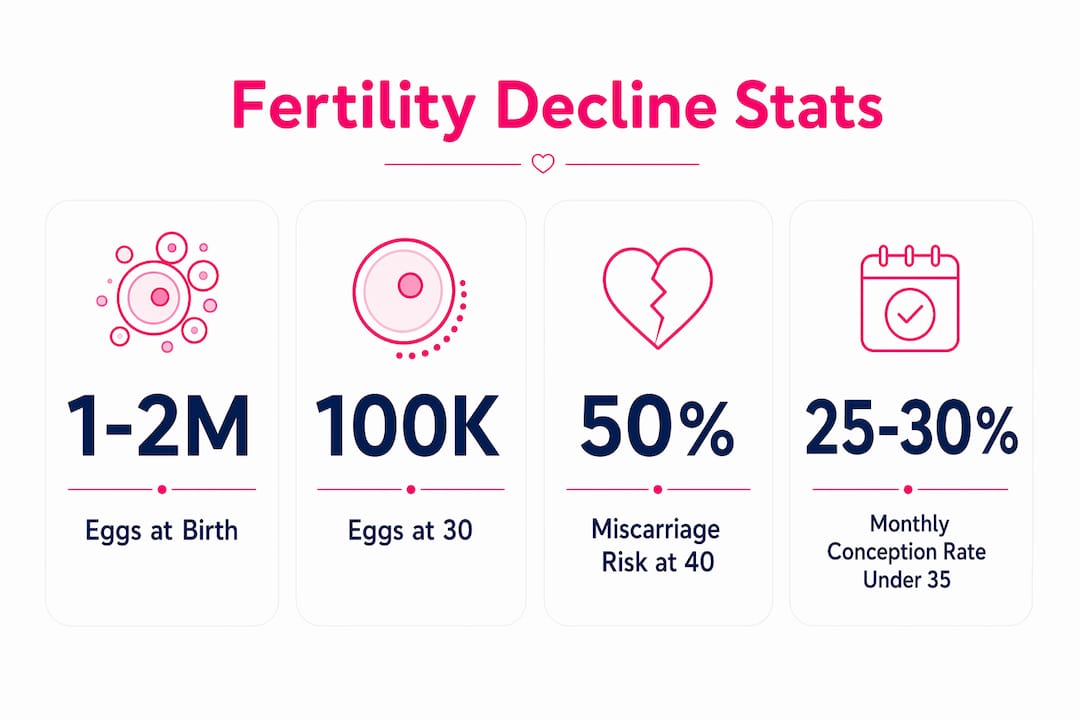
Fertility declines with age because women are born with a finite number of eggs that shrink in quantity and degrade in quality over time. This process, known clinically as age-related ovarian decline, accelerates after age 30 and becomes pronounced after 35. Monthly conception probability sits at 25–30% in a woman’s early 20s, then drops steadily with each passing decade. The average age at first birth has risen globally into the late 20s and 30s, meaning more people now face these biological realities head-on. Understanding the mechanisms behind this decline is the first step toward making informed reproductive decisions.
Why fertility declines with age: the egg supply problem
The ovarian reserve is the total pool of eggs a woman carries, and it is established before birth. A female fetus develops roughly 6–7 million primordial follicles by mid-gestation. That number falls to about 1–2 million at birth, and continues dropping through childhood and reproductive life. No new eggs are created after birth. Every month, a cohort of follicles is recruited and the vast majority die off, whether or not ovulation occurs.
The decline is not linear. Egg loss accelerates after age 30 and again after 37. By the time a woman reaches her early 40s, the remaining follicle pool is a fraction of what it was at 25. This matters because fewer eggs mean fewer chances for a viable embryo each cycle. Conception probability tracks directly with follicle count, which is why fertility specialists measure ovarian reserve through antral follicle count (AFC) and anti-Müllerian hormone (AMH) testing.

The table below shows how egg count changes across a woman’s life.
| Age | Estimated follicle count |
|---|---|
| Birth | 1–2 million |
| Puberty | 300,000–500,000 |
| Age 30 | ~100,000–150,000 |
| Age 37 | ~25,000 |
| Age 40+ | Fewer than 10,000 |
Pro Tip: Ask your OB-GYN or fertility specialist for an AMH blood test and an AFC ultrasound. These two markers give the clearest picture of your remaining egg supply and help guide timing decisions.
Why does egg quality deteriorate over time?
Egg quantity tells only part of the story. Egg quality is the factor that most directly determines whether fertilization succeeds and whether an embryo develops normally. Fertility decline involves follicular depletion, mitochondrial dysfunction, oxidative stress, and meiotic errors, all of which compound as a woman ages.
Mitochondria power the egg’s ability to complete the final stages of cell division before fertilization. As eggs age, mitochondrial function weakens. The result is a higher rate of errors during meiosis, the process by which an egg divides to carry exactly half the chromosomes needed for a viable embryo. When meiosis goes wrong, the resulting egg carries an abnormal chromosome count, a condition called aneuploidy.
The numbers here are striking. Embryonic aneuploidy rates rise from roughly 20% in women under 35 to 60% at age 40. That means at 40, six out of ten embryos carry a chromosomal error that will either prevent implantation or result in miscarriage. This is the primary biological reason why miscarriage risk climbs so sharply with age.
The main biological mechanisms that degrade egg quality include:
- Mitochondrial dysfunction: Reduced energy output impairs cell division accuracy.
- Oxidative stress: Accumulated cellular damage disrupts DNA integrity in the egg.
- Meiotic spindle errors: The structure that separates chromosomes becomes less reliable with age.
- Shortened telomeres: Chromosomal end-caps erode over time, reducing cellular repair capacity.
- Reduced cohesion proteins: These proteins hold chromosomes together during division and decline with age, increasing segregation errors.
You can find a detailed breakdown of these age-related fertility factors on the Life IVF Center blog.
Pro Tip: Declining egg quality rarely causes obvious symptoms. Irregular cycles, shorter cycle lengths, or a history of early miscarriage can all signal reduced egg quality. Discuss these patterns with a reproductive endocrinologist rather than attributing them to stress alone.
How uterine and hormonal changes affect fertility with age
Fertility decline is multifactorial. The egg is not the only variable. The uterine environment changes with age through inflammation and immune dysregulation that impair embryo implantation. Even a chromosomally normal embryo can fail to implant if the uterine lining does not respond correctly.
Research shows that immune system remodeling affects implantation in older women. Altered T-cell subsets and elevated inflammatory markers change how the endometrium responds to an embryo. This is distinct from egg quality and represents an independent contributor to age-related infertility.
Hormonal shifts compound the picture. As ovarian reserve falls, FSH (follicle-stimulating hormone) levels rise as the body tries to recruit follicles. Estrogen and progesterone patterns shift, affecting both ovulation timing and endometrial receptivity. The endometrium, the uterine lining that must receive an embryo, becomes less responsive to progesterone signaling over time. These changes mean that even when fertilization occurs, the window for successful implantation narrows.
Does male age also affect fertility?
Male fertility declines more gradually than female fertility, but the impact is real. Sperm quality declines with age, and this affects both conception rates and pregnancy outcomes. Paternal age is an independent risk factor for miscarriage and certain developmental conditions in offspring.
Key effects of advancing paternal age include:
- Reduced sperm motility and morphology after age 40
- Increased DNA fragmentation in sperm, which impairs embryo development
- Higher rates of de novo genetic mutations passed to offspring
- Elevated miscarriage risk when the male partner is over 45
For couples pursuing parenthood later in life, both partners’ ages matter. A GP referral for fertility testing covers both male and female assessments and is a practical first step for any couple over 35 who has been trying to conceive for six months or more.
What are the practical implications for family planning?
Understanding the biology translates directly into decisions about timing and treatment. Miscarriage risk rises from 10% in women aged 20–24 to 50% in women aged 40–44. That is not a reason to panic. It is a reason to plan with accurate information.
Assisted reproductive technologies (ART) such as IVF and egg freezing offer meaningful options, but they do not eliminate age-related risk entirely. ART success rates decline with maternal age, and freezing eggs earlier in life consistently produces better outcomes than freezing after 38.
The table below compares natural conception and assisted conception by age group.
| Age group | Natural monthly conception rate | IVF considerations |
|---|---|---|
| Under 35 | 25–30% | High success rates; fewer cycles typically needed |
| 35–37 | Declining | Aneuploidy rates rising; PGT-A testing often recommended |
| 38–40 | Significantly lower | Egg quality a primary concern; donor egg may be discussed |
| Over 40 | Markedly reduced | Donor egg IVF offers the most consistent outcomes |
Preimplantation genetic testing for aneuploidy (PGT-A) is a tool used during IVF to screen embryos for chromosomal abnormalities before transfer. For women over 35, PGT-A can reduce miscarriage risk and improve the chance of a successful transfer. Reviewing IVF success rates by age helps set realistic expectations before starting treatment.
Pro Tip: If you are 35 or older and considering IVF, ask your specialist about PGT-A testing. Transferring a chromosomally screened embryo significantly reduces the chance of a failed cycle or miscarriage compared to an unscreened transfer.
Early fertility assessment is the single most effective step for anyone over 30 who wants children in the future. Knowing your AMH level, AFC, and cycle regularity gives you real data to work with, whether you plan to conceive now or in several years.
Key Takeaways
Age-related fertility decline is driven by falling egg quantity, deteriorating egg quality, and uterine changes that together reduce the probability of conception and increase miscarriage risk with each passing decade.
| Point | Details |
|---|---|
| Egg supply is finite | Women are born with all the eggs they will ever have; the pool shrinks continuously from birth. |
| Aneuploidy rises sharply after 35 | Chromosomal errors in embryos increase from 20% under age 35 to 60% at age 40. |
| Uterine changes are independent | Immune dysregulation and inflammation in the uterus impair implantation beyond egg quality alone. |
| Male age matters too | Sperm DNA fragmentation and mutation rates increase after 40, raising miscarriage and developmental risks. |
| Early assessment changes outcomes | AMH and AFC testing before age 35 gives patients the most options for timing and preservation. |
The part most people overlook
Most conversations about age and fertility focus almost entirely on egg count. That framing is incomplete, and it leads people to draw the wrong conclusions. I have seen patients with a relatively strong ovarian reserve still struggle to conceive at 40 because egg quality and uterine receptivity were the limiting factors, not the number of eggs remaining. The biology is more layered than a single number suggests.
The other thing I notice is how often people wait for a problem to appear before seeking evaluation. Fertility decline is largely silent until it becomes a barrier. There are no symptoms when your AMH drops. There is no warning when aneuploidy rates cross a threshold. The only way to know where you stand is to test. A single blood draw and an ultrasound can give you a clear picture in under a week.
What gives me genuine confidence in modern reproductive medicine is how much the options have expanded. Egg freezing at 32 or 33 is not a sign of pessimism. It is a practical hedge that preserves choices. PGT-A testing during IVF has meaningfully reduced the emotional and physical toll of failed transfers for older patients. These tools do not reverse biology, but they work with it in ways that were not possible a decade ago.
The most useful thing you can do right now is get informed before you need to act. Knowing your signs of fertility decline and understanding your baseline gives you time to make decisions rather than react to them.
Fertility care at Life IVF Center for age-related challenges
Life IVF Center specializes in reproductive care for patients navigating the realities of age-related fertility decline. The clinic’s Precision IVF® approach customizes treatment protocols based on each patient’s biological profile, ovarian reserve, and medical history, reducing the number of cycles needed and improving the chance of a successful outcome.

For patients considering egg preservation or IVF, Life IVF Center offers structured fertility treatment packages designed to be both effective and financially accessible. The team also provides egg freezing packages for those who want to preserve options before age-related decline accelerates. Consultations are available across multiple Southern California locations, and the care team guides patients through every step of the evaluation and treatment process.
FAQ
What is the main reason fertility declines with age?
Fertility declines primarily because the ovarian egg supply shrinks continuously from birth, and the quality of remaining eggs deteriorates due to mitochondrial dysfunction, oxidative stress, and increasing chromosomal errors.
At what age does fertility decline become significant?
Conception probability begins declining after age 30 and drops more sharply after 35, with monthly rates falling well below the 25–30% seen in the early 20s.
How does age affect miscarriage risk?
Miscarriage risk rises from 10% in women aged 20–24 to 50% in women aged 40–44, largely because older eggs produce embryos with higher rates of chromosomal abnormalities.
Can IVF overcome age-related fertility decline?
IVF improves the odds by allowing embryo selection and genetic screening, but success rates still decline with maternal age. Freezing eggs before 38 or using donor eggs offers the most consistent outcomes for older patients.
Does a man’s age affect fertility outcomes?
Yes. Paternal age is linked to reduced sperm quality, higher DNA fragmentation, and increased miscarriage risk, particularly when the male partner is over 45.
Recommended
- Age-Related Infertility Types: What You Need to Know
- IVF Success Rates by Age: What the Data Shows
- Blog – Life IVF Center
- Common Fertility Myths Debunked: Facts You Need to Know
Ready to take the next step?
Life IVF Center specializes in individualized Precision IVF® care for complex cases—including diminished ovarian reserve, prior failed cycles, and advanced maternal age. Our in-house labs and dedicated physicians are ready to help.
Book a Free Consultation →