
Accessibility in fertility care is defined as the full spectrum of physical, financial, social, and systemic conditions that determine whether a person can receive reproductive health treatment. The role of accessibility in fertility care extends far beyond ramp access or clinic location. It shapes who gets diagnosed, who starts treatment, and who successfully completes it. Fewer than 50% of U.S. women with infertility ever access treatment, and the gap widens sharply along racial lines. The American Society for Reproductive Medicine (ASRM) and clinics like Life IVF Center have identified this disparity as one of the most urgent problems in reproductive health today.
What barriers limit accessibility to fertility care today?
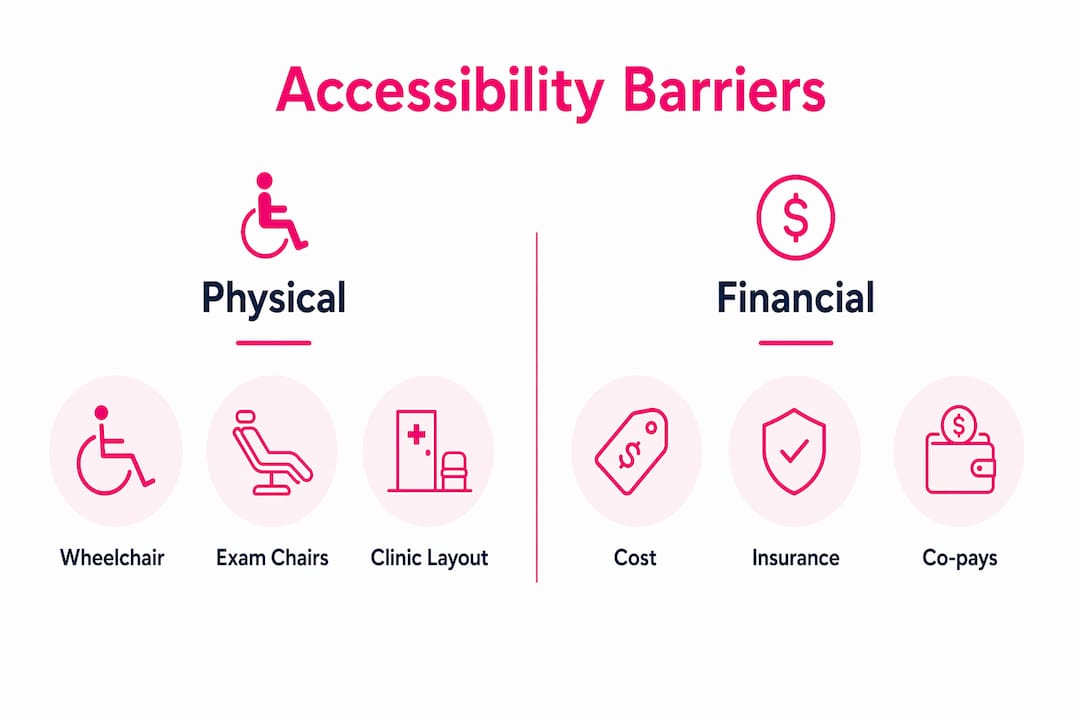
Barriers to fertility treatment fall into four distinct categories: physical, financial, social, and geographic. Each one operates independently, but they compound each other in ways that push treatment out of reach for millions of people.
Physical barriers are more common than most patients expect. Only 11% of fertility clinics have wheelchair-accessible scales. That figure means the vast majority of clinics cannot complete a standard weight assessment for a patient who uses a wheelchair, which can delay or compromise care. Height-adjustable exam tables are similarly rare. Women with mobility impairments frequently report skipping exams entirely because the equipment simply does not accommodate them.

Financial barriers represent the single largest obstacle for most patients. A typical IVF cycle costs $15,000–$30,000 out of pocket, and only 25% of U.S. employers offer any IVF or infertility coverage. That leaves the majority of working Americans entirely self-funded. Without insurance, many patients delay treatment until their prognosis worsens, or they abandon it altogether.
Social and systemic barriers are harder to quantify but equally damaging. Stigma around infertility, particularly in communities where family-building is culturally central, prevents people from seeking help. Provider training gaps mean that clinicians often lack the skills to serve patients with intellectual disabilities, chronic illness, or non-traditional family structures. Geographic disparities concentrate fertility specialists in urban centers, leaving rural patients with no local options.
The racial data on treatment access disparities is stark. Only 4% of Hispanic women and 3% of Black women with infertility access treatment, compared to 17% of Asian women and 13% of White women. These numbers reflect the combined weight of financial, social, and systemic barriers acting simultaneously on the same populations.
- Inaccessible clinic equipment limits care for patients with physical disabilities
- High out-of-pocket costs exclude patients without employer-sponsored coverage
- Geographic concentration of specialists disadvantages rural patients
- Racial and ethnic disparities reflect compounding systemic inequities
- Social stigma and provider training gaps reduce care-seeking behavior
Pro Tip: Before your first clinic visit, call ahead and ask specifically whether the facility has height-adjustable exam tables and accessible restrooms. This single question tells you a great deal about how prepared the clinic is to serve patients with diverse physical needs.
How do accessibility initiatives improve fertility care inclusivity?
The most instructive example of what targeted investment can accomplish comes from Seoul, South Korea. The city launched a disability-friendly OB-GYN program that placed dedicated patient coordinators in specialized clinics. These coordinators managed appointment logistics, arranged sign language interpretation, and provided continuity support throughout treatment. The results were measurable. Patient numbers rose from 55 to 289 in two years, and 7 out of 11 births in the program involved women with severe disabilities. That is a fivefold increase in access, driven entirely by structural changes rather than new medical technology.
The coordinator model works because it removes the administrative friction that causes patients to drop out. Fertility treatment requires multiple appointments, lab results, medication adjustments, and follow-up calls. For a patient managing a disability, chronic illness, or language barrier, that coordination burden is often the breaking point.
| Initiative | Mechanism | Measured Outcome |
|---|---|---|
| Seoul disability-friendly OB-GYN program | Patient coordinators, sign language support, staff training | Patient volume increased fivefold in two years |
| ASRM 2026 insurance guidance | Remove prior authorization for fertility preservation | Faster, equitable access to time-sensitive treatment |
| Sunnybrook Accessible Care Pregnancy Clinic | Individualized care from preconception through postpartum | Improved patient empowerment and treatment continuity |
| Proposed U.S. stand-alone fertility insurance | $120,000 lifetime cap, reduced employer burden | Projected expansion of coverage to more workers |
Canada’s Sunnybrook Health Sciences Centre runs an Accessible Care Pregnancy Clinic that provides individualized reproductive care for people with disabilities from preconception through postpartum. The clinic integrates early intervention, cross-specialty partnerships, and patient empowerment as core design principles. This model demonstrates that accessibility is not a feature added to standard care. It is a care philosophy that changes outcomes at every stage.
Provider training is the third lever. Clinics that invest in training staff to work with patients who have intellectual disabilities, communication differences, or complex medical histories see higher treatment completion rates. The training addresses both clinical technique and communication style, which reduces the dropout rates that inflate the access gap.
How does insurance coverage affect access to fertility services?
Insurance coverage is the most direct determinant of whether a patient starts fertility treatment at all. With only 25% of employers currently offering IVF coverage, the majority of patients face the full cost without assistance. The proposed federal rule to create stand-alone fertility insurance with a $120,000 lifetime cap would change that calculus significantly for workers whose employers currently offer nothing.
The authorization process creates a separate layer of delay even for patients who do have coverage. ASRM’s 2026 committee opinion states directly that health insurance should cover fertility preservation without prior authorization. The reasoning is clinical. Fertility preservation is often time-sensitive, particularly for patients facing cancer treatment or other conditions that threaten reproductive function. Requiring prior authorization introduces delays that can permanently affect outcomes.
| Insurance model | Coverage scope | Patient impact |
|---|---|---|
| No fertility benefit | Zero IVF coverage | Full out-of-pocket cost, $15,000–$30,000 per cycle |
| Employer-sponsored IVF benefit | Partial or full IVF coverage | Reduced cost, but varies widely by plan design |
| Proposed stand-alone fertility plan | Up to $120,000 lifetime cap | Broader access for employees at smaller companies |
| State mandate coverage (select states) | Defined IVF cycles covered | Strongest protection, but only in mandate states |
Insurance authorization delays and denials require patients to prepare for appeals and sometimes independent medical reviews, which stall necessary treatments. Patients who understand this process in advance are better positioned to push back effectively. Knowing that ASRM explicitly opposes prior authorization requirements gives patients a credible clinical argument when appealing a denial.
Pro Tip: Request a written explanation of benefits from your insurer before starting any fertility treatment. Ask specifically whether fertility preservation requires prior authorization and what the appeals process looks like. Having this in writing before you need it saves weeks of delay later.
You can also review insurance and SB729 details at Life IVF Center to understand how California’s coverage mandates may apply to your specific plan.
What can individuals do to navigate and advocate for accessible fertility care?
Patients who approach fertility care with a clear strategy get further faster. The system has real gaps, but it also has documented pathways that informed patients can use. Here is a practical sequence for identifying and accessing inclusive care.
-
Verify physical accessibility before your first appointment. Ask the clinic directly about wheelchair-accessible exam tables, accessible restrooms, and parking. A clinic that cannot answer these questions clearly is signaling a gap in readiness.
-
Request a patient coordinator or navigator. Many clinics have this role but do not advertise it. A coordinator can manage appointment scheduling, insurance communication, and care continuity. For patients managing disabilities or complex medical histories, this role is not optional.
-
Audit your insurance before treatment begins. Confirm whether your plan covers IVF, fertility preservation, or diagnostic testing. Identify whether prior authorization is required and request the appeals procedure in writing. Clinics like Life IVF Center provide dedicated support for prospective insurance patients to help decode coverage.
-
Explore financing options if insurance falls short. Fertility-specific financing programs, grants from organizations like the Tinina Q. Cade Foundation, and clinic payment plans can reduce the immediate financial burden. Life IVF Center’s fertility financing options are designed for patients who need flexibility without sacrificing care quality.
-
Connect with patient advocacy networks. RESOLVE: The National Infertility Association provides peer support, insurance advocacy resources, and a clinic finder that includes accessibility information. These networks also track state-level insurance mandate legislation, which changes frequently.
Social determinants including financial, social, and infrastructure barriers greatly influence whether individuals start and complete fertility treatments. Addressing them requires both systemic change and individual preparation. You cannot fix the system alone, but you can move through it more effectively with the right information.
Key takeaways
Accessibility in fertility care determines who receives treatment, not just who needs it, making systemic and financial reform the most urgent priorities in reproductive health equity.
| Point | Details |
|---|---|
| Racial disparities are severe | Only 3–4% of Black and Hispanic women access treatment, versus 13–17% of White and Asian women. |
| Physical clinic barriers are widespread | Only 11% of clinics have wheelchair-accessible scales, limiting care for patients with mobility impairments. |
| Insurance coverage remains the primary financial lever | Just 25% of employers offer IVF coverage; proposed federal rules aim to expand access significantly. |
| Coordinator models produce measurable results | Seoul’s program increased patient volume fivefold by adding dedicated coordinators and staff training. |
| Patients can advocate effectively | Verifying accessibility, auditing insurance, and using patient navigators are the three highest-impact steps. |
Why I think we underestimate the coordinator problem
Working with fertility patients across a wide range of circumstances, I have seen one pattern repeat more than any other. The patients who drop out of treatment are not always the ones with the worst prognosis or the least money. They are often the ones who ran out of bandwidth to manage the administrative side of care.
Fertility treatment is relentless in its demands. Appointments shift. Lab results need interpretation. Insurance calls take hours. Medication protocols change mid-cycle. For a patient who also manages a disability, a demanding job, or a language barrier, that load becomes unsustainable. The clinical team is focused on the medicine. Nobody is focused on the logistics.
The Seoul program proved that coordinators change this. Patient volume increased fivefold not because the medicine improved, but because someone was assigned to make the process manageable. That finding should be standard practice in every fertility clinic in the United States, and it is not.
The other thing I have come to believe strongly is that financial accessibility and physical accessibility are treated as separate problems when they are actually the same problem. A clinic that cannot accommodate a wheelchair and a clinic that cannot accommodate a $15,000 bill are both telling the same patient that they do not belong there. The solution in both cases is the same: design the system around the patient, not around the convenience of the provider.
Systemic change takes time. But clinics that commit to both physical and financial accessibility today will serve a broader, more diverse patient population and produce better outcomes. That is not idealism. It is what the data shows.
How Life IVF Center supports accessible fertility treatment
Life IVF Center is built around the principle that personalized care and accessible care are the same thing. The clinic’s Precision IVF® approach customizes every treatment protocol to the patient’s unique biology, medical history, and goals, which reduces unnecessary cycles and lowers total cost. Multiple Southern California locations reduce the geographic burden for patients across the region.
For patients navigating insurance, Life IVF Center provides dedicated support for those with existing coverage and transparent pricing for those without it. The clinic’s treatment packages are structured to make costs predictable from the start. Whether you are exploring IVF for the first time or returning after a previous cycle, Life IVF Center’s team is equipped to meet you where you are, with the clinical depth and logistical support that inclusive fertility care requires.
FAQ
What does accessibility mean in fertility care?
Accessibility in fertility care means that all individuals, regardless of physical ability, income, race, or location, can receive reproductive health treatment. It covers physical clinic design, insurance coverage, provider training, and social support systems.
Why do racial disparities exist in fertility treatment access?
Racial disparities in fertility care reflect compounding financial, social, and systemic barriers. Only 3% of Black women and 4% of Hispanic women with infertility access treatment, compared to 13% of White women and 17% of Asian women.
Does insurance cover IVF and fertility preservation?
Coverage varies widely. Only 25% of U.S. employers currently offer IVF benefits, and ASRM recommends that insurers cover fertility preservation without prior authorization to prevent care delays.
What is a fertility patient coordinator and do I need one?
A patient coordinator manages appointment logistics, insurance communication, and care continuity throughout treatment. Research from Seoul’s disability-friendly OB-GYN program shows that coordinator support increases treatment completion rates and reduces dropout significantly.
How can I find an accessible fertility clinic?
Call the clinic before your first visit and ask about wheelchair-accessible equipment, patient coordinator availability, and insurance support services. You can also review fertility challenges and access resources at Life IVF Center to understand what inclusive care looks like in practice.
Recommended
- Life IVF Center: Home Draft
- Egg and Embryo Freezing – Fertility Preservation Packages
- Understanding California’s SB 729 Fertility Coverage Law – Life IVF Center
- Real Examples of Fertility Challenges Explained
Ready to take the next step?
Life IVF Center specializes in individualized Precision IVF® care for complex cases—including diminished ovarian reserve, prior failed cycles, and advanced maternal age. Our in-house labs and dedicated physicians are ready to help.
Book a Free Consultation →