
The most favorable window for elective egg freezing is typically the late 20s to early 30s, when egg quantity and quality are both still high. That said, ovarian reserve varies widely between individuals, and the ASRM guideline on oocyte cryopreservation notes there isn’t enough data to name one single optimal age, which is why personalized counseling matters more than a birthday on a calendar.
TL;DR:
- Egg quantity declines steadily from birth, with the most rapid loss occurring after age 35, but reserve markers vary widely between women.
- Younger women usually need fewer eggs to reach a desired live birth probability, though the precise number depends on individual reserve and egg quality.
- Optimal timing for freezing is typically in the late 20s to early 30s, with a drop in success rates and increased cycles needed after age 35.
- Freezing at older ages (mid to late 30s and beyond) can be less efficient, often requiring multiple cycles and potentially leading to lower chromosomally normal egg rates.
- Personalized reserve testing and counseling are crucial, as age-based guidelines are broad and individual outcomes depend on specific biological factors.
Table of Contents
- How age affects egg quantity and quality
- What the evidence and guidelines say about age-specific outcomes
- How many eggs should you aim to freeze?
- Timing by decade: what changes in your 20s, 30s, and 40s
- Who is a good candidate for egg freezing?
- What the egg-freezing process actually involves
- Budgeting for cycles and storage
- Life IVF Center’s approach to timing and individualized counseling
- Balancing the data, the cost, and your own timeline
- Egg freezing services and how to book a consultation
- FAQ
- Sources
How age affects egg quantity and quality
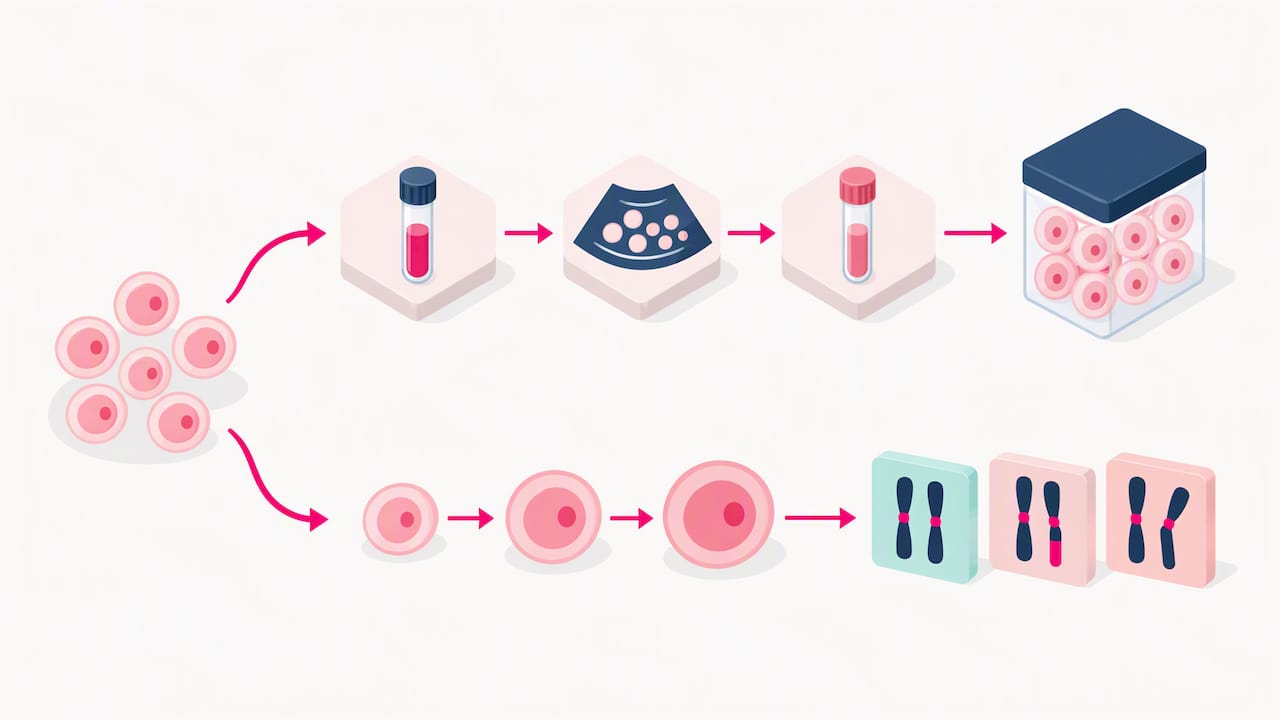
Every woman is born with her full supply of eggs, and that pool shrinks steadily from birth onward, accelerating in the mid-30s. This decline shows up in three lab markers clinicians use to estimate ovarian reserve:
- AMH (anti-Mullerian hormone): a blood test reflecting the size of the remaining egg pool, with levels dropping as reserve declines.
- AFC (antral follicle count): an ultrasound count of small follicles visible early in a menstrual cycle.
- FSH (follicle-stimulating hormone): a hormone that tends to rise as the ovaries require more stimulation to recruit eggs.
Quantity is only half the story. Egg quality also declines with age, largely because older eggs have a higher rate of chromosomal abnormalities, or aneuploidy. An embryo formed from an aneuploid egg is less likely to implant or develop into a healthy pregnancy, which is why age affects outcomes even when a reserve test still looks reasonable.
This is also the central limitation of reserve testing: AMH, AFC, and FSH estimate how many eggs remain, not whether those eggs are chromosomally normal. A 38-year-old and a 28-year-old can have similar AMH levels and still face very different odds of a chromosomally normal egg at retrieval, since quality tracks age more closely than it tracks reserve markers.
What the evidence and guidelines say about age-specific outcomes
The ASRM guideline on oocyte cryopreservation reports that live birth rates per embryo transfer improve when eggs are frozen at a younger age, though the committee stops short of recommending a single ideal age, pointing instead to counseling that weighs each patient’s circumstances.
One of the most detailed looks at this question comes from an individual patient data meta-analysis on oocyte cryopreservation, which pooled outcomes across multiple studies and found that live birth probability declines with maternal age at the time of freezing, and that vitrified eggs generally produced higher estimated live birth probabilities than slow-frozen eggs. Even with modern vitrification, age remains the strongest predictor of outcome: freezing technique can improve how well an egg survives thawing, but it cannot undo age-related chromosomal changes.
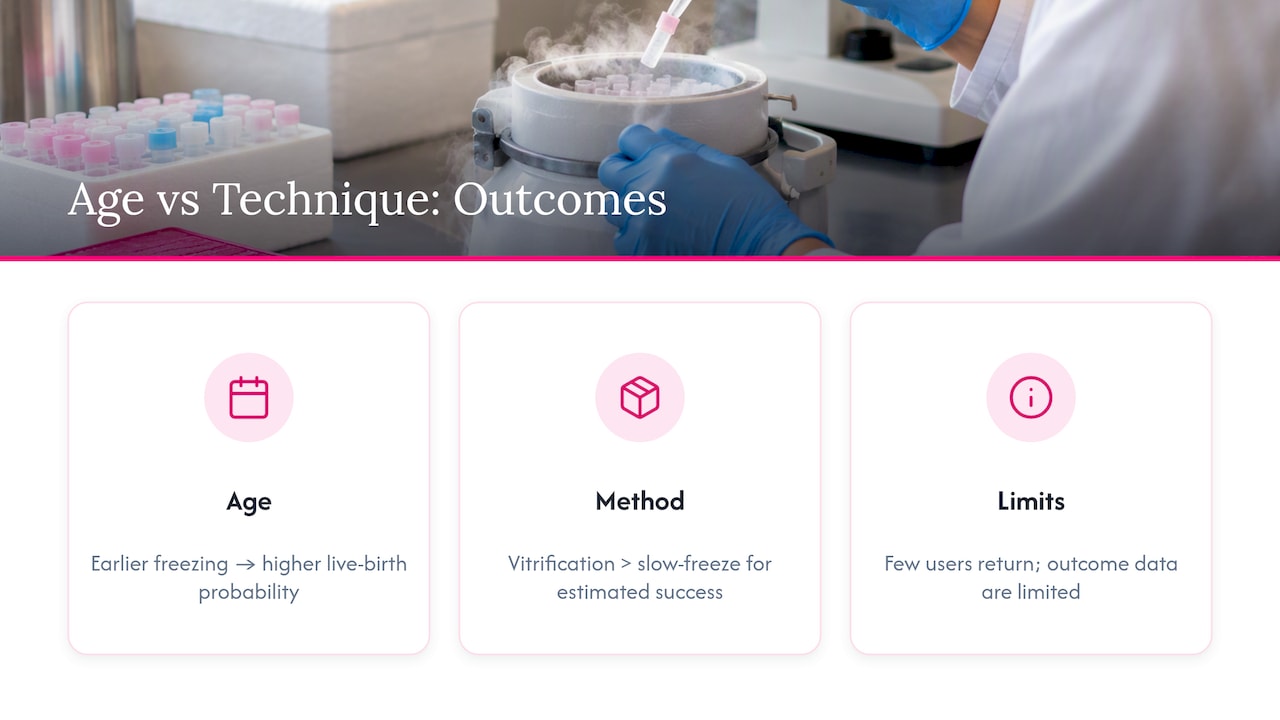
It’s worth being honest about the evidence gaps here. Relatively few women who elected to freeze their eggs have returned to actually use them, so long-term, real-world outcome data remain limited, and much of the age-specific guidance relies on modeling rather than large completed-cycle datasets.
How many eggs should you aim to freeze?
Because so few elective cryopreservation patients have completed the full cycle of thawing and using their eggs, researchers have built predictive models to translate egg counts into probability estimates. These models rely on several assumptions:
- Thaw survival rate: the percentage of frozen eggs expected to survive warming.
- Euploidy rate by age: the proportion of eggs likely to be chromosomally normal.
- Live birth rate per euploid embryo: the chance a normal embryo results in a baby.
A counseling-model study published in Human Reproduction illustrates just how much age changes the math: the model estimated that a significantly lower number of mature oocytes at age 34 could reach a given probability target for at least one live birth, while considerably more mature oocytes are needed at age 42 for the same target. These figures come from a specific modeling framework and are meant to guide conversation, not to predict any one patient’s result, since real outcomes depend on individual reserve, lab conditions, and embryo development.
The practical implication is that a single retrieval cycle, which might yield somewhere in the range of 8 to 15 mature eggs depending on age and stimulation response, is often enough for a woman in her late 20s or early 30s to reach a meaningful egg count, while a woman in her early 40s may need two or three cycles to bank a comparable number of usable eggs. Diminishing ovarian reserve also means each additional cycle after 40 tends to yield fewer eggs than the one before it, which is part of why clinicians often recommend starting sooner rather than stacking cycles later.
Timing by decade: what changes in your 20s, 30s, and 40s
- 20s: Egg quantity and quality are both typically strong, so fewer eggs are often needed to reach a given probability target, but the immediate need for freezing is usually low, so this decade is mostly a cost-versus-urgency decision.
- Early 30s (30 to 34): Many fertility specialists point to this stretch, alongside the late 20s, as a practical sweet spot that balances still-favorable biology with a more settled life stage, according to expert commentary summarized by Today.
- Mid-to-late 30s (35 to 40): Decline accelerates, more eggs are generally needed to reach the same probability, and this is a reasonable point to get a fertility consultation sooner rather than later.
- 40 and above: Egg yield per cycle tends to be lower and elective freezing becomes less efficient, so conversations about donor eggs or other paths often enter the discussion alongside an individualized reserve evaluation.
Who is a good candidate for egg freezing?
Egg freezing serves two broad groups: women freezing electively to preserve options while they focus on career, relationship timing, or other life circumstances, and women freezing for medical reasons, such as before chemotherapy or radiation that could damage ovarian function.
- Elective candidates generally benefit most when reserve testing still shows a reasonable egg supply.
- Medical candidates facing gonadotoxic treatment often need to move quickly, sometimes with a compressed timeline.
- Diminished ovarian reserve or a history of unilateral oophorectomy can lower expected yields and may shift the conversation toward realistic egg-count goals or alternative paths.
- A personal or family history of genetic conditions may warrant additional counseling or carrier screening before moving forward.
Pro Tip: Ask for an AMH and antral follicle count before your first consultation so your care team can tailor the conversation to your actual reserve rather than general age averages.
What the egg-freezing process actually involves
The timeline from first appointment to frozen eggs typically unfolds over a few weeks, with most of the active time spent on stimulation and monitoring.
- Baseline testing: bloodwork and ultrasound to assess reserve, plus screening such as an infectious disease panel or carrier screening for genetic disease.
- Ovarian stimulation: daily injectable medications for about 10 to 14 days, with monitoring visits to track follicle growth, as described in Hopkins Medicine’s overview of egg freezing.
- Trigger shot and retrieval: a final injection matures the eggs, followed by a short outpatient retrieval procedure under sedation.
- Vitrification and storage: mature eggs are rapidly frozen and moved into long-term storage.
Recovery from retrieval is usually brief, with mild cramping or bloating common for a day or two. Clinics monitor closely for ovarian hyperstimulation syndrome (OHSS), a risk that protocols are designed to minimize through careful medication dosing.
Budgeting for cycles and storage
A realistic budget accounts for several separate cost buckets:
- Medication costs, which vary based on the stimulation protocol and dose.
- The retrieval procedure fee.
- Laboratory and vitrification fees for freezing the eggs.
- Initial and ongoing annual storage costs.
Most elective egg freezing is self-pay, though some employers now offer fertility benefits, so it’s worth checking your plan details directly. Package pricing and payment plans can also make a meaningful difference, and since reaching a target egg count sometimes takes more than one cycle, it’s worth planning for that possibility rather than budgeting for just one round.
Life IVF Center’s approach to timing and individualized counseling
At Life IVF Center, our Precision IVF® framework adjusts stimulation protocols and lab strategy to each patient’s biology, history, and goals, rather than applying one standard approach to every age group. We offer a range of fertility services, with multi-language support and financial guidance built into the consultation process. For readers weighing timing against life circumstances, an individualized consultation gives you a reserve evaluation and a protocol discussion shaped around your actual numbers, not just your age.
Balancing the data, the cost, and your own timeline
Our clinical philosophy favors freezing earlier when it’s feasible, since the biology genuinely favors it, but we never treat a guideline age as a mandate. The right move is testing your AMH and antral follicle count, then sitting down with a care team to translate those numbers into an actual plan.
— Ben
Egg freezing services and how to book a consultation
We know that choosing when to freeze eggs comes with real financial and emotional weight, which is why we keep our pricing transparent and our scheduling straightforward.
- Review bundled options on our treatment packages page, including The Egg Cryo Package.
- Check itemized costs for Precision Egg Freezing and Precision Embryo Freezing.
- Compare storage plans, including Annual Storage, Monthly Storage, and the 3 Year Prepaid option.
- Book a personalized consultation to discuss Precision IVF® and your own reserve numbers.
A consultation with our team covers your reserve testing results, a discussion of realistic egg-count goals for your age and history, and financial guidance so you know what to expect before committing to a cycle.
This article is general information, not a substitute for advice from a qualified doctor. Consult a qualified healthcare professional about your own circumstances before acting on anything here.
FAQ
At what age are 90% of your eggs gone?
The egg supply declines steadily from birth, with the steepest drop occurring in the mid-to-late 30s. Rather than a single cutoff age, reserve tests like AMH and antral follicle count give a more individualized picture of how much supply remains at any given age.
How many eggs do I need to freeze for 2 kids?
The number needed depends heavily on age, since a Human Reproduction counseling-model study shows that far fewer mature oocytes are typically needed at 34 than at 42 to reach a given live birth probability target. A fertility consultation can translate your own reserve testing into a personalized target rather than relying on general averages.
Can I still freeze my eggs at 47?
Egg freezing is medically possible at advanced ages, but egg yield per cycle and the chance that retrieved eggs are chromosomally normal both tend to decrease with age, per the individual patient data meta-analysis on oocyte cryopreservation. Many women in this age range use the consultation to discuss both egg freezing and alternative paths, such as donor eggs, based on their individual reserve results.
Is it worth freezing eggs at 39?
Freezing at later reproductive ages can still be worthwhile, though the ASRM guideline on oocyte cryopreservation notes that younger ages generally yield better per-transfer outcomes, so more eggs may be needed at older ages than in younger ones to reach the same probability target. An individualized reserve evaluation and counseling session can clarify whether one cycle is likely sufficient or whether multiple cycles make sense for your goals.
Sources
- ASRM guideline: Evidence-based outcomes after oocyte cryopreservation (2021)
- Age-specific probability of live birth with oocyte cryopreservation: an individual patient data meta-analysis
- Predicting the likelihood of live birth for elective oocyte cryopreservation: a counseling tool for physicians and patients (Human Reproduction)
This article is for general educational purposes only and is not a substitute for personalized medical advice, diagnosis, or treatment. Fertility care is highly individual; please consult a qualified healthcare professional about your specific circumstances.
Ready to take the next step?
Life IVF Center specializes in individualized Precision IVF® care for complex cases—including diminished ovarian reserve, prior failed cycles, and advanced maternal age. Our in-house labs and dedicated physicians are ready to help.
Book a Free Consultation →