

Supporting a partner through IVF is one of the most meaningful things you can do as a couple, yet many people feel uncertain about where to begin. The physical demands of treatment are visible, but the emotional weight, the waiting, the hoping, and the grief after setbacks, often goes unspoken. This guide offers practical, evidence-based strategies for every stage of the IVF process, from the first consultation to the final result. Whether you are preparing for your first cycle or navigating a difficult second attempt, the steps here will help you show up in ways that genuinely matter.
Table of Contents
- Understand the emotional challenges IVF brings
- Preparation: Set shared expectations and plans
- Step-by-step: How to be there for your partner during IVF
- Troubleshooting: Common mistakes and how to avoid them
- Verification: Recognizing the impact of your support
- A new perspective on support: Why presence beats perfection
- Get personalized IVF support from the experts
- Frequently asked questions
Key Takeaways
| Point | Details |
|---|---|
| Emotional awareness | Recognizing and discussing emotions is essential for strong IVF partnership support. |
| Shared preparation | Setting clear expectations and dividing tasks reduces misunderstandings and stress. |
| Practical support | Daily actions and presence matter more than perfect words during IVF. |
| Avoiding burnout | Prioritizing self-care and professional resources prevents supporter fatigue. |
| Adaptability | Being flexible and responsive helps couples grow stronger together through IVF challenges. |
Understand the emotional challenges IVF brings
Before you can offer meaningful support, you need to understand what your partner is actually experiencing. IVF is not simply a medical procedure. It is a sustained emotional event that reshapes how both partners see themselves, each other, and their future.
Anxiety is one of the most consistently reported experiences among people undergoing fertility treatment. Feelings of guilt and self-blame are also common, particularly for the partner whose diagnosis is the primary factor in treatment. These emotions do not stay neatly contained. They spill into daily conversations, affect sleep, and can quietly erode the sense of connection that couples rely on most during hard times.
What many couples do not expect is how differently each partner processes these emotions. One person may want to research every detail of the protocol, while the other needs to step back from medical information entirely. Neither response is wrong, but without open dialogue, these differences can look like indifference or avoidance to the other person.
Research highlights that infertility reshapes couple dynamics, often shifting from a shared challenge to something one partner feels they “own,” which increases conflict and reduces empathy. Recognizing this pattern early is the first step toward preventing it.
| Emotional challenge | Who it commonly affects | What it can look like |
|---|---|---|
| Anxiety about outcomes | Both partners | Trouble sleeping, irritability, withdrawal |
| Guilt or self-blame | Partner with diagnosis | Apologizing, emotional shutdown |
| Feeling left out | Supporting partner | Frustration, sense of helplessness |
| Grief after failed cycles | Both partners | Sadness, anger, questioning the process |
| Communication breakdown | Both partners | Avoiding the topic, short responses |
“When infertility becomes one partner’s ‘problem,’ couples lose the shared ownership that makes hard experiences survivable. Rebuilding that shared sense of purpose requires intentional, empathetic communication.”
Getting a clear introduction to IVF together, as a couple, can help normalize the process and reduce the isolation that often builds when only one partner feels fully informed. Reading about what to expect with IVF before treatment begins gives both of you a common language for what lies ahead.
Preparation: Set shared expectations and plans
Once you both understand the emotional landscape, the next step is building a practical framework for the journey. Preparation is not about eliminating uncertainty. It is about reducing the number of surprises that catch you off guard and strain your relationship when you need it most.
Start by sitting down together and reviewing the treatment timeline your clinic has provided. IVF typically involves several distinct phases: ovarian stimulation, egg retrieval, fertilization and embryo development, and embryo transfer. Each phase carries its own physical and emotional demands. Knowing this in advance allows you to plan around key dates, arrange time off work if needed, and anticipate moments when your partner may need extra support.

One of the most effective things you can do is divide responsibilities clearly. When one partner handles everything, resentment builds quietly. When both partners have defined roles, the load feels shared even when the physical experience is not.
Here is a framework for dividing support roles:
| Support type | Examples for the supporting partner | Examples for the partner in treatment |
|---|---|---|
| Emotional | Daily check-ins, active listening, validation | Communicating needs clearly, asking for help |
| Logistical | Scheduling appointments, tracking medications | Attending all required medical visits |
| Practical | Preparing meals, handling household tasks | Resting when needed, accepting help |
| Informational | Researching clinic resources, attending webinars | Reviewing treatment materials together |
Discussing emotional triggers before they arise is equally important. Ask your partner directly: What does support look like to you right now? What would feel intrusive? These conversations feel awkward at first, but they prevent the far more painful misunderstandings that come from guessing.
- Review the full treatment timeline together before the first cycle begins.
- Identify which logistical tasks each partner will own.
- Agree on a weekly check-in to discuss how you are both feeling.
- Decide in advance how you will handle news, both good and difficult.
- Research financial and logistical options, including egg and embryo freezing, so decisions do not feel rushed.
Pro Tip: Attending an IVF webinar together before treatment starts gives both partners the same foundational knowledge and reduces the information gap that can create distance during the process.
Understanding IVF basics as a team, rather than leaving one partner to absorb all the clinical details alone, sets a collaborative tone from the very beginning.
Step-by-step: How to be there for your partner during IVF
With your shared framework in place, it is time to focus on the day-to-day actions that make the biggest difference. Good intentions matter, but consistent, specific actions are what your partner will actually feel and remember.
1. Stay engaged with the treatment schedule. Know when medications are due, when injections happen, and when key appointments are scheduled. You do not need to become a medical expert, but being familiar with the timeline shows your partner that this is your journey too, not just theirs.
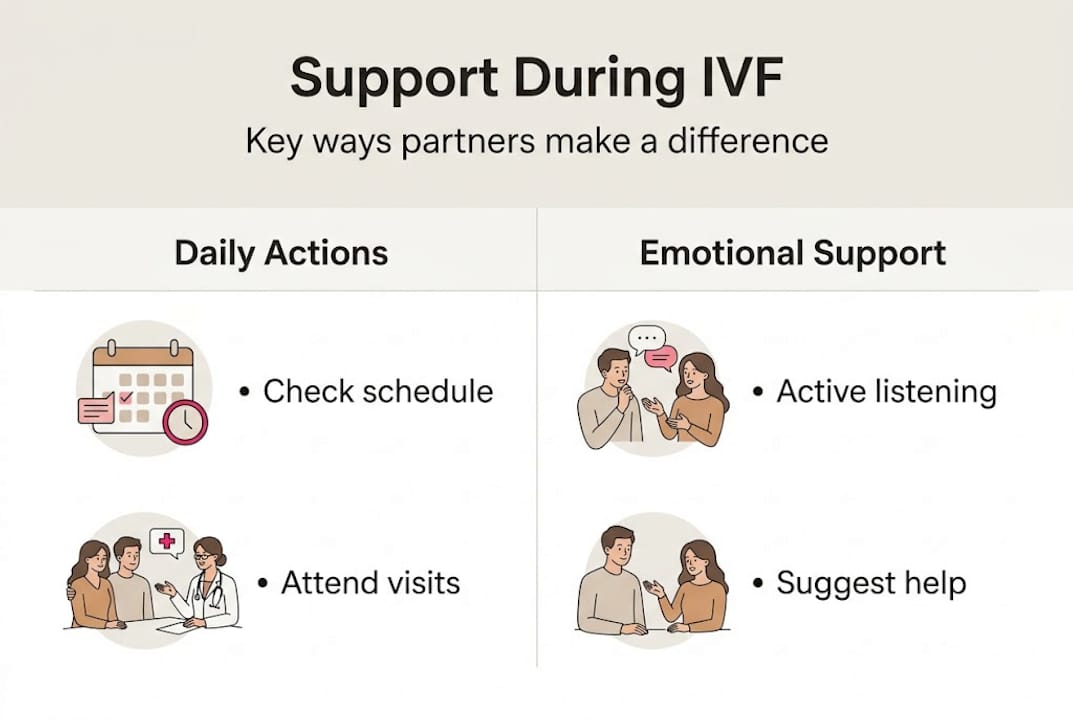
2. Attend appointments whenever possible. Clinic visits can feel clinical and isolating. Having you present, even silently, signals that your partner is not facing this alone. If you cannot attend in person, follow up immediately afterward with a call or message.
3. Practice active listening, not problem-solving. When your partner shares how they are feeling, the instinct to fix or reassure is natural. Resist it. Often, what your partner needs most is to feel heard. Phrases like “That sounds really hard” or “I’m glad you told me” carry more weight than any solution you can offer.
4. Offer hands-on help with injections and daily routines. Many IVF protocols involve self-administered injections. Offering to help prepare the medication, provide a steady hand, or simply sit with your partner during the injection can reduce the anxiety attached to this part of treatment significantly.
5. Maintain normalcy where you can. IVF can make life feel like it is entirely on hold. Cooking a favorite meal, planning a low-key activity, or simply watching a show together preserves a sense of ordinary life that is genuinely comforting.
6. Know when to suggest professional support. There are moments when the emotional weight exceeds what a partner can carry alone. If your partner is showing signs of persistent sadness, withdrawal, or hopelessness, gently suggesting counseling or a support group is an act of care, not a failure. Organizations like Resolve.org offer peer-led groups specifically for people navigating infertility.
For partners who want additional guidance on their own role in the process, reviewing male IVF preparation tips provides targeted, practical steps. Couples exploring IVF for LGBTQ+ partners will find resources that address their specific journey with the same depth and care.
Pro Tip: Your well-being matters too. Research consistently shows that supporter burnout is real and can undermine the support you are trying to provide. Schedule time for your own physical and mental health throughout the treatment cycle.
Troubleshooting: Common mistakes and how to avoid them
Even the most well-meaning partners make mistakes during IVF. Recognizing these patterns early allows you to correct course before they cause lasting damage to your relationship or your partner’s experience of the process.
Overstepping boundaries. Some partners respond to helplessness by taking over, researching every possible outcome, managing every appointment, and making decisions without input. This can feel controlling rather than supportive. Ask before acting, and check in regularly about whether your level of involvement feels right.
Minimizing emotions or offering forced positivity. Saying “Just stay positive” or “Everything will work out” is well-intentioned but often lands as dismissive. It signals that difficult emotions are not welcome, which pushes your partner further into isolation. Acknowledge the reality of what they are feeling before offering any reassurance.
Ignoring your own needs. The emotional weight of infertility affects both partners. Suppressing your own grief, fear, or frustration does not make you a better supporter. It makes you a depleted one. Seek your own outlets, whether through exercise, trusted friends, or a therapist.
Avoiding difficult conversations. It is tempting to sidestep hard topics to keep the peace. But unspoken fears about failed cycles, financial strain, or what happens if IVF does not work tend to grow louder over time. Addressing them directly, even imperfectly, is healthier than avoidance.
“Seeking professional help, whether through counseling or peer support groups, is not a sign that your relationship is failing. It is a sign that you are taking the emotional demands of this process seriously.”
Here are concrete strategies to avoid the most common pitfalls:
- Ask your partner weekly: “What kind of support do you need most right now?”
- Replace “stay positive” with “I’m here no matter what happens.”
- Schedule one activity each week that has nothing to do with fertility treatment.
- Agree on a signal or phrase your partner can use when they need space.
- Consider a joint session with a counselor before a difficult milestone, such as a transfer or a result day.
If you have questions about fertility factors that affect both partners, reviewing the male fertility FAQ can fill in important gaps. Couples using donor eggs, sperm, or surrogacy can find dedicated guidance through third-party IVF support resources.
Verification: Recognizing the impact of your support
Knowing that your efforts are making a difference is not always obvious in the middle of a difficult process. But there are real, observable signs that your support is landing well, and signs that you may need to adjust your approach.
Positive indicators to watch for include:
- Your partner voluntarily shares updates about how they are feeling without being asked.
- Tension during medical discussions has decreased compared to earlier in the cycle.
- Your partner expresses gratitude, directly or through small gestures, for specific things you have done.
- You both feel more like a team when facing appointments or results.
- Humor and lightness return to your interactions, even briefly.
Signs that something needs to shift include:
- Your partner becomes more withdrawn despite your efforts to engage.
- Arguments increase around treatment decisions or communication styles.
- You feel consistently exhausted or emotionally empty after conversations.
- One or both of you stops talking about the process entirely.
Research confirms that open communication reduces conflict and builds the empathy couples need to sustain each other through infertility. If you notice the warning signs above, treat them as information rather than failure. Adjust your approach, have a direct conversation, or bring in outside support.
Couples navigating unique paths through fertility treatment, including same-sex couples and single parents by choice, will find relevant perspectives and resources through LGBTQ+ IVF experiences that address the specific emotional and logistical dimensions of their journey.
A new perspective on support: Why presence beats perfection
There is a persistent and unhelpful belief that being a good partner during IVF means always knowing the right thing to say or do. This belief causes real harm. It leads partners to stay silent out of fear of saying the wrong thing, which their partner then experiences as indifference.
The couples who navigate IVF most successfully are not the ones where one partner had perfect words or flawless execution. They are the ones where both partners kept showing up, imperfectly and consistently, even when they did not know what to do next.
Practitioners who work with fertility patients across multiple cycles observe something consistent: couples who adapt their support style over time do far better than those who rely on a fixed approach. What your partner needs in week one of stimulation is different from what they need the night before a transfer or the morning after a negative result. Rigidity, even well-intentioned rigidity, fails to meet the moment.
The most valuable thing you can offer is not expertise. It is presence. Sitting with uncertainty together, without rushing to resolve it, is an act of profound support. Reviewing practical preparation tips can give you a starting point, but the willingness to adapt those tips based on what your partner actually needs is what makes the difference.
Support is not a task you complete. It is a practice you return to, day after day, adjusted and renewed.
Get personalized IVF support from the experts
Navigating IVF as a couple is easier when you have a team that understands both the science and the human experience behind it.
Life IVF Center offers more than advanced medical protocols. Through its Precision IVF® approach, each treatment plan is built around your unique biological profile, medical history, and goals, reducing unnecessary cycles and increasing the likelihood of success. The team also provides guidance on insurance coverage for IVF, so financial uncertainty does not add to your emotional load. Whether you are just beginning to explore your options or are ready to take the next step, you can learn more about IVF and schedule a consultation with a specialist who will treat your journey with the care it deserves.
Frequently asked questions
What if my partner doesn’t want to talk about IVF?
Respect their need for space, but gently suggest scheduled check-ins so communication does not disappear entirely. If the silence persists and causes strain, professional counseling attended together can open the door in a safer setting.
How can I avoid feeling helpless during my partner’s treatment?
Focus on specific, practical contributions like managing the medication schedule or preparing meals, and prioritize your own self-care so that supporter burnout does not undermine your ability to be present.
What are signs I’m supporting my partner effectively during IVF?
Increased openness, reduced tension during medical conversations, and direct expressions of appreciation are reliable indicators. Research shows that empathetic communication consistently improves relationship outcomes during infertility treatment.
Should both partners attend every IVF appointment?
Attending together strengthens the sense of shared ownership over the process, but it is equally important to communicate openly about preferences and respect each other’s boundaries if attendance at every visit is not realistic.
When should we seek outside support for emotional struggles?
If emotional distress feels unmanageable or is causing consistent conflict, seeking counseling or a support group is the right step. Early intervention protects both the relationship and the treatment experience.
Recommended
- Male Fertility: Tips and Key Factors for IVF Success – Life IVF Center
- A. Intro to IVF Archives – Life IVF Center
- IVF for LGBTQ+ Patients – Life IVF Center
Ready to take the next step?
Life IVF Center specializes in individualized Precision IVF® care for complex cases—including diminished ovarian reserve, prior failed cycles, and advanced maternal age. Our in-house labs and dedicated physicians are ready to help.
Book a Free Consultation →