
The most useful fertility hormone tests are AMH, FSH, LH, estradiol (E2), progesterone, prolactin, and TSH. Together, they reveal ovarian reserve, ovulation status, thyroid function, and possible pituitary issues. For men, testosterone alongside FSH and LH provides the equivalent picture of testicular function and sperm production. According to the Endocrine Society, ovulatory disorders account for roughly 25% of female infertility cases, and most of those disorders show up first in hormone results. The American Society for Reproductive Medicine (ASRM) recommends AMH and antral follicle count (AFC) as the most sensitive markers of ovarian reserve, though neither predicts natural conception probability on its own.
Key things to know before you read your results:
- A single abnormal value rarely tells the whole story. Cycle phase, recent illness, and medications all shift numbers.
- AMH can be tested on any cycle day; FSH and estradiol belong on days 2–4; progesterone is most informative around day 21 of a 28-day cycle.
- Prolactin and TSH can be drawn at any time but should be repeated if borderline.
- Male hormone testing (testosterone, FSH, LH) is a standard part of any couple’s workup.
If you have been trying to conceive for more than 6–12 months (or 6 months if you are over 35), or if your results show persistent abnormalities after lifestyle changes, reviewing them with a fertility specialist is the logical next step.
Pro Tip: Bring your full lab report, including reference ranges, to your specialist appointment. Different labs use different assays, so the number alone is less useful than the number in context.

Table of Contents
- What each fertility hormone measures and when to test it
- How fertility hormone tests are done: timing, sample types, and home kits
- How to interpret your results: ranges, common meanings, and pitfalls
- Who should get tested and what comes next
- What hormone tests cannot tell you, and what fills the gaps
- Lifestyle steps that support hormonal balance, according to clinicians
- Key Takeaways
- How fertility specialists actually use hormone panels in practice
- Coordinated fertility evaluation at Lifeivfcenter
- Authoritative sources and further reading
What each fertility hormone measures and when to test it
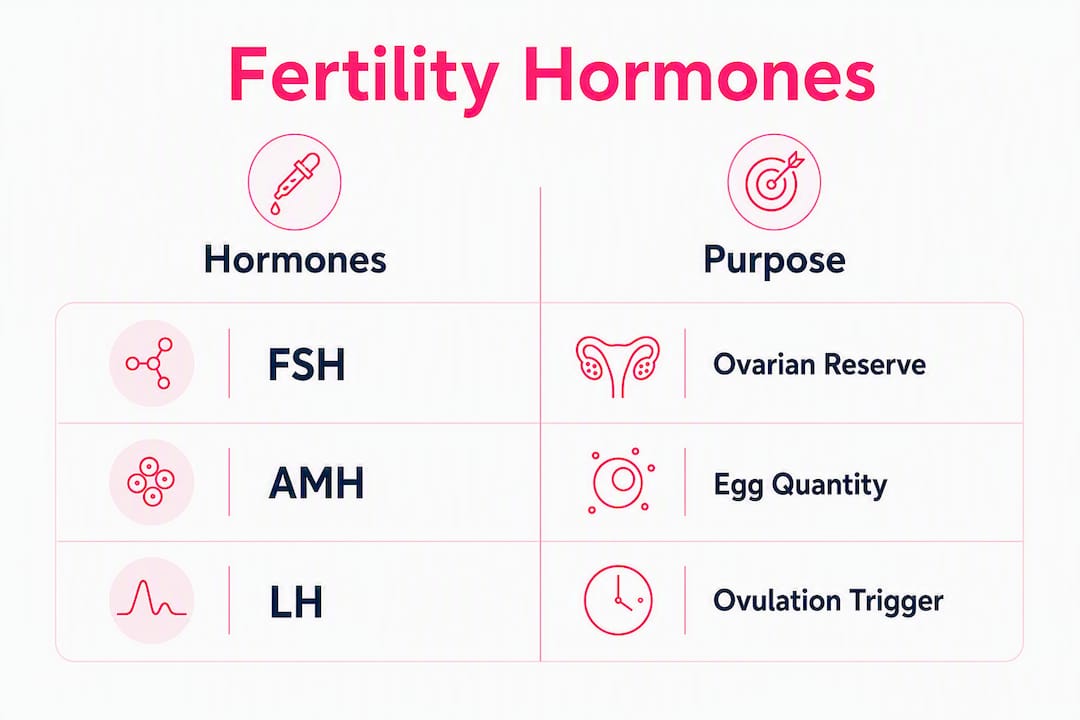
Understanding what each hormone does, and when to draw it, prevents the most common misreading errors. The table below gives a working reference. All ranges are illustrative examples; your lab’s own reference intervals and your clinician’s interpretation take precedence.
| Hormone | What it measures | When to test | Example reference range | High suggests | Low suggests |
|---|---|---|---|---|---|
| AMH | Ovarian reserve (pool of remaining follicles) | Any cycle day | 1.0 ng/mL (reproductive age) | PCOS, high follicle count | Diminished ovarian reserve |
| FSH | Pituitary signal driving follicle growth | Days 2–4 | 3–10 mIU/mL (day 3) | Diminished reserve, poor response | Hypogonadotropic hypogonadism |
| LH | Triggers ovulation; surge precedes egg release | Days 2–4 baseline; surge monitoring mid-cycle | 2–10 mIU/mL (follicular) | PCOS (elevated ratio), LH surge | Pituitary dysfunction |
| Estradiol (E2) | Follicle maturity; suppresses FSH artificially | Days 2–4 | 25–60 pg/mL (early follicular) | Dominant cyst, falsely normal FSH | Ovarian insufficiency |
| Progesterone | Confirms ovulation occurred; supports implantation | Day ~21 (mid-luteal) | >10 ng/mL indicates ovulation | Adrenal or luteal cyst | Anovulation, luteal phase defect |
| Prolactin | Pituitary hormone; excess suppresses GnRH/LH/FSH | Any time (fasting preferred) | 2–20 ng/mL | Pituitary adenoma, hypothyroidism, medications | Rarely clinically significant |
| TSH | Thyroid function; thyroid affects entire reproductive axis | Any time | — | Hypothyroidism (impairs ovulation) | Hyperthyroidism |
| Testosterone (men) | Drives spermatogenesis and libido | Morning draw | — | Adrenal/testicular tumor | Hypogonadism, poor sperm production |
| FSH/LH (men) | Pituitary signals to testes | Any time | Similar to female follicular ranges | Primary testicular failure | Pituitary dysfunction |
A few points worth emphasizing:
- AMH is the most cycle-stable marker. Unlike FSH, it does not fluctuate significantly from day to day, which makes it a reliable first screen for ovarian reserve. That said, AMH and AFC are among the most sensitive ovarian reserve markers, per ASRM, yet neither reliably predicts natural conception probability on its own.
- Day-3 estradiol matters alongside FSH. An elevated E2 on day 3 can suppress FSH into a falsely normal range, making a woman appear to have better reserve than she does. Clinicians read these two together.
- Progesterone below 2 ng/mL mid-luteal is a strong signal of anovulation and should prompt expanded testing including gonadotropins, androgens, TSH, prolactin, and AMH per standard diagnostic protocols.
- Prolactin elevation can stem from hypothyroidism, pituitary adenoma, or even the stress of the blood draw itself. A single elevated result usually warrants a repeat fasting draw before further workup.
Pro Tip: For men, the workup starts with semen analysis, not hormone testing. Hormones are added when sperm counts are very low or when a structural cause is suspected.
Clinicians interpret all of these values together with age, cycle phase, medication history (especially hormonal contraceptives), and partner testing. No single number is a diagnosis.

How fertility hormone tests are done: timing, sample types, and home kits
Getting the logistics right matters as much as understanding the results. A progesterone drawn on day 10 instead of day 21 tells you almost nothing about whether ovulation occurred.
- Days 2–4 blood draw: FSH, LH, estradiol, and AMH are typically collected together in a single morning serum draw during the early follicular phase. Most clinics count the first day of full menstrual flow as day 1.
- Mid-luteal progesterone (approximately day 21): Timed to roughly 7 days before the expected next period. For cycles longer or shorter than 28 days, the draw date shifts accordingly (e.g., day 28 for a 35-day cycle).
- LH surge monitoring: Ovulation predictor kits (OPKs) detect the LH surge in urine 24–36 hours before egg release. Serum LH can confirm the surge but is rarely needed unless OPKs give inconsistent results.
- Prolactin and TSH: No cycle-day restriction, but prolactin is ideally drawn fasting and without recent breast stimulation, which can transiently elevate it.
- Male hormones: Testosterone is most accurate when drawn before 10 AM, as levels follow a diurnal pattern and are highest in the morning.
Home testing kits vs. clinic serum draws
Home hormone tests have improved considerably. LH surge kits are reliable for timing intercourse or intrauterine insemination (IUI). Some at-home panels now include AMH via finger-prick dried blood spot. Their main limitations:
- Finger-prick AMH results can vary from serum values and are not yet considered equivalent to lab-based assays for clinical decision-making.
- Home kits cannot measure progesterone accurately enough to confirm ovulation.
- TSH and prolactin home testing is not widely validated for fertility purposes.
Home testing has value for initial monitoring, but persistent abnormalities or suspected conditions like PCOS or thyroid dysfunction should be confirmed with serum testing and specialist review.
Pre-test preparation
- Hormonal contraceptives: AMH can be suppressed by oral contraceptives, sometimes significantly. Clinicians often wait until two to three natural cycles have passed after stopping the pill before drawing a baseline AMH.
- Fasting: Not required for most fertility hormones, but recommended for prolactin and any metabolic add-ons (fasting glucose, insulin).
- Illness and stress: Acute illness, recent surgery, or significant psychological stress can temporarily shift FSH, LH, and prolactin. Repeat testing after recovery gives a cleaner baseline.
- Steroid medications: Corticosteroids and anabolic steroids suppress the hypothalamic-pituitary-gonadal axis and can lower FSH, LH, and testosterone.
A single borderline result is not a diagnosis. FSH in particular shows significant intercycle variability; a value that looks elevated one month may normalize the next. Clinicians use repeat testing, AMH, and AFC ultrasound together before drawing conclusions about ovarian reserve.
How to interpret your results: ranges, common meanings, and pitfalls
Knowing the numbers is only half the work. Knowing what they mean, and where they can mislead, is the other half.
Example ranges and what they commonly suggest
These are illustrative values based on widely cited clinical references. Your lab’s reference intervals may differ, and your clinician’s interpretation accounts for your age, cycle phase, and full history.
- AMH below 1.0 ng/mL in a woman under 35 suggests diminished ovarian reserve and typically prompts further evaluation. Low AMH does not guarantee inability to conceive naturally. Per ASRM guidance, AMH and AFC predict oocyte yield for IVF but are poor independent predictors of spontaneous conception.
- FSH above 10 mIU/mL on day 3 raises concern for diminished reserve, but FSH has significant intercycle variability. A single elevated result is specific but not sensitive; it should be repeated and paired with AMH and AFC.
- Mid-luteal progesterone above 10 ng/mL is generally accepted as evidence that ovulation occurred. Values below 3 ng/mL in the mid-luteal phase suggest anovulation.
- Prolactin above 25–30 ng/mL (lab-dependent) warrants repeat fasting testing and, if confirmed, imaging of the pituitary. Hyperprolactinemia accounts for a meaningful proportion of secondary amenorrhea and can suppress GnRH, LH, and FSH.
- TSH above 2.5 mIU/L may be technically within a general lab’s normal range but can still impair fertility. Fertility-focused clinicians often target TSH below 2.5 mIU/L and may extend testing to Free T4, Free T3, and thyroid antibodies (Anti-TPO, anti-thyroglobulin) when TSH is borderline.
Common interpretation pitfalls
- Elevated day-3 E2 masking poor FSH: A day-3 estradiol above 60–80 pg/mL can suppress FSH into a normal-looking range. Always read these together.
- OCP-suppressed AMH: Women who test while on hormonal contraceptives may receive a falsely low AMH result. This is one of the most common sources of unnecessary alarm.
- High FSH variability: Basal FSH shows significant intercycle variability; high variability itself can indicate more advanced diminished reserve and mandates repeat testing or combined assessment with AMH and AFC.
- Isolated low AMH: A low AMH in the absence of other abnormalities does not close the door on natural conception or IVF success. It informs stimulation protocol design, not prognosis alone.
Pro Tip: When you receive your results, ask your provider for the lab’s specific reference range for each value, not just a “normal/abnormal” flag. A number at the low end of normal reads very differently from one well within range.
Understanding how to read blood test results in context, including units, assay methods, and population norms, helps you have a more productive conversation with your specialist.
Who should get tested and what comes next
Hormone testing is not only for people who have been trying for years. Certain situations call for earlier evaluation.
Who should consider testing now
- Trying to conceive for more than 12 months (or 6 months if you are 35 or older)
- Irregular or absent menstrual cycles, which may signal ovulatory dysfunction
- Known or suspected PCOS, which affects LH/FSH ratios, androgens, and insulin signaling
- Diagnosed thyroid disease or a family history of thyroid conditions
- Previous chemotherapy, radiation, or ovarian surgery
- Family history of early menopause (before age 45)
- Recurrent pregnancy loss (two or more miscarriages)
- Male partner with known or suspected fertility concerns
Knowing how to request a fertility specialist referral before your first appointment can save time and help you arrive with the right documentation.
The typical next-step evaluation sequence
- Repeat or confirm abnormal hormone values. A single out-of-range result is rarely acted on alone. FSH and prolactin in particular benefit from repeat testing.
- Pelvic ultrasound for AFC and structural assessment. Antral follicle count confirms or refines the ovarian reserve picture from AMH. The ultrasound also screens for fibroids, polyps, ovarian cysts, and uterine anomalies.
- Semen analysis for the male partner. This is standard in any couple’s workup and should not wait until female testing is complete. Male factors contribute to roughly half of infertility cases.
- Expanded metabolic and autoimmune labs as indicated. Fasting glucose and insulin, vitamin D, ferritin, and thyroid antibodies are commonly added when initial results are borderline or when metabolic conditions are suspected.
- Specialist consultation and individualized plan. A fertility specialist reviews all results together with your history, medication list, and goals before recommending a treatment path.
Your fertility evaluation checklist can help you track which tests have been completed and what still needs to be scheduled.
What hormone tests cannot tell you, and what fills the gaps
Hormone panels are powerful, but they have real limits. Understanding those limits prevents both false reassurance and unnecessary alarm.
What hormone testing reveals and what it does not
- Reveals: Ovarian reserve proxies (AMH, FSH, AFC), evidence of ovulation (progesterone), thyroid and pituitary signals (TSH, prolactin), and gonadotropin-driven testicular function in men.
- Does not reveal: Egg quality (no blood test measures this directly), uterine anatomy, tubal patency, sperm DNA fragmentation, or immune and autoimmune factors affecting implantation.
Hormone results alone cannot explain why an embryo fails to implant or why a structurally normal uterus does not sustain a pregnancy. Uterine health and structural factors require imaging to assess properly.
AMH vs. antral follicle count: how they compare
| Feature | AMH (blood test) | AFC (ultrasound) |
|---|---|---|
| What it measures | Granulosa cell secretion; reflects follicle pool size | Direct count of visible antral follicles (2–10 mm) |
| Cycle-day dependence | Cycle-independent | Best on days 2–5 |
| Operator variability | Low (lab assay) | Moderate (sonographer-dependent) |
| ASRM equivalence | Both are the most sensitive and specific reserve markers | Both are the most sensitive and specific reserve markers |
| Best use case | Initial screen, monitoring over time | Confirms AMH; guides stimulation dosing |
Per ASRM, AMH and AFC are considered equivalent in sensitivity and specificity for ovarian reserve assessment. Most clinicians use both together because they provide complementary information.
When expanded testing is ordered
Clinicians add metabolic and inflammatory markers when hormone results are borderline or when a systemic driver is suspected. A reasonable expanded panel often includes fasting glucose and insulin, vitamin D, ferritin, and thyroid antibodies. Advanced fertility testing that goes beyond basic hormone panels frequently changes the diagnostic picture and the treatment approach.
Lifestyle steps that support hormonal balance, according to clinicians
Hormonal balance is dynamic. Sleep, blood sugar regulation, stress, and nutrient status all influence ovarian signaling, and changes in these areas can shift hormone patterns within months.
Clinician-endorsed steps with the strongest evidence base:
- Prioritize sleep (7–9 hours). Sleep deprivation elevates cortisol, which suppresses GnRH and downstream LH and FSH. Chronic stress and HPA activation can cause luteal phase insufficiency and anovulation by reducing available progesterone.
- Stabilize blood sugar. Even mild insulin resistance can disrupt ovulation, lower progesterone, and increase miscarriage risk. Post-meal walks and a protein-rich breakfast are practical starting points that improve glucose handling without requiring a complete dietary overhaul.
- Exercise moderately. Both sedentary behavior and excessive high-intensity training can impair ovulation. Moderate activity, roughly 150 minutes per week of brisk walking or equivalent, supports insulin sensitivity without stressing the HPA axis.
- Check vitamin D and ferritin. Both are commonly low and both affect ovarian signaling. Correcting a deficiency is straightforward and can be done alongside other testing.
- Reduce chronic stressors where possible. Cortisol competes with progesterone for the same precursor molecule, so sustained high cortisol can effectively reduce progesterone availability even when the ovaries are functioning normally.
When lifestyle changes are not enough
Expect meaningful hormonal shifts to take at least 3 months, since that is roughly one full follicle development cycle. If cycles remain irregular, anovulation persists, or symptoms worsen despite consistent lifestyle changes, those are signals to pursue medical evaluation rather than continue self-management.
Pro Tip: Thyroid and blood sugar assessment are worth prioritizing early. Both are common, both are treatable, and both are frequent drivers of persistent ovulatory dysfunction that lifestyle changes alone cannot fully correct.
Key Takeaways
Fertility hormone testing gives you a meaningful snapshot of ovarian reserve, ovulation, thyroid function, and pituitary health, but results require specialist interpretation alongside imaging and partner testing to be clinically useful.
| Point | Details |
|---|---|
| Test timing matters | FSH and E2 belong on days 2–4; progesterone is most informative around day 21 of a 28-day cycle. |
| AMH is cycle-independent | AMH can be drawn any day but may be suppressed by hormonal contraceptives; wait for natural cycles before drawing a baseline. |
| Single values can mislead | FSH has significant intercycle variability; repeat testing paired with AMH and AFC gives a more reliable reserve picture. |
| Hormones alone are incomplete | Uterine anatomy, tubal patency, and sperm health require imaging and semen analysis, not hormone panels. |
| Specialist review adds clarity | Lifeivfcenter offers coordinated hormone evaluation, AFC ultrasound, and Precision IVF® for patients ready to move from results to a plan. |
How fertility specialists actually use hormone panels in practice
The clinical reality is that hormone panels are a starting point, not a conclusion. When a patient arrives at a first consultation, the conversation begins with history: cycle regularity, prior pregnancies, medications, and how long conception has been attempted. The lab results come next, read in that context.
What typically follows is an AFC ultrasound, scheduled on days 2–5 of the next cycle, to confirm or refine what AMH suggests about ovarian reserve. If the male partner has not had a semen analysis, that is ordered at the same time, not after. Waiting on partner testing is one of the most common delays in fertility workups, and it adds months to a process that is already time-sensitive for many patients.
When results point toward a specific diagnosis, such as diminished ovarian reserve, PCOS-related ovulatory dysfunction, or thyroid-driven cycle irregularity, the treatment plan is built around that finding. At Lifeivfcenter, hormone results feed directly into the Precision IVF® protocol design, which adjusts stimulation type, dosing, and timing based on each patient’s individual reserve and response profile rather than a standard template. Patients with PCOS-related hormone patterns, for example, require a meaningfully different stimulation approach than patients with diminished reserve, and that distinction starts with the hormone panel.
The first consultation is also where financial and insurance questions are addressed. Understanding coverage options early prevents delays in starting treatment.
Coordinated fertility evaluation at Lifeivfcenter
Hormone results are most useful when they are part of a coordinated workup, not a standalone number you are trying to interpret alone.

Lifeivfcenter offers fertility treatment packages that bring hormone testing, AFC ultrasound, and specialist review together in a single, organized process. For patients whose results point toward IVF, the clinic’s Precision IVF® approach builds a protocol around your specific hormone profile, ovarian reserve, and medical history, rather than applying a one-size-fits-all stimulation plan. Services include:
- Comprehensive hormone panels (AMH, FSH, LH, E2, progesterone, prolactin, TSH, and expanded metabolic markers)
- AFC ultrasound coordinated with your cycle timing
- Semen analysis and male factor evaluation
- Egg freezing and embryo preservation packages
- Genetic testing and donor egg or sperm programs
- Insurance guidance and financial counseling
- Travel coordination for patients coming from outside Southern California
To schedule a coordinated fertility evaluation, contact Lifeivfcenter directly or book a consultation through the website. Bringing your existing lab results, even if drawn elsewhere, gives your specialist a head start.
Authoritative sources and further reading
The following clinical and consumer references were used to build this guide. Each is listed with a brief note on its relevance.
- Endocrine Society: Infertility patient summary — Prevalence of ovulatory disorders and hormone-related infertility causes; accessible patient-facing overview.
- ASRM Practice Committee Opinion: Testing and Interpreting Measures of Ovarian Reserve (2020) — The primary clinical reference for AMH, FSH, AFC interpretation, and their limitations as fertility predictors.
- PMC: Endocrine disorders and fertility — peer-reviewed update — Comprehensive review of how thyroid, prolactin, gonadotropin, and metabolic disorders affect reproductive outcomes in men and women.
- MedlinePlus: FSH Levels Test — Plain-language explanation of FSH testing, reference ranges, and clinical uses.
- Endotext / NCBI Bookshelf: Physiology of GnRH and Gonadotrophin Secretion — Detailed reference on the hypothalamic-pituitary-gonadal axis, prolactin’s role, and how systemic factors modulate gonadotropin secretion.
- Robin Berzin MD: Fertility over 35 protocol — Evidence-aligned practitioner guide on metabolic drivers of hormone disruption, thyroid optimization, and lifestyle levers.
- Lifeivfcenter: Fertility evaluation checklist — Step-by-step guide to coordinating a complete fertility workup.
- Lifeivfcenter: Why advanced fertility testing changes your diagnosis — Explains the value of expanded panels and imaging beyond basic hormone testing.
This article provides general health information and is not a substitute for professional medical advice. For interpretation of your specific results, consult a licensed fertility specialist or your treating clinician.
Recommended
- Your fertility evaluation checklist: Steps, tests, and benchmarks
- Signs of Fertility Decline: What to Watch After 30
- Why consider fertility testing? Key insights and action steps
- Top fertility supplements: Evidence, comparisons, and expert picks
Ready to take the next step?
Life IVF Center specializes in individualized Precision IVF® care for complex cases—including diminished ovarian reserve, prior failed cycles, and advanced maternal age. Our in-house labs and dedicated physicians are ready to help.
Book a Free Consultation →