

Third-party reproduction is any fertility arrangement in which a person other than the intended parent or parents contributes eggs, sperm, embryos, or carries a pregnancy to help build a family. The five main options are donor sperm, donor egg, donor embryo, gestational carrier (surrogacy), and reciprocal IVF (also called Co-IVF). According to ReproductiveFacts.org, the process typically moves through three phases: medical evaluation, selection of a donor or carrier, and execution of legal agreements that define each party’s rights and responsibilities.
Here is a quick overview of the main options:
- Donor sperm: A sperm donor’s sample is used for intrauterine insemination (IUI) or IVF.
- Donor egg: An egg donor undergoes ovarian stimulation and retrieval; the eggs are fertilized and transferred to the intended mother or a carrier.
- Donor embryo: A fully formed embryo, often from another couple’s completed IVF cycle, is transferred to the intended mother or carrier.
- Gestational carrier: A woman carries a pregnancy created from the intended parents’ or donors’ genetic material; she has no genetic connection to the child.
- Reciprocal IVF: One partner provides the eggs, the other carries the resulting embryo, allowing both partners to participate biologically.
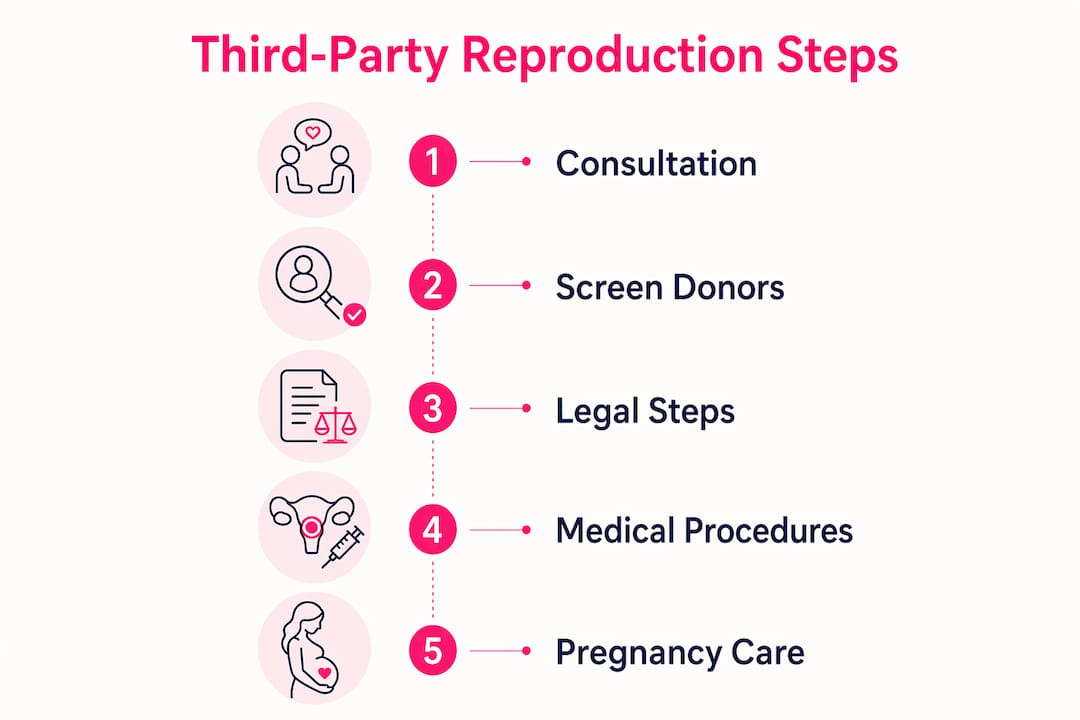
Your first step is to schedule an initial consultation with a reproductive endocrinologist, retain a reproductive law attorney, and connect with a mental health counselor who specializes in third-party arrangements. All three should be in place before medical procedures begin.
Table of Contents
- What are the main types of third-party reproduction?
- Who typically uses third-party reproduction?
- What does the medical process look like, step by step?
- How are donors and carriers screened and matched in the U.S.?
- What are the legal and parental rights issues in the U.S.?
- What ethical and psychosocial factors should you consider?
- What are the risks and success rates?
- What do third-party reproduction options typically cost and how long do they take?
- How do you choose the right clinic, agency, or attorney?
- What happens after the birth?
- How Life IVF Center supports third-party reproduction
- Key Takeaways
- A note on navigating this process with care
- Life IVF Center’s third-party services: where to start
- Useful sources
What are the main types of third-party reproduction?
Understanding the differences between each option makes it much easier to identify which path fits your medical situation and family goals.

1. Donor sperm
A sperm donor provides a sample that is used to fertilize an egg via IUI or IVF. Sperm donation is generally the least medically complex third-party option. Sperm is collected, frozen, and held for at least six months with infectious-disease testing before clinical use. This route is commonly chosen by single women, lesbian couples, and heterosexual couples where the male partner has severe male-factor infertility.
2. Donor egg
An egg donor undergoes ovarian stimulation and a minor surgical retrieval procedure. Her eggs are fertilized with sperm from the intended father or a sperm donor, and the resulting embryo is transferred to the intended mother or a gestational carrier. Donor egg IVF is more clinically involved than sperm donation and carries higher costs, but it gives the intended mother the experience of pregnancy and delivery. It is the most common third-party option for women with diminished ovarian reserve, premature ovarian failure, or age-related decline in egg quality.
3. Donor embryo
A pre-formed embryo, typically one that remains from another couple’s completed IVF cycle, is transferred to the intended mother or a gestational carrier via a frozen embryo transfer (FET). Because the child is genetically unrelated to both intended parents, embryo donation requires a pre-donation agreement and careful legal review given the variation in state parentage statutes. It tends to be the most affordable IVF-based option.
4. Gestational carrier (surrogacy)
A gestational carrier agrees to carry a pregnancy created from the intended parents’ embryo. She has no genetic link to the child. This is distinct from traditional surrogacy, in which the carrier also provides the egg and is therefore the genetic mother. Traditional surrogacy is rarely practiced today because it creates significantly more complex legal and emotional dynamics. Gestational carrier arrangements are the most legally and financially intensive third-party route.

5. Reciprocal IVF (Co-IVF)
One partner in a same-sex female couple provides the eggs; those eggs are fertilized and the resulting embryo is transferred to the other partner, who carries the pregnancy. Both partners have a direct biological role. This option requires IVF and is available at clinics that offer full donor egg and embryo transfer services.
Pro Tip: If you are deciding between donor egg, donor embryo, and reciprocal IVF, the key question is whether a genetic connection to one or both intended parents matters to your family. Donor embryo is the most cost-effective path when genetic connection is not a priority. Reciprocal IVF is the right fit when both partners in a same-sex female couple want a biological role. Donor egg IVF is the standard choice when one intended parent wants a genetic link and the other will carry the pregnancy.
Who typically uses third-party reproduction?
Third-party reproduction is not a single-profile decision. The people who pursue it span a wide range of medical situations and family structures.
Common medical indications include:
- Diminished ovarian reserve (DOR) or premature ovarian insufficiency (POI), where egg quality or quantity is too low for a successful own-egg cycle
- Azoospermia or severe oligospermia, where the male partner produces no or very few sperm
- Recurrent pregnancy loss linked to chromosomal abnormalities in the embryo
- A known genetic condition that carries a high risk of transmission to a child
- Uterine abnormalities or repeated implantation failure that may benefit from a gestational carrier
- Prior cancer treatment that affected fertility
Social and family-structure reasons include:
- Single women who want to conceive using donor sperm via IUI or IVF
- Same-sex male couples who need both an egg donor and a gestational carrier
- Same-sex female couples who may use donor sperm or pursue reciprocal IVF
- Single men who need both an egg donor and a gestational carrier
A few illustrative scenarios: A 43-year-old woman with low AMH levels may find that donor egg IVF offers substantially better success rates than another own-egg cycle. A male same-sex couple building their family will typically work with both an egg donor and a gestational carrier simultaneously. A woman with a BRCA mutation may choose preimplantation genetic testing combined with her own eggs, or she may opt for donor embryo if her own egg supply is limited.
The type of third-party arrangement that fits best depends on which element is missing or at risk: the egg, the sperm, the embryo, or the ability to carry a pregnancy.
What does the medical process look like, step by step?
The medical pathway varies by arrangement, but most third-party cycles follow a shared sequence of evaluation, preparation, and treatment.
- Initial evaluation: The intended parent or parents complete hormone panels (AMH, FSH, estradiol, LH), a uterine assessment (sonohysterogram or hysteroscopy), and a semen analysis if applicable. The gestational carrier, if involved, undergoes a full physical and uterine evaluation.
- Donor or carrier selection and matching: Intended parents review profiles and select a donor or carrier. Known donors or carriers may already be identified; anonymous donors are typically sourced through a clinic’s in-house bank or an external agency.
- Infectious-disease and genetic screening: All parties complete required FDA-mandated infectious-disease testing. Donors and carriers also complete genetic carrier screening and psychological evaluation.
- Legal contracting: Before any medical procedures begin, all parties sign legally binding agreements. This step runs in parallel with medical preparation.
- Ovarian stimulation (egg donation cycles): The egg donor receives injectable gonadotropins for approximately 10–14 days, with regular monitoring via ultrasound and bloodwork. Timing is synchronized with the recipient’s or carrier’s uterine preparation.
- Egg retrieval: The donor undergoes a transvaginal ultrasound-guided egg retrieval under light sedation. The procedure typically takes 20–30 minutes.
- Fertilization and embryo culture: Retrieved eggs are fertilized using conventional IVF or intracytoplasmic sperm injection (ICSI). Embryos are cultured for 5–6 days to the blastocyst stage. Preimplantation genetic testing for aneuploidies (PGT-A) may be performed at this stage to select chromosomally normal embryos.
- Embryo transfer: A single euploid embryo is transferred to the prepared uterus of the intended mother or gestational carrier. The procedure is brief and typically does not require sedation.
- Pregnancy confirmation: A blood hCG test is performed approximately 10–14 days after transfer. A positive result is followed by ultrasound confirmation and transition to obstetric care.
Typical tests by party:
| Party | Tests Required |
|---|---|
| Egg donor | Hormone panel, infectious-disease panel (FDA-mandated), genetic carrier screen, psychological evaluation, physical exam |
| Sperm donor | Semen analysis, infectious-disease panel, genetic carrier screen, psychological evaluation |
| Gestational carrier | Full physical, uterine assessment, infectious-disease panel, psychological evaluation, background check |
| Intended parents | Hormone panels, semen analysis (if applicable), uterine evaluation, genetic carrier screen, psychological consultation |
Timeline notes:
- A standard donor-egg IVF cycle, from matching through embryo transfer, typically takes 2–4 months.
- A gestational surrogacy pathway, including carrier matching, legal contracting, medical clearance, and embryo transfer, commonly takes 6–12 months or longer.
- Synchronization between the donor’s stimulation cycle and the carrier’s or recipient’s uterine preparation is managed by the clinic’s coordination team and requires precise medication timing.
How are donors and carriers screened and matched in the U.S.?
Screening is one of the most consequential steps in any third-party arrangement. Gaps in screening create medical, legal, and emotional risk for every party involved.
Known vs. anonymous donors and carriers
Known donors and carriers (a friend or family member) offer the advantage of a complete, accessible medical and family history, a pre-existing relationship, and often a clearer sense of motivation. The tradeoff is that the personal relationship can complicate boundaries, compensation discussions, and future contact expectations.
Anonymous donors are recruited through clinic banks or third-party agencies. They complete standardized profiles and screening, but the intended parents may have limited access to ongoing medical updates. With the rise of direct-to-consumer DNA testing, true anonymity is increasingly difficult to guarantee, and many programs now offer “open-ID” arrangements where the donor agrees to contact after the child turns 18.
Agency-recruited carriers are matched through a surrogacy agency that handles initial screening, background checks, and coordination. Agency fees add to overall cost but reduce the administrative burden on intended parents.
Mandatory and recommended screening
The FDA requires infectious-disease testing for all donor tissue, including testing for HIV, hepatitis B and C, syphilis, gonorrhea, chlamydia, and cytomegalovirus (CMV). Beyond the federal floor, ASRM guidelines recommend:
- Comprehensive genetic carrier screening (expanded panels covering 200+ conditions)
- Psychological evaluation and counseling for donors and carriers
- Full medical history and physical examination
- Uterine assessment for carriers
- Background check for gestational carriers
- Informed consent documentation for all parties
Compensation and legal handling
Egg donors in the U.S. typically receive compensation for their time and discomfort; gestational carriers receive a base fee plus expense reimbursements. Carrier compensation is held in an escrow account managed by a neutral third party and disbursed according to the legal contract milestones. Sperm donors are generally compensated at a lower rate than egg donors, reflecting the difference in medical burden.
Red flags to watch for: insufficient or incomplete medical history from a donor, no psychological evaluation on record, a carrier who has not yet completed her own family (a standard ASRM recommendation), or an agency that discourages independent legal counsel for the carrier.
Pro Tip: Ask any donor bank or agency whether their donors have completed expanded genetic carrier screening, not just the basic panel. A donor who carries a recessive condition is not disqualified, but you need that information to assess the combined risk with your own carrier status.
What are the legal and parental rights issues in the U.S.?
U.S. law on third-party reproduction varies significantly by state, and that variation has real consequences for parental rights. There is no single federal statute governing surrogacy or donor parentage. Some states have clear, enforceable surrogacy statutes and allow prebirth parentage orders; others restrict or prohibit compensated surrogacy entirely.
Well-drafted legal contracts and independent attorney representation for each party are the primary defenses against future parental-rights disputes. A contract alone is not always sufficient: in states without clear surrogacy statutes, a prebirth order from a court is the most reliable way to establish the intended parents as the legal parents before the child is born, avoiding the need for adoption proceedings after delivery.
Questions to ask your reproductive law attorney:
- Can we obtain a prebirth parentage order in our state, and what is the process?
- What happens if the gestational carrier changes her mind during the pregnancy?
- How is the donor’s parental status legally terminated?
- Who has medical decision-making authority during the pregnancy?
- What contingency provisions should the contract include (selective reduction, termination, medical emergencies)?
- Does the carrier have her own independent legal counsel, and is that cost covered?
Key legal considerations by arrangement:
- Donor sperm: Most states treat a sperm donor as having no parental rights when the donation is made through a licensed physician or sperm bank. Private arrangements carry more legal risk.
- Donor egg: The intended mother who carries the pregnancy is typically recognized as the legal mother; additional legal steps may be needed when a carrier is involved.
- Donor embryo: State law varies widely. A pre-donation agreement is strongly recommended, and some states require a formal adoption process.
- Gestational carrier: Requires a comprehensive legal contract and, ideally, a prebirth order. State law determines whether the order is available and enforceable.
Pro Tip: Retain a reproductive law attorney who practices in the state where the gestational carrier will deliver, not just the state where you live. Parentage orders are issued by the court in the delivery state, and the laws there govern the outcome.
What ethical and psychosocial factors should you consider?
Third-party reproduction raises ethical questions that go beyond the medical and legal framework. The AMA Code of Medical Ethics identifies voluntariness, exploitation risk, psychosocial impact, and conflicts of interest as the central concerns physicians and patients must address.
Core ethical issues:
- Voluntariness and exploitation: Donors and carriers must make decisions free from financial coercion. High compensation packages can blur the line between genuine consent and economic pressure, particularly for egg donors who assume real medical risk.
- Commodification: Treating gametes or gestational services as market commodities raises concerns about the dignity of donors, carriers, and the children born through these arrangements.
- Donor anonymity vs. the child’s right to know: Children conceived with donor gametes have a legitimate interest in knowing their genetic origins. Open-ID and identity-release donor programs address this, but they require proactive planning.
- Informed consent: All parties must receive complete information about medical risks, legal implications, and psychological impacts before signing any agreement.
Psychosocial impacts to anticipate:
- Intended parents often experience grief around the loss of a genetic connection, particularly when using donor eggs or embryos. This is a recognized and normal response, not a sign that the decision is wrong.
- Gestational carriers may experience unexpected emotional attachment during pregnancy, even when they clearly understand the arrangement. Psychological preparation and ongoing counseling reduce the risk of distress at relinquishment.
- Donors may have complex feelings about the existence of genetic offspring they will not raise, which can surface years after the donation.
The AMA recommends that physicians maintain separate patient-physician relationships with each party to avoid dual loyalty, and that thorough psychological screening be completed before any medical procedures begin.
Pro Tip: Schedule counseling at three key milestones: before matching, before the embryo transfer, and after the birth. Clinics that offer integrated mental health support at each of these points, rather than a single pre-cycle session, produce better long-term outcomes for all parties.
What are the risks and success rates?
Medical risks by party
Egg donors face risks associated with ovarian stimulation, including ovarian hyperstimulation syndrome (OHSS), which ranges from mild bloating to, in rare cases, a serious condition requiring hospitalization. The egg retrieval procedure itself carries a small risk of bleeding, infection, or injury to adjacent structures.
Gestational carriers assume all standard pregnancy risks, including gestational diabetes, hypertension, preterm labor, and the risks associated with cesarean delivery if required. Multiple pregnancy, which is now largely preventable through single-embryo transfer, was historically the most significant risk amplifier.
Recipients face the risks of any IVF cycle: medication side effects, a small risk of OHSS if using their own eggs for a reciprocal cycle, and the emotional and physical demands of a failed transfer.
Success rates and the age effect
SART data show that female age is the single most important predictor of IVF success. Patients under 30 can expect higher per-retrieval success rates compared to patients over 40 using their own eggs, who see significantly lower rates. The critical insight for third-party reproduction is that donor egg cycles produce success rates aligned with the donor’s age, not the recipient’s. A 45-year-old recipient using eggs from a younger donor can expect success rates comparable to those typical of the younger donor’s age group. This is the primary clinical reason older patients choose donor eggs. For more on how age affects outcomes, see IVF success rates by age.
Genetic risk and screening limitations
Genetic carrier screening reduces but does not eliminate the risk of heritable conditions. Screening panels test for known variants of common recessive conditions; they do not detect every possible mutation. Intended parents should discuss residual risk with a genetic counselor before finalizing their donor selection.
Steps clinics take to reduce risk: thorough donor and carrier screening, single-embryo transfer protocols to prevent multiple pregnancy, PGT-A to select chromosomally normal embryos, and coordination with experienced maternal-fetal medicine specialists for high-risk pregnancies.
Key statistic: Per SART, patients over 40 using their own eggs see realistic success rates that are substantially lower than in younger patients, compared to substantially higher rates when donor eggs from younger women are used.
What do third-party reproduction options typically cost and how long do they take?
Cost and timeline are two of the most practical questions intended parents face, and the answers vary considerably by arrangement.
Typical U.S. cost ranges
| Arrangement | Typical U.S. Cost Range | Major Cost Drivers |
|---|---|---|
| Donor sperm (IUI) | $300–$1,500 per cycle | Sperm bank fees, IUI procedure |
| Donor sperm (IVF) | $15,000–$25,000 per cycle | IVF cycle, sperm bank fees, lab costs |
| Donor egg IVF | $25,000–$45,000 per cycle | Donor compensation, stimulation meds, IVF cycle, agency/matching fees |
| Donor embryo (FET) | $5,000–$15,000 per cycle | FET procedure, legal review, embryo storage transfer |
| Gestational surrogacy | $80,000–$150,000+ total | Carrier compensation, agency fees, legal contracts, medical cycle, escrow |
Note: Ranges reflect commonly cited U.S. figures and vary by clinic, geography, and individual circumstances. Costs above do not include potential repeat cycles.
Timeline estimates
- Donor sperm (IUI): 1–2 months from initial consultation to first insemination, assuming no delays in donor selection.
- Donor egg IVF: 2–4 months from matching to embryo transfer; longer if using a fresh donor cycle that requires synchronization.
- Donor embryo (FET): 1–3 months once a donor embryo is identified and legal review is complete.
- Gestational surrogacy: 6–12 months is a realistic minimum, accounting for carrier matching, psychological and medical clearance, legal contracting, and the IVF or FET cycle itself. Some arrangements take 18 months or more.
Financial considerations:
- Most insurance plans in the U.S. do not cover donor gamete costs or gestational carrier compensation, though some cover the IVF cycle itself. Review your policy carefully, and ask your clinic about insurance coverage options before committing to a financial plan.
- Agency fees for egg donation or surrogacy typically range from $8,000 to $25,000 and cover matching, coordination, and case management.
- Carrier compensation is held in escrow and disbursed in installments tied to contract milestones, not paid upfront.
Pro Tip: Ask your clinic for an itemized cost estimate that separates the medical cycle fee from donor compensation, agency fees, legal fees, and medication costs. Bundled quotes can obscure where costs are concentrated and make it harder to compare programs or plan for contingencies.
How do you choose the right clinic, agency, or attorney?
Choosing the right team is as important as choosing the right arrangement. A well-coordinated program reduces delays, legal risk, and emotional strain.
Evaluation criteria for clinics
- Accreditation and lab standards: The clinic’s embryology laboratory should meet College of American Pathologists (CAP) or equivalent accreditation standards.
- Transparent success reporting: Look for clinics that report outcomes through SART, which allows you to compare their results against national benchmarks using standardized data.
- Integrated support: The strongest programs offer reproductive endocrinology, genetic counseling, mental health support, and legal coordination under one roof or through established referral relationships.
- Donor and carrier program infrastructure: Ask whether the clinic maintains its own donor bank or relies entirely on external agencies, and how matching timelines are managed.
- Clear communication: You should receive a written treatment plan, a timeline, and an itemized cost estimate before committing.
Top questions to ask a clinic
- What are your donor-egg IVF success rates for recipients in my age group, reported through SART?
- Do you perform PGT-A, and what is your recommendation for my specific case?
- How do you coordinate the donor’s stimulation cycle with my uterine preparation?
- What happens if a cycle is canceled due to poor donor response?
- Do you have in-house mental health and legal referral support?
Top questions to ask a surrogacy agency
- What is your average time from application to carrier match?
- How do you screen carriers psychologically and medically?
- Does the carrier have independent legal counsel, and how is that arranged?
- What is your policy if a match does not work out after initial agreement?
- How is carrier compensation structured and held in escrow?
Top questions to ask a reproductive law attorney
- What is the surrogacy and donor parentage law in the delivery state?
- Can we obtain a prebirth order, and what is the timeline?
- What provisions should the contract include for medical decision-making and contingencies?
- Do you represent only the intended parents, or do you also represent carriers and donors?
- What is your experience with cases in our specific state and arrangement type?
Red flags
- Vague or unsigned contracts before medical procedures begin
- No requirement for the carrier or donor to have independent legal counsel
- Unrealistic success-rate claims not backed by SART-reported data
- Agencies that discourage questions about carrier screening or compensation structure
- Clinics that cannot provide a written, itemized cost estimate
What happens after the birth?
Securing legal parentage and organizing records after delivery requires deliberate follow-through. These steps are not automatic, and delays can create complications.
Postbirth administrative steps:
- Confirm that the prebirth order has been filed and accepted by the hospital before delivery, so the intended parents are listed on the birth certificate from the start.
- If a prebirth order was not available in your state, initiate the post-delivery parentage or adoption process immediately after birth.
- Register the child’s birth and apply for a Social Security number.
- Notify your pediatrician of the child’s genetic background, including any known donor medical history, so it can be incorporated into the child’s health record.
- Update your health insurance to add the child within the enrollment window (typically 30–60 days after birth).
Recordkeeping checklist:
- Donor’s medical and family history (retain a copy independent of the clinic)
- Genetic carrier screening results for the donor
- All signed consent forms and legal contracts
- Copies of the prebirth order or parentage judgment
- Embryology records (fertilization report, PGT-A results if applicable, embryo grading)
Disclosure to the child:
Research and clinical guidance consistently support early, age-appropriate disclosure to children about their donor or carrier origins. Children who learn about their conception story gradually, starting in early childhood, tend to adjust better than those who discover it unexpectedly as adolescents or adults. The Donor Sibling Registry and similar organizations offer resources for families navigating these conversations. There is no single script, but honesty, delivered with warmth and appropriate detail for the child’s developmental stage, is the consistent recommendation from mental health professionals in this field.
How Life IVF Center supports third-party reproduction
Life IVF Center, based in Southern California, offers a full range of third-party reproductive services for individuals and couples at every stage of the process. The clinic’s programs include donor egg IVF, donor sperm coordination, gestational carrier support, donor embryo transfer, and reciprocal IVF, all delivered through its Precision IVF® approach, which customizes protocols based on each patient’s biological profile, medical history, and treatment goals.
What Life IVF Center’s third-party program includes:
- Comprehensive donor and carrier matching support, with access to both in-house and agency resources
- Expanded genetic carrier screening and PGT-A for embryo selection
- Integrated mental health consultation at key milestones in the process
- Legal referral coordination to connect intended parents with reproductive law attorneys in their jurisdiction
- Multi-language support and travel coordination for patients coming from outside Southern California
- Financial guidance and transparent, itemized cost estimates
The clinic’s multidisciplinary team, which includes reproductive endocrinologists, genetic counselors, and patient coordinators, works to reduce the coordination burden that often makes third-party arrangements feel overwhelming. Patients with prior failed IVF cycles or complex histories, including diminished ovarian reserve, recurrent pregnancy loss, or immune-related implantation failure, are among those who benefit most from the clinic’s personalized protocol design.
To learn more or schedule a consultation, visit Life IVF Center’s third-party services overview or explore available treatment packages.
Key Takeaways
Third-party reproduction requires coordinating medical, legal, and psychological support simultaneously, and the arrangement you choose should be matched to your specific medical indication, family structure, and financial plan.
| Point | Details |
|---|---|
| Five main options | Donor sperm, donor egg, donor embryo, gestational carrier, and reciprocal IVF each serve different medical and family needs. |
| Donor egg success rates | SART data show donor egg cycles produce success rates aligned with the donor’s age, not the recipient’s, making them a strong option for patients over 40. |
| Legal counsel is mandatory | State laws vary widely; prebirth parentage orders and independent attorney representation for each party are essential before medical procedures begin. |
| Counseling at every milestone | Mental health support before matching, before transfer, and after birth reduces long-term distress for all parties involved. |
| Life IVF Center | Offers donor egg, donor sperm, gestational carrier, and reciprocal IVF programs through its Precision IVF® approach, with integrated legal referral and counseling coordination. |
A note on navigating this process with care
Third-party reproduction is one of the most medically and emotionally layered paths to parenthood available today. What often gets underestimated is not the complexity of the medical process, which is well-documented and manageable with the right team, but the emotional work of accepting a conception story that differs from what you originally imagined. That work is real, and it deserves as much attention as the clinical protocol.
The conventional wisdom tends to treat counseling as a checkbox: something you complete once before the cycle begins. The evidence points in a different direction. Intended parents who engage with mental health support at multiple points in the process, including after the birth, report better adjustment and more confidence in how they talk to their children about their origins. The same is true for gestational carriers and donors who receive ongoing psychological support rather than a single pre-participation evaluation.
There is also a tendency to treat the legal step as something to handle quickly so the medical process can start. That instinct is understandable, but it is the wrong order of priorities. A prebirth order that is not in place before delivery, or a contract that does not address contingencies, can create complications that no amount of clinical success can undo. The legal framework is not administrative overhead. It is the foundation on which the entire arrangement rests.
For families considering this path, the most useful thing to know is that the complexity is navigable. Clinics with integrated teams, attorneys who specialize in reproductive law, and mental health professionals who understand the specific dynamics of donor and carrier arrangements make a measurable difference in outcomes, not just clinical ones.
Life IVF Center’s third-party services: where to start
For individuals and couples ready to take the next step, Life IVF Center offers a direct path from initial consultation to a fully coordinated third-party treatment plan. Whether you are considering donor egg IVF, working with a gestational carrier, or exploring reciprocal IVF as a same-sex couple, the clinic’s team in Southern California provides personalized protocol design, genetic testing, legal referral support, and financial guidance in one place.

Life IVF Center’s treatment packages are structured to give you a clear picture of costs and timelines before you commit, with multi-language support and travel coordination available for patients coming from outside the region. Schedule a consultation through the third-party services overview page to discuss your specific situation with a reproductive endocrinologist and get a personalized plan.
Useful sources
The following authoritative U.S.-focused resources are recommended for further reading and verification. Laws and clinical guidelines vary by state; consult a reproductive law attorney in your jurisdiction for guidance specific to your situation.
- ReproductiveFacts.org: Third-Party Reproduction Booklet (ASRM): The American Society for Reproductive Medicine’s comprehensive patient education resource covering definitions, types, screening, and legal considerations.
- ReproductiveFacts.org: Avoiding Conflict in Third-Party Reproduction: ASRM guidance on legal agreements, cost responsibilities, and conflict prevention.
- SART: Third-Party Reproduction: The Society for Assisted Reproductive Technology’s overview of third-party options and success rate data.
- AMA Code of Medical Ethics: Third-Party Reproduction: The American Medical Association’s ethics guidance on voluntariness, exploitation, and psychosocial screening.
- CDC: Assisted Reproductive Technology: National data on ART outcomes, including donor cycles, reported annually.
- Life IVF Center: Third-Party Services Overview: Clinic-specific information on donor egg, donor sperm, gestational carrier, and reciprocal IVF programs.
This article is for general informational purposes only and does not constitute medical, legal, or psychological advice. Consult a licensed reproductive endocrinologist, a reproductive law attorney in your state, and a qualified mental health professional before making decisions about third-party reproduction.
Recommended
- Intro to Third Party – Life IVF Center
- Working with Gestational Carriers – Life IVF Center
- Working with Donor Sperm – Life IVF Center
- Advanced Reproductive Technology Guide for 2026
Ready to take the next step?
Life IVF Center specializes in individualized Precision IVF® care for complex cases—including diminished ovarian reserve, prior failed cycles, and advanced maternal age. Our in-house labs and dedicated physicians are ready to help.
Book a Free Consultation →