

IVF lab accreditation is an independent review of an embryology laboratory’s procedures, people and safeguards, carried out by a nonprofit body rather than the government. In the United States, two organizations accredit embryology labs: the College of American Pathologists (CAP) and The Joint Commission. If you are choosing a clinic, accreditation is one of the clearest signs that the lab handling your eggs, sperm and embryos works to documented, inspected standards. It is also only one part of the picture, and this guide explains what it covers, what it leaves out, and how to check it.
TL;DR
- U.S. embryology labs are accredited by CAP or The Joint Commission. Both are private, nonfederal organizations, according to the CDC National ART Surveillance System page.
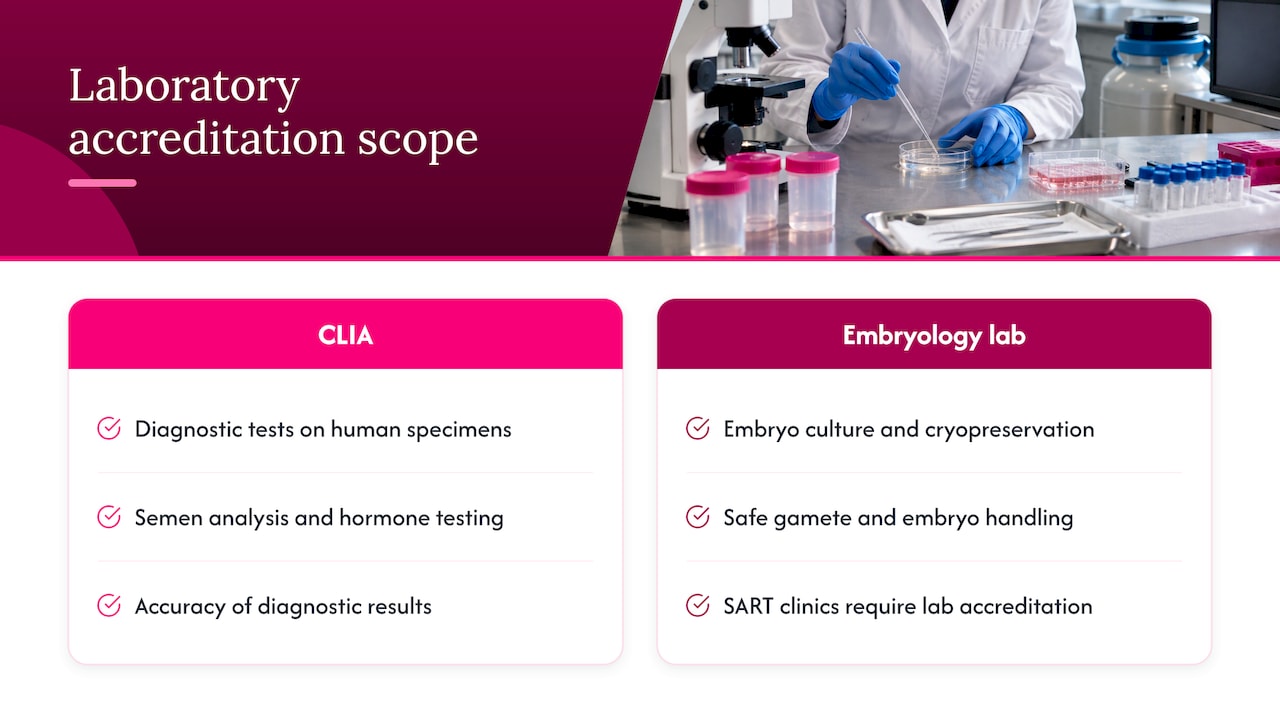
- CLIA, the federal lab law, covers diagnostic tests such as semen analysis and hormone testing. It does not cover embryo culture or cryopreservation.
- SART member clinics must keep an accredited embryology lab, and the CDC publishes each clinic’s lab accreditation status in its annual ART report.
- Accreditation shows that a lab follows written procedures and has competent staff. It does not predict your personal outcome.
Table of Contents
- What accreditation means for an IVF laboratory
- Who oversees IVF labs in the United States
- The two accrediting programs
- What accreditation inspectors look at
- How CLIA fits in, and where it stops
- Is accreditation required?
- How to check a clinic’s lab accreditation
- What accreditation tells you, and what it does not
- Our perspective on lab quality
- Why lab standards matter for freezing and storage
- Pre-treatment testing and the lab
- See what a plan looks like at Life IVF Center
- FAQ
- Sources
What accreditation means for an IVF laboratory
People often use three words as if they meant the same thing: accreditation, certification and regulatory compliance. They are different.
Regulatory compliance means meeting a legal requirement. For labs, that includes federal rules for diagnostic testing and for handling human tissue.
Certification is the term used in the federal Fertility Clinic Success Rate and Certification Act of 1992. According to the Congressional Research Service overview of ART regulation, that law requires clinics to report ART outcomes to the CDC and calls for certification of embryology laboratories.
Accreditation is the peer review itself. A professional body writes standards, inspects the lab against them, and grants or withholds its seal. The same CRS overview names CAP and The Joint Commission as the organizations that carry out embryology laboratory accreditation.
In plain terms: the law sets the expectation, and accreditation is how a lab demonstrates that it meets a defined standard. A lab that is accredited has to provide evidence that its facilities, treatment processes and personnel meet the required standards, a principle described in published work on quality control and certification in assisted reproduction.
Who oversees IVF labs in the United States
The U.S. has no single regulator for IVF. Oversight is layered, and each layer looks at something different.
| Body | Role | What it touches |
|---|---|---|
| CMS (through CLIA) | Federal regulation of diagnostic lab testing | Semen analysis, hormone testing and similar tests |
| FDA | Rules for handling human cells and tissue | Donor eligibility and tissue handling |
| CDC | Collects clinic data under the 1992 Act | Annual ART reporting and surveillance |
| CAP and The Joint Commission | Private embryology lab accreditation | Embryology lab processes and personnel |
| ASRM and SART | Professional standards and membership rules | Best practices, ethics, outcome reporting |
The division of roles above follows the CRS summary of ART regulation and oversight. The American Society for Reproductive Medicine’s overview of IVF oversight adds that state licensing of individual practitioners and private professional bodies also play a part, and that professional oversight complements government rules by setting best practices and ethical standards.
The practical result is that no clinic is forced by a single federal rule to hold an embryology accreditation. The pressure comes from the combination: certification language in federal law, professional membership requirements, and patient expectations.
The two accrediting programs
CAP Reproductive Laboratory Accreditation Program
The CAP Reproductive Laboratory Accreditation Program is a peer-based model. Practicing embryologists perform on-site inspections every two years to assess compliance with quality and safety standards. CAP describes its focus as fail-safe processes for patient identification, specimen labeling, handling of embryos and gametes, and cryostorage, along with evaluation of personnel competency.

Most labs that hold this accreditation combine andrology (sperm) and embryology functions under one program. CAP is also a CMS-approved accrediting organization for andrology and other tests regulated by CLIA, which means one inspection program can address both the embryology side and the diagnostic testing side.
The Joint Commission
The Joint Commission is the second accrediting organization the CDC lists for embryology labs. It is better known for hospital accreditation, and some clinics that sit within larger health systems hold it. The CDC’s National ART Surveillance System page identifies both organizations as the two nonfederal accreditors operating in the U.S. today.
What accreditation inspectors look at
Standards differ in detail between programs, but the themes are consistent. Based on CAP’s published description, an inspection concentrates on the points where an error would be irreversible:
- Patient identification. Every specimen must be matched to the right patient at every step.
- Specimen labeling. Dishes, straws, vials and tanks need clear, verifiable labels.
- Gamete and embryo handling. Procedures should be written down, followed and checked.
- Cryostorage. Storage systems and records need to prevent loss and mix-ups.
- Personnel competency. Staff must be trained and shown to be competent for the work they do.
The broader literature on lab quality makes the same point from a management angle: accreditation emphasizes quality control and verifies that written procedures are actually followed, as discussed in this academic review of quality control and variability in IVF labs. The goal of an IVF lab, the authors note, is a healthy baby, and accreditation is a framework for supporting that goal, not a substitute for it.
How CLIA fits in, and where it stops
CLIA, the Clinical Laboratory Improvement Amendments of 1988, applies to laboratory tests performed on human specimens for diagnosis or treatment decisions. In a fertility practice that means semen analysis, hormone testing and similar work in the andrology and endocrine labs.
Embryology is different. According to ASRM’s committee opinion on laboratory management and operations, procedures such as embryo culture and cryopreservation are not covered by CLIA, because they are not diagnostic tests. The same document explains that CAP or Joint Commission accreditation may substitute for state CLIA inspections of clinical testing laboratories, while SART member clinics must have an accredited embryology laboratory.
If you want a plain-language primer on the CLIA categories themselves, this explanation of what CLIA waived means covers how the federal system sorts tests by complexity. Fertility lab testing generally sits outside the simplest category, which is one reason accreditation matters for andrology and hormone work too.
The takeaway is simple. CLIA protects the accuracy of diagnostic results. Embryology accreditation protects the handling of your gametes and embryos. A clinic that wants to show full quality coverage should be able to speak to both.
Is accreditation required?
It depends on what you mean by required.
- For SART members: yes. SART membership requires embryology laboratory accreditation, renewed every two years, along with annual submission of clinic outcome data, as described on the SART membership page.
- Under federal law: certification is part of the statute. The 1992 Act, summarized by the Congressional Research Service, includes embryology lab certification and CDC reporting, but the accreditation itself is carried out by private organizations.
- For CLIA: only the diagnostic side. Embryology procedures are outside CLIA’s scope.
Because the system is layered, the most useful question for a patient is not whether a rule forces accreditation but whether the clinic’s lab holds it.
How to check a clinic’s lab accreditation
You do not have to take a website’s word for it. A few steps will give you an independent answer.
- Look at the CDC’s annual ART report. The CDC publishes each reporting clinic’s embryology laboratory accreditation status. Start at the CDC National ART Surveillance System page and follow the link to the current report.
- Check SART membership. SART lists member clinics, and membership carries the accredited-lab requirement noted above.
- Read the clinic’s own quality information. Many clinics describe their lab standards and accrediting body on their websites.
- Note which accrediting body is named and which lab activities it covers. Some programs cover embryology and andrology together. Others may apply to a single function.
If a clinic uses outside laboratories for parts of your care, such as genetic testing or diagnostic bloodwork, the accreditation question applies to those labs as well.
What accreditation tells you, and what it does not
Accreditation is a strong signal about process. It shows that a laboratory has been reviewed against written standards, that staff competency is evaluated, and that systems exist for identifying, labeling and storing specimens safely.
It is not a prediction of your own result. IVF outcomes depend on many factors that sit outside the lab: age, ovarian reserve, sperm quality, uterine factors, the stimulation protocol and the underlying diagnosis. Accreditation is best read as one input, alongside a clinic’s approach to your specific history, its transparency about costs, and how clearly the team explains your options.
For that reason, we suggest pairing accreditation checks with the questions that shape your own plan:
- How will the protocol be tailored to my diagnosis and history?
- Is the lab in-house, and who handles each step?
- What testing is done before treatment, and what does it cost?
- How are frozen eggs and embryos tracked and stored?
- What happens to my specimens if there is a power failure or equipment fault?
Our perspective on lab quality
At Life IVF Center, we believe the lab is where a treatment plan becomes real. A well-designed protocol still depends on careful handling at every step, from retrieval to culture to freezing and transfer.
That is why we run our work around in-house laboratory control. Keeping key steps under one roof means our team can coordinate the clinical and laboratory sides of each patient’s plan, which matters most for complex histories such as diminished ovarian reserve, endometriosis, advanced maternal age and immune disorders.
Our Precision IVF® approach is built on the idea that treatment should be shaped by each patient’s biology, medical history and goals. A strong lab, clear standards and a personalized protocol work together, and we think patients are best served when all three are explained openly, including what each treatment step costs.
We also welcome second-opinion cases and patients who have been told elsewhere that options are limited. If you want to understand how lab standards fit your situation, we are glad to walk through them with you.
Why lab standards matter for freezing and storage
Accreditation themes such as specimen labeling and cryostorage become personal when you freeze eggs or embryos. These materials may sit in storage for years, so tracking and storage systems are central to the decision, alongside the cost of keeping them there.
Our published freezing and storage prices, read from our site, are:
| Service | Price |
|---|---|
| Precision Egg Freezing | $7,500 one-off |
| Precision Embryo Freezing | $8,950 one-off |
| Annual Storage | $750 per year |
| 3 Year Prepaid Storage | $2,000 one-off |
| Monthly Storage | $70 per month |
Details and what each item includes are on our freezing pricing page and our storage cost page.
Pre-treatment testing and the lab
Much of the diagnostic work before IVF happens in clinical laboratories, which is where CLIA applies. Our published pre-IVF testing prices include a sperm count at $185, a Pap smear at $185, carrier screening for genetic disease at $349, a karyotype chromosomal analysis at $595, a saline infusion sonohysterogram at $450, an endometrial receptivity assay at $975, and an infectious disease panel at $550 to $750. You can see the full list on our pre-IVF testing page.
These evaluations help shape a protocol before any cycle begins. For patients with complex histories, they are often where a personalized plan starts.
See what a plan looks like at Life IVF Center
If you are comparing clinics, the clearest next step is to look at what a complete treatment plan includes and what it costs. Our Advanced IVF Package is listed at $13,500, and embryo transfer is listed from $2,950. Both appear on our treatment packages page, alongside the IVF Package and the Egg Cryo Package. For our personalized approach to treatment, see our Precision IVF® overview.

When you are ready to talk about your own history, our team can review your records, explain how lab and clinical steps fit together, and outline options including IUI, genetic testing, donor programs and gestational surrogacy. You can find the full list of services on our care page.
FAQ
Is IVF lab accreditation the same as CLIA certification?
No. CLIA is a federal program for diagnostic laboratory testing, such as semen analysis and hormone tests. Embryology work like embryo culture and freezing is not diagnostic, so CLIA does not cover it, according to ASRM’s laboratory guidance. Embryology accreditation comes from CAP or The Joint Commission.
Who accredits IVF labs in the United States?
Two nonfederal organizations do: the College of American Pathologists, through its Reproductive Laboratory Accreditation Program, and The Joint Commission. The CDC’s ART surveillance page names both. CAP inspections are conducted on site by practicing embryologists every two years.
How can I find out if a clinic’s lab is accredited?
The CDC reports embryology laboratory accreditation status for reporting clinics in its annual ART report. You can also check whether a clinic is a SART member, since SART requires accredited embryology labs for membership. Clinics also commonly describe their lab standards on their own sites.
Does accreditation guarantee a successful IVF cycle?
No. Accreditation shows that a lab follows written procedures and has competent staff, but your result depends on factors such as age, diagnosis and protocol. Your fertility specialist can explain how those factors apply to you.
Sources
- Congressional Research Service: Assisted Reproductive Technology Regulation and Oversight
- CDC National ART Surveillance System
- CAP Reproductive Laboratory Accreditation Program
- Academic Review: Quality Control, Best Practices and Variability of IVF Laboratories
This article is for general educational purposes only and is not a substitute for personalized medical advice, diagnosis, or treatment. Fertility care is highly individual; please consult a qualified healthcare professional about your specific circumstances.
Ready to take the next step?
Life IVF Center specializes in individualized Precision IVF® care for complex cases—including diminished ovarian reserve, prior failed cycles, and advanced maternal age. Our in-house labs and dedicated physicians are ready to help.
Book a Free Consultation →