
The best ovulation predictor kit for most people is the Clearblue Advanced Digital Ovulation Test, which detects both LH and estrogen to identify a broader fertile window and displays results as a clear digital symbol rather than a line you have to interpret. For detailed multi-hormone data, the Inito Fertility Tracker is the strongest choice. For budget-conscious testing across multiple cycles, Easy@Home Ovulation Test Strips or Wondfo Ovulation Test Strips keep cost per test low. If you need to both predict and confirm ovulation, particularly with PCOS or irregular cycles, the Proov Predict & Confirm Kit adds post-ovulation progesterone marker testing that standard LH strips cannot provide. These picks are drawn from editorial in-home testing of multiple brands, clinician input, and alignment with FDA ovulation test guidance on labeling and intended use. When home testing produces ambiguous results or you are preparing for IUI or IVF, clinical monitoring at a fertility center like Life IVF Center offers a more precise path.
TL;DR: Quick picks by use case
- Best overall / digital clarity: Clearblue Advanced Digital Ovulation Test
- Best multi-hormone detail: Inito Fertility Tracker
- Best for PCOS / ovulation confirmation: Proov Predict & Confirm Kit
- Best budget strips: Easy@Home or Wondfo Ovulation Test Strips
- Best for clinical follow-up: Life IVF Center (Precision IVF® and clinic monitoring)
Table of Contents
- What are the best ovulation predictor kits? At-a-glance comparison
- Detailed picks: which kit is right for you?
- How we tested and chose these ovulation kits
- How do ovulation predictor kits detect your fertile window?
- How do you choose the right OPK for your situation?
- How to use OPKs and time intercourse correctly
- What are the limits of at-home OPKs?
- When does clinic monitoring add more than a home OPK can?
- What is the final recommendation?
- Key Takeaways
- What testing actually taught us about these kits
- When home testing is not enough: Life IVF Center’s clinical approach
- Authoritative sources and further reading
What are the best ovulation predictor kits? At-a-glance comparison
The table below compares each kit on the dimensions that matter most for a buying decision. Manufacturer accuracy claims are noted where published; cost-per-test figures reflect typical U.S. retail ranges.
| Kit | Type | Hormones detected | Result display | Accuracy / validation | Pack size & cost per test | Best for | Where to buy |
|---|---|---|---|---|---|---|---|
| Clearblue Advanced Digital | Digital reader + sticks | LH + estrogen (E2) | Digital smiley symbol | Up to 99% LH-surge detection (manufacturer claim) | 10–20 sticks; higher cost per test | Clear readout, broader fertile window | Amazon, Target, Walmart, CVS |
| Inito Fertility Tracker | Smart tracker + app | LH, E3G, PdG, FSH | Quantitative app graph | Multi-hormone clinical validation | Monitor + test strips; ~$3–$5/test | Irregular cycles, data-focused users | Inito website, Amazon |
| Premom Quantitative Strips | Strip + app | LH (quantitative) | Numeric app readout | App-based quantitative LH | 50 strips; under $0.50 per test | LH trend tracking on a budget | Amazon, Premom app |
| Easy@Home Strips | Strip | LH only | Visual line | Standard LH detection | 50–100 strips; ~$0.20–$0.40/test | Budget, high-frequency testing | Amazon, Walmart |
| Wondfo Strips | Strip | LH only | Visual line | Standard LH detection | 50–100 strips; ~$0.20–$0.35/test | No-frills LH timing | Amazon |
| Proov Predict & Confirm | Strip kit | LH + PdG (progesterone marker) | Visual line | PdG confirmation post-ovulation | ~28 strips/kit; higher cost per test | PCOS, ovulation confirmation | Amazon, Proov website |
| MomMed Strips | Strip | LH only | Visual line | Standard LH detection | 50 strips; under $0.50 per test | Simple, consistent supply | Amazon |
| Vivoo Ovulation & Pregnancy Kit | Strip (combo) | LH + hCG (pregnancy) | Visual line | Standard LH/hCG detection | Combo pack; around $0.50 per test | Budget dual-purpose testing | Amazon |
Detailed picks: which kit is right for you?
Clearblue Advanced Digital Ovulation Test and Clearblue Smart
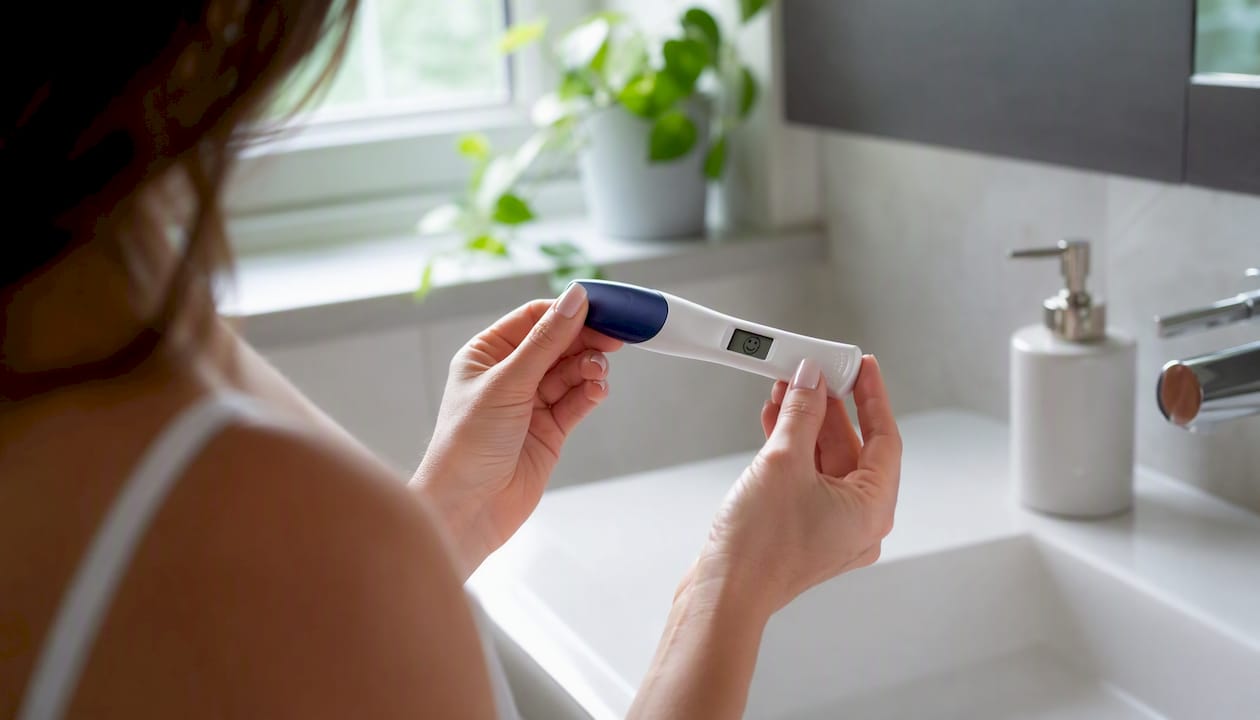
The Clearblue Advanced Digital is the most straightforward choice for anyone who finds line-reading stressful. The digital reader converts the result into a smiley face: a flashing smiley for high fertility (rising estrogen), a solid smiley for peak fertility (LH surge). Clearblue markets this as highly accurate at detecting LH surges in clinical testing, and the two-hormone approach typically identifies a broader fertile window than the two days a standard LH-only strip catches.
Pros: Clear digital readout eliminates line-reading ambiguity; two-hormone detection broadens the fertile window; widely available at major U.S. retailers; app integration available with the Clearblue Smart version.
Cons: Ongoing cost of replacement sticks adds up; the reader itself is an additional upfront purchase.
Who should buy it: Anyone who wants a reliable, easy-to-read result and is willing to pay a modest premium for clarity. Particularly useful if you have been misreading line-based strips.
Inito Fertility Tracker
Inito is the most data-rich home option on this list. The monitor plugs into a smartphone and reads test strips that measure four hormones: estrogen (E3G), LH, progesterone metabolite (PdG), and FSH. The app charts each hormone numerically across your cycle, so you can see not just when LH peaks but whether estrogen rose appropriately beforehand and whether PdG confirmed ovulation afterward. Editorial testing at The Bump highlights Inito as a top pick for users who want granular cycle data.
Pros: Quantitative multi-hormone charting; confirms ovulation via PdG; useful for identifying cycle irregularities over time.
Cons: Higher cost per test strip; requires a smartphone and the Inito app to read results; data volume can feel excessive for users who just want a simple positive or negative.
Who should buy it: People with irregular cycles, a history of unexplained infertility, or anyone who wants to understand their cycle pattern before consulting a specialist. Also a strong choice before a fertility evaluation to bring meaningful data to a first clinic appointment.
Premom Quantitative Ovulation Test Strips
Premom strips occupy a useful middle ground: the strips themselves are inexpensive, but the Premom app reads the line darkness and converts it into a numeric LH value, giving you a trend chart over time. This quantitative readout lets you see whether your LH is rising gradually or spiking sharply, which can help you time testing more precisely in subsequent cycles.
Pros: Low cost per strip; quantitative LH trend data via app; large pack sizes available.
Cons: App dependency for quantitative reading; LH only (no estrogen or PdG confirmation); line reading without the app is still subjective.
Who should buy it: Budget-conscious users who want more than a simple positive or negative but are not ready to invest in a full multi-hormone tracker.
Easy@Home Ovulation Test Strips
Easy@Home strips are among the most widely used budget options in the U.S., largely because bulk packs of 50 or more keep the cost per test well under $0.50. They detect LH only and display a visual line. The Premom app can also scan Easy@Home strips for a numeric readout, which extends their utility. Parents’ editorial testing of more than 20 brands includes Easy@Home among its top picks for value.
Pros: Very low cost per test; large pack sizes; compatible with the Premom app scanner; widely available.
Cons: Visual line reading requires practice; LH only; no digital clarity.
Who should buy it: Anyone testing daily across a full cycle who needs to keep costs manageable. Also a practical choice for a first cycle of testing before deciding whether to invest in a more advanced kit.
Wondfo Ovulation Test Strips
Wondfo strips are functionally similar to Easy@Home: LH-only, visual line, bulk packs, low cost per test. They are slightly faster to read than some competitors, with a result window that is clear within about five minutes. For users who simply want to detect an LH surge without any app involvement, Wondfo is a reliable, no-frills option.
Pros: Affordable; fast result; no app required; widely available on Amazon.
Cons: LH only; no quantitative data; line interpretation can be ambiguous near the surge.
Who should buy it: Users who want the cheapest possible option for basic LH timing and are comfortable reading lines without app assistance.
Proov Predict & Confirm Kit
Proov is the only kit on this list designed explicitly to both predict and confirm ovulation. The “predict” strips detect LH surge; the “confirm” strips test for PdG, a urine progesterone metabolite that rises after ovulation occurs. This two-phase approach is particularly valuable for people with PCOS, where elevated baseline LH can produce false-positive surges on standard strips. As University of Iowa Health Care notes, LH-only kits can be unreliable for people with PCOS or complex reproductive histories.
Pros: Confirms ovulation actually occurred, not just that LH surged; useful for PCOS; provides PdG data that standard strips cannot.
Cons: Higher cost per cycle than basic strips; requires testing across more days; two separate strip types to manage.
Who should buy it: Anyone with PCOS, irregular cycles, or a history of suspected anovulatory cycles. Also useful for people who have had positive LH results but are not conceiving, and want to verify that ovulation is actually happening.
MomMed Ovulation Test Strips
MomMed strips are a straightforward LH-only option with consistent availability and simple packaging. There is no app integration or quantitative readout. They function reliably for basic cycle timing and are sold in packs of 50, making them a practical choice for users who want a predictable supply without complexity.
Pros: Simple to use; consistent pack sizing; no app required.
Cons: LH only; no digital or quantitative readout; nothing that distinguishes them from other basic strips.
Who should buy it: Users who want a dependable, no-frills strip option and are not interested in app-based tracking.
Vivoo Ovulation & Pregnancy Test Kit
Vivoo’s combined kit includes both ovulation (LH) and pregnancy (hCG) test strips in one package. The value proposition is convenience: you buy one kit instead of two separate products. The strips are basic visual-line tests with no digital reader or app integration.
Pros: Combined ovulation and pregnancy testing; budget-friendly; convenient single purchase.
Cons: No quantitative data; LH only for ovulation detection; no app or digital readout.
Who should buy it: Budget buyers who want to cover both ovulation timing and early pregnancy detection without purchasing two separate products.
Pro Tip: If you are using a basic LH strip and the line looks almost as dark as the control line but not quite, test again two to four hours later. LH surges can rise quickly, and a borderline result in the morning sometimes becomes a clear positive by early afternoon.
How we tested and chose these ovulation kits
Selecting the best ovulation predictor kits required more than reading product descriptions. The evaluation process involved in-home testing across multiple brands and cycle days, assessing each kit against a defined set of criteria: hormone detection type, result clarity, repeatability across days, cost per test, app or reader requirements, and accuracy of packaging claims relative to published clinical standards.
The shortlist was cross-referenced against editorial testing from Parents, which covered more than 20 brands with real-world home use, and against The Bump’s clinician-reviewed testing, which incorporated input from reproductive endocrinologists. Manufacturer accuracy claims were evaluated against FDA guidance for home ovulation urine tests and peer-reviewed clinical literature.
Inclusion criteria for the shortlist:
- Available for purchase in the United States through major retailers or direct online
- Published accuracy claims or clinical validation data from the manufacturer or independent sources
- Pack sizes practical for at least one full cycle of testing
- Clear labeling of which hormones are detected and how results are displayed
- Sufficient user and editorial testing data to assess real-world performance
Products were excluded if they lacked any published clinical validation, were unavailable through U.S. retail channels, or had significant unresolved labeling discrepancies.
“Combining editorial testing with clinician input is the most reliable way to evaluate ovulation kits, because what looks clear on a package insert does not always match what a user sees at 7 AM on cycle day 14.”
(Editorial testing methodology, aligned with The Bump’s clinician-reviewed approach)
One consistent finding across testing: kits that require app-based reading for their primary function introduce a dependency that affects usability for some users. This was weighted as a moderate negative for kits where the app is mandatory (rather than optional) to obtain a result.
How do ovulation predictor kits detect your fertile window?
Ovulation predictor kits work by detecting hormonal changes in urine that signal the body is approaching ovulation. The most common target is luteinizing hormone (LH), which surges sharply in the 24–36 hours before an egg is released. According to University of Iowa Health Care, ovulation typically occurs within about 36 hours of an LH surge, and the recommended window for intercourse is the day of a positive result and the day after.
Key timing fact: Ovulation occurs within approximately 36 hours of an LH surge. Having intercourse on the day of a positive OPK result and the following day captures the highest-probability conception window.
Different kit types detect different signals, and understanding those differences helps you choose the right tool for your situation.
LH-only strips and midstream sticks detect the LH surge in urine and display a visual line or digital symbol. They are the most common and affordable type, but they identify only the peak fertility moment, not the broader fertile window leading up to it.
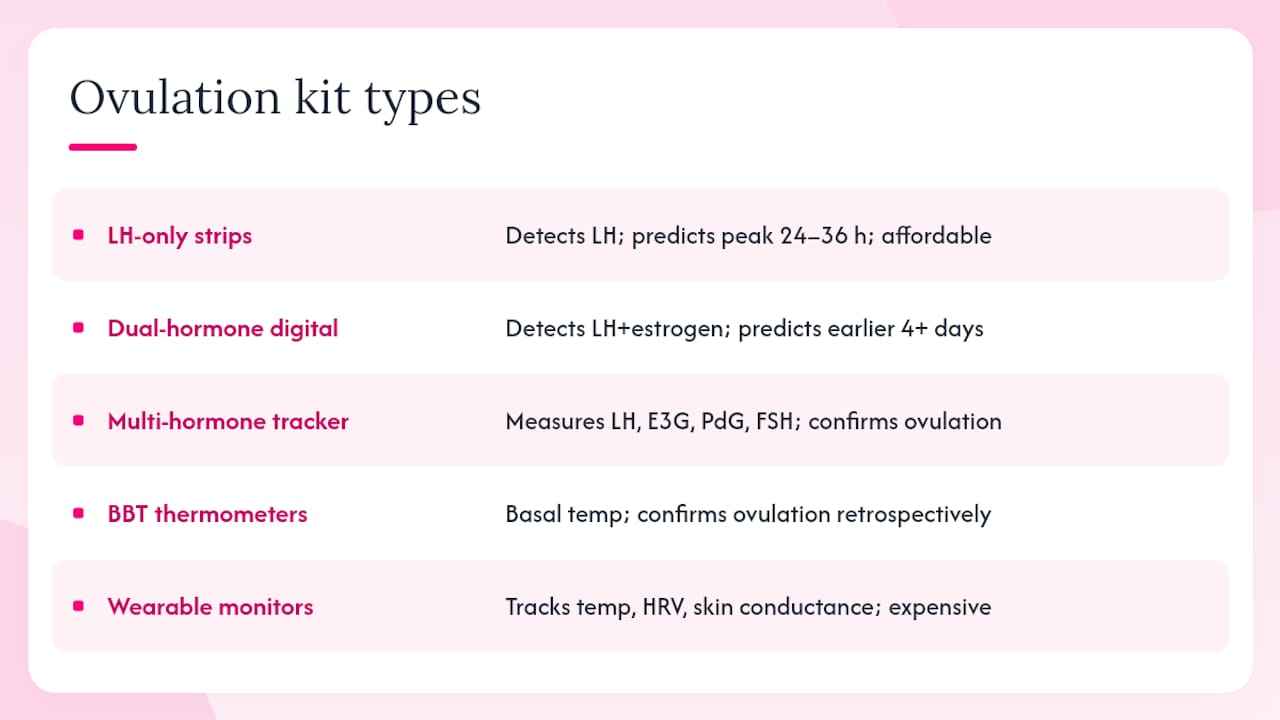
Dual-hormone digital tests (such as Clearblue Advanced Digital) detect both LH and estrogen (E2). Rising estrogen signals the approach of ovulation before LH peaks, so these tests can identify high-fertility days earlier in the cycle, typically extending the detectable fertile window to four or more days.
Multi-hormone quantitative trackers (such as Inito) measure LH, estrogen metabolite (E3G), progesterone metabolite (PdG), and FSH numerically. This gives a complete picture of the cycle: estrogen rise, LH peak, and post-ovulation progesterone confirmation. Understanding fertility hormone levels in this context helps users interpret whether each phase of the cycle is proceeding normally.
BBT thermometers measure basal body temperature, which rises slightly after ovulation due to progesterone. As Cleveland Clinic resources clarify, BBT confirms ovulation retrospectively rather than predicting it, making it a complement to OPKs rather than a replacement.
Wearable monitors track continuous physiological signals (temperature, heart rate variability, skin conductance) to estimate fertile windows, but their clinical validation varies and they are generally more expensive than strip-based options.
Mayo Clinic recommends combining OPKs with cervical mucus observation and BBT tracking for more reliable ovulation detection, particularly for users with irregular cycles.
Pro Tip: If you are using LH-only strips and want to extend your fertile-window detection without upgrading to a digital kit, start tracking cervical mucus changes alongside your strips. The combination gives you an earlier signal than LH alone.
How do you choose the right OPK for your situation?
The right ovulation predictor kit depends on three things: how much data you want to manage, how regular your cycles are, and what you plan to do with the results. Here is a practical framework.
Start with your cycle regularity. If your cycles are consistent (within a few days of the same length each month), a basic LH strip or digital test is usually sufficient. If your cycles vary by more than a week, or if you have been diagnosed with PCOS, a multi-hormone tracker or the Proov Predict & Confirm Kit gives you more reliable information.
Consider your comfort with apps. Some kits require an app to display results (Inito, Premom quantitative). Others offer an app as an optional enhancement (Easy@Home with Premom scanner). If you prefer a self-contained test with no phone dependency, Clearblue Advanced Digital or any basic strip works independently.
Calculate your real cost per cycle. A pack of 50 Easy@Home strips at $15 costs $0.30 per test. If you test once daily for 10 days, that is $3 per cycle. A Clearblue Advanced Digital kit with 10 sticks at $20 costs $2 per test, or $20 for the same 10-day window. The Inito monitor has a higher upfront cost but lower per-strip cost over time. Budget the full cycle, not just the pack price.
Key questions to ask yourself before buying:
- Do I have regular cycles, or do they vary significantly in length?
- Am I comfortable reading visual lines, or do I need a digital readout?
- Do I want to confirm that ovulation actually occurred, or just predict it?
- Am I preparing for IUI or IVF, where clinic protocols may override home-test timing?
- How many cycles am I planning to test before escalating to clinical evaluation?
Red flags to watch for:
- Kits that require a paid app subscription to read results (app lock-in)
- Manufacturers that do not publish their LH detection threshold (mIU/mL)
- Persistent positive LH results across multiple days, which may indicate PCOS rather than a true surge
- Packaging that claims “detects ovulation” rather than “detects the LH surge that precedes ovulation,” a meaningful distinction
Pro Tip: Calculate cost per useful cycle, not cost per strip. If you test for 10 days per cycle and use two strips per day during your peak window, a pack of 50 strips covers roughly two to three cycles. That is the number that matters for budgeting.
For users considering top fertility supplements alongside OPK testing, timing supplementation to cycle phase becomes more meaningful once you have reliable ovulation data.
How to use OPKs and time intercourse correctly
Using an ovulation predictor kit correctly is straightforward, but a few common errors reduce accuracy significantly. Follow this sequence for reliable results.
- Determine when to start testing. Subtract 17 from your average cycle length to find your start day. For a 28-day cycle, start testing on day 11. For a 35-day cycle, start on day 18.
- Choose the right time of day. For intercourse timing, test between 10 AM and 8 PM. LH is synthesized in the morning and appears in urine a few hours later, so midday testing catches the surge earlier than first-morning urine. First-morning urine is appropriate for some multi-hormone trackers (check your specific kit’s instructions).
- Limit fluid intake before testing. Avoid drinking large amounts of fluid for two hours before testing, as diluted urine can reduce LH concentration and produce a false-negative result.
- Test once daily until you see a rise, then increase to twice daily. Once you observe a line that is noticeably darker than previous days, test again 8–12 hours later to catch the peak.
- Read the result within the time window. Most strips should be read at 3–5 minutes. Reading too early or too late can affect line interpretation.
- Record your results. Log each result with the date and time, either in an app or a paper chart. Trends across days are more informative than any single result.
- Time intercourse on the day of a positive result and the following day. University of Iowa Health Care recommends this two-day window as the highest-probability period for conception.
Timing window: Ovulation occurs within approximately 36 hours of an LH surge. The day of a positive OPK and the following day represent the peak conception window for most people.
Practical tips for better results:
- If using a strip, lay it flat on a clean surface rather than holding it during the result window.
- Photograph each strip result with your phone for a visual record of the LH rise across days.
- If you get a positive on cycle day 10 or earlier, consider whether your cycle is shorter than expected or whether the result may be a false positive.
- For IUI timing specifically, follow your clinic’s instructions rather than the package insert. Clinics often instruct patients to test during the day, call by a specific time if positive, and may use different timing protocols than home-use directions suggest.
What are the limits of at-home OPKs?
Home ovulation predictor kits are reliable tools for most people with regular cycles, but they have documented limitations that are worth understanding before you rely on them exclusively.
PCOS and elevated baseline LH. People with polycystic ovary syndrome frequently have chronically elevated LH levels, which can produce persistent positive or near-positive results on LH-only strips. This makes it difficult to identify a true surge. University of Iowa Health Care notes that LH-only kits can be unreliable for people with PCOS, and that tracking additional markers (PdG, E3G) or using clinic bloodwork and ultrasound reduces diagnostic uncertainty.
Fertility medications. Clomiphene (Clomid), letrozole, and injectable gonadotropins can alter LH patterns and make OPK results difficult to interpret. Some medications trigger an LH-like surge that produces a false positive. If you are taking any fertility medication, consult your prescribing physician before relying on home OPK results.
Perimenopause. Fluctuating FSH and LH levels during perimenopause can produce erratic OPK readings that do not correspond to true ovulatory cycles.
Low-estrogen cycles. In cycles where estrogen does not rise adequately, dual-hormone tests may not detect a “high fertility” phase even if LH surges normally. This can underestimate the fertile window.
“At-home OPKs detect the hormonal signal that precedes ovulation, they do not confirm that ovulation actually occurred. For confirmation, progesterone testing or ultrasound monitoring is required.”
(Aligned with NCBI peer-reviewed clinical literature on OPK accuracy)
When to see a fertility specialist:
- No positive OPK result by cycle day 22 in a regular cycle
- Persistent positive results across five or more consecutive days (possible PCOS signal)
- Irregular cycles that make it difficult to know when to start testing
- Prior failed conception attempts after six months of timed intercourse (12 months if under 35)
- Planning IUI or IVF, where clinic monitoring replaces home testing
- Any history of endometriosis, diminished ovarian reserve, or immune-related fertility concerns
Pro Tip: If you have been getting positive OPK results but are not conceiving after several cycles, ask your doctor about a mid-luteal progesterone blood test. A positive LH strip confirms a surge occurred; it does not confirm that a viable egg was released or that progesterone rose adequately afterward.
When does clinic monitoring add more than a home OPK can?
Home OPKs are a practical first step for most people trying to conceive, but there are clinical scenarios where urine hormone testing alone is insufficient. Life IVF Center’s clinical team sees this regularly: patients who have been testing at home for months, getting positive LH results, and still not conceiving. The gap is often not in the testing itself but in what the testing cannot see.
Clinic monitoring adds value in several specific situations. For patients with PCOS, bloodwork and transvaginal ultrasound can distinguish a true LH surge from the chronically elevated baseline LH that makes home strips unreliable. For patients with diminished ovarian reserve or irregular cycles, serial ultrasound monitoring of follicle growth gives a direct view of whether a dominant follicle is developing and when it is likely to release. This is the kind of precision that follicle monitoring in fertility treatment provides that no home kit can replicate.
For IUI cycles, the timing difference matters clinically. As University of Iowa Health Care explains, clinic protocols for IUI often instruct patients to test during the day rather than using first-morning urine, and to call the clinic by a specific time if positive. The clinic may then schedule the IUI procedure within a precise window that differs from standard home-use package directions.
For IVF cycles, ovulation timing is managed entirely through the clinic’s stimulation protocol. Home OPKs are not used during a monitored IVF cycle because the clinic controls the hormonal environment directly. Understanding the IVF process makes clear why clinic monitoring replaces, rather than supplements, home testing at that stage.
Pro Tip: If you are considering IUI and your clinic has not given you specific OPK instructions, ask explicitly whether to use first-morning urine or midday urine, and what time to call if you get a positive. The answer will differ from your kit’s package insert.
What is the final recommendation?
For most people trying to conceive with regular cycles, the Clearblue Advanced Digital Ovulation Test is the best overall choice: clear digital results, two-hormone detection, and manufacturer clinical accuracy claims make it the most reliable and user-friendly option at a reasonable price point.
Quick alternatives by situation:
- Best for detailed cycle data: Inito Fertility Tracker, for users who want quantitative multi-hormone charting across the full cycle
- Best for PCOS or ovulation confirmation: Proov Predict & Confirm Kit, for its predict-and-confirm approach with PdG testing
- Best budget option: Easy@Home or Wondfo strips, for high-frequency testing at the lowest cost per test
- Best for LH trend tracking on a budget: Premom Quantitative Strips with the Premom app
- Best combined kit: Vivoo Ovulation & Pregnancy Test Kit, for budget buyers who want both test types in one purchase
Next steps:
- Buy a kit matched to your cycle regularity and data preferences using the comparison table above.
- Test for at least one full cycle before drawing conclusions about your pattern.
- If results are ambiguous, inconsistent, or you are not conceiving after several cycles of timed intercourse, schedule a fertility evaluation with a specialist.
Key Takeaways
The most reliable ovulation predictor kit for most people is the Clearblue Advanced Digital, which detects both LH and estrogen to identify a broader fertile window with a clear digital readout.
| Point | Details |
|---|---|
| Best overall kit | Clearblue Advanced Digital detects LH and estrogen, displays a clear digital result, and claims up to 99% LH-surge detection accuracy. |
| Best for PCOS or confirmation | Proov Predict & Confirm Kit adds post-ovulation PdG testing, making it the most reliable choice when LH-only strips produce ambiguous results. |
| Best budget strips | Easy@Home and Wondfo strips cost under $0.40 per test and are suitable for daily testing across a full cycle. |
| Key OPK limitation | LH-only strips cannot confirm ovulation occurred; PCOS, fertility medications, and perimenopause can all produce unreliable readings. |
| When to escalate to clinic care | If no positive OPK appears by cycle day 22, cycles are irregular, or conception has not occurred after several timed cycles, clinic monitoring at Life IVF Center provides precision that home testing cannot. |
What testing actually taught us about these kits
The most consistent finding across testing was that clarity of result display matters more than most buyers expect. Users who switched from visual-line strips to a digital reader consistently reported fewer missed surges, not because the digital test detected LH more accurately, but because they stopped second-guessing borderline lines. That distinction has a real effect on whether intercourse is timed correctly.
The second finding is less obvious: more data is not always better. Multi-hormone trackers like Inito provide genuinely useful information for users with irregular cycles or a history of unexplained infertility. For someone with a regular 28-day cycle who simply wants to know when to have intercourse, the same tracker can produce data overload that leads to anxiety rather than clarity. The right kit is the one that gives you the information you will actually use, at a cost you can sustain across multiple cycles.
A recurring user error across all kit types: testing only once per day and stopping after the first positive. LH surges can be brief, and a single daily test can miss the peak entirely. Testing twice daily during the expected surge window, and continuing for one day after a positive, captures the full picture.
When home testing is not enough: Life IVF Center’s clinical approach
Home ovulation predictor kits are a practical starting point, but they have a ceiling. For patients with PCOS, diminished ovarian reserve, endometriosis, or a history of failed timed cycles, Life IVF Center’s Precision IVF® approach offers something no home kit can: a treatment protocol customized to your specific hormonal profile, cycle history, and reproductive goals.
At Life IVF Center’s Southern California locations, clinic monitoring replaces the guesswork of home testing with serial bloodwork, ultrasound follicle tracking, and physician-directed timing for IUI or IVF procedures. Patients who have spent months testing at home and not conceiving often find that a single monitored cycle reveals the specific issue that strips could not detect. Whether you are considering IUI, IVF, egg freezing, or a comprehensive fertility evaluation, the path forward starts with a consultation.
Review treatment packages and pricing or book a consultation directly through the Life IVF Center website to discuss which monitoring or treatment approach fits your situation.
Authoritative sources and further reading
The following sources were used to verify clinical claims, accuracy figures, and testing methodology throughout this article.
University of Iowa Health Care: Ovulation Predictor Kits (OPK)
Primary clinical reference for LH surge timing (ovulation within ~36 hours), intercourse timing recommendations, IUI protocol differences, and PCOS limitations of LH-only kits.
FDA: Ovulation Urine Test
Regulatory guidance on intended use, labeling standards, and consumer information for home ovulation tests sold in the United States.
NCBI / PMC: Peer-reviewed clinical literature on OPK accuracy
Systematic review and observational study data on OPK accuracy, false-positive and false-negative rates, and appropriate clinical contexts for home testing.
Mayo Clinic: Ovulation and fertility Q&A
Recommends combining OPKs with cervical mucus observation and BBT tracking; explains observable ovulation signs.
Cleveland Clinic: Hormone timing and OPK context
Clarifies that progesterone rises after ovulation and BBT confirms ovulation retrospectively, distinguishing what OPKs detect from what clinics confirm.
Clearblue: Smart Ovulation Test
Manufacturer accuracy claims (up to 99% LH-surge detection), two-hormone detection methodology, and app integration details.
The Bump: 6 Best Ovulation Tests
Clinician-reviewed editorial testing supporting multi-hormone trackers and naming Inito, Clearblue Advanced, Easy@Home, Premom, Wondfo, Proov, MomMed, and Vivoo among top picks.
Parents: The 10 Best Ovulation Tests
Editorial testing of more than 20 brands with real-world home use, pregnancy outcomes, and comparative user notes supporting the shortlist choices in this article.
A note on medical advice: This article provides general information about ovulation predictor kits and is not a substitute for personalized medical advice. If you have concerns about your cycle, fertility, or reproductive health, consult a qualified healthcare provider or fertility specialist.
Recommended
- Top fertility supplements: Evidence, comparisons, and expert picks
- Your fertility evaluation checklist: Steps, tests, and benchmarks
- Blog – Life IVF Center
- Why consider fertility testing? Key insights and action steps
Ready to take the next step?
Life IVF Center specializes in individualized Precision IVF® care for complex cases—including diminished ovarian reserve, prior failed cycles, and advanced maternal age. Our in-house labs and dedicated physicians are ready to help.
Book a Free Consultation →