
Donor egg IVF is a fertility treatment where eggs from a screened donor are fertilized with sperm and transferred to the recipient’s uterus to achieve pregnancy. It is the standard clinical term for what many people call “egg donor IVF” or “IVF with donor eggs.” For individuals and couples exploring this path, understanding donor egg IVF what to expect medically, emotionally, and practically makes the process far less overwhelming. This guide covers every stage: the egg donor IVF process, donor egg IVF success rates, emotional preparation, and what pregnancy looks like after a successful transfer.
What does the donor egg IVF process involve?
Donor egg IVF differs from standard IVF in one critical way: the recipient does not undergo egg retrieval. The donor handles that part. The recipient’s role centers entirely on preparing her uterus to receive the embryo. Understanding this division of responsibility clarifies what you will actually experience during treatment.
The egg donor IVF process follows these steps in sequence:
- Donor screening and selection. Donors undergo genetic testing, psychological evaluation, and medical screening. Recipients typically choose from an agency or clinic database based on physical traits, education, and health history.
- Ovarian stimulation. The donor receives injectable hormones to stimulate her ovaries to produce multiple eggs. This phase lasts approximately 10–14 days.
- Egg retrieval. The donor’s eggs are collected under sedation using a transvaginal ultrasound-guided needle. This is the donor’s egg retrieval procedure, not the recipient’s.
- Fertilization and embryo culture. Retrieved eggs are fertilized with the intended father’s or donor sperm in a laboratory. Embryos develop over 3–5 days.
- Uterine preparation. The recipient takes estrogen and progesterone to thicken the uterine lining and prepare it for implantation. Recipient uterine receptivity is critical for implantation success, making this phase as medically significant as the retrieval itself.
- Embryo transfer. One or two embryos are placed into the recipient’s uterus via a thin catheter. The procedure takes about 15 minutes and requires no anesthesia.
- Pregnancy test. A blood test approximately 10–14 days after transfer confirms whether implantation occurred.
The full timeline from consultation to pregnancy test spans approximately 6–8 weeks. That is a relatively short window for a process with such significant outcomes.
Fresh vs. frozen donor egg cycles

The choice between fresh and frozen donor eggs affects timing, cost, and logistics. Frozen donor eggs simplify scheduling because the recipient’s cycle does not need to be synchronized with the donor’s. That flexibility is a meaningful advantage for couples managing work, travel, or complex medical schedules.
| Factor | Fresh donor eggs | Frozen donor eggs |
|---|---|---|
| Cycle synchronization | Required | Not required |
| Scheduling flexibility | Limited | High |
| Live birth rate per transfer | ~55.3% | ~46.7% |
| Cost | Generally higher | Generally lower |
| Availability | Dependent on donor schedule | Immediately available |
Pro Tip: If your schedule or geographic location makes synchronization difficult, frozen donor eggs offer nearly equivalent success with far greater flexibility. Discuss both options with your specialist before committing.
What are the donor egg IVF success rates?
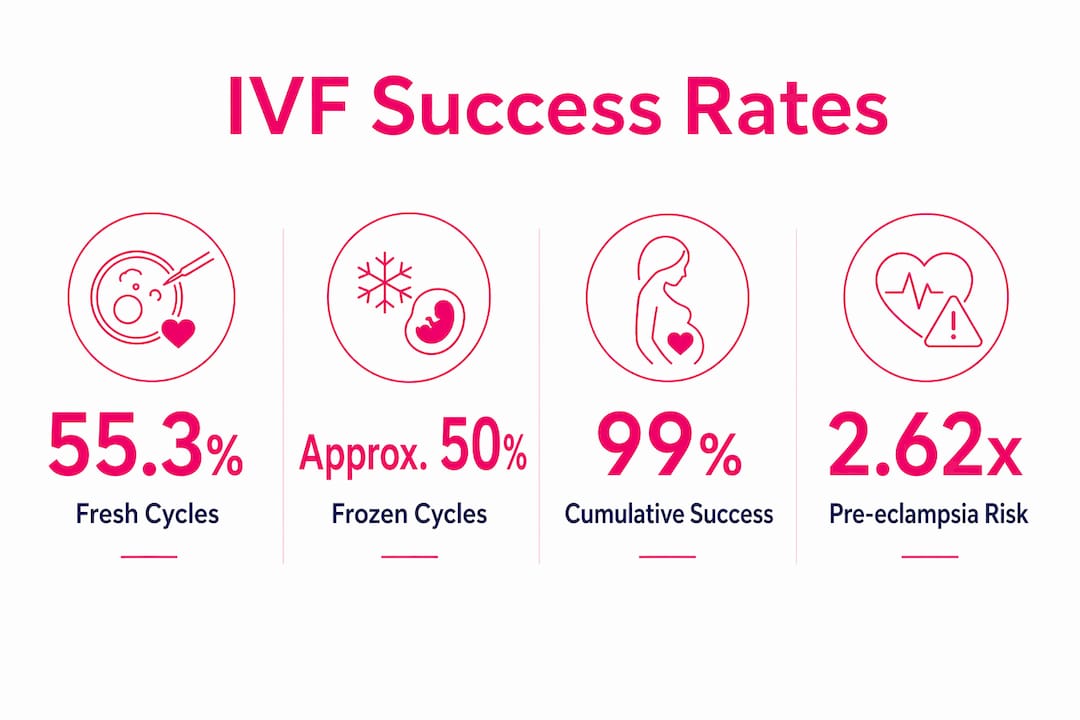
Fresh donor egg cycles carry a live birth rate of approximately 55.3% per transfer. Frozen donor egg cycles come in at approximately 46.7%. These numbers are significantly higher than standard IVF using a patient’s own eggs, primarily because donor eggs come from younger, thoroughly screened women.
The cumulative picture is even more encouraging. With multiple embryo transfers, success rates approach 99% in some programs. That figure reflects the compounding probability across several transfer attempts, not a single cycle guarantee.
Statistic callout: A recipient using frozen donor eggs has approximately a 47% chance of a live birth on the first transfer. After a second attempt with a replacement donor egg lot, live birth probability remains roughly the same as the first attempt. Persistence is clinically supported.
Several factors influence individual outcomes beyond the published averages:
- Donor age. Younger donors produce higher-quality eggs with better chromosomal integrity.
- Recipient uterine health. Conditions like fibroids, polyps, or thin endometrial lining reduce implantation success.
- Sperm quality. Male factor fertility directly affects fertilization rates. A male fertility evaluation before starting treatment helps identify and address any issues early.
- Clinic expertise. Laboratory quality, embryologist experience, and protocol customization all affect outcomes.
Pro Tip: If your first transfer does not result in pregnancy, request a full review of your uterine preparation protocol before the next attempt. Small adjustments to estrogen dosing or transfer timing can make a measurable difference.
What emotional challenges should you expect during donor egg IVF?
Emotional preparation is as important as medical preparation in donor egg IVF. Many recipients experience a grief response over the absence of a genetic connection to the child, even when they feel intellectually at peace with the decision. That grief is normal, and it does not predict how you will feel as a parent.
Emotional challenges including grief, anxiety, and mood changes are common throughout treatment. Hormone medications during the uterine preparation phase can amplify these feelings. Recognizing that as a physiological effect, not a personal failing, helps you stay grounded.
Common emotional experiences during the donor egg IVF timeline include:
- Grief over genetic loss. Processing the absence of a biological connection takes time. Many recipients find this feeling resolves significantly after a positive pregnancy test.
- Anxiety during the two-week wait. The period between embryo transfer and pregnancy test is consistently reported as the most psychologically difficult phase.
- Relationship strain. Partners often process the experience differently. Open communication and shared decision-making reduce conflict.
- Hope and anticipation. Most recipients also report strong feelings of hope, particularly after seeing high-quality embryos confirmed by the lab.
Professional counseling is not optional for most people going through this process. It is a clinical recommendation. IVF counseling helps recipients process identity questions, manage anxiety, and build communication skills with their partners. Support groups, both in-person and online, connect you with others who understand the specific experience of using donor eggs.
Involving your partner actively in appointments, decisions, and emotional check-ins reduces isolation for both of you. If your partner is not the one undergoing hormone treatment, they may underestimate the physical and emotional toll. Sharing this guide with them is a practical first step.
What does pregnancy look like after a successful donor egg transfer?
A donor egg pregnancy is medically managed like any other IVF pregnancy in most respects. You will continue progesterone and estrogen supplementation for the first 8–10 weeks until the placenta takes over hormone production. After that, prenatal care follows a standard schedule.
One important distinction: donor egg pregnancies carry approximately 2.62 times the risk of pre-eclampsia compared to own-egg IVF pregnancies. The immune response to genetically foreign placental tissue is the likely mechanism. This does not mean pre-eclampsia is inevitable. It means your care team will monitor your blood pressure and urine protein levels more frequently than in a typical pregnancy.
Key medical considerations during a donor egg pregnancy include:
- Frequent blood pressure monitoring starting in the first trimester, not just the third.
- Regular urinalysis to detect early signs of pre-eclampsia before symptoms appear.
- Ultrasound surveillance at standard intervals, with additional scans if your provider identifies any concerns.
- Multiple pregnancy risk. Approximately 20–25% of donor egg IVF pregnancies result in multiples when more than one embryo is transferred. Most clinics now recommend single embryo transfer to reduce this risk.
- Miscarriage rates with donor eggs are lower than with own-egg IVF in older patients, because donor egg quality is typically higher.
The emotional experience of a donor egg pregnancy is also worth acknowledging. Many recipients report that the physical reality of carrying the pregnancy, feeling movement, and giving birth creates a profound sense of connection that transcends genetics. That is not a guarantee, but it is a consistently reported experience.
Key Takeaways
Donor egg IVF offers live birth rates above 55% per fresh transfer cycle, with cumulative success approaching 99% across multiple attempts, making it one of the most effective fertility treatments available.
| Point | Details |
|---|---|
| Recipient role is uterine preparation | You focus on hormonal lining preparation; the donor handles egg retrieval entirely. |
| Fresh vs. frozen affects scheduling | Frozen eggs offer more flexibility with only a modest difference in live birth rates. |
| Success rates are high and cumulative | A 47% live birth rate per frozen transfer compounds significantly across multiple attempts. |
| Emotional support is clinically recommended | Counseling and partner involvement improve outcomes and reduce psychological strain. |
| Pre-eclampsia risk requires monitoring | Donor egg pregnancies carry a higher pre-eclampsia risk, requiring closer prenatal surveillance. |
What I have learned from working with donor egg IVF recipients
The patients who navigate donor egg IVF most successfully are not the ones who feel no doubt. They are the ones who ask the hardest questions early and get honest answers before they start.
The most common misconception I encounter is that a high single-cycle success rate means the process will be quick and linear. It often is. But when it is not, patients who were not prepared for a second attempt feel blindsided. The data is clear: a second attempt with replacement donor eggs carries essentially the same success probability as the first. That is genuinely good news. But it only feels like good news if you knew it going in.
Clinic selection matters more than most patients realize. The published success rates between clinics vary significantly, and laboratory quality is a major driver of that variation. Ask specifically about their donor egg live birth rates, not just overall IVF rates. Those are different numbers.
The emotional dimension is consistently underestimated. I have seen couples invest months in medical preparation and almost no time in psychological preparation. The two-week wait after transfer is harder than the injections. Plan for it. If your first cycle does not succeed, resources like guidance after failed cycles can help you regroup without losing momentum.
Finally, the genetic question resolves differently for different people, and that is fine. Do not let anyone tell you how you are supposed to feel about it. What matters is that you make the decision with full information and genuine support.
How Life IVF Center supports your donor egg IVF path
Life IVF Center specializes in personalized donor egg IVF care across Southern California, with protocols tailored to each recipient’s uterine profile, medical history, and goals. The Precision IVF® approach means your treatment plan is not a template. It is built around your specific biology.
For couples concerned about cost and financial risk, Life IVF Center offers shared risk and multi-cycle packages that bundle multiple embryo transfers under a single fee structure. These programs reduce the financial uncertainty that makes many couples hesitate. You can also explore third-party fertility options including donor egg IVF directly on the site. Schedule a consultation to review your options with a specialist who will give you a clear, honest picture of what your path forward looks like.
FAQ
What is the success rate for donor egg IVF?
Fresh donor egg cycles have a live birth rate of approximately 55.3% per transfer, while frozen cycles come in at approximately 46.7%. Cumulative success across multiple transfers approaches 99% in some programs.
How long does the donor egg IVF process take?
The full process from initial consultation to pregnancy test takes approximately 6–8 weeks. Frozen donor egg cycles can move faster because they do not require cycle synchronization with the donor.
Is donor egg IVF emotionally difficult?
Grief over the absence of a genetic connection, anxiety during the two-week wait, and mood changes from hormones are all common. Professional counseling and active partner involvement significantly improve how recipients cope with these challenges.
What are the risks of a donor egg pregnancy?
Donor egg pregnancies carry approximately 2.62 times the risk of pre-eclampsia compared to own-egg IVF pregnancies. Close monitoring of blood pressure and urinalysis throughout pregnancy is the standard clinical response to this elevated risk.
What happens if the first donor egg transfer fails?
A second attempt using a replacement donor egg lot carries roughly the same live birth probability as the first attempt, approximately 47%. Failure on the first transfer does not indicate a fundamental problem with the recipient’s ability to carry a pregnancy.
Recommended
- Intro to Third Party – Life IVF Center
- Previous IVF Failures – Life IVF Center
- Egg retrieval tips: Expert guidance for IVF success
- Become an Egg Donor – Life IVF Center
Ready to take the next step?
Life IVF Center specializes in individualized Precision IVF® care for complex cases—including diminished ovarian reserve, prior failed cycles, and advanced maternal age. Our in-house labs and dedicated physicians are ready to help.
Book a Free Consultation →