
A fertility treatment timeline is a structured roadmap that maps every clinical phase from your first consultation through pregnancy confirmation. In vitro fertilization, known as IVF, is the most documented example, and a single IVF cycle typically takes 6–8 weeks from the start of ovarian stimulation to the pregnancy test. The full process, including initial workup and any frozen transfer preparation, can extend to 2–6 months or more. This fertility treatment timeline guide walks you through each phase so you can plan with realistic expectations and fewer surprises.
What does a fertility treatment timeline guide actually cover?
A fertility treatment timeline covers six distinct phases: initial evaluation, ovarian stimulation, egg retrieval, fertilization and embryo development, embryo transfer, and the post-transfer waiting period. Each phase has a defined duration and specific clinical milestones. Understanding the full sequence helps you coordinate work schedules, insurance approvals, and emotional support before treatment begins. Life IVF Center uses its Precision IVF® approach to customize this sequence based on each patient’s hormone profile, medical history, and reproductive goals.
What are the initial steps before starting fertility treatment?
The fertility treatment process begins with a thorough diagnostic workup, not with medication. Rushing the diagnostic stage can lead to cycle delays or outright failures, making this the most consequential phase in the entire process. Clinical experts identify the initial fertility workup as the strongest predictor of treatment success.
Your evaluation typically includes:
- Blood hormone tests: AMH (anti-Müllerian hormone) and FSH (follicle-stimulating hormone) measure ovarian reserve and predict how your body will respond to stimulation medications.
- Transvaginal ultrasound: Imaging assesses antral follicle count and checks for structural issues like fibroids, polyps, or endometriosis.
- Genetic carrier screening: A blood test for genetic conditions identifies whether preimplantation genetic testing (PGT) will be recommended later.
- Semen analysis: Male factor infertility accounts for a significant portion of cases. Your partner’s sperm count, motility, and morphology are assessed at this stage.
- Uterine evaluation: A saline infusion sonogram or hysteroscopy may be ordered to confirm the uterine cavity is ready for transfer.
This phase typically takes 1–4 weeks, depending on how quickly results return and whether additional imaging is needed. Your fertility evaluation checklist at Life IVF Center outlines every test and benchmark so nothing gets missed.
Pro Tip: Schedule your initial bloodwork on cycle day 2 or 3 for the most accurate FSH and estradiol readings. Timing matters more than most patients realize at this stage.
How does ovarian stimulation and egg retrieval unfold?
Ovarian stimulation is the phase most patients associate with IVF, and it is also the most time-intensive in terms of daily involvement. Most IVF cycles involve 8–14 days of daily hormone injections to stimulate the ovaries to produce multiple mature follicles. The goal is to retrieve several eggs in one cycle rather than relying on the single egg a natural cycle produces.
Here is how the stimulation and retrieval sequence unfolds:
- Day 1–2: Baseline ultrasound and bloodwork confirm your cycle is ready to begin. Injections start the same day or the following morning.
- Days 3–10: You self-administer subcutaneous hormone injections at home, typically using gonadotropins such as Follistim or Gonal-F. Monitoring appointments occur every 2–3 days.
- Monitoring visits: Each visit includes a transvaginal ultrasound to measure follicle growth and a blood draw to check estradiol levels. Your medication dose is adjusted based on results.
- Trigger shot: Once follicles reach the target size (typically 18–20 mm), your doctor administers a trigger shot of hCG or leuprolide. This is given 34–36 hours before retrieval to finalize egg maturation.
- Egg retrieval: This outpatient procedure takes 20–30 minutes under light sedation. A thin needle passes through the vaginal wall to aspirate follicular fluid and collect eggs. Most patients return home within 1–2 hours.
Pro Tip: Wear loose, comfortable clothing on retrieval day and arrange for someone to drive you home. Sedation affects coordination for several hours after the procedure.
What happens during fertilization, embryo development, and transfer?

Fertilization occurs approximately one day after egg retrieval, either through conventional insemination or intracytoplasmic sperm injection (ICSI). ICSI involves injecting a single sperm directly into each mature egg and is the standard method when sperm parameters are suboptimal. Embryos are then cultured in the laboratory for 3–7 days, with most clinics aiming for blastocyst stage development by day 5.
Fresh vs. frozen embryo transfer: what changes your timeline
The choice between a fresh and a frozen embryo transfer (FET) is one of the biggest variables in the overall fertility treatment stages.
| Factor | Fresh Transfer | Frozen Transfer (FET) |
|---|---|---|
| Timing after retrieval | Day 3 or Day 5 | 6–8 weeks of uterine prep |
| Uterine readiness | Assessed during stimulation | Hormone priming required |
| Genetic testing (PGT) | Not possible before transfer | Compatible; adds 5–6 days |
| Success rate consideration | Immediate but may be lower | Often higher in certain cases |
| Best suited for | Younger patients, normal response | PGT candidates, high responders |
Frozen embryo transfer involves hormone prepping the uterine lining over 6–8 weeks before the embryo is placed. Many patients find FET adds significant time, but the added preparation often improves implantation conditions. If your clinic recommends PGT, genetic screening adds roughly 5–6 days to the embryo phase while the biopsy results are analyzed by a genetics lab.
Key points about the embryo transfer itself:
- The transfer procedure takes approximately 10–15 minutes and requires no sedation.
- A thin catheter places the embryo into the uterine cavity under ultrasound guidance.
- You will rest briefly at the clinic, then resume light activity the same day.
- Progesterone supplementation begins after retrieval and continues through the early weeks of pregnancy if the transfer is successful.
For a detailed breakdown of what to expect on transfer day, Life IVF Center’s resource on embryo transfer preparation covers the biological process and post-transfer monitoring in full.
What is the two-week wait and when can you test?
The “two-week wait” is the period between embryo transfer and the first pregnancy blood test. It is not an arbitrary delay. The wait allows blastocyst implantation and early embryo development to reach a point where hCG levels are detectable and clinically meaningful. Testing too early produces false negatives because hCG has not yet accumulated to threshold levels.
What to expect during this phase:
- Days 1–5 post-transfer: The embryo travels to the uterine lining and begins the implantation process.
- Days 6–10: hCG production starts if implantation is successful. Progesterone support continues throughout.
- Days 9–14: Your clinic schedules a beta hCG blood test. Test timing varies from 9 to 14 days depending on whether a day 3 or day 5 embryo was transferred. Day 5 blastocysts typically test closer to day 9–10.
- Follow-up testing: A second beta hCG is drawn 48 hours later to confirm that levels are rising appropriately.
- Ultrasound: A positive test is followed by ultrasound at 5–7 weeks to check for a heartbeat and confirm viability.
“The two-week wait is biologically necessary for embryo implantation and early development, not just an arbitrary delay.” (Fertility Education Blog)
Home pregnancy tests are not recommended during this period. Trigger shot residue can produce false positives, and early negative results can cause unnecessary distress before implantation is complete.
How long does the full fertility treatment process take?
The complete fertility treatment process, from first consultation to a confirmed pregnancy, typically takes 2–6 months. That range reflects real variation in patient circumstances, not clinical inefficiency. Menstrual cycle timing, insurance approvals, and individual medical factors all affect how quickly each phase can begin.
| Phase | Typical Duration |
|---|---|
| Initial consultation and workup | 1–4 weeks |
| Ovarian stimulation | 8–14 days |
| Egg retrieval | 1 day (outpatient) |
| Fertilization and embryo culture | 3–7 days |
| Fresh transfer (if applicable) | Day 3 or Day 5 post-retrieval |
| Frozen transfer preparation | 6–8 weeks |
| Two-week wait and pregnancy test | 9–14 days |
| Total (fresh cycle) | Approximately 6–8 weeks |
| Total (FET cycle) | 3–5 months or more |
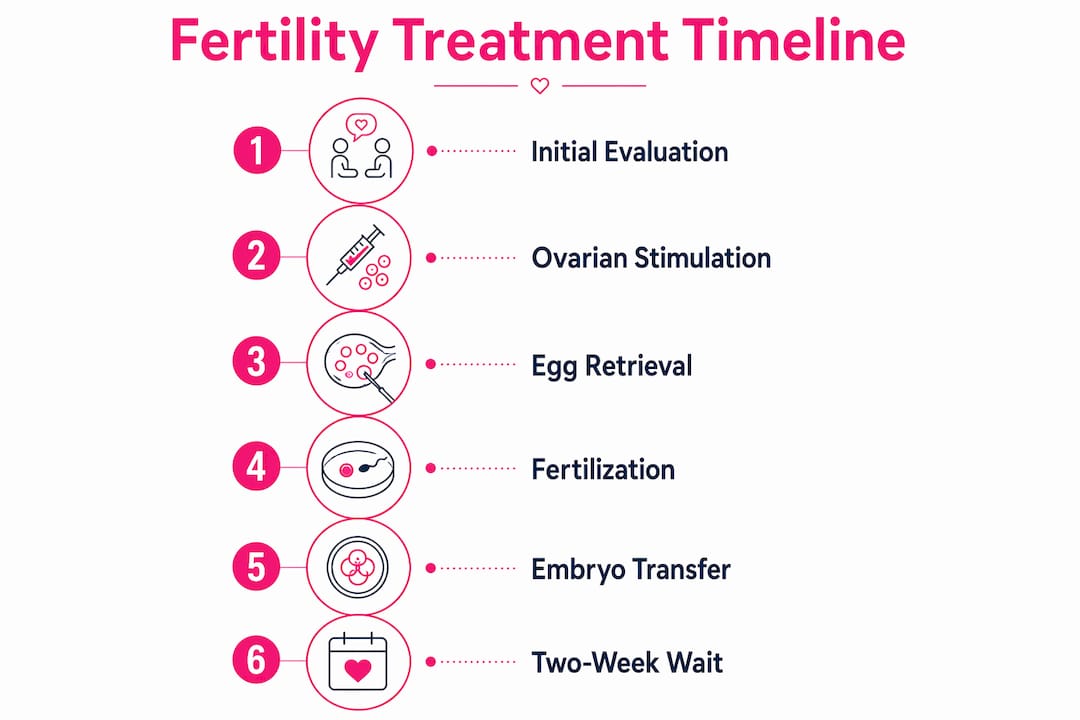
Several factors can extend your timeline beyond these estimates. PGT adds 5–6 days for biopsy analysis. Insurance pre-authorization can take 2–4 weeks. A cancelled cycle due to poor stimulation response requires starting over in the next menstrual cycle. Clinics like Life IVF Center balance efficiency with maximizing success, which sometimes means recommending a rest cycle or additional testing before proceeding.
Pro Tip: Ask your clinic for a personalized calendar at your first appointment. A written schedule with projected dates for each phase reduces uncertainty and helps you plan work and travel around monitoring visits.
To explore your fertility treatment options and understand which path fits your diagnosis, Life IVF Center provides detailed guidance on effectiveness and best uses for each approach.
Key takeaways
A complete IVF cycle takes 6–8 weeks from stimulation start to pregnancy test, but the full process including workup and frozen transfer preparation commonly extends to 3–5 months.
| Point | Details |
|---|---|
| Diagnostic workup sets the foundation | AMH, FSH, ultrasound, and semen analysis must be completed before stimulation begins. |
| Stimulation lasts 8–14 days | Daily injections and monitoring visits every 2–3 days are standard during this phase. |
| Fresh vs. frozen transfer changes timing | Frozen embryo transfer adds 6–8 weeks of uterine preparation compared to a fresh transfer. |
| PGT extends the embryo phase | Genetic screening adds approximately 5–6 days and requires a frozen transfer. |
| The two-week wait is clinically necessary | Testing before 9–14 days post-transfer risks inaccurate results and added emotional stress. |
What i’ve learned about trusting the fertility timeline
Patients often arrive expecting a faster process than the biology allows. The most common frustration I observe is the impulse to skip or compress the diagnostic phase. That instinct is understandable. When you want to start treatment, every additional week of testing feels like a delay. The data tells a different story. A thorough initial workup is the strongest predictor of cycle success, and skipping it tends to produce the very delays patients are trying to avoid.
The two-week wait generates the most emotional difficulty in the entire process. What I find helpful to communicate is that this period is not passive. Implantation is an active biological process, and the body needs time to complete it accurately. Testing at day 7 does not speed anything up. It only introduces uncertainty that a day 10 or 12 test would resolve cleanly.
Personalized treatment plans consistently outperform generic protocols in my observation. Patients who receive a customized medication schedule based on their AMH and antral follicle count tend to have better stimulation responses and fewer cancelled cycles. The Precision IVF® model at Life IVF Center is built on exactly this principle. Adjusting the protocol to the individual rather than applying a standard dose to every patient is not a luxury. It is the most direct path to a successful outcome.
If you are in the middle of this process and feeling overwhelmed by the timeline, that response is normal and valid. Use every support resource available to you, including counseling, patient coordinators, and peer support groups. The timeline has a structure. Understanding that structure makes it manageable.
Start your fertility treatment plan with Life IVF Center
Knowing the timeline is the first step. Taking action on it is the next one.
Life IVF Center offers fertility treatment packages designed to make every phase of your IVF process clear, supported, and financially accessible. From your first consultation through pregnancy confirmation, the team at Life IVF Center builds a personalized protocol around your specific hormone profile, medical history, and goals. With multiple Southern California locations and a dedicated patient support team, you get expert guidance at every stage. Schedule a consultation today to receive your personalized treatment calendar and take the uncertainty out of your fertility process.
FAQ
How long does a single IVF cycle take from start to finish?
A single IVF cycle takes approximately 6–8 weeks from the start of ovarian stimulation to the pregnancy test. Adding the initial workup phase, the full process from first consultation to a result typically spans 2–3 months.
What is the difference between a fresh and a frozen embryo transfer timeline?
A fresh transfer occurs on day 3 or day 5 after egg retrieval, while a frozen embryo transfer requires 6–8 weeks of uterine preparation with hormone medications before the embryo is placed.
When is the earliest you can take a pregnancy test after embryo transfer?
Most clinics schedule the beta hCG blood test 9–14 days after transfer, depending on whether a day 3 or day 5 embryo was used. Testing earlier risks false negatives because hCG levels have not yet reached detectable thresholds.
Does genetic testing (PGT) significantly extend the IVF timeline?
PGT adds approximately 5–6 days to the embryo phase while biopsy results are analyzed. Because PGT requires embryos to be frozen before transfer, it also adds the 6–8 week frozen transfer preparation period.
What factors most commonly cause delays in fertility treatment?
Menstrual cycle timing, insurance pre-authorization, poor stimulation response, and additional diagnostic findings are the most common causes of timeline extensions. A thorough initial workup reduces the likelihood of unexpected delays mid-cycle.
Recommended
- Fertility treatment options: Effectiveness and best uses
- The Fertility Consultation Process: What to Expect
- Male Fertility: Tips and Key Factors for IVF Success – Life IVF Center
- IVF Process Explained: Personalize Your Path to Success
Ready to take the next step?
Life IVF Center specializes in individualized Precision IVF® care for complex cases—including diminished ovarian reserve, prior failed cycles, and advanced maternal age. Our in-house labs and dedicated physicians are ready to help.
Book a Free Consultation →