
Fertility options after 40 include IVF with your own eggs, egg donation, surrogacy, and fertility preservation methods, each suited to different medical circumstances and personal goals. IVF is the best fertility treatment for infertile women over 40 using their own eggs, as it avoids delays that reduce conception chances. Egg donation and surrogacy offer higher success rates when egg quality or uterine health becomes a limiting factor. Perimenopause adds complexity, since ovulation remains irregular and unpredictable, making personalized counseling from a reproductive specialist a critical first step before choosing any path.
What are the fertility options after 40 with IVF?
IVF, or in vitro fertilization, is the process of stimulating the ovaries to produce multiple eggs, retrieving those eggs, fertilizing them in a laboratory, and transferring one or more resulting embryos into the uterus. For women over 40, this process is the most direct route to conception using their own genetic material. The procedure typically spans two to four weeks per cycle and requires close hormonal monitoring throughout.
Success rates using your own eggs decline meaningfully with age. Reduced ovarian reserve and egg quality are the primary reasons IVF outcomes differ between women in their early 40s and those in their late 40s. This means that two women of the same age can have very different prognoses depending on their antral follicle count, AMH levels, and prior response to stimulation.

Clinic-specific data matters more than national averages when you are evaluating your own chances. Personalized success rate data helps patients make informed decisions about IVF and preservation rather than relying on broad statistics that may not reflect their individual profile. Asking your clinic for their live birth rates by age group and ovarian reserve category gives you a far more accurate picture.
Key factors that influence IVF outcomes for women over 40 include:
- Ovarian reserve: Measured by AMH and antral follicle count, this determines how many eggs can be retrieved per cycle.
- Egg quality: Chromosomal abnormalities in eggs increase with age, which affects fertilization and embryo development rates.
- Uterine health: Conditions like fibroids or prior myomectomy can affect implantation and must be assessed before treatment.
- Number of prior IVF cycles: Cumulative data from multiple cycles often provides a clearer picture of prognosis than a single attempt.
Pro Tip: Schedule a fertility consultation before your 41st birthday if you are considering IVF with your own eggs. Even a six-month difference in ovarian reserve can affect the number of eggs retrieved and the number of viable embryos available for transfer.
How do egg donation and surrogacy work as fertility options after 40?
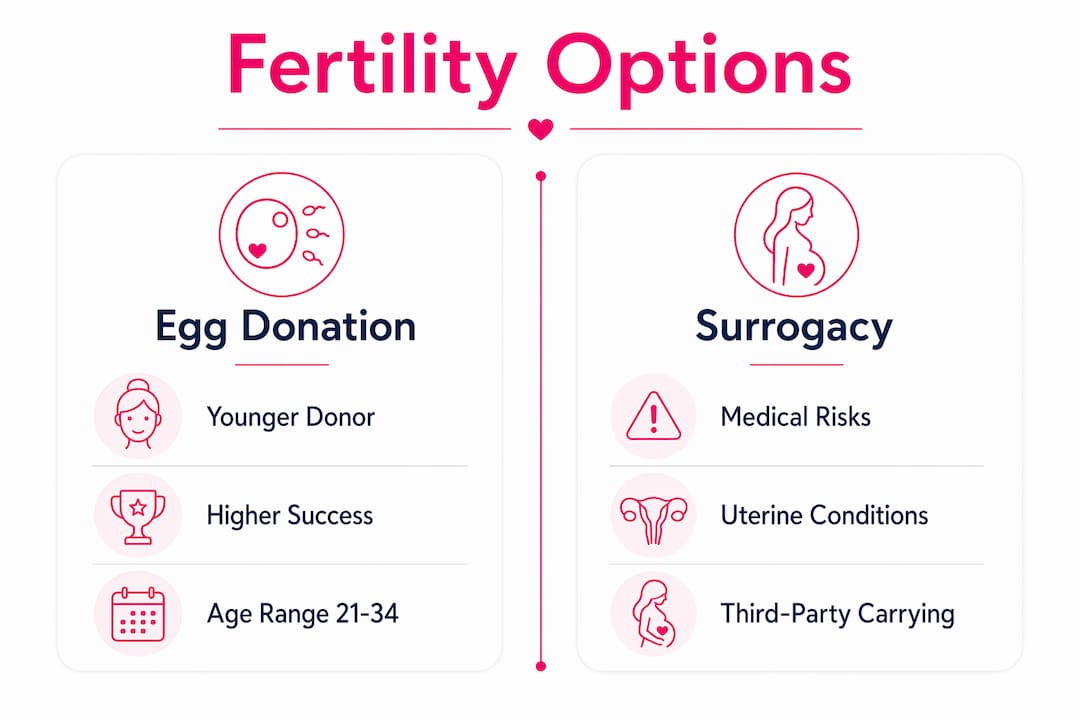
Egg donation involves using eggs from a younger donor, typically between 21 and 34 years old, fertilized with sperm from your partner or a donor, and then transferring the resulting embryo into your uterus. Egg donation success rates significantly outperform IVF using own eggs in women over 40, because the egg quality reflects the donor’s age rather than the recipient’s. This makes egg donation the most effective path to pregnancy for women whose own egg quality has declined substantially.
Surrogacy is the appropriate option when carrying a pregnancy poses a medical risk to you, or when uterine conditions make implantation unlikely. A gestational surrogate carries an embryo created from your eggs or a donor’s eggs, meaning the surrogate has no genetic connection to the child. This path requires legal agreements, medical screening of the surrogate, and coordination between multiple parties, including attorneys and fertility clinics.
| Option | Best suited for | Approximate success advantage |
|---|---|---|
| Egg donation | Diminished ovarian reserve, poor egg quality | Higher live birth rates vs. own-egg IVF after 40 |
| Gestational surrogacy | Uterine abnormalities, high-risk pregnancy history | Removes uterine factor from the equation |
| Embryo donation | Both egg and sperm quality concerns | Uses fully donated embryos, lower cost than fresh IVF |
Both egg donation and surrogacy carry legal and emotional dimensions that require careful preparation. You will need independent legal counsel in most U.S. states to formalize parental rights before or immediately after birth. Psychological counseling for both the intended parent and the donor or surrogate is standard practice and strongly recommended by the American Society for Reproductive Medicine (ASRM).
What fertility preservation methods are available after 40?
Fertility preservation refers to the process of storing eggs, embryos, or ovarian tissue before circumstances reduce their viability. For women over 40, the three primary methods are egg freezing (oocyte cryopreservation), embryo freezing (embryo cryopreservation), and ovarian tissue cryopreservation. Each method has different clinical indications and success profiles.
Embryo cryopreservation prior to medical treatments shows clinical pregnancy rates of approximately 49% and live birth rates between 35% and 41% per embryo transfer. This makes embryo freezing the most predictable preservation method, since the number of stored embryos gives clinicians a clearer forecast of future success. Egg freezing, by contrast, depends on how many mature eggs are retrieved and their post-thaw survival rate.
The 2026 ASRM committee opinion on fertility preservation recommends that individualized counseling using clinic-specific success rates and age at vitrification be provided to every patient considering egg freezing. One study in the ASRM guidance reported a 35% live birth rate in 80 patients using vitrified oocytes. That figure underscores why the number of eggs retrieved matters: more eggs stored translates to a higher cumulative probability of a live birth.
Ovarian tissue cryopreservation is a specialized option most relevant for women facing cancer treatment or other gonadotoxic therapies. Unlike egg or embryo freezing, ovarian tissue preservation requires no hormone stimulation and can be performed quickly when cancer treatment timing is urgent. Meta-analyses show clinical pregnancy rates of 43.8% and live birth rates between 19% and 32% following ovarian tissue transplantation. These rates are lower than embryo freezing, but the method’s speed makes it the only viable option for some patients.
Women with a BRCA mutation face a specific decision point: fertility preservation before prophylactic oophorectomy. Removing the ovaries eliminates cancer risk but also ends natural hormone production and egg availability. Freezing eggs or embryos before surgery preserves reproductive options. Similarly, women undergoing radiation therapy for pelvic cancers should discuss ovarian shielding and preservation before treatment begins, since post-gonadotoxic therapy egg yields are reduced and IVF cycle cancellation rates increase after treatment.
Pro Tip: If you are facing cancer treatment, request a fertility preservation consultation within 24 to 48 hours of your oncology appointment. Most fertility clinics, including Life IVF Center, can coordinate urgent preservation cycles that fit within oncology timelines.
How does perimenopause affect fertility treatment choices?
Perimenopause is the transitional phase before menopause, typically beginning in the mid-40s, during which ovarian function becomes irregular and hormone levels fluctuate unpredictably. Pregnancy can still occur during perimenopause, because ovulation continues even when cycles are irregular. This means fertility does not reach zero until menopause is confirmed by 12 consecutive months without a period.
The unpredictability of perimenopause creates two distinct challenges. First, women who do not want to conceive need contraception, since irregular cycles make natural family planning unreliable. Second, women who do want to conceive face a narrowing window and need to act without delay. Hormonal contraceptives can regulate cycles and reduce perimenopausal symptoms, but they also mask the underlying hormonal picture, which complicates fertility assessment.
Fertility treatments remain effective during perimenopause, but they require closer monitoring and more flexible protocols. Key considerations include:
- Hormone level variability: FSH and estradiol levels fluctuate significantly, so a single blood test may not reflect true ovarian reserve.
- Cycle timing: Irregular cycles mean stimulation protocols must be adapted to the patient’s current hormonal state rather than a fixed calendar.
- Egg quality: Even when ovulation occurs, egg chromosomal quality declines with age, increasing miscarriage risk.
- Contraception guidance: The Cleveland Clinic recommends contraception until menopause is confirmed, to prevent unintended pregnancy during this phase.
Women in perimenopause who are pursuing conception should request a full hormonal panel including AMH, FSH, estradiol, and antral follicle count at the start of their fertility evaluation. This gives the treating physician the most accurate baseline from which to build a treatment plan.
Key takeaways
Fertility options after 40 are most effective when treatment is personalized to your ovarian reserve, medical history, and reproductive goals rather than selected based on age alone.
| Point | Details |
|---|---|
| IVF with own eggs | The first-line treatment for women over 40, but success rates depend heavily on ovarian reserve and egg quality. |
| Egg donation advantage | Donor egg IVF delivers significantly higher live birth rates than own-egg IVF for women with diminished egg quality after 40. |
| Preservation timing | Embryo freezing before cancer treatment or prophylactic surgery offers live birth rates of 35 to 41% per transfer. |
| Perimenopause complexity | Ovulation continues irregularly during perimenopause, requiring contraception if pregnancy is not desired and prompt evaluation if it is. |
| Counseling specificity | Clinic-specific success data, not national averages, produces the most accurate prognosis for individual patients. |
What I’ve learned about advising women over 40 on fertility
The most common mistake I see is women waiting for a definitive answer before taking action. Fertility medicine after 40 rarely offers certainty upfront. What it does offer is data: your AMH, your antral follicle count, your clinic’s live birth rates for patients with your profile. That data is the starting point, not the finish line.
Generic statistics are the second problem. A national average live birth rate for women over 40 tells you almost nothing useful. What matters is what your specific clinic achieves with patients who share your age, ovarian reserve, and diagnosis. Life IVF Center’s Precision IVF® approach is built on exactly this principle: protocols are customized to the individual, not applied uniformly across an age bracket.
The emotional weight of fertility treatment after 40 is real and should not be minimized. Balancing hope with realistic expectations is not a contradiction. It is the foundation of good clinical care. The patients who navigate this process most effectively are the ones who ask hard questions early, understand their numbers, and stay in close communication with their care team throughout.
How Life IVF Center supports women over 40
Life IVF Center offers personalized IVF treatment packages designed specifically for patients whose reproductive goals require more than a standard protocol. Whether you are pursuing IVF with your own eggs, exploring egg donation, or planning fertility preservation before a medical procedure, the team at Life IVF Center builds a protocol around your biology, not a template.
Life IVF Center’s egg and embryo freezing services include counseling on age-specific success probabilities and coordination with oncology teams when preservation is medically urgent. Third-party reproduction options, including egg donation and surrogacy, are available through Life IVF Center’s third-party services program. If you are ready to understand your coverage and financial options, the prospective insurance patients page outlines what to expect before your first consultation.
FAQ
What is the most effective fertility treatment for women over 40?
IVF using your own eggs is the recommended first-line treatment for infertile women over 40, as it avoids delays that reduce conception chances. When egg quality is significantly diminished, egg donation IVF delivers substantially higher live birth rates.
Can you get pregnant naturally during perimenopause?
Yes. Ovulation continues during perimenopause, making natural conception possible until menopause is confirmed by 12 consecutive months without a period. Contraception is advised for women who do not wish to conceive during this phase.
What fertility preservation options exist before cancer treatment?
Embryo cryopreservation and egg freezing are the primary options before cancer treatment, with embryo freezing showing live birth rates of 35 to 41% per transfer. Ovarian tissue cryopreservation is available when there is no time for hormone stimulation before treatment begins.
How does a BRCA mutation affect fertility planning?
Women with a BRCA mutation who are considering prophylactic oophorectomy should freeze eggs or embryos before surgery to preserve reproductive options. Timing the preservation cycle before the procedure is critical, as the surgery permanently ends natural egg production.
How many IVF cycles should a woman over 40 expect?
The number of cycles depends on ovarian reserve, egg quality, and individual response to stimulation, so there is no universal answer. Clinic-specific data and a thorough baseline evaluation give the most accurate forecast of how many cycles may be needed to achieve a live birth.
Recommended
- Signs of Fertility Decline: What to Watch After 30
- Fertility treatment options: Effectiveness and best uses
- Evidence-Based Endometriosis Fertility Tips for Better Conception
- Why consider fertility testing? Key insights and action steps
Ready to take the next step?
Life IVF Center specializes in individualized Precision IVF® care for complex cases—including diminished ovarian reserve, prior failed cycles, and advanced maternal age. Our in-house labs and dedicated physicians are ready to help.
Book a Free Consultation →