
You usually do not need a routine hysteroscopy before IVF if your transvaginal ultrasound looks normal and this is your first cycle. The evidence shifts, though, once you have a failed transfer behind you or your imaging raises a question mark. In those cases, hysteroscopy is worth a real conversation with your care team, not an automatic add-on.
The strongest trial on this question, the inSIGHT randomized controlled trial, found no meaningful live birth benefit from routine hysteroscopy before a first IVF cycle in women with normal ultrasound findings (57% versus 54% live birth rate). But a pooled analysis of 15 trials covering more than 5,000 women found hysteroscopy raised live birth rates by a relative 24% and clinical pregnancy rates by 36% overall, with the clearest benefit concentrated in women with prior failed IVF attempts. That gap between “routine” and “selective” is the whole story.
Before you schedule anything, bring three things to your clinician: your most recent uterine imaging, any history of failed transfers, and a note on abnormal bleeding or pelvic symptoms. Those three data points determine which side of the evidence you actually fall on.
Key Takeaways
Hysteroscopy is generally considered selectively, especially after prior implantation failure or when imaging or symptoms suggest a uterine-cavity abnormality. It is not routinely needed before every first IVF cycle.
| Point | Details |
|---|---|
| Routine use lacks support | The inSIGHT trial found no significant live birth benefit from routine hysteroscopy in first-cycle patients with normal ultrasound. |
| Selective use shows real gains | Pooled trial data show a 24% relative increase in live birth rate and 36% in clinical pregnancy rate for broader ART populations, higher for prior IVF failure. |
| Watch the timing windows | Plan embryo transfer within about 50 days after diagnostic hysteroscopy and up to 120 days after operative procedures. |
| Safety profile is reassuring | Infection rates run roughly 0.01% to 0.2%, with perforation and major bleeding uncommon. |
| Get a tailored evaluation | Life IVF Center reviews your imaging and IVF history through its Precision IVF® approach to decide if hysteroscopy fits your case. |
Table of Contents
- What the Evidence Says About Hysteroscopy Before IVF
- Who Should Consider Hysteroscopy Before IVF?
- What Hysteroscopy Finds and How It’s Treated
- How Is Hysteroscopy Performed and What Are the Risks?
- When Should Hysteroscopy Happen Relative to IVF?
- Are There Alternatives to Hysteroscopy Before IVF?
- How Life IVF Center Approaches the Hysteroscopy Decision
- A Clinician’s Perspective on the Hysteroscopy Question
- Getting the Right Diagnostic Plan From Life IVF Center
- Frequently Asked Questions
- Sources
What the Evidence Says About Hysteroscopy Before IVF
The research on hysteroscopy before IVF splits cleanly along one line: does the patient have a normal uterine cavity and no treatment history, or not? The inSIGHT trial, a multicenter randomized controlled trial, enrolled women heading into their first IVF cycle with a normal transvaginal ultrasound. Statistically, that is a coin flip. For a healthy first-timer with clean imaging, this trial is the reason most reproductive endocrinologists will not push for the procedure.
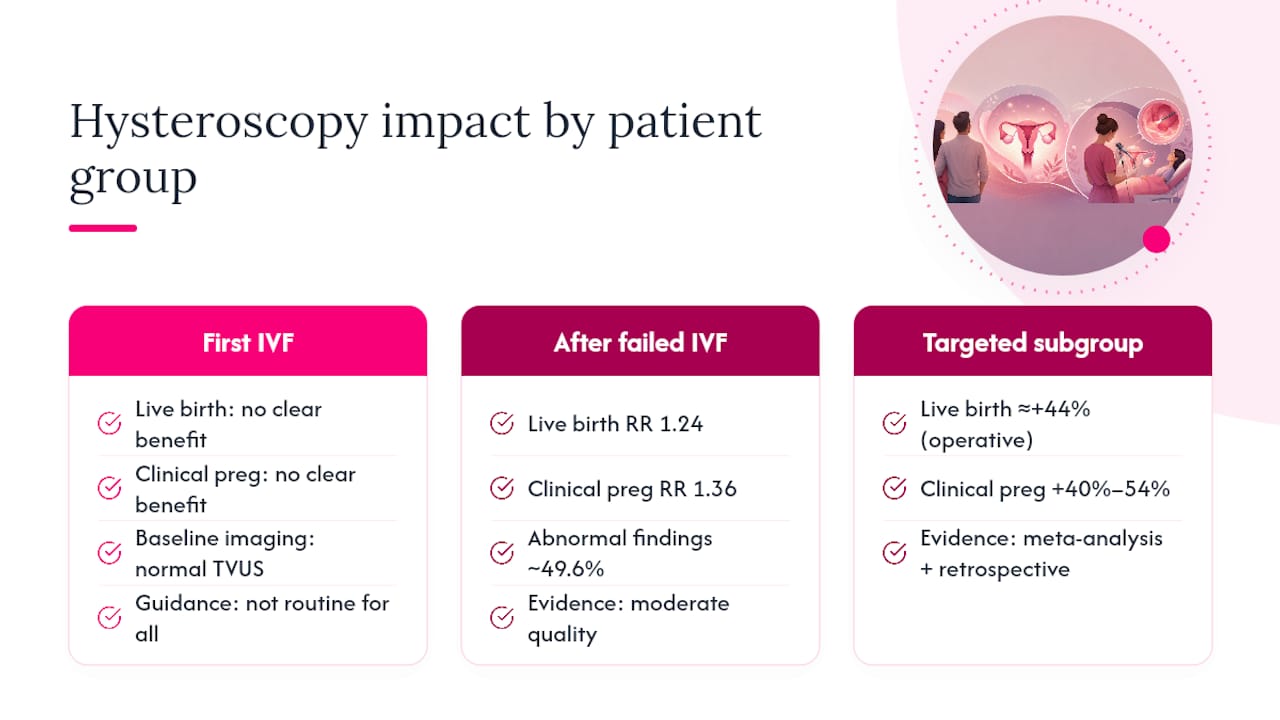
Everything changes when you look at women who have already had a failed cycle or two. A systematic review and meta-analysis of randomized trials found that hysteroscopy before assisted reproductive technology increased live birth rate with a relative risk of 1.24 (95% CI 1.09 to 1.43) and clinical pregnancy rate with a relative risk of 1.36 (95% CI 1.18 to 1.57), and the researchers rated this as moderate-quality evidence, with the benefit driven largely by subgroups who had already experienced ART failure. Moderate quality means the finding is credible but not airtight. Some included trials had design limitations, and effect sizes varied by population, which is exactly why blanket recommendations for every patient do not hold up.
In patients specifically flagged for recurrent implantation failure or a suspected uterine cavity abnormality, hysteroscopy’s payoff gets bigger. Meta-analytic data on this narrower group show clinical pregnancy rate increases in the range of 40% to 54%, with live birth improvements around 44% for some operative procedures in targeted populations. A retrospective propensity-score matched cohort study backs this up from a different angle: operative hysteroscopy before a first frozen embryo transfer was tied to a 54.3% relative increase in clinical pregnancy rate (adjusted OR 1.543) and a 44.2% increase in live birth rate (adjusted OR 1.442) after the researchers adjusted for confounding factors. That is a meaningfully different picture than what inSIGHT showed for first-time, low-risk patients.
Newer retrospective data add nuance rather than settle the debate. The same study reported abnormal findings in nearly half of patients who underwent the procedure, roughly 49.6% of the cohort. That prevalence number matters: it tells you hysteroscopy is not a low-yield fishing expedition in patients being evaluated after a failed cycle. It is finding something close to half the time.
Cochrane-level review adds a necessary check on enthusiasm. Systematic evidence summaries conclude the overall picture remains mixed, and while some reviews note possible gains in pregnancy and live birth rates, the evidence quality is judged insufficient to justify routine screening hysteroscopy for every IVF patient regardless of history. That is the guideline-level consensus this article follows: selective, not routine.
On safety, hysteroscopy carries a reassuring track record. Reported infection rates run low, cited in the literature at roughly 0.01% to 0.2% of procedures, with uterine perforation and major bleeding uncommon across both trial and observational data. The risk-benefit math tilts favorably for patients who fall into a genuine indication group, and stays neutral to unfavorable for patients who do not.
Who Should Consider Hysteroscopy Before IVF?
Hysteroscopy earns its place in your IVF prep when specific red flags are present, not as a default step for everyone walking into a fertility clinic. The clinical indications that make the conversation worthwhile include:
- Recurrent implantation failure: generally defined as multiple failed transfers of good-quality embryos, which is the group with the clearest documented benefit.
- Abnormal or ambiguous findings on transvaginal ultrasound, saline infusion sonography, hysterosalpingography, or 3D ultrasound that suggest a polyp, fibroid, or irregular cavity contour.
- Unexplained abnormal uterine bleeding, especially bleeding that does not fit your normal cycle pattern.
- A history of pelvic infection or endometritis, which raises suspicion for adhesions or chronic inflammatory changes in the lining.
- Prior uterine surgery, including dilation and curettage, myomectomy, or cesarean delivery, which can leave scar tissue (Asherman-type adhesions) that interferes with implantation.
These indications matter because polyps, adhesions, fibroids, or other cavity findings may affect treatment planning. Whether identifying or treating a finding improves an individual outcome depends on the type of lesion and the patient’s broader clinical picture.
The flip side deserves equal weight. If you are heading into your first IVF cycle, your transvaginal ultrasound is unremarkable, you have no history of abnormal bleeding, and you have no prior uterine surgery, the evidence does not support hysteroscopy as a routine gatekeeper step. Adding it here means extra cost, an extra procedure day, and a delay to your treatment timeline, without a demonstrated boost in your odds. This is the group inSIGHT was built around, and the trial’s null result should carry real weight in that decision.
What Hysteroscopy Finds and How It’s Treated
Hysteroscopy is a direct look inside the uterine cavity, and what clinicians find there generally falls into a short list of categories. Each one carries a different treatment path and a different evidence picture for IVF outcomes.
- Endometrial polyps: small, usually benign growths of the uterine lining, frequently removed on the spot through polypectomy.
- Submucosal fibroids: muscular growths that bulge into the cavity, typically requiring hysteroscopic myomectomy when they distort the cavity shape.
- Intrauterine adhesions (Asherman-type scarring): fibrous bands from prior surgery or infection, addressed through adhesiolysis.
- Chronic endometritis: low-grade inflammation of the lining, often confirmed with biopsy and treated with a course of antibiotics.
- Congenital anomalies, such as a uterine septum, which may need surgical correction depending on severity and reproductive history.
| Finding | Typical hysteroscopic action | Likely impact on IVF outcomes |
|---|---|---|
| Endometrial polyp | Polypectomy (removal) | Generally favorable; removal is associated with improved implantation in patients with prior failure |
| Submucosal fibroid | Hysteroscopic myomectomy | Favorable when the fibroid distorts the cavity; evidence is stronger here than for fibroids outside the cavity |
| Intrauterine adhesions | Adhesiolysis | Often improves cavity function, though severe cases may need repeat procedures |
| Chronic endometritis | Biopsy plus antibiotic treatment | Emerging evidence of benefit, but data remain more limited than for structural lesions |
| Congenital septum | Surgical correction (septoplasty) | Case-dependent; typically considered when septum size or shape is judged clinically significant |
Not every category carries equally strong evidence. Chronic endometritis treatment is a newer area, and while early data are encouraging, it has not accumulated the trial volume that polyp and fibroid removal have. Congenital anomaly correction is similarly individualized. This is exactly why a blanket “hysteroscopy helps everyone” claim does not survive contact with the actual literature, even though it clearly helps identifiable subgroups.
How Is Hysteroscopy Performed and What Are the Risks?
Hysteroscopy comes in two working modes, and which one you get depends on what your clinician expects to find. Diagnostic hysteroscopy is typically an office-based procedure: a thin, lighted scope is passed through the cervix to visualize the cavity, often with little to no anesthesia beyond an oral pain reliever or a local cervical block. It usually takes 10 to 15 minutes. Operative hysteroscopy, used when a polyp, fibroid, or adhesion needs to be removed during the same visit, may call for conscious sedation or general anesthesia depending on the complexity, and it runs longer, sometimes 30 to 60 minutes, often in an operating room or ambulatory surgical setting.
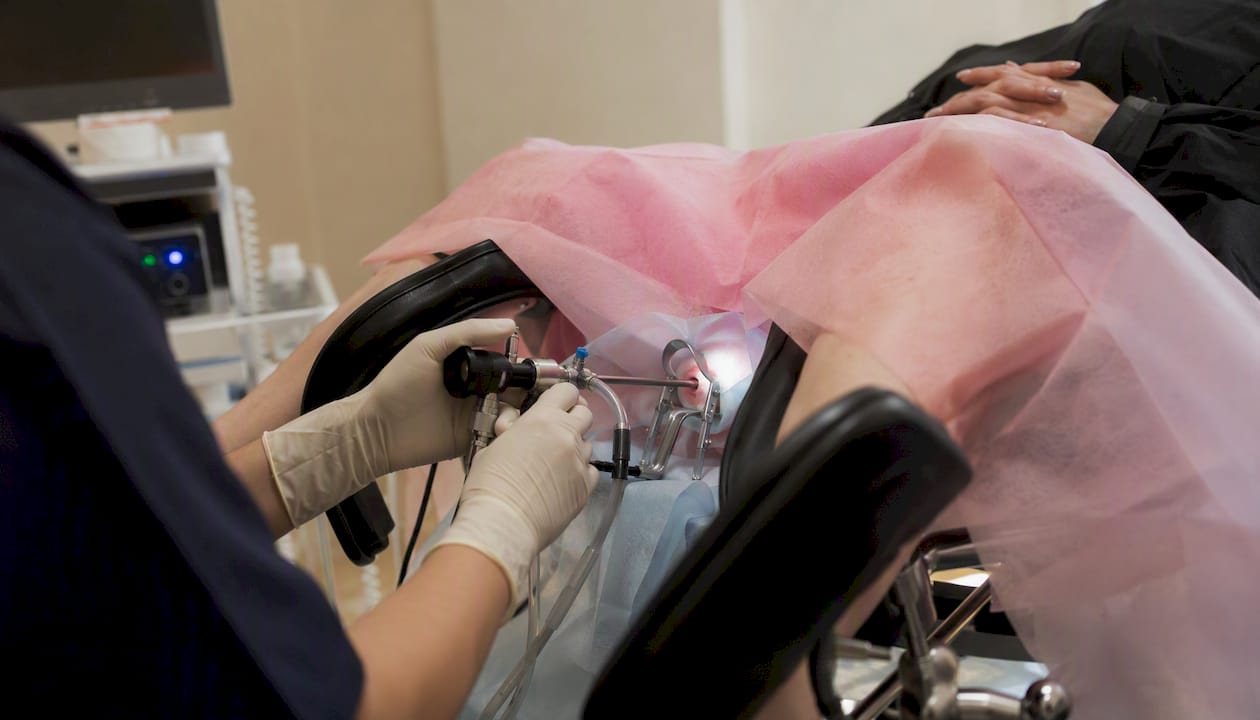
Recovery from a diagnostic office procedure is short. Most patients experience mild cramping and light spotting for a day or two and return to normal activity the same day. Operative hysteroscopy recovery stretches longer, with cramping and spotting that can persist several days to about a week, depending on what was corrected.
| Risk category | Approximate rate | Notes |
|---|---|---|
| Procedure-related infection | Roughly 0.01% to 0.2% | Rare; antibiotics used selectively based on risk factors |
| Uterine perforation | Uncommon | Slightly higher risk during operative procedures involving instrumentation |
| Significant bleeding | Uncommon | More often associated with operative rather than diagnostic hysteroscopy |
The safety data across trials and observational studies are consistently reassuring, with serious complications remaining rare in both diagnostic and operative settings.
Pro Tip: Ask your clinic to schedule your diagnostic hysteroscopy in the early to mid follicular phase of your cycle, right after your period ends. The lining is thin, visualization is clearer, and there is no risk of disrupting an early pregnancy. Bring a support person if you are having an operative procedure with sedation, since you will not be able to drive yourself home.
When Should Hysteroscopy Happen Relative to IVF?
Timing is where the evidence gets genuinely actionable, because it is not just about whether to do hysteroscopy, but when to schedule it around your IVF cycle. A systematic review and meta-analysis on this exact question found that embryo transfer within about 50 days after a diagnostic hysteroscopy was associated with better live birth outcomes, while transfer within roughly 120 days after an operative hysteroscopy (polypectomy, adhesiolysis, myomectomy) tended to show stronger clinical pregnancy rates.
These windows are not arbitrary. Diagnostic procedures barely disturb the endometrium, so the lining is ready quickly and a longer wait offers no real advantage. Operative procedures, by contrast, involve genuine tissue trauma and healing, and the endometrium needs time to remodel before it can support implantation well. Cohort data suggest this reflects real biological healing and immune signaling changes in the uterine lining, not just an arbitrary calendar rule.
In practice, this breaks into three scheduling patterns:
- Diagnostic hysteroscopy, no findings requiring treatment: many clinics proceed with the planned IVF cycle in the same or next cycle, well within that 50 day window.
- Diagnostic hysteroscopy with a minor finding treated on the spot: transfer is often still planned within roughly 50 days, though your clinician may extend this slightly depending on what was removed.
- Operative hysteroscopy for a fibroid, larger polyp, or adhesions: plan for a longer runway, generally up to about 120 days, to let the lining heal fully before transfer.
Two questions come up constantly. Can hysteroscopy happen on the same day as egg retrieval? Generally no. They serve different purposes and are typically scheduled separately, often with hysteroscopy done ahead of a stimulation cycle rather than layered onto retrieval day. How soon after hysteroscopy can transfer occur? For diagnostic procedures, often within the same cycle or the next one. For operative procedures, plan for one or more full menstrual cycles of healing first.
Are There Alternatives to Hysteroscopy Before IVF?
Hysteroscopy is not the only way to check your uterine cavity, and for many patients, less invasive imaging answers the question just as well.
- Transvaginal ultrasound is the standard first-line tool, quick and noninvasive, but it can miss small polyps or subtle adhesions.
- Saline infusion sonography (SIS) improves on plain ultrasound by distending the cavity with saline, making polyps and fibroids easier to spot.
- Hysterosalpingography (HSG) primarily checks tubal patency but can also reveal cavity distortions, though it exposes you to a small amount of radiation and contrast dye.
- 3D ultrasound offers detailed cavity mapping, particularly useful for detecting congenital anomalies like a septum.
If your transvaginal ultrasound or SIS comes back clean and you have no history of failed transfers or symptoms, these tests are usually sufficient, and hysteroscopy adds little. If imaging is equivocal, or you have already failed a cycle despite normal-looking scans, hysteroscopy remains the more definitive next step because it lets your clinician see and treat in the same visit.
How Life IVF Center Approaches the Hysteroscopy Decision
At Life IVF Center, the hysteroscopy decision can begin with review of existing ultrasound, saline-infusion sonography, HSG results, symptoms, and prior IVF history. The care team can then discuss whether additional cavity evaluation may add useful information.
That conversation typically covers:
- What findings are most likely given your history and imaging.
- How a confirmed finding would change your treatment timeline and protocol.
- Realistic pain management options for the procedure itself.
- Cost and insurance considerations before anything is scheduled.
This review fits within Precision IVF®, which emphasizes individualized planning based on clinical findings. If operative hysteroscopy is appropriate, timing and referral options should be coordinated with the planned treatment cycle and healing period.
A Clinician’s Perspective on the Hysteroscopy Question
Patients often arrive assuming hysteroscopy is either mandatory or pointless, and the truth sits in between. Selective use, guided by your history and imaging, matches what the strongest trials actually show. The anxiety I hear most is about pain and lost time, and both concerns are usually smaller than patients expect once they understand the office-based option and the realistic timing windows involved.
Four questions come up on nearly every consult:
- “Will this delay my IVF cycle?” For a diagnostic procedure with no findings, usually not much. For an operative one, plan for a longer runway.
- “Will it hurt?” Office hysteroscopy is typically manageable with over-the-counter pain relief; sedation is available for operative cases.
- “Does insurance cover this?” Coverage varies widely, and it is worth confirming before scheduling.
- “What if my ultrasound was already normal?” Normal imaging plus no prior failures usually means hysteroscopy is not going to move the needle.
If your clinician’s recommendation does not match what you are reading here, a second opinion is a reasonable and normal step, not a confrontation.
Getting the Right Diagnostic Plan From Life IVF Center
If imaging is unclear or you have experienced a prior failed transfer, a consultation can help determine whether hysteroscopy belongs in the next phase of evaluation. Availability, referral needs, timing, and costs should be confirmed for the individual plan.
Bring prior ultrasound, saline-infusion sonography, HSG reports, and IVF records to a consultation so the discussion can start with your existing data. Life IVF Center can also help you prepare insurance and cost questions, but coverage and payment estimates are not guarantees.
Frequently Asked Questions
Do I need a hysteroscopy before my first IVF cycle?
Usually not, if your transvaginal ultrasound is normal and you have no history of bleeding, infection, or prior uterine surgery. The inSIGHT trial found no live birth benefit from routine hysteroscopy in this group.
Can hysteroscopy improve outcomes after a failed transfer? In selected patients, especially when a uterine-cavity abnormality is suspected or found, published studies suggest possible benefit. The evidence does not support routine hysteroscopy for every patient.
How long should I wait to do an embryo transfer after hysteroscopy?
Roughly 50 days after a diagnostic hysteroscopy and up to about 120 days after an operative procedure like polypectomy or adhesiolysis, based on timing meta-analyses.
Can hysteroscopy be done on the same day as egg retrieval?
No, they are generally scheduled as separate procedures serving different purposes, with hysteroscopy typically completed before a stimulation cycle begins.
Is hysteroscopy painful, and what are my pain management options?
Office-based diagnostic hysteroscopy is usually manageable with over-the-counter pain relief or a local block. Operative hysteroscopy often uses sedation or general anesthesia depending on complexity.
Does insurance cover hysteroscopy before IVF?
Coverage varies by plan and by whether the procedure is classified as diagnostic or medically necessary. Confirming benefits before scheduling, through resources like insurance guidance for fertility patients, avoids surprise costs.
This article is for general educational purposes only and is not a substitute for personalized medical advice, diagnosis, or treatment. Fertility care is individual; please consult a qualified healthcare professional about your circumstances. To discuss your options with our team, schedule a consultation with Life IVF Center.
Sources
- Hysteroscopy before in-vitro fertilisation (inSIGHT): a multicentre, randomised controlled trial
- Efficacy of hysteroscopy in improving fertility outcomes in women undergoing ART: systematic review and meta-analysis
- Meta-analytic findings on hysteroscopy in implantation failure and suspected lesions (PubMed entry)
- Operative hysteroscopy before the first frozen–thawed embryo transfer: retrospective PSM cohort study
- Cochrane Review: Hysteroscopy before IVF: systematic review evidence
Recommended
- Endometriosis IVF Process: What You Need to Know
- Uterine Health and IVF Success: What You Need to Know
- Pre-IVF Requirements – Life IVF Center
- The Role of Counseling in IVF: What You Need to Know
Ready to take the next step?
Life IVF Center specializes in individualized Precision IVF® care for complex cases—including diminished ovarian reserve, prior failed cycles, and advanced maternal age. Our in-house labs and dedicated physicians are ready to help.
Book a Free Consultation →