

Traveling to another state for IVF is common, and it is usually manageable. Most patients do their testing and day-to-day monitoring near home and travel only for the major procedures, typically egg retrieval and embryo transfer. The decision comes down to four things: what your insurance will pay, what the full cost looks like once travel is added, whether the clinic can treat your specific diagnosis, and how well the clinic coordinates with a provider near you. This guide walks through each one.
TL;DR
- Many patients complete baseline testing and cycle monitoring (ultrasounds and blood work) locally, then travel only for retrieval and transfer. Ask any clinic to confirm this in writing before you commit.
- Insurance rules depend on your plan type as much as your state. Self-funded employer plans are generally exempt from state mandates, so verify yours before assuming coverage.
- Compare total cost, not the cycle price alone: medication, testing, storage, lodging, flights and time off work all count.
- Choose a program based on your diagnosis and the clinic’s published, verifiable outcome data (CDC and SART reports), not on price alone.
- State law can affect embryos, donor arrangements and surrogacy. Speak with a fertility attorney before you finalize an out-of-state plan that involves third parties.
Table of Contents
- Why patients travel for IVF
- How an out-of-state cycle works step by step
- What can usually be done locally
- Does insurance cover IVF out of state?
- Comparing total cost, not just the cycle price
- How to choose a program when your case is complex
- Legal considerations that change by state
- Perspective
- Planning with Life IVF Center
- A practical checklist before you book
- FAQ
- Sources
Why patients travel for IVF
Patients cross state lines for several reasons: cost differences, specialized treatment, higher reported success rates, or state-specific legal restrictions. In our experience, the reasons usually fall into four groups:
- Access. Some regions have few fertility clinics, long waitlists, or no program offering donor eggs, gestational surrogacy or fertility preservation.
- Complexity. Diminished ovarian reserve, endometriosis, advanced maternal age, immune factors, or several failed cycles elsewhere often lead patients to look for a second opinion or a more individualized protocol.
- Coverage. Your insurance may cover IVF in one state and not another, or a clinic in a particular network may be out of state.
- Law and policy. Rules on embryo storage, donor anonymity and surrogacy differ by state.
The trade-offs are real, and they are logistical rather than medical: travel and lodging costs, time away from work, medication shipping and storage, and coordinating two sets of providers. Planning for these early is what separates a smooth cycle from a stressful one.
How an out-of-state cycle works step by step
The sequence below is the pattern most traveling patients follow. Details vary by clinic and protocol, so treat it as a framework to confirm, not a guarantee.
- Remote consultation. Many clinics, including ours, can begin with a virtual visit, so you can review records and discuss a plan before you travel.
- Records and baseline testing. Hormone levels, an ultrasound for antral follicle count, semen analysis, infectious disease screening and genetic carrier screening can often be done near home and sent to the clinic.
- Treatment plan and medication. The clinic designs the protocol and sends prescriptions to a pharmacy you choose. Confirm shipping and refrigeration requirements.
- Local monitoring. During stimulation, preliminary steps and monitoring such as ultrasounds and blood work can often be handled by a local provider, with results sent to the treating clinic the same day so the team can adjust doses.
- Travel for retrieval. You arrive for the final days of stimulation, the trigger shot and the egg retrieval. A companion is generally needed because of sedation.
- Fertilization, embryo culture and testing. This happens in the clinic’s lab while you are home or still in town, depending on the plan.
- Transfer. A frozen embryo transfer is often scheduled as a separate, shorter trip. Some patients arrange nearby monitoring for the weeks that follow, then return to a local OB.
Two questions to ask any clinic: who reviews my local monitoring results, and how quickly can medication changes be made? Same-day communication matters most during stimulation.
What can usually be done locally
| Step | Often done near home | Usually requires travel |
|---|---|---|
| Initial consultation | Yes (virtual) | No |
| Blood work, infectious disease panel | Yes | No |
| Sperm analysis | Yes | No |
| Saline infusion sonohysterogram, Pap smear | Often | Sometimes |
| Stimulation monitoring | Yes, with a cooperating local provider | Final days sometimes |
| Egg retrieval | No | Yes |
| Embryo transfer | No | Yes |
| Early pregnancy monitoring and OB care | Yes | No |
Some of the tests above are priced openly on our site. For example, our published pre-IVF testing list includes a sperm count at 185 USD, a Pap smear at 185 USD, carrier screening for genetic disease at 349 USD, a saline infusion sonohysterogram (SIS) at 450 USD and an Endometrial Receptivity Assay (ERA) at 975 USD. You can review the full list on our pre-IVF testing price page. If a local clinic or lab performs equivalent tests, ask us whether we can accept the results rather than repeating them.
Does insurance cover IVF out of state?
This is the question that most often changes the plan, and the answer depends on your policy, not on where the clinic sits.
Start with your plan type. Coverage for fertility treatment in the U.S. is highly variable, and state mandates often apply only to fully insured employer plans, while self-funded plans are exempt. RESOLVE also advises employees to check whether their plan is fully insured or self-insured. Your HR department or the member services number on your card can tell you.
Know what the state laws do. According to RESOLVE, 15 states have IVF insurance mandates, and 25 states have laws that provide some insurance coverage of infertility. A mandate in your home state generally governs your policy if it is issued there, which means a policy written in a state with a mandate does not automatically follow you to a clinic elsewhere, and a clinic’s state does not create coverage you do not have.
Read for exclusions and caps. Even where mandates exist, coverage may exclude certain treatments or carry lifetime financial caps, and plans do not always treat fertility care as medically necessary.
Questions to put to your insurer, ideally with the answers in writing:
- Is my plan fully insured or self-funded?
- Does it cover IVF, IUI, egg or embryo freezing, genetic testing, and donor or surrogacy-related care separately?
- Is an out-of-network or out-of-state fertility clinic eligible, and at what reimbursement level?
- Will you cover monitoring at a local in-network provider if the cycle is managed elsewhere?
- Are there lifetime maximums, age limits or diagnosis requirements?
- Is prior authorization needed?
If coverage is partial, fertility-specific lenders and financing programs may help with costs insurance does not pay. Eligibility depends on each lender’s criteria, so confirm which expenses a program accepts before you rely on it for travel.
Comparing total cost, not just the cycle price
A lower headline price in another state can disappear once everything is added up. Build a single spreadsheet for each clinic you are considering and fill in the same lines for each.
Clinic and lab fees
- What the package or cycle fee covers and what it excludes (monitoring, anesthesia, lab work, embryo culture)
- Testing, such as genetic screening of embryos or an endometrial receptivity assay
- Embryo freezing, transfer and storage
- Medication, which is often billed separately
Travel costs
- Flights or gas for you and a companion, for each trip
- Lodging for the retrieval window and for transfer
- Ground transport, meals and pharmacy cold-pack shipping
- Lost income or unpaid leave
Local costs
- Monitoring fees at a nearby provider (confirm whether they charge per visit)
- OB care and early pregnancy ultrasounds
The American Society for Reproductive Medicine’s ethics guidance on cross-border reproductive care says clinics should disclose prices for all services so patients avoid unexpected debt after treatment. Use that standard as your test: if a clinic cannot tell you what is and is not included, keep asking until it can.
What our published pricing looks like
We publish many of our prices so that you can build that spreadsheet. As listed on our site:
| Service | Published price |
|---|---|
| The Advanced IVF Package | 13,500 USD |
| Embryo Transfer | from 2,950 USD |
| Precision Egg Freezing | 7,500 USD |
| Precision Embryo Freezing | 8,950 USD |
| Annual Storage | 750 USD per year |
| Monthly Storage | 70 USD per month |
| 3 Year Prepaid Storage | 2,000 USD |
These details are on our treatment packages page, our freezing pricing page and our storage cost page. Always check those pages for what each price includes, since prices can change. Some services, such as OB monitoring visits and coordination, do not have a published price, so ask our team for a quote.
So what is the cheapest state for IVF?
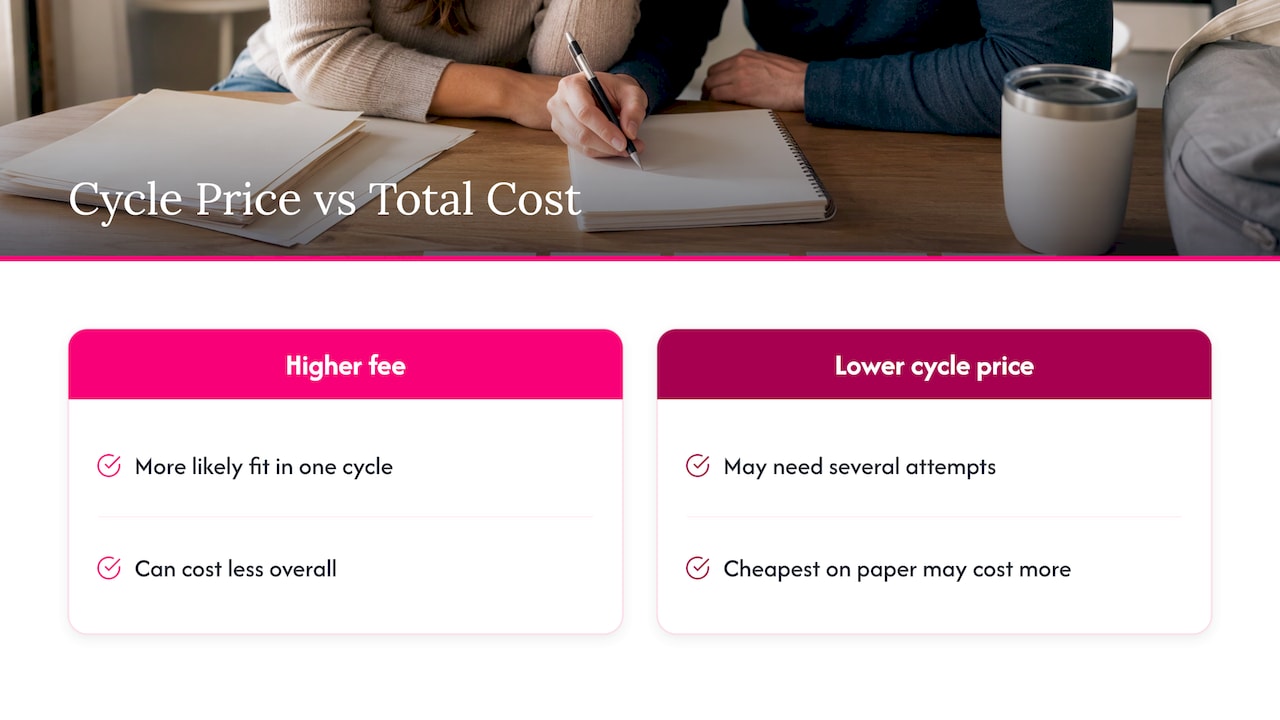
There is no single answer you can rely on. Cycle prices vary by region, clinic and protocol, and the cheapest cycle on paper is rarely the cheapest for a patient who needs a second retrieval, embryo testing or donor gametes. Rather than chasing the lowest state, ask for the same itemized quote from two or three programs that treat your diagnosis, then add your travel estimate. A program with a higher fee that is more likely to fit your biology in one cycle can cost less overall than a cheaper one that requires several attempts. We make no promise about outcomes, but this is the right way to run the comparison.
How to choose a program when your case is complex
Price should come after fit. Patients with diminished ovarian reserve, endometriosis, advanced maternal age, immune disorders, a history of failed cycles, or plans involving donor eggs or a gestational carrier should weigh the following.
- Review published outcomes carefully. Compare clinics using CDC and SART reporting, which is where U.S. clinics report cycle outcomes. A 2021 analysis of national data found that most U.S. ART clinics were SART members, about a quarter reported directly to the CDC, and a small share did not report at all, so check that any clinic you consider reports. Compare results for patients with your age and diagnosis, not the overall average.
- Match services to your needs. Confirm that the clinic offers what you may need beyond the first cycle: genetic testing, embryo freezing, donor programs, IUI, or surrogacy coordination.
- Ask about the lab. In-house labs give a clinic more control over embryo culture, handling and timing.
- Ask about second opinions. If you have been turned away or had unexplained failures elsewhere, ask whether the team will review your records before you commit to travel.
- Check coordination. Who is your point of contact, how are local results transmitted, and what happens if your retrieval date shifts by a day or two?
Legal considerations that change by state
Law is the part of out-of-state IVF that patients overlook most often. A few examples worth knowing:
- Embryo status. In 2024, the Alabama Supreme Court treated frozen embryos as unborn children under that state’s wrongful-death law, which created potential liability for IVF clinics there. The ruling applies only to Alabama, but it shows why you should ask where your embryos will be stored and under which state’s law.
- Surrogacy and donor arrangements. Parentage rules, contract enforceability and who may be named on a birth certificate differ by state. If you are planning gestational surrogacy or donor conception across state lines, consult a fertility attorney in the relevant state before signing anything. Intended parents also often need to understand DNA testing in surrogacy and how results are used for legal documentation.
- Consent and storage forms. Read what happens to embryos in the event of separation, death or non-payment of storage fees, and make sure the forms match your wishes.
Perspective
We see out-of-state patients often, and the ones who do best are not the ones who found the lowest price. They are the ones who started with the right questions: what does my biology need, what can be done near home, and what will the full journey cost?
At Life IVF Center, our Precision IVF® approach is built around that idea. Treatment protocols are designed around each patient’s biology, medical history and goals, with the aim of reducing the number of trial cycles. For complex cases, including diminished ovarian reserve, endometriosis, advanced age and immune disorders, we think individualization matters more than a standard protocol applied to everyone.
Our in-house labs give us tighter control over the steps that happen between retrieval and transfer. We welcome second-opinion cases and patients who have been told elsewhere that their options are limited. We also publish prices where we can, offer multi-language support, and help coordinate travel and financial guidance, so that a trip to Southern California is something you can plan in advance rather than something that surprises you.
Our advice is simple: ask every clinic for an itemized quote, ask exactly which visits can be done near home, and ask how your individual case would be handled. We are glad to answer those questions for you.
Planning with Life IVF Center
If you are considering a cycle in Southern California, our team can review your records, outline which steps can be completed near home and give you an itemized picture of costs before you book travel. Our Precision IVF® program starts with a plan built around your own biology, and you can see our published treatment packages and prices at any time.
If you are also exploring genetic testing or IUI, our care overview explains what each involves.
A practical checklist before you book
- Get an itemized written quote from each clinic.
- Call your insurer and ask the questions listed above, and write down the date, the representative and the answers.
- Ask each clinic which monitoring can be done locally and identify a local provider in advance.
- Plan your travel windows, including a buffer for a shifted retrieval date.
- Ask how medications are shipped, stored and billed.
- Confirm where embryos will be stored and what the storage terms are.
- Speak with a fertility attorney if donors, a gestational carrier or embryo disposition are part of your plan.
- Talk with your own physician about whether travel and the planned protocol are right for your health.
FAQ
Can I do IVF monitoring at a clinic near home?
Often, yes. Ultrasounds and blood work during stimulation can frequently be performed by a local provider, with results sent to the treating clinic. Confirm the arrangement in advance, including how quickly results are reviewed and who adjusts your medication.
How many trips will I need to make?
It depends on the protocol. Many patients make one trip for retrieval and a second, shorter one for a frozen embryo transfer. Your clinic can lay out the expected schedule after reviewing your records, and it is wise to leave flexibility for date changes.
Will my insurance pay for IVF at an out-of-state clinic?
That depends on your plan. State mandates usually apply to fully insured plans and not to self-funded employer plans, and many plans exclude some treatments or cap benefits. Ask your insurer in writing whether an out-of-network, out-of-state clinic is eligible and at what rate.
Should I choose a clinic based on its success rates?
Use outcome data as one input, not the only one. Compare CDC and SART reports for patients of your age and diagnosis, then weigh them against fit, cost, communication and how the clinic would manage your specific case.
Sources
- Can I Travel Out of State for IVF? American Surrogacy Blog
- Coverage and Use of Fertility Services in the U.S., KFF
- Insurance Coverage by State, RESOLVE
- Financing Programs for Fertility Treatment, RESOLVE
- SART and Non-SART Member Clinics: A Comparison of ART Success Rates, Fertility and Sterility
- Surrogacy DNA Testing: What U.S. Intended Parents Must Know
This article is for general educational purposes only and is not a substitute for personalized medical advice, diagnosis, or treatment. Fertility care is highly individual; please consult a qualified healthcare professional about your specific circumstances.
Ready to take the next step?
Life IVF Center specializes in individualized Precision IVF® care for complex cases—including diminished ovarian reserve, prior failed cycles, and advanced maternal age. Our in-house labs and dedicated physicians are ready to help.
Book a Free Consultation →