
Luteal phase defect (LPD), also called luteal phase deficiency, is the term for a luteal phase in which the ovaries may not produce enough progesterone, or produce it for long enough, to prepare the uterine lining for implantation. It is usually linked to a luteal phase of 10 days or less. It is also one of the most debated diagnoses in reproductive medicine: there is no single reliable test for it, and it has not been proven to cause infertility on its own. This guide explains what LPD is, what signs to watch for, how clinicians evaluate it, what treatment can and cannot do, and when it makes sense to see a fertility specialist.
TL;DR
- LPD is a clinical diagnosis tied to a luteal phase of 10 days or less, when progesterone may be too low or too short-lived to support a healthy uterine lining.
- No test (cycle length, basal body temperature, progesterone level or endometrial biopsy) reliably separates fertile from infertile women, and LPD has also been found in women who conceive without trouble.
- Treatment starts by looking for a cause, such as a thyroid disorder, high prolactin, PCOS or endometriosis. Progesterone and ovulation induction are used empirically, but quality evidence of benefit in natural cycles is lacking.
- Lifestyle changes can address contributors such as stress, excessive exercise and weight, but they are not a proven cure.
- If you are over 35, have had repeated losses, or have tried to conceive for 6 to 12 months, a full evaluation is more useful than chasing one diagnosis.
Table of Contents
- What luteal phase defect means
- Signs and symptoms of luteal phase defect
- What can cause a short luteal phase
- Can you get pregnant with a luteal phase defect?
- How luteal phase defect is diagnosed
- Treatment: what is used and what the evidence shows
- When to see a fertility specialist
- Our perspective at Life IVF Center
- How testing and treatment at Life IVF Center can fit in
- Questions to ask your doctor
- FAQ
- Sources
What luteal phase defect means
The menstrual cycle has two halves. In the first (follicular) phase, a follicle matures. After ovulation, the empty follicle becomes the corpus luteum, which makes progesterone. That is the luteal phase, and it ends with your period if no pregnancy occurs. Progesterone converts the uterine lining into a secretory endometrium that can receive an embryo.
The American Society for Reproductive Medicine (ASRM) describes LPD as a clinical diagnosis associated with a luteal phase of 10 days or less, in which ovarian hormone production may be insufficient to maintain a functional secretory endometrium and allow normal implantation and early growth. The problem can be too little progesterone, progesterone that does not last long enough, or a lining that does not respond to progesterone normally (progesterone resistance).
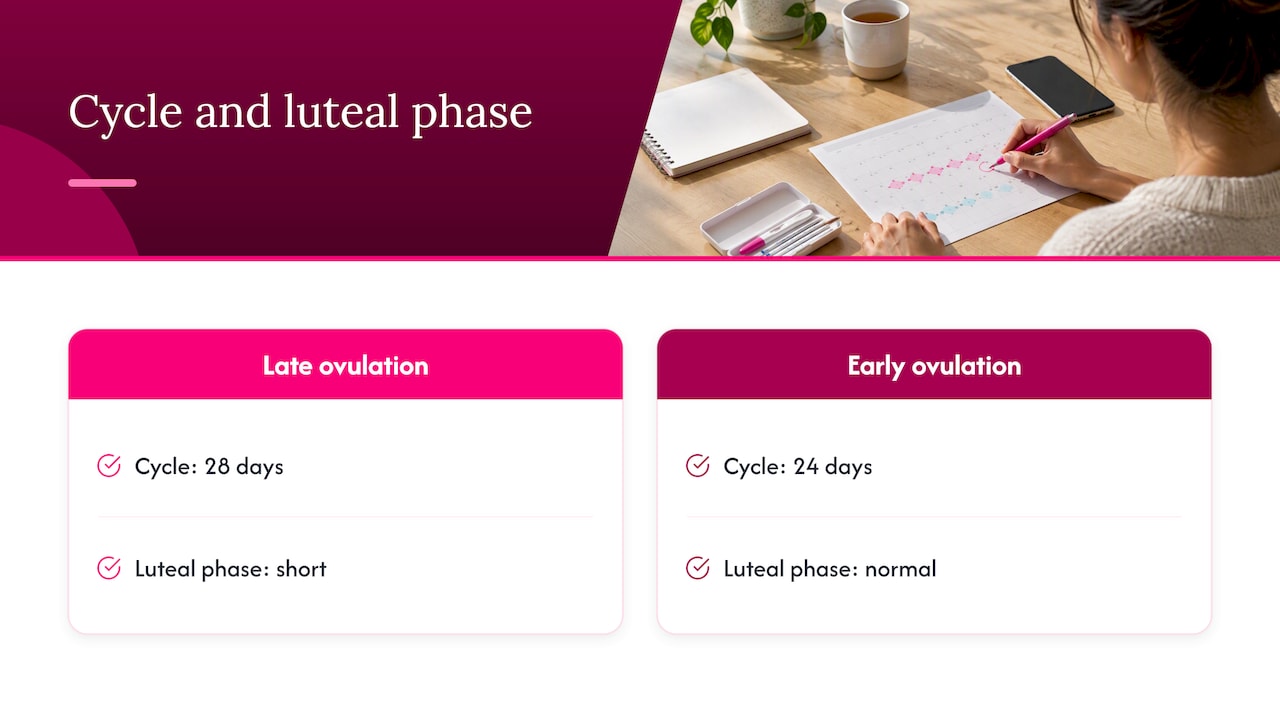
A short luteal phase is not the same as a short cycle. You can have a 28-day cycle with a short luteal phase if you ovulate late, and you can have a 24-day cycle with a normal luteal phase if you ovulate early.
Signs and symptoms of luteal phase defect
LPD rarely announces itself. Many people discover it after tracking their cycles for months. Patterns that may prompt a closer look include:
- A luteal phase of 10 days or less on basal body temperature charts or ovulation test tracking, repeated over several cycles.
- Spotting before your period, especially for several days.
- Cycles that run short, often under 25 days, though this is not a rule.
- Early pregnancy loss or difficulty conceiving, which are the reasons most people end up asking the question.
These signs are not specific. Spotting and short cycles have many causes. Clinicians also look for signs of the conditions that sit behind LPD. Clinical findings can include an enlarged thyroid, milky nipple discharge (galactorrhea) suggesting high prolactin, or uterine fibroids, which point toward thyroid disease, hyperprolactinemia or structural problems rather than a stand-alone luteal defect.
What can cause a short luteal phase
According to the ASRM, causes include insufficient progesterone production or duration, progesterone resistance, and underlying conditions such as thyroid disorders, PCOS, endometriosis, stress, obesity and excessive exercise. In some people no cause is found, and the picture is called idiopathic.
| Possible contributor | How it may affect the luteal phase |
|---|---|
| Thyroid disorders | Disturb ovulation and hormone balance; correctable with treatment |
| High prolactin | Can suppress ovulation and corpus luteum function |
| PCOS | Irregular or absent ovulation, so progesterone output is unpredictable |
| Endometriosis | Associated with LPD and with progesterone resistance |
| Low body weight, excessive exercise, high stress | Can reduce the hormone signals that drive ovulation |
| Obesity | Associated with altered hormone patterns |
| Age | Egg quality and ovarian reserve decline, and cycle patterns shift |
The useful point for patients: finding one of these contributors is more actionable than the LPD label itself, because many of them can be treated directly.
Can you get pregnant with a luteal phase defect?
Yes, many people do. The ASRM states that LPD has not been proven to be an independent entity that causes infertility or recurrent pregnancy loss, and notes that the pattern has also been diagnosed in fertile, normally menstruating women. In other words, one short luteal phase in one cycle does not mean you cannot conceive.
That does not mean the question is meaningless. If you have a persistently short luteal phase along with irregular cycles, pregnancy loss, or a long time trying, something is worth investigating. The more likely explanation may be ovulation problems, thyroid disease, endometriosis, egg quality or another factor, and LPD may be a marker of one of these rather than the cause.
How luteal phase defect is diagnosed
This is where the topic gets uncomfortable, and it is better to know up front. LPD is diagnosed clinically, but the ASRM reports there is no single reliable test, because biochemical, histological and clinical markers fail to distinguish fertile from infertile women. The usual tools are:
- Cycle and temperature tracking. Charting basal body temperature and ovulation tests shows how many days pass between ovulation and your period. It is inexpensive but imprecise.
- Mid-luteal progesterone blood test. Drawn about a week after ovulation. A single value can vary a great deal, because progesterone is released in pulses, so one low number is hard to interpret.
- Endometrial biopsy. Once the traditional standard for “dating” the lining. The ASRM does not consider it definitive or highly reliable, and it is invasive, so it is no longer a routine first step.
- Looking for the cause. Thyroid function, prolactin, and, when the history suggests it, an ovarian reserve assessment, ultrasound and tests of the uterine cavity.
Because of this, a good evaluation does not hinge on one result. It combines your history, your cycle data and a targeted workup.
Treatment: what is used and what the evidence shows
Treat the underlying condition first
If thyroid dysfunction, high prolactin or another condition is found, treating it is the logical first step. This is the approach with the clearest rationale, since it addresses a cause instead of a number.
Progesterone and ovulation induction
Two empirical treatments are common: progesterone supplementation (vaginal, oral or injected) after ovulation, and medications that stimulate ovulation. The ASRM notes there is no quality evidence that these improve outcomes in natural cycles. Clinicians still use them in specific situations, and some patients find a clear plan helpful, but you should hear that limitation before starting. If a provider promises that supplementing progesterone will fix an unexplained short luteal phase, ask what evidence they are relying on.
The picture is different in IVF. Without a normal corpus luteum response, as in medicated frozen embryo transfer cycles, or after the hormonal changes of stimulation, progesterone is not optional. Fertility and Sterility notes that luteal phase support with progesterone is the standard of care for assisted reproductive technology cycles. The context matters: giving progesterone because the cycle has been medically altered is a different decision from giving it to treat a short natural luteal phase.
Can you fix it naturally?
There is no proven natural fix, and be wary of supplement lists that claim one. What is reasonable, because the contributors are known, is to look at the factors that interfere with ovulation:
- Stress. Persistent stress has been associated with LPD. Sleep, counseling and relaxation practices are worth trying for their own sake, but they are not guaranteed to change your luteal phase.
- Exercise. Excessive training is a recognized contributor. If you train intensely and have short or irregular cycles, adjusting load and fueling may help.
- Weight. Both low body weight (including anorexia) and obesity are associated with LPD. Changes should be made with your doctor, not through restrictive dieting.
- Thyroid and prolactin. These are medical, not lifestyle, issues. Ask for testing instead of trying to manage them with supplements.
These steps are low-risk and can support overall health, but expect them to be part of a plan, not the whole plan. If you have been trying for months without success, waiting for lifestyle changes to work can cost time that matters, particularly after 35.
When to see a fertility specialist
Consider an evaluation sooner rather than later if any of the following applies:
- You are under 35 and have tried for 12 months, or are 35 or older and have tried for 6 months.
- You have had two or more pregnancy losses.
- Your cycles are very irregular or absent, or your luteal phase is consistently 10 days or less.
- You have known endometriosis, PCOS, thyroid disease or a history of pelvic surgery.
- You are considering egg or embryo freezing and want to understand your hormonal picture first.
A short luteal phase is a reason to ask questions, not a diagnosis of infertility. Bring your cycle charts, ovulation test results and any lab work to the first visit, because they speed up the conversation.
Our perspective at Life IVF Center
We see luteal phase defect as a useful flag rather than a final answer. Because the label cannot be confirmed with a single reliable test, we think the more responsible question is why the cycle looks the way it does and whether it is affecting your chance of pregnancy at all. That is the reasoning behind our Precision IVF® approach: protocols are built around each patient’s biology, history and goals, not around one lab value or a template.
In practice, that means we start with the full picture. Hormonal factors, ovarian reserve, the uterine cavity, partner factors and prior treatment history are reviewed together. We welcome second-opinion cases, including patients who were told elsewhere that nothing was wrong, or that nothing more could be done, and we have in-house labs so that the testing and the treatment plan can be coordinated.
If progesterone support is needed as part of a treatment cycle, it is planned deliberately around the protocol, not added as a guess. And if a straightforward cause such as thyroid disease is found, we will say so, because the best outcome for you may not require IVF. We also think patients deserve to hear plainly what the evidence does and does not show, particularly on a topic where online information is often more confident than the research.
How testing and treatment at Life IVF Center can fit in
If you want a structured evaluation, a pre-treatment workup can clarify what is going on. Life IVF Center publishes prices for pre-IVF testing, including a Saline Infusion Sonohysterogram (SIS) for $450 to examine the uterine cavity, an Endometrial Receptivity Assay (ERA) for $975, a Karyotype Chromosomal Analysis for $595 and Carrier Screening for Genetic Disease for $349. Whether any given test is right for you depends on your history, which we review with you first.
If your evaluation points toward treatment, our treatment packages include the Advanced IVF Package at $13,500, and Embryo Transfer from $2,950. For patients who want to preserve options while their hormonal picture is clarified, Precision Egg Freezing is $7,500 and Precision Embryo Freezing is $8,950, with storage priced separately. You can also read about our fertility care services, including IUI and genetic testing, or learn more about Precision IVF®. Prices are as published on our site and can change, so confirm them at your consultation.
Questions to ask your doctor
Whether you are seeing a primary care physician, a gynecologist or a fertility specialist, these questions keep the conversation useful:
- What evidence do we have that my luteal phase is actually short, and over how many cycles?
- Have my thyroid and prolactin been checked?
- Could another condition, such as PCOS or endometriosis, explain my cycles?
- If you recommend progesterone, what is the goal, and how will we know whether it helped?
- Given my age and how long I have been trying, is it reasonable to wait, or should we move to a broader workup?
FAQ
What are the signs of a luteal phase defect?
The most common sign is a luteal phase of 10 days or less, seen on temperature charts or ovulation tracking across several cycles. Some people also have spotting before a period, short cycles or early pregnancy loss. None of these are specific, so they are a reason for evaluation, not a diagnosis.
Can you still get pregnant with a luteal phase defect?
Yes. The ASRM states LPD has not been proven to independently cause infertility or recurrent pregnancy loss, and it has been found in women who conceive normally. If you have tried for a long time or have had losses, a broader evaluation looks for the real cause.
Can luteal phase defect be fixed naturally?
There is no proven natural cure. Managing stress, avoiding excessive exercise and reaching a healthy weight address known contributors, and they support general health. Thyroid disease and high prolactin need medical treatment, not supplements.
Does progesterone treat luteal phase defect?
Progesterone is widely prescribed, but the ASRM notes there is no quality evidence that it improves outcomes in natural cycles. In IVF cycles, progesterone support is standard of care because the hormonal environment has been altered by treatment.
Sources
- ASRM Committee Opinion: Diagnosis and Treatment of Luteal Phase Deficiency
- Medscape: Luteal Phase Dysfunction Practice Essentials
- Fertility and Sterility: Luteal Phase Support for Frozen Embryo Transfer Cycles
This article is for general educational purposes only and is not a substitute for personalized medical advice, diagnosis, or treatment. Fertility care is highly individual; please consult a qualified healthcare professional about your specific circumstances.
Ready to take the next step?
Life IVF Center specializes in individualized Precision IVF® care for complex cases—including diminished ovarian reserve, prior failed cycles, and advanced maternal age. Our in-house labs and dedicated physicians are ready to help.
Book a Free Consultation →